AI has a strange superpower.
It can be wrong without looking wrong.
A false date can appear beside five correct dates.
An invented study can have a perfectly believable title.
A statistic can look precise enough to trust.
And a real source can be cited for something that source never actually says.
That's why "the AI included sources" isn't the same thing as "the answer is verified."
You don't need to distrust everything AI tells you.
You do need to know which claims deserve checking and how to check them quickly.
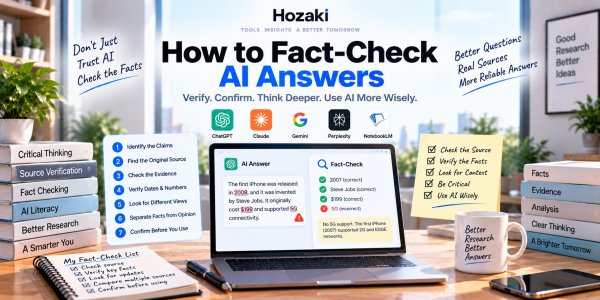
This guide shows you a practical method for fact-checking answers from ChatGPT, Claude, Gemini, Perplexity and other AI assistants.
The goal isn't to spend 30 minutes checking every paragraph.
It's to catch the mistakes that actually matter.
Quick Answer: How Do You Fact-Check an AI Answer?
Use this basic workflow:
- Identify the factual claims.
- Decide which claims matter enough to verify.
- Find the original source.
- Check whether the source actually supports the claim.
- Verify numbers, dates, names and quotes.
- Check whether the information is current.
- Look for missing context.
- Search for contradictory evidence.
- Separate facts from AI interpretation.
- Mark anything you can't verify as uncertain.
The most important rule is:
Don't verify the AI. Verify the claim.
That's a subtle difference.
You're not asking:
Is ChatGPT trustworthy?
You're asking:
What evidence supports this specific sentence?
That turns a vague trust problem into a research task.
Why Can AI Give Wrong Answers So Confidently?
Generative AI is extremely good at producing coherent language.
Coherent language isn't the same thing as verified information.
An AI system may generate an answer containing:
- Incorrect facts
- Outdated information
- Invented references
- Misattributed quotes
- Wrong dates
- Incorrect calculations
- Unsupported conclusions
- Missing qualifications
- Confused product features
These errors are often described as AI hallucinations.
The difficult part is that a hallucinated answer doesn't necessarily look unusual.
It can contain headings.
Tables.
Citations.
Professional language.
Specific numbers.
Even detailed explanations.
None of those things independently prove the information is correct.
First: Don't Fact-Check Every Sentence
Verification has a cost.
If you ask AI:
What's a metaphor?
you probably don't need to launch a forensic investigation.
But if the AI says:
This software costs $29 per month.
you should check the current pricing page before publishing that number.
The amount of verification should depend on the consequences of being wrong.
Use a Risk-Based Verification System
A simple framework is:
Low Risk
Examples:
- Brainstorming
- General explanations
- Rewriting
- Ideas
- Draft structure
Usually light verification is enough.
Medium Risk
Examples:
- Blog articles
- Product comparisons
- Business research
- Market statistics
- Technical information
- Academic assignments
Verify important factual claims.
High Risk
Examples:
- Medical information
- Legal information
- Financial decisions
- Safety information
- Compliance
- Important academic research
- Business decisions involving significant money
Use authoritative current sources and appropriate qualified expertise where necessary.
The question isn't:
Can AI answer this?
It's:
What happens if this answer is wrong?
Step 1: Break the AI Answer Into Claims
Don't try to verify an entire paragraph at once.
Suppose AI says:
Company X launched Product Y in March 2025. It costs $20 per month and supports Windows, macOS and Linux.
That's at least three claims:
Claim 1: Product Y launched in March 2025.
Claim 2: Product Y costs $20/month.
Claim 3: Product Y supports Windows, macOS and Linux.
Each requires different evidence.
Create a simple table:
| Claim | Needs Verification? | Best Source |
|---|---|---|
| Launch date | Yes | Company announcement |
| Price | Yes | Current pricing page |
| OS support | Yes | Official documentation |
Now verification becomes manageable.
Step 2: Prioritize Specific Claims
Some types of information deserve extra suspicion simply because they are easy to get subtly wrong.
Always pay attention to:
Numbers
Percentages, prices, revenue, market size, measurements.
Dates
Launch dates, deadlines, publication dates.
Names
People, products, organizations, authors.
Quotes
Exact wording and attribution.
Research Findings
What a study actually found.
Current Product Features
Software changes constantly.
Laws and Regulations
Jurisdiction and date matter.
Rankings
"Number one" according to whom?
Superlatives
Largest.
Fastest.
Most popular.
Leading.
These words usually require evidence.
Step 3: Ask the AI for Sources
If an important factual claim doesn't have a source, ask:
What is the original source for this claim? Give me the source that directly supports it rather than another article repeating it.
But there's a catch.
The AI giving you a source doesn't verify the claim.
It merely gives you something to investigate.
Your next action should be:
Open it.
Step 4: Check Whether the Source Actually Exists
This catches one of the easiest AI mistakes.
Suppose AI gives you:
Johnson, R. (2024). "Generative AI and Student Learning." Journal of Digital Education.
It looks plausible.
That proves nothing.
Search:
- Exact paper title
- Author
- Journal
- DOI
If you can't find the source through credible academic indexes or the publisher, don't cite it.
Plausible Isn't Evidence
AI is extremely good at generating things that look like references.
Academic formatting makes fabricated information particularly dangerous because it visually resembles legitimate research.
Step 5: Check Whether the Source Supports the Claim
This is even more important.
A real source can still be used incorrectly.
Imagine the AI says:
A study found AI increased student performance by 40%.
The study exists.
Great.
You open it.
The actual finding says:
Performance increased by 40% on one specific practice task among a particular participant group.
Those aren't equivalent claims.
So verification has two separate tests:
Test 1: Does the source exist?
Test 2: Does it support this exact claim?
Passing Test 1 doesn't mean it passes Test 2.
Step 6: Find the Original Source
Suppose you find this chain:
AI answer
↓
Blog article
↓
News article
↓
University press release
↓
Research paper
Whenever practical, move toward the original evidence.
For statistics:
Find the dataset.
For company revenue:
Find the financial report.
For product features:
Find official documentation.
For research findings:
Find the paper.
For legislation:
Find the official legal text.
Secondary sources are still valuable.
But don't use a five-step game of telephone when the original evidence is available.
Step 7: Check the Date
An answer can be perfectly accurate and still be useless because it's outdated.
This happens constantly with AI and software.
For example:
Tool X offers unlimited free usage.
Maybe it did.
Two years ago.
Check:
- Publication date
- Last updated date
- Product version
- Pricing date
- Applicable period
For fast-changing topics, prioritize recent information.
This matters especially for:
- AI tools
- Software
- Pricing
- APIs
- Regulations
- Company information
- Current events
Step 8: Verify Numbers Separately
Numbers create an illusion of precision.
AI says:
The market is worth $47.3 billion.
That looks authoritative.
Ask:
Which market?
Which year?
Which geography?
Revenue or market valuation?
Actual value or forecast?
Nominal or adjusted?
Then open the underlying source.
Watch for Changed Denominators
AI may say:
67% of consumers prefer AI support.
The actual source may say:
67% of surveyed consumers who had previously used AI support preferred it for simple questions.
Huge difference.
Never extract the percentage without its population and context.
Step 9: Verify Quotes Word for Word
Quotes are particularly dangerous because changing one word can change the meaning.
If AI provides:
"Artificial intelligence will transform every industry."
don't assume the person actually said it.
Search the exact phrase.
Then verify:
- Speaker
- Original publication
- Date
- Context
- Exact wording
If you can't locate the original quote, paraphrase the verified idea instead—or don't use it.
Step 10: Separate Fact From Interpretation
Suppose a company reports:
Revenue increased 22%.
That's evidence.
AI then writes:
The company is rapidly taking market share from competitors.
That's interpretation.
Revenue growth alone doesn't establish market-share growth.
Competitors may also be growing.
The total market may be expanding.
Acquisitions may explain the increase.
So label the difference.
| Type | Example |
|---|---|
| Fact | Revenue increased 22% |
| Interpretation | The company appears to be growing quickly |
| Unsupported leap | The company is dominating competitors |
This habit prevents a surprising number of research errors.
Step 11: Search for Contradictory Evidence
Don't only search for evidence that confirms the AI.
Suppose AI concludes:
Remote workers are more productive.
Search:
remote work productivity negative effects study
or ask:
Find credible research that challenges this conclusion.
Then compare.
Why might studies disagree?
Possibilities include:
- Different industries
- Different time periods
- Different definitions
- Different sample sizes
- Different methodology
- Self-reported vs measured productivity
Contradictory evidence doesn't automatically make the original claim false.
It helps you understand its limits.
This is a core part of the workflow in our How to Use AI for Research guide.
Step 12: Check Whether Sources Are Independent
Five articles repeating the same statistic aren't necessarily five sources.
They may all trace back to one report.
Imagine:
Article A → Survey X
Article B → Article A
Article C → Survey X
Article D → Article B
You don't have four independent pieces of evidence.
You have one.
Trace statistics backward until you find their origin.
How to Fact-Check ChatGPT Answers
Use the same claim-based workflow.
Suppose ChatGPT provides a long answer.
Don't ask:
Are you sure?
An AI saying "yes" doesn't add evidence.
Instead ask:
Break your answer into factual claims and provide the best primary source for each claim.
Then independently inspect the important sources.
For research-heavy tasks, our How to Use AI for Research guide provides the full workflow.
How to Fact-Check Claude Answers
Claude is often used for:
- Long documents
- Research
- Writing
- Analysis
If the answer is based on documents you supplied, verification can be easier.
Ask:
For each conclusion, identify exactly which part of the supplied document supports it.
Then open that section yourself.
For a broader platform comparison, see ChatGPT vs Claude.
How to Fact-Check Gemini Answers
For web-based information, focus heavily on:
- Source
- Date
- Exact wording
- Currentness
If Gemini provides links or source references, open them rather than treating their presence as verification.
For comparisons involving Google's AI ecosystem, see ChatGPT vs Gemini.
How to Fact-Check Perplexity Answers
Perplexity's source-oriented interface makes citations visible.
That's useful.
But visible citations still need checking.
Ask:
Does Source 3 actually support the sentence beside Citation 3?
Then open Source 3.
Citation quantity isn't the same thing as evidence quality.
This is particularly important when using AI for research.
See our Best AI Research Tools guide for more research-focused workflows.
How to Verify AI-Generated Academic Citations
Academic references deserve a dedicated workflow.
For each citation:
1. Search the Exact Title
Does it exist?
2. Verify the Authors
Do they match?
3. Verify the Journal
Is it legitimate?
4. Verify the Year
Correct?
5. Check the DOI
Does it resolve?
6. Open the Paper
Does it contain the claimed finding?
7. Read the Relevant Section
Does context change the interpretation?
Only after these steps should you use the source.
If you're working with academic literature regularly, see Best AI Literature Review Tools and Elicit vs Consensus.
How to Check AI Statistics
Use this mini-checklist:
Source?
Where did the number originate?
Year?
When was the data collected?
Population?
Who was measured?
Sample size?
How many?
Geography?
Where?
Definition?
What exactly was measured?
Method?
How was it measured?
Actual or forecast?
Critical distinction.
Primary source?
Can you reach the original dataset?
A statistic without context can be technically accurate and still deeply misleading.
How to Check AI Product Recommendations
Suppose AI recommends:
Tool A is the best free AI writing tool because it provides unlimited usage and supports 50 languages.
Check each component.
"Best"
What criteria establish that?
"Free"
What does the current free plan include?
"Unlimited"
Really unlimited?
"50 languages"
According to current documentation?
Product comparisons become stale quickly.
This is why Hozaki's own software comparison content should always record when volatile information was checked.
How to Check AI Pricing Information
Never trust remembered AI pricing for a purchase decision.
Go to the current official pricing page.
Check:
- Monthly price
- Annual price
- Taxes
- Usage limits
- Credits
- Included features
- Region
- Team minimums
- Trial conditions
Pricing pages change constantly.
A six-month-old comparison can already be wrong.
How to Check AI-Generated Code
Code needs a different verification method.
Don't ask:
Does this code work?
Run it.
Then test:
- Normal input
- Empty input
- Invalid input
- Boundary conditions
- Error handling
- Security implications
- Dependencies
- Version compatibility
Also inspect unfamiliar libraries or APIs against current official documentation.
Executable verification beats conversational reassurance.
Can You Use Another AI to Fact-Check AI?
Yes—but with an important limitation.
Suppose ChatGPT says:
X is true.
Then Claude says:
X is true.
That does not prove X is true.
Both systems may rely on similar public information or reproduce the same error.
A second model is useful for:
- Finding disagreements
- Surfacing missing details
- Suggesting alternative sources
- Challenging reasoning
But the final verification should come from evidence.
Use AI to find what needs checking.
Use sources to settle the check.
The 5-Minute AI Fact-Check
You don't always have time for a full research audit.
Use this quick method.
Minute 1 — Circle the Claims
Find:
- Numbers
- Dates
- Names
- Quotes
- Product claims
Minute 2 — Search the Most Important Claim
Find an authoritative source.
Minute 3 — Open the Source
Don't rely on the search snippet.
Minute 4 — Check Context and Date
Does it really support the claim?
Is it current?
Minute 5 — Check One Contradictory Source
Search for evidence that disagrees.
If the claim survives those checks, your confidence improves substantially.
If it doesn't, investigate further.
Build an AI Verification Table
For research or published content, use:
| Claim | Source | Date | Support | Action |
|---|---|---|---|---|
| Tool costs $20 | Official pricing | Current | Supported | Keep |
| Market grew 35% | Industry report | 2024 | Partial | Rewrite |
| Study proves X | Research paper | 2025 | Unsupported | Remove |
| CEO said quote | No original found | — | Unverified | Remove |
Use four simple statuses:
Supported
Source clearly supports the claim.
Partially Supported
Some of the claim is supported.
Contradicted
Source says something different.
Unverified
You don't have enough evidence.
"Unverified" is a perfectly acceptable result.
You don't need to force every claim into true or false.
Red Flags That an AI Answer Needs Checking
Pay extra attention when you see:
- Extremely precise statistics
- Quotes without links
- Academic citations you can't recognize
- "Studies show"
- "Experts agree"
- "Research proves"
- Current prices
- Current software features
- Superlatives
- Legal claims
- Medical claims
- Historical anecdotes
- Very specific dates
- Confident predictions
None automatically means the answer is wrong.
They simply deserve verification.
Common Fact-Checking Mistakes
Asking the Same AI If It's Sure
Confidence isn't evidence.
Using Search Snippets as Sources
Open the page.
Counting Links Instead of Checking Them
Ten weak sources don't beat one strong primary source.
Checking Whether the Source Exists but Not What It Says
This is a huge one.
Ignoring Dates
Correct old information can become incorrect current information.
Treating Multiple AI Models as Independent Evidence
They're tools, not primary sources.
Verifying Only Claims You Doubt
The most dangerous error may be the one that sounds completely reasonable.
A Better Prompt for Reliable AI Answers
You can reduce—not eliminate—verification work by giving better instructions.
Try:
Answer this question using current authoritative sources. Separate verified facts from interpretation. For every important factual claim, provide the source. If reliable evidence is unavailable or sources disagree, say so rather than guessing. Do not invent citations.
Then still verify important claims.
A prompt can improve behavior.
It can't guarantee truth.
Frequently Asked Questions
Can AI answers be wrong?
Yes. Generative AI can produce inaccurate, outdated, unsupported, or fabricated information while presenting it fluently.
How can I verify a ChatGPT answer?
Break the answer into factual claims, find authoritative or primary sources for important claims, and check whether those sources actually support what the answer says.
How do I know if an AI citation is fake?
Search the exact title or reference, verify authors and publication details, and open the original source. For academic work, check the DOI and publisher or trusted academic database.
Are AI citations reliable?
They can be useful for finding evidence, but the citation itself should be checked. A real citation can still fail to support the AI's specific claim.
Can I ask ChatGPT to fact-check itself?
You can ask it to identify claims, provide sources, or reconsider an answer, but self-review isn't independent verification. Important claims should be checked against external evidence.
Is using two AI tools enough to verify an answer?
No. Agreement between AI tools isn't equivalent to independent source confirmation.
What information should I always fact-check?
Prioritize consequential claims, especially statistics, quotes, dates, prices, academic findings, legal information, medical information, financial information, and current product details.
What is an AI hallucination?
The term generally refers to generated information that appears plausible but is inaccurate, unsupported, or fabricated.
Continue Exploring
How to Use AI for Research
Build a complete workflow for research planning, source discovery, verification, evidence analysis, and synthesis.
Best AI Research Tools
Compare AI tools for web research, academic research, documents, citations, and deep research.
Best AI Literature Review Tools
Explore tools for finding papers, analyzing research, checking citations, and synthesizing academic evidence.
Elicit vs Consensus
Compare two specialized tools for academic research and literature-review workflows.
How to Summarize a PDF With AI
Learn how to analyze long reports and research papers without losing important details.
Best AI PDF Tools
Compare AI tools for reading, summarizing, questioning, and analyzing documents.
ChatGPT vs Claude
Compare two general-purpose AI assistants for research, writing, coding, and document analysis.
ChatGPT vs Gemini
Compare ChatGPT and Gemini across research, productivity, documents, and everyday AI tasks.
Best AI Tools in 2026
Explore AI tools across research, writing, coding, PDFs, images, and productivity.
Comments 0