AI can help researchers find papers, organize references, and review academic writing. But there is a serious problem with treating AI-generated citations as reliable evidence: a reference can look convincing without being real, and a real paper can be cited for a claim it does not support.
A citation may include a plausible article title, a recognizable journal name, and a DOI-like identifier. That appearance alone does not establish that the publication exists.
Even when a source is genuine, its author, publication year, page numbers, or research findings may be misrepresented.
To verify citations with AI, you need a workflow that separates automated assistance from independent evidence. AI can help flag suspicious references, organize metadata, and compare passages. However, the actual verification should rely on bibliographic records, publisher information, and the original source whenever possible.
This guide explains how to check academic citations using AI, Crossref, Zotero, DOI records, and a structured reference audit.
Quick Answer: How to Verify Citations With AI
To verify AI-generated citations, follow these steps:
-
Collect the complete reference and the specific claim it supports.
-
Search for the publication using its DOI, title, or another reliable identifier.
-
Confirm that the source exists and matches the citation.
-
Compare authors, title, publication year, journal, and other relevant metadata.
-
Open the original article, book, or report whenever accessible.
-
Check whether the cited passage actually supports the claim.
-
Use AI to organize discrepancies and identify references requiring further review.
-
Record the result as verified, incorrect, unsupported, or unresolved.
The most important distinction is that finding a real publication does not automatically verify the claim attributed to it.
Why AI-Generated Citations Can Be Wrong
AI-generated references can fail in several different ways. Understanding the error type helps determine the appropriate verification method.
Fabricated References
An AI assistant may generate a publication that does not exist.
For example, a citation might contain a realistic title, plausible authors, and a recognizable journal but fail to match any identifiable publication.
A failed search does not always prove fabrication. The source could be poorly indexed, published under a different title, or unavailable in the databases searched.
The appropriate status is unverified until sufficient evidence is available.
Incorrect Citation Metadata
A real publication may be cited with an incorrect author, year, journal title, volume, issue, or DOI.
These errors can make it difficult for readers to locate the original work.
They may also occur when an AI system combines details from multiple publications.
Real Source, Wrong Claim
A citation can point to a genuine article while misrepresenting its findings.
For example, a study reporting an association between two variables may be cited as proof that one variable causes the other.
This is not primarily a metadata problem. It is a claim-support problem.
Missing Qualifications
An AI summary may omit important details about a study's:
-
Sample size.
-
Population.
-
Research design.
-
Statistical uncertainty.
-
Study limitations.
-
Conditions under which the findings apply.
A citation may be technically related to a claim while failing to justify the strength of the wording.
Outdated or Corrected Sources
Some publications are later corrected, updated, or retracted.
A complete citation audit should therefore check relevant publication notices, especially when a source is central to an important argument.
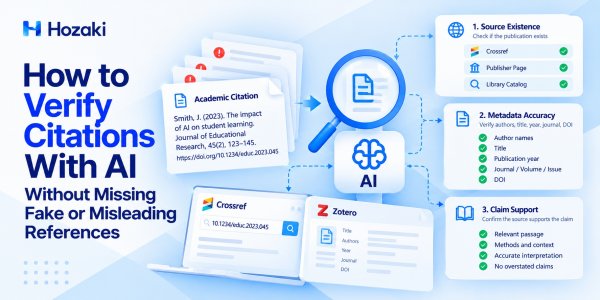
The Three Levels of Citation Verification
A reliable workflow separates three questions.
| Verification Level | Main Question | Evidence Needed |
|---|---|---|
| Level 1: Source existence | Does this publication exist? | Publisher page, DOI record, library catalog, or authoritative repository |
| Level 2: Metadata accuracy | Are the citation details correct? | Bibliographic record and original publication information |
| Level 3: Claim support | Does the source support the statement? | Relevant passage, findings, methods, and context from the original work |
These levels should be checked independently.
A source may pass the first two levels but fail the third.
For instance, the DOI and publication details might be correct while the cited article addresses a different research question.
Step 1: Collect the Citation and Its Associated Claim
Before checking references, build a list of the citations that need verification.
For each citation, record both the bibliographic information and the statement it is supposed to support.
A useful working table looks like this:
| Field | Example |
|---|---|
| Reference ID | REF-001 |
| Citation text | Author, year, title, journal |
| DOI or URL | Identifier supplied in the reference |
| Cited claim | The sentence or argument using the citation |
| Source location | Paragraph, section, or page |
| Verification status | Not checked |
Why the Associated Claim Matters
A bibliography-only review can identify nonexistent or incorrectly described publications.
It cannot establish whether the citations have been used appropriately in the manuscript.
For example, a paragraph may state:
"Research proves that a particular teaching method improves outcomes for every student."
Even if the cited study exists, the original research may have examined a small population under specific conditions.
The claim could therefore be stronger than the available evidence.
Prompt: Organize References for Verification
Copy this prompt into an AI assistant:
I will provide a manuscript section and its reference list.
Extract every citation and identify the specific sentence or claim it supports.
Create a table containing reference ID, citation text, associated claim, DOI or URL if supplied, and verification status.
Do not invent missing bibliographic information.
Do not mark any reference as verified unless independent source evidence is supplied.
This step creates an audit inventory rather than assuming the references are correct.
Step 2: Check Whether the Publication Exists
The next task is to establish the identity of each cited source.
Method A: Search by DOI
A Digital Object Identifier, or DOI, is a persistent identifier commonly assigned to scholarly publications and other research outputs.
If a reference includes a DOI, start by opening:
https://doi.org/DOI-HERE
Replace DOI-HERE with the identifier provided in the reference.
Check whether the DOI resolves to the expected publication.
Compare the destination page with the citation rather than assuming that a working DOI means the reference is correct.
A DOI can be valid but belong to a different publication.
Method B: Check Crossref Metadata
Crossref provides a public API for retrieving metadata deposited for registered scholarly works.
For a Crossref-registered DOI, the general endpoint is:
https://api.crossref.org/works/{doi}
Replace {doi} with the relevant DOI.
The returned record may include the title, authors, publication dates, publication venue, and other available metadata.
Crossref is useful for verifying bibliographic identity, but it is not a substitute for reading the original publication.
Not every DOI is registered with Crossref. Some are managed by other registration agencies, so a missing Crossref record is not sufficient proof that a DOI is fake.
Method C: Search by Exact Title
If a reference does not include a DOI, search the full title in quotation marks.
Compare the results from:
-
The publisher's website.
-
Scholarly indexes.
-
University repositories.
-
Library catalogs.
-
Subject-specific databases.
If the title is not found, search a distinctive phrase, author name, or publication venue.
Avoid accepting a loosely related paper as an exact match.
Method D: Check the Original Publication Page
When available, the publisher's article page can help confirm the identity of the publication.
Check that the title, author list, publication venue, and identifier correspond to the citation.
For books, reports, theses, and other materials, the most appropriate authoritative source may be a library catalog, institutional repository, official organization, or publisher record rather than Crossref.
What to Do When No Match Is Found
Do not immediately label the citation fabricated.
Record the search methods used and classify the reference as unresolved.
A useful status note might be:
"Unable to confirm this reference using the supplied DOI, exact-title search, or available publisher records. Further investigation required."
This is more defensible than claiming the source is fake without sufficient evidence.
Step 3: Verify Authors, Titles, Dates, and DOI Details
Once a publication has been located, compare the citation against its bibliographic record.
Metadata Verification Checklist
Check the following fields where applicable:
-
Author names and order.
-
Full article or chapter title.
-
Publication year.
-
Journal or book title.
-
Volume and issue.
-
Page range or article number.
-
DOI.
-
Publisher.
-
Edition or version.
Not every source type contains every field.
A journal article may have an article number instead of conventional page numbers. An online-first article may also have a publication date that differs from the date associated with a later journal issue.
The citation should follow the required style while accurately representing the source.
Use Zotero to Inspect Reference Metadata
Zotero can retrieve bibliographic information using identifiers such as DOIs, ISBNs, and PubMed IDs.
A practical workflow is:
-
Open Zotero.
-
Select the Add Item by Identifier function.
-
Enter the available DOI or other supported identifier.
-
Review the imported bibliographic record.
-
Compare it with the original reference.
-
Confirm important fields against the publisher or another authoritative record.
-
Correct any verified errors.
Zotero is a reference manager, not a guarantee that every imported metadata field is accurate.
The imported record should still be inspected.
Prompt: Compare Citation Metadata
Compare the supplied citation against the authoritative metadata I provide.
Check author names, author order, title, publication year, journal, volume, issue, pages or article number, and DOI.
Return a field-by-field comparison.
Label each field as Match, Mismatch, Missing, or Not Applicable.
Suggest corrections only when supported by the supplied source information.
Do not invent missing details.
Step 4: Verify That the Source Supports the Claim
This is often the most important part of citation verification.
A source can exist and have accurate metadata while being used to support a misleading or exaggerated statement.
Start With the Exact Claim
Copy the sentence that contains the citation.
Identify what the sentence actually asserts.
Does it claim:
-
A correlation?
-
A causal relationship?
-
A numerical effect?
-
A comparison between groups?
-
A general conclusion?
-
A result applying to a specific population?
The type and strength of the claim determine what evidence is needed.
Find the Relevant Passage
Open the original article or an authorized full-text version.
Look for the relevant evidence in:
-
Abstract.
-
Methods.
-
Results.
-
Tables and figures.
-
Discussion.
-
Limitations.
An abstract may be enough to establish the general subject of a study, but it may not provide enough detail to verify a specific numerical or causal claim.
When full text is unavailable, record that limitation.
Check the Strength of the Evidence
Consider the difference between these statements:
Stronger claim: "The intervention causes better outcomes for all participants."
Narrower claim: "The study reported improved outcomes among participants in the intervention group under the conditions examined."
The second statement may be more defensible if the research was limited to a particular population or design.
Do not rewrite the claim to sound stronger than the evidence allows.
Check Whether the Claim Matches the Study Population
Suppose a study examined 120 university students.
A manuscript should not automatically generalize the findings to all children, adults, or educational settings.
Check whether the claim preserves relevant limitations.
Prompt: Verify Claim Support
Evaluate whether the provided source passage supports the following claim.
Claim: [Insert claim]
Source passage: [Insert relevant passage]
Study context: [Insert available methods and limitations]
Classify the relationship as:
Directly supported.
Partially supported.
Overstated.
Contradicted.
Insufficient evidence.
Explain your reasoning using only the supplied source text.
Identify any omitted qualifications.
Suggest a more accurate version of the claim if necessary.
Do not infer results that are not present in the source.
The classification should be treated as a review aid. A human reviewer must still inspect the evidence.
Step 5: Use AI to Flag Suspicious References
AI can be particularly useful when reviewing a long bibliography.
Instead of asking the model to certify every citation, ask it to identify inconsistencies that deserve attention.
Useful Warning Signs
Potential problems include:
-
Missing titles or publication venues.
-
DOI and title mismatches.
-
Inconsistent author names.
-
Duplicated references with different metadata.
-
Implausible publication details.
-
Citations that appear unrelated to the associated claim.
-
Missing page references for specific quotations.
-
References to unavailable or unidentified documents.
These are investigation triggers, not automatic proof of fabrication.
Prompt: Citation Risk Screening
Review this reference list for possible citation problems.
Identify incomplete metadata, inconsistent author names, duplicate entries, suspicious DOI-title combinations, and references that may require source verification.
Rank the issues by their potential impact on the manuscript.
Do not claim that a reference is fabricated based only on its appearance.
Explain exactly what should be checked using authoritative sources.
Step 6: Verify Multiple Citations Efficiently
Checking dozens or hundreds of references manually can be time-consuming.
A structured workflow makes the process more manageable.
Build a Citation Audit Spreadsheet
Use columns such as:
| Column | Purpose |
|---|---|
| Reference ID | Unique citation identifier |
| Citation | Original reference |
| Associated Claim | Statement supported by the citation |
| DOI / URL | Source identifier |
| Existence Status | Confirmed, unresolved, or incorrect |
| Metadata Status | Match, mismatch, or incomplete |
| Claim Support | Supported, partial, overstated, contradicted, or unverified |
| Evidence Location | Page, section, table, or paragraph |
| Required Action | Correct, replace, rewrite, investigate |
| Reviewer Notes | Verification evidence and limitations |
Prioritize High-Impact Citations
Not all references have the same consequences if they are wrong.
Start with citations that support:
-
The central research hypothesis.
-
Important numerical claims.
-
Causal conclusions.
-
Safety-related findings.
-
Major policy recommendations.
-
Statements repeated throughout the document.
Then review the remaining references.
Keep a Record of Verification
For every material correction, document:
-
The original citation.
-
The identified issue.
-
The authoritative evidence.
-
The correction made.
-
The date and reviewer.
This helps make the process reproducible.
Practical Example: A Citation Verification Exercise
Consider a fictional manuscript containing the following claim:
"An AI-based study found that every student improved academic performance by at least 30%."
The manuscript includes a reference that appears to describe a published education study.
For this exercise, the reference and claim are intentionally hypothetical. They are not presented as an actual publication or a verified research finding.
Stage 1: Check the Source
Search the supplied DOI or title.
If the reference cannot be located, record it as unresolved rather than automatically declaring it fake.
Stage 2: Compare the Metadata
Suppose a matching publication is eventually found, but the manuscript lists the wrong publication year.
That is a metadata error requiring correction.
Stage 3: Inspect the Findings
Now suppose the actual source reports an average improvement in a limited sample, rather than an improvement for every participant.
The manuscript's claim is overstated.
The correct response is not merely to fix the citation format. The claim itself must be revised to match the evidence.
Stage 4: Document the Outcome
A verification record might look like this:
| Check | Example Result |
|---|---|
| Source existence | Confirmed in the hypothetical scenario |
| Publication year | Incorrect in manuscript |
| Claim support | Overstated |
| Required action | Correct year and revise claim |
| Final status | Pending revision |
This example demonstrates why citation verification must go beyond checking whether a DOI resolves.
How to Check AI Citations in ChatGPT
If you use ChatGPT to help prepare research notes or literature summaries, do not assume that references in its response have been independently validated.
Use a staged process.
First: Request a Structured Reference List
Ask ChatGPT to list each source separately with its supplied title, authors, year, and DOI.
Require it to leave unknown fields blank.
Second: Check the References Externally
Verify the bibliographic identity using DOI records, publishers, libraries, or relevant scholarly databases.
Do not treat ChatGPT repeating the same reference as independent confirmation.
Third: Supply Verified Source Material
Where permitted, provide the original article, relevant excerpt, or reliable source metadata.
Ask ChatGPT to compare the manuscript's claims against that material.
Fourth: Review the Evidence Yourself
Inspect important passages, tables, methods, and limitations.
For research papers, our guide on how to compare research papers with AI explains how to examine differences between studies without losing important details.
For finding source publications in the first place, see how to find academic papers with AI.
Can NotebookLM Help Verify Citations?
NotebookLM can be useful for exploring information within a collection of uploaded research sources and locating relevant passages.
However, two separate checks remain necessary.
First, verify that the uploaded documents are authentic and correctly identified.
Second, verify that the passages used to support a claim have been interpreted accurately.
A citation or source reference generated within a document-grounded AI workflow does not automatically establish that the underlying study is valid or that the claim is justified.
If you are using NotebookLM as part of a research process, see How to Use NotebookLM for Research: A Practical Workflow.
Common Citation Verification Mistakes
Mistake 1: Assuming a Working DOI Proves the Citation Is Correct
A DOI may resolve to a different publication than the one described.
Better approach: Compare the title, authors, year, and publication venue.
Mistake 2: Treating a Missing Crossref Result as Proof of Fabrication
Not every scholarly work has a Crossref DOI.
Better approach: Check the relevant registration agency, publisher, repository, or library catalog.
Mistake 3: Checking Metadata but Not the Claim
A real source can still be cited inaccurately.
Better approach: Inspect the relevant passage and compare it with the manuscript's wording.
Mistake 4: Asking AI to Fill in Missing References
An AI assistant may supply plausible but unsupported metadata.
Better approach: Leave missing fields unresolved until authoritative information is found.
Mistake 5: Using Abstracts to Verify Detailed Results
Abstracts often omit important methodological or statistical information.
Better approach: Consult the full text when necessary and available.
Mistake 6: Ignoring Corrections and Retractions
Publication status can change after an article is released.
Better approach: Check relevant notices for important sources and document their status.
Mistake 7: Treating AI Verification as a Single Pass
One prompt cannot reliably establish source existence, metadata accuracy, and claim support in every case.
Better approach: Use a documented, multi-stage audit.
A Reusable AI Citation Verification Prompt
The following prompt combines the major stages of the workflow.
Act as a citation verification assistant.
I will provide a reference list, associated manuscript claims, and any available authoritative source information.
For each reference:
Identify the cited publication.
Extract the supplied bibliographic metadata.
Compare it with authoritative metadata when provided.
Flag mismatches or missing fields.
Evaluate whether the available source passage supports the associated claim.
Identify overstatements or missing qualifications.
Recommend a specific corrective action.
Use these verification statuses:
Verified.
Metadata correction needed.
Claim revision needed.
Incorrect source.
Unresolved.
Do not invent authors, publication dates, DOIs, quotations, page numbers, or research findings.
If external verification has not been performed, say so explicitly.
Return a structured audit table and a short summary of high-priority issues.
Final Citation Verification Checklist
Before submitting or publishing a research document, confirm that:
-
Every important citation can be traced to an identifiable source.
-
DOI records match the intended publications where applicable.
-
Author names, titles, and publication details are accurate.
-
Direct quotations match the source text.
-
Page references are correct where required.
-
Numerical findings have been checked against the original results.
-
Causal claims are supported by appropriate evidence.
-
Study limitations have not been omitted.
-
Relevant corrections or retractions have been considered.
-
Unresolved references have been clearly identified.
-
AI-generated corrections have been independently reviewed.
A citation should be considered fully verified only when the checks relevant to that citation have been completed.
Frequently Asked Questions
Can AI verify academic citations automatically?
AI can assist with reference screening, metadata comparison, and claim-support analysis. However, reliable verification requires independent source evidence and human review, especially for important claims.
How can I tell whether a ChatGPT citation is fake?
Search for the publication using its DOI, exact title, author information, and relevant scholarly databases. If it cannot be confirmed, classify it as unresolved until further investigation establishes whether it is fabricated or simply difficult to locate.
Is a DOI enough to verify a reference?
No. A DOI helps identify a publication, but the associated metadata must match the reference. It also does not establish that the publication supports the claim.
Can Crossref detect fake citations?
Crossref can help verify metadata for works registered with it. A missing record does not necessarily mean a citation is fabricated, and a matching record does not prove claim support.
Can Zotero verify references?
Zotero can retrieve and organize bibliographic metadata, making it useful for identifying discrepancies. It does not independently guarantee that every citation detail or research claim is correct.
How do I verify citations when the full paper is behind a paywall?
You can often verify bibliographic identity using publisher records, DOI metadata, and library catalogs. For detailed claim verification, seek an authorized full-text version or library access. If the relevant passage cannot be examined, record the claim-support status as unresolved.
What is the difference between citation checking and plagiarism checking?
Citation checking examines source identity, metadata, and whether references support claims. Plagiarism checking evaluates potential unattributed or improperly reused content. They address different problems.
Conclusion: AI Can Assist Citation Verification, but Evidence Must Decide
AI can make citation verification more efficient by organizing references, identifying suspicious metadata, and helping compare manuscript claims with source passages.
But a convincing citation is not necessarily a correct citation.
A working DOI does not guarantee accurate metadata. Accurate metadata does not guarantee that the cited study supports the associated statement. And a source that supports a narrow finding may not justify a broad conclusion.
The most reliable workflow is:
Confirm the source → Verify the metadata → Inspect the evidence → Check the claim → Document the result.
Use AI to make those checks easier to manage, while keeping the final judgment grounded in verifiable sources.
Comments 0