AI can find information in seconds.
That's useful.
It can also give you a beautifully written answer supported by sources you haven't read, evidence you haven't checked, and conclusions you don't actually understand.
That's considerably less useful.
The best way to use AI for research isn't:
Question → AI → answer → finished
A stronger workflow is:
Question → research plan → discovery → sources → verification → analysis → synthesis → final work
AI can accelerate almost every stage.
But the researcher still needs to decide what question matters, which sources deserve trust, whether evidence actually supports a claim, and what conclusions can reasonably be drawn.
In this guide, we'll build a practical AI research workflow you can use for academic research, market research, business research, content research, competitive analysis, and everyday fact-finding.
If you're still choosing software, our Best AI Research Tools guide compares tools for web research, academic papers, documents, citations, and deeper research workflows.
Quick Answer: How Should You Use AI for Research?
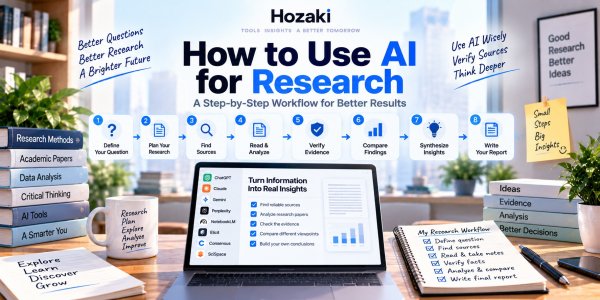
A reliable AI research process looks like this:
- Define the research question.
- Ask AI to help build a research plan.
- Identify the best types of sources.
- Use AI to discover relevant information.
- Open the original sources.
- Extract evidence separately from interpretation.
- Look for contradictory evidence.
- Verify important claims, numbers, and citations.
- Synthesize the verified information.
- Write the final answer from your evidence base.
The most important idea is simple:
Use AI to navigate information—not to decide what is true for you.
Let's build the workflow.
Step 1: Start With a Research Question, Not an AI Prompt
Weak research often begins with a question that's far too broad.
For example:
Research artificial intelligence.
What exactly are you trying to learn?
A better question might be:
How is generative AI changing customer-support software for mid-sized U.S. businesses?
Now we have:
Technology: Generative AI
Industry: Customer support
Market: Mid-sized businesses
Geography: United States
That's much easier to investigate.
Turn Broad Topics Into Researchable Questions
Ask AI:
I need to research AI in education. Don't research it yet. Help me turn this broad topic into 10 specific research questions covering learning outcomes, teacher workload, assessment, academic integrity, costs, and student behavior.
This is an excellent use of AI.
You're using it to improve the question before searching for answers.
Step 2: Define the Scope
Before researching, decide what counts.
You may need to define:
- Geography
- Time period
- Population
- Industry
- Product category
- Evidence type
- Publication type
- Required depth
Suppose you're researching:
Is remote work more productive?
That's still vague.
Productive for whom?
Software engineers?
Salespeople?
Call-center employees?
Over what period?
Measured by output, hours, revenue, or self-reported productivity?
A stronger research brief might be:
Investigate evidence published from 2020 onward on the effect of remote or hybrid work on measurable employee productivity in knowledge-work roles.
Now AI has boundaries.
Step 3: Ask AI to Build a Research Plan
Don't immediately ask for the final report.
First ask:
Create a research plan for this question. Identify the major subquestions, evidence required for each one, and the most authoritative source types to prioritize. Do not answer the research question yet.
The AI might identify areas such as:
- Market size
- Historical trends
- Major competitors
- Consumer behavior
- Regulation
- Technology changes
- Risks
- Forecasts
Review the plan yourself.
Ask:
What important question is missing?
Then revise it.
Why Research Planning Matters
Without a plan, AI research can become:
search → interesting fact → another fact → random tangent → report
A research plan gives the investigation structure.
Step 4: Create a Source Hierarchy
Not all sources deserve equal weight.
For many research questions, a useful hierarchy might prioritize:
Primary Sources
Examples:
- Research papers
- Government data
- Regulatory filings
- Company financial reports
- Official statistics
- Original surveys
- Court documents
- Company announcements
Strong Secondary Sources
Examples:
- Reputable journalism
- Academic reviews
- Industry analysis
- Established research organizations
Discovery Sources
Examples:
- Blogs
- Forums
- Social media
- Aggregators
- AI-generated summaries
Discovery sources can be extremely useful.
But the source that helps you find a claim isn't always the source you should use to support the claim.
Tell the AI What to Prioritize
Instead of:
Research the electric vehicle market.
try:
Research the U.S. electric vehicle market. Prioritize government data, automaker filings, investor reports, and primary company announcements. Use secondary sources mainly for context.
The evidence quality usually improves immediately.
Step 5: Use AI for Source Discovery
Now AI can start searching.
Research-oriented AI tools can help identify:
- Sources
- Papers
- Reports
- Terminology
- Companies
- Statistics
- Competing claims
For web research, you might ask:
Find authoritative sources on how U.S. EV sales changed from 2023 through 2025. Prioritize original datasets and industry reports. For every source, explain what information it can support.
For academic research:
Find research investigating the relationship between social media use and adolescent sleep quality. Separate systematic reviews, longitudinal studies, cross-sectional studies, and randomized studies if available.
This gives the search structure.
For software options, see our Best AI Research Tools guide.
Step 6: Open the Original Sources
This is where many AI research workflows fall apart.
The AI provides citations.
The user sees citations.
The user assumes the research is verified.
It isn't.
A citation tells you where the AI says the information came from.
You still need to check it.
For important claims:
- Open the source.
- Find the relevant section.
- Read the surrounding context.
- Confirm the number or statement.
- Check whether qualifications were omitted.
Citation Present ≠ Claim Verified
Imagine the AI says:
72% of consumers prefer AI-powered customer support.
and provides a source.
Open it.
Perhaps the actual survey says:
72% were comfortable using AI for simple support questions.
Those are not the same claim.
The difference matters.
Step 7: Separate Evidence From Interpretation
This is one of the most useful AI research habits.
Ask the AI to create two columns:
| Evidence | Interpretation |
|---|---|
| What the source explicitly states | What we might conclude from it |
For example:
Evidence:
Company A reported 35% year-over-year growth in AI-related revenue.
Interpretation:
Demand for its AI products appears to be growing quickly.
The first may be directly sourced.
The second is an inference.
Both can be useful.
They shouldn't be presented as the same thing.
Useful Prompt
Separate every major finding into "Source Evidence" and "Interpretation." Do not present an inference as if the source explicitly stated it.
This simple instruction can make research much cleaner.
Step 8: Use AI to Read Long Documents
Research often involves PDFs nobody wants to read from page 1 to page 180.
AI can help you navigate them.
Upload or provide a supported document and ask:
First identify the structure of this report. Don't summarize it yet.
Then:
I'm researching market growth, competitors, pricing, and risks. Tell me which sections are most relevant.
Then:
Summarize only those sections and preserve important numbers, dates, assumptions, and limitations.
Now you're using AI as a document-navigation layer.
For a complete workflow, see How to Summarize a PDF With AI.
Step 9: Use AI to Read Research Papers
Academic papers need more structured analysis.
Don't ask only:
Summarize this paper.
Ask for:
- Research question
- Hypothesis
- Study population
- Sample size
- Methodology
- Variables
- Results
- Effect size
- Limitations
- Authors' conclusion
Then ask:
Which conclusions are directly supported by the results, and which require more interpretation?
This forces a closer reading.
Compare Papers in a Table
If you have several studies, build:
| Study | Population | Method | Sample | Main Result | Limitation |
|---|
AI can help extract the information.
You should verify important cells against the original papers.
If you're doing a larger literature review, see our Best AI Literature Review Tools guide.
Step 10: Look for Contradictory Evidence
AI systems are very good at producing coherent answers.
Research isn't always coherent.
Different sources may disagree.
That's useful information.
Ask:
Find credible evidence that challenges the current conclusion.
Then:
Why might these sources disagree?
Possible reasons include:
- Different populations
- Different dates
- Different methodology
- Different definitions
- Different datasets
- Conflicts of interest
- Measurement differences
A good research process doesn't hide disagreement.
It investigates it.
Step 11: Fact-Check Important Claims
Not every sentence deserves the same verification effort.
Focus especially on:
- Statistics
- Dates
- Quotes
- Rankings
- Market sizes
- Scientific claims
- Financial numbers
- Legal claims
- Product capabilities
- Historical claims
Use a claim-verification table:
| Claim | Source | Verified? | Notes |
|---|---|---|---|
| Market grew 18% | Source A | Yes | 2025 data |
| Company leads category | Source B | No | Source doesn't establish leadership |
| 62% prefer X | Source C | Yes | Survey of 1,200 U.S. adults |
This makes weak claims visible before they reach your final work.
Step 12: Check Publication Dates
Freshness matters enormously in some research areas.
Consider:
- AI
- Software
- Pricing
- Regulation
- Markets
- Politics
- Company leadership
- Product features
A source from 2023 may be historically useful but poor evidence for what is true in 2026.
Ask:
For each source, show the publication date and explain whether freshness matters for the claim it supports.
This prevents old information from silently becoming "current."
Step 13: Prefer Primary Sources When Possible
Suppose you want to know how much revenue a company generated.
You find:
Blog → cites news article → cites financial report
Why stop at the blog?
Go to the report.
Similarly:
Article → summarizes research paper
Go to the paper.
News story → discusses government data
Go to the dataset.
This doesn't mean secondary sources are bad.
They can provide excellent analysis and context.
But primary sources let you inspect the original evidence.
Step 14: Use AI to Compare Sources
This is where AI becomes extremely useful.
Instead of reading five reports independently and trying to remember everything, ask:
Compare these sources in a table showing their main conclusion, evidence, methodology, date, limitations, and where they disagree.
Then:
Which conclusions are supported by at least three independent sources?
Then:
Which conclusion relies primarily on one source?
This helps reveal where your research is strong and where it is fragile.
Step 15: Build an Evidence Bank Before Writing
Don't research and write simultaneously.
First create an evidence bank.
For each important finding, record:
Claim
What might you say?
Evidence
What supports it?
Source
Where did it come from?
Date
How fresh is it?
Confidence
How strong is the evidence?
Caveat
What could weaken the claim?
Once this exists, writing becomes much easier.
You're no longer asking AI:
What should I say?
You're asking:
How should I organize evidence I've already verified?
That's a much safer workflow.
Step 16: Use AI for Synthesis
Now we reach one of AI's strongest research applications.
You have:
- Verified sources
- Notes
- Evidence
- Contradictions
- Data
Ask:
Based only on the verified evidence below, identify the four strongest conclusions. For each conclusion, show supporting evidence, contradictory evidence, and remaining uncertainty.
That's synthesis.
It's different from summarization.
Summary
What did the sources say?
Synthesis
What does the evidence collectively suggest?
Research depends heavily on the second.
Step 17: Use AI to Challenge Your Conclusion
Before writing the final report, attack your own argument.
Ask:
Assume my conclusion is wrong. Using the evidence collected, construct the strongest reasonable counterargument.
Then:
What evidence would we need to distinguish between these two interpretations?
This is one of the highest-value uses of AI.
Instead of using AI to agree with you, use it to pressure-test your reasoning.
Step 18: Write From Verified Evidence
Only now should the final report take shape.
Provide your evidence bank and ask:
Create an outline based only on this verified material. Don't introduce new facts or sources.
Review the outline.
Then write section by section.
For important research, you may want the AI to clearly mark unsupported areas:
If the supplied evidence is insufficient for a claim, write [MORE EVIDENCE NEEDED] instead of filling the gap.
That instruction is surprisingly useful.
How to Use ChatGPT for Research
ChatGPT can participate in many parts of this workflow:
- Question refinement
- Research planning
- Web research
- Source discovery
- Document analysis
- Data analysis
- Comparison
- Synthesis
- Writing
The biggest mistake is using all of that capability as:
Research X and tell me the answer.
Break the task into stages.
A better sequence is:
Prompt 1: Build the research plan.
Prompt 2: Find sources.
Prompt 3: Organize evidence.
Prompt 4: Find contradictory evidence.
Prompt 5: Verify gaps.
Prompt 6: Synthesize.
Prompt 7: Build the final report.
Research quality often improves when you stop trying to get everything from one prompt.
How to Use AI for Academic Research
Academic research requires additional discipline.
AI can help with:
- Research questions
- Search terminology
- Paper discovery
- Literature mapping
- Paper explanation
- Evidence extraction
- Comparing studies
- Citation discovery
- Organizing notes
But academic research also requires:
- Appropriate databases
- Research methodology
- Citation accuracy
- Source evaluation
- Academic-integrity compliance
If you're conducting a literature review, tools such as Elicit and Consensus address more specialized academic workflows.
Our Elicit vs Consensus comparison explains how their approaches differ.
How to Use AI for Market Research
Market research is particularly well suited to AI because information is fragmented across:
- Company websites
- Financial reports
- Industry reports
- News
- Government data
- Product pages
- Reviews
- Customer discussions
Start with a structured question.
For example:
Research the U.S. AI meeting assistant market. I need competitors, pricing, target customers, positioning, market signals, recent product changes, and evidence of customer demand.
Then define sources:
Prioritize company websites, pricing pages, investor information, reputable market data, and recent reporting.
Then compare companies.
AI can reduce hours of tab-switching.
But current pricing, product features, and market claims should still be checked directly.
How to Use AI for Competitor Research
Create the comparison framework before researching the competitors.
For software, that might include:
| Company | Product | Audience | Pricing | Key Features | Positioning | Strength |
|---|
Then research each field.
This prevents one competitor from receiving three paragraphs of analysis while another receives two random facts.
Consistency makes comparisons useful.
How to Use AI for Content Research
AI can help content teams research:
- Search intent
- Definitions
- Statistics
- Examples
- Expert sources
- Product information
- Competitor coverage
- Common questions
But avoid this workflow:
AI summarizes ranking pages → you rewrite the summary → publish
That produces derivative content.
Instead:
SERP/topic discovery → primary research → original structure → verified sources → useful examples
AI should make content research deeper, not merely faster.
How to Use AI for Research Papers
If you're writing a research paper, use AI at specific stages.
Before Research
Refine the question.
During Search
Generate search terms and discover papers.
During Reading
Explain difficult methods or terminology.
During Analysis
Compare studies.
During Writing
Challenge arguments and improve structure.
During Editing
Check clarity and logical flow.
But follow your institution's rules for AI use.
Policies differ by school, course, journal, and assignment.
How to Use AI Without Fake Citations
Never ask:
Give me 20 academic citations about this topic.
and assume the output is real.
Instead:
- Discover a paper.
- Search for the original.
- Confirm title.
- Confirm authors.
- Confirm journal.
- Confirm year.
- Confirm DOI if applicable.
- Read the relevant section.
- Save the verified source.
AI can help find citations.
Your bibliography should contain sources you've verified.
How to Use AI Without Plagiarizing
Research assistance and authorship aren't the same thing.
A safer workflow is:
AI helps discover → you read → you understand → you take notes → you write
rather than:
AI generates → you lightly rewrite
For academic work, follow the applicable disclosure and academic-integrity requirements.
For professional content, original analysis and source verification also make the final work substantially more useful.
Best AI Research Prompts
Here are reusable prompts for different stages.
Research Planning
Build a research plan for [question]. Identify subquestions, evidence needed, source types, and potential blind spots. Do not answer the question yet.
Source Discovery
Find authoritative sources for [claim]. Prioritize primary sources and explain what each source can support.
Source Comparison
Compare these sources by conclusion, methodology, evidence, date, limitations, and disagreements.
Contradictory Evidence
Find credible evidence that challenges this conclusion. Explain why the sources may disagree.
Document Analysis
Analyze this document specifically for [goal]. Preserve important numbers, dates, assumptions, exceptions, and limitations.
Research Paper Analysis
Extract the research question, population, sample, methodology, variables, results, limitations, and conclusion.
Verification
Separate claims into verified, partially supported, unsupported, and requiring further investigation.
Synthesis
Based only on this verified evidence, identify the strongest conclusions, contradictory evidence, and remaining uncertainty.
Counterargument
Construct the strongest reasonable argument against my current conclusion using the available evidence.
Final Outline
Build an outline using only the verified evidence provided. Mark any section that requires additional evidence.
Save these.
They're much more useful than one magical "research prompt."
Common Mistakes When Using AI for Research
Mistake 1: Starting With a Vague Question
Fix the scope first.
Mistake 2: Asking for the Final Answer Immediately
Build a research plan.
Mistake 3: Trusting Citations Without Opening Them
Verify.
Mistake 4: Using Only Secondary Sources
Look for originals.
Mistake 5: Ignoring Contradictory Evidence
Search for it deliberately.
Mistake 6: Confusing AI Interpretation With Source Evidence
Separate them.
Mistake 7: Using Old Sources for Current Claims
Check dates.
Mistake 8: Letting AI Write Before Research Is Finished
Build an evidence bank first.
Mistake 9: Using One AI Tool for Everything
Different research stages may need different tools.
Mistake 10: Never Challenging the Conclusion
Ask AI to argue against you.
Frequently Asked Questions
Can AI be used for research?
Yes. AI can assist with research planning, source discovery, document analysis, academic-paper workflows, evidence comparison, synthesis, and writing. Important information still needs appropriate verification.
What is the best way to use AI for research?
Use AI as part of a structured workflow: define the question, plan the research, discover sources, verify evidence, compare information, look for contradictions, synthesize verified findings, and then write.
Can ChatGPT do research?
ChatGPT can support multiple research stages, including planning, web research, document analysis, data analysis, synthesis, and report preparation.
Is AI reliable for academic research?
AI can be useful, but generated facts, citations, summaries, and interpretations may contain errors. Academic claims should be checked against original research and appropriate databases.
Can AI find research papers?
Yes. General research assistants and specialized academic tools can help discover papers. Formal research may still require established academic databases.
Can AI write research papers?
AI can assist with planning, organization, analysis, and editing, but academic policies vary. Researchers and students remain responsible for the evidence, citations, reasoning, and compliance requirements of their work.
How do I fact-check AI research?
Open the original source, confirm that it supports the claim, check publication date and context, verify important numbers, and deliberately look for contradictory evidence.
Should I cite AI or the original source?
For factual and research claims, use the original source where appropriate rather than treating an AI summary as a substitute for the underlying evidence.
Continue Exploring
Best AI Research Tools
Compare tools for web research, academic research, documents, citations, and deep research.
Best AI Literature Review Tools
Find tools for discovering papers, screening studies, analyzing evidence, and building literature reviews.
Elicit vs Consensus
See how two academic research tools differ in search, literature reviews, evidence extraction, and research workflows.
Best AI PDF Tools
Compare AI tools for reading, summarizing, analyzing, and chatting with research documents.
How to Summarize a PDF With AI
Learn a structured method for summarizing long reports and research papers.
Best AI Tools for Students
Explore AI tools for studying, research, writing, PDFs, notes, math, and presentations.
Best AI Tools in 2026
Explore AI software across research, writing, documents, coding, images, and productivity.
Comments 0