Finding academic papers is not always difficult because there is too little research. Often, the problem is knowing which terms to search, where to search, and how to separate relevant studies from thousands of results.
AI can help with these tasks. It can turn a broad topic into searchable questions, suggest academic terminology, generate search strings, and help you screen the papers you discover.
But there is an important limitation: an AI-generated reference is not automatically a real academic paper.
A convincing title, a plausible author list, and a professional-looking citation do not prove that a publication exists. Even a real paper may be irrelevant to your question or unsuitable as evidence.
The most reliable approach is to use AI to improve your search process while relying on scholarly search platforms, publisher records, and original papers to verify what you find.
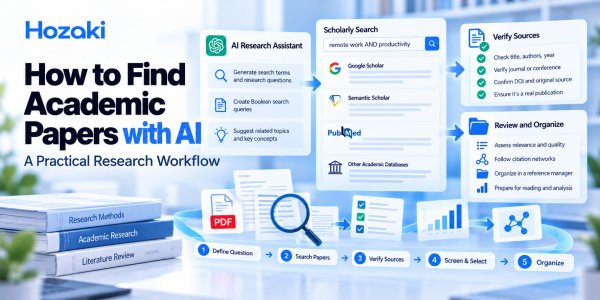
In this guide, you'll learn how to find academic papers with AI using a practical seven-step workflow, from defining your research question to building a verified reading list.
Quick Answer: How to Find Academic Papers With AI
To find academic papers with AI:
-
Define your research question. Identify the topic, population, outcomes, and scope.
-
Generate academic search terms. Use AI to suggest synonyms, technical terminology, and alternative phrases.
-
Search scholarly sources. Use Google Scholar, Semantic Scholar, PubMed, or relevant subject databases.
-
Verify each paper. Confirm its title, authors, publication details, DOI, and original source.
-
Screen for relevance. Evaluate titles, abstracts, methods, and the fit with your research question.
-
Follow citation networks. Explore references and newer papers citing relevant studies.
-
Organize your results. Record verified sources, screening decisions, and unanswered questions.
AI can support every stage, but you should not rely on generated citations without checking them.
Can AI Really Help You Find Academic Papers?
Yes. AI can make academic literature discovery more efficient, particularly when you are unfamiliar with a field or unsure which search terms researchers use.
However, different tools perform different roles.
What AI can help you do
AI can assist with:
-
Turning broad topics into focused research questions.
-
Identifying related academic terminology.
-
Suggesting Boolean search strings.
-
Discovering possible research subtopics.
-
Organizing search results into a structured table.
-
Summarizing abstracts you provide.
-
Comparing the relevance of candidate papers.
-
Identifying missing perspectives in an initial reading list.
Some research-focused platforms also use machine learning to support paper discovery and related-literature exploration.
What AI cannot reliably guarantee
AI cannot automatically guarantee that:
-
Every suggested paper exists.
-
Every citation is accurate.
-
A search has found all relevant studies.
-
A paper's conclusions are valid.
-
The most highly cited paper is the best evidence.
-
A generated literature summary is complete.
-
A publication is peer-reviewed merely because it appears in a search result.
These limitations matter because literature discovery, bibliographic verification, and critical appraisal are separate tasks.
A tool may be useful for one without being sufficient for the others.
The Best Types of Tools for Finding Academic Papers With AI
Before starting your search, distinguish among scholarly search engines, AI-assisted discovery platforms, and general AI assistants.
They can complement one another, but they are not interchangeable.
| Tool | Main role | Best use |
|---|---|---|
| Google Scholar | Broad scholarly literature search | Finding papers, citations, and related publications |
| Semantic Scholar | Scholarly search and AI-assisted discovery | Exploring topics and connections between papers |
| PubMed | Biomedical and life-sciences literature database | Finding research in relevant health and life-science fields |
| Elicit | AI-assisted research workflows | Discovering and organizing candidate studies |
| ChatGPT | General-purpose AI assistant | Developing search strategies and organizing information |
| Crossref | Scholarly publication metadata | Checking DOI and bibliographic information |
| Zotero | Reference management | Saving, organizing, and citing verified sources |
Availability, search coverage, features, and usage limits can change. Check each platform's current documentation before relying on a particular capability.
Google Scholar: Broad academic discovery
Google Scholar is a useful starting point for finding scholarly literature across many disciplines.
You can search by topic, paper title, author, or distinctive phrases.
It also provides ways to explore related publications and citations.
Best use: Building an initial reading list and expanding it through citation links.
Limitation: Results can include different kinds of scholarly material, and appearance in Google Scholar does not by itself establish peer-review status or research quality.
Semantic Scholar: Research discovery and connections
Semantic Scholar is a scholarly search platform that uses AI-related technologies to support research discovery.
It can help users explore papers, authors, and related research.
Best use: Finding candidate studies and identifying connections within a research topic.
Limitation: Its coverage and available information are not necessarily complete for every discipline.
PubMed: Biomedical and life-sciences research
PubMed is particularly relevant to biomedical and life-sciences literature.
It supports structured searching, including subject terminology and filters.
Best use: Research questions within its subject coverage.
Limitation: It should not be treated as a comprehensive database for every academic discipline.
Elicit: AI-assisted literature workflows
Elicit is designed to assist with research-related tasks, including literature discovery and organizing information from papers.
Best use: Exploring candidate studies and building structured research notes.
Limitation: AI-extracted information and source coverage still require verification.
ChatGPT: Search strategy and research organization
ChatGPT can be useful before and after searching academic databases.
You can ask it to generate search terms, identify alternative terminology, develop inclusion criteria, or organize verified paper information.
When search capabilities are available, it may also assist with finding candidate sources.
Best use: Improving the search strategy and turning collected information into a usable research workflow.
Limitation: A paper title or citation generated by ChatGPT must be verified independently. Do not assume the assistant has searched a scholarly database unless the relevant search was actually performed.
Which tool should you start with?
For most exploratory research tasks, a practical combination is:
AI assistant for search planning → scholarly search platform for discovery → original source for verification → reference manager for organization.
You do not need every tool in this table.
Start with the platforms appropriate for your discipline and research question.
Step 1: Turn Your Topic Into a Searchable Research Question
The first step is not opening an AI tool. It is deciding what you actually want to know.
Consider this broad topic:
Remote work and productivity.
That topic could refer to many different questions:
-
Does remote work affect employee productivity?
-
Do hybrid schedules affect productivity differently from fully remote arrangements?
-
How is productivity measured in remote-work studies?
-
Does the effect differ by industry or occupation?
-
Are findings different between self-reported and objective productivity measures?
A search that mixes all these questions may produce a large but unfocused reading list.
Define the key concepts
For a manageable research question, identify:
| Element | Example |
|---|---|
| Population | Employees |
| Exposure or intervention | Remote work |
| Comparison | Office-based or hybrid work |
| Outcome | Productivity |
| Context | Particular industries or occupations |
| Time period | A period relevant to the research question |
| Study types | Empirical studies, reviews, or other specified designs |
Not every project needs every field. The goal is to identify what matters before searching.
Example of a focused research question
Broad topic:
Remote work and productivity.
More focused question:
How do empirical studies measure the relationship between remote work arrangements and employee productivity?
This version is more useful because it emphasizes research evidence and measurement rather than assuming a particular conclusion.
Use AI to refine the question
Copy this prompt:
I am researching the relationship between remote work and employee productivity.
Help me develop three focused academic research questions.
For each question, identify the population, main concepts, potential outcome measures, and possible research limitations.
Do not suggest a conclusion before reviewing evidence.
Review the suggestions and choose the question that matches your actual purpose.
Checkpoint: You should be able to explain your research question in one or two sentences before proceeding.
Step 2: Use AI to Generate Better Academic Search Terms
Academic papers may describe the same concept using different terminology.
A beginner might search only for "remote work," while relevant studies use terms such as "telework," "telecommuting," or "working from home."
AI can help identify these alternatives.
Build a keyword matrix
For the example question:
| Concept | Possible search terms |
|---|---|
| Remote work | remote work, telework, telecommuting, working from home |
| Productivity | productivity, work performance, job performance |
| Population | employees, workers, workforce |
| Measurement | objective measures, self-reported productivity, performance indicators |
These are candidate terms, not a guarantee that every term will be appropriate for every database.
Use Boolean operators
Boolean operators help combine concepts.
OR broadens a search by including alternatives.
AND narrows a search by requiring multiple concepts.
NOT may exclude terms, but careless use can remove relevant papers.
A sample search string is:
("remote work" OR telework OR telecommuting OR "working from home") AND (productivity OR "job performance") AND (employees OR workers)
Different platforms interpret operators, quotation marks, parentheses, and search fields differently.
Adjust the query to the database's supported syntax.
Generate broad, balanced, and narrow queries
A useful strategy is to test several query levels.
Broad query:
remote work productivity
More structured query:
("remote work" OR telework) AND (productivity OR "job performance")
Narrower query:
("remote work" OR telework) AND "objective productivity" AND employees
The narrow query may miss studies using different measurement terminology.
That is why search refinement should be iterative rather than a one-time exercise.
Prompt: Generate academic search terms
My research question is:
[Insert your research question]
Generate:
The main search concepts.
Academic synonyms for each concept.
Relevant abbreviations and alternative terminology.
Three search strings: broad, balanced, and narrow.
Terms that could create irrelevant results.
Suggestions for adapting the search to different academic databases.
Do not invent paper titles, authors, or citations.
Checkpoint: You should now have a small set of testable search strings and understand what each one is intended to retrieve.
Step 3: Search Academic Databases and AI Research Tools
Once you have a search strategy, move from AI-generated suggestions to actual scholarly search results.
This is where you begin identifying real candidate papers.
Search Google Scholar
-
Open Google Scholar.
-
Enter one of your search queries.
-
Review titles and available snippets.
-
Open promising results and inspect their bibliographic information.
-
Use available date controls when recency matters.
-
Explore related articles and citation links.
-
Record candidate papers in a research table.
Do not assume the first result is the most suitable paper.
Ranking can reflect multiple factors and does not replace relevance assessment.
Search Semantic Scholar
-
Open Semantic Scholar.
-
Search the same topic or research question.
-
Review paper titles, abstracts, and available metadata.
-
Explore related research where the platform provides it.
-
Record potentially relevant studies.
-
Check the original publication information.
Using more than one search platform can help reveal papers missed by a single source.
Search a subject-specific database
If your research question belongs to a specialized discipline, identify appropriate databases.
For biomedical topics, PubMed may be a useful starting point.
For other disciplines, your university library or research institution may recommend databases with better subject coverage.
A general AI assistant should not be your only method of discovering literature for a serious academic project.
Record your search activity
Keep a simple search log.
| Field | What to record |
|---|---|
| Database | Where you searched |
| Search date | When the search was run |
| Query | Exact terms used |
| Filters | Date, language, document type, etc. |
| Candidate papers | Potentially relevant results |
| Notes | Problems, useful terms, next search |
For formal evidence reviews, more detailed search documentation may be necessary.
What if your search returns too many papers?
Narrow the scope by adjusting:
-
The research population.
-
The outcome measure.
-
The study design.
-
The publication period.
-
The geographic or industry context.
Avoid applying arbitrary restrictions that could exclude important evidence without a defensible reason.
What if your search returns too few papers?
Try:
-
Removing one restrictive concept.
-
Adding synonyms.
-
Using broader terminology.
-
Searching a different database.
-
Following references from relevant papers.
-
Checking whether your question is too narrow.
Checkpoint: You should have a set of candidate records found through identifiable scholarly sources—not merely a list of references generated by AI.
Step 4: Verify That Every Paper Is Real
This is one of the most important steps in an AI-assisted literature search.
Generative AI can produce plausible but incorrect bibliographic information.
Errors may include:
-
A paper title that does not exist.
-
A real author attached to the wrong paper.
-
An incorrect publication year.
-
A fabricated journal name.
-
A DOI that belongs to another publication.
-
A real paper cited as evidence for something it does not discuss.
Verify the bibliographic identity
For each candidate paper, check:
-
Exact title.
-
Author names.
-
Publication year.
-
Journal, conference, repository, or publisher.
-
DOI or another stable identifier, where available.
-
Original publication page or full text.
Not every legitimate paper has a DOI. A missing DOI alone does not prove that a publication is fake.
Use DOI and publisher records
If a DOI is provided, check whether it resolves to the expected publication.
Crossref is one source of scholarly metadata.
You can also inspect the publisher's page, an institutional repository, or another authoritative publication record.
A matching DOI helps confirm the publication's identity.
It does not prove that the research is methodologically sound.
Watch for metadata mismatches
Imagine an AI assistant suggests:
Smith and Lee (2023), "Remote Work and Productivity," Journal of Workplace Research.
This is an illustrative citation, not a verified paper.
Before using it, search the exact title and compare the author names, year, venue, and identifier against an authoritative record.
If the details cannot be confirmed, do not add the citation to your bibliography as though it were verified.
Use AI as a verification assistant, not the authority
A useful prompt is:
I have a list of academic references.
Help me prepare a verification checklist for each reference, including title, authors, year, publication venue, DOI, and original source.
Mark details as unverified unless supporting evidence is available.
Do not invent missing bibliographic information.
If the AI does not have access to a current external source, it cannot independently confirm a paper's existence merely by generating a plausible answer.
Verification status table
| Paper | Title confirmed | Authors confirmed | Source confirmed | Status |
|---|---|---|---|---|
| Candidate A | Yes | Yes | Yes | Bibliographic identity verified |
| Candidate B | Yes | No | No | Needs further checking |
| Candidate C | No | No | No | Unverified |
This is a template, not a record of actual publications.
Checkpoint: Every paper in your final reading list should have a traceable publication identity.
Step 5: Screen Papers for Relevance and Quality
A real paper is not necessarily a useful paper.
Once you verify a publication, determine whether it answers your research question.
Start with the title and abstract
Ask:
-
Does the paper address the right topic?
-
Does it study the relevant population?
-
Does it examine the outcome I care about?
-
Is the research design appropriate for my question?
-
Is the publication within the intended scope?
A paper may mention remote work and productivity without actually measuring their relationship.
That paper might be useful as background but not as direct evidence.
Create inclusion and exclusion criteria
For the remote-work example, possible criteria might be:
Include:
-
Empirical studies involving employee work arrangements.
-
Studies reporting relevant productivity or performance measures.
-
Publications with sufficient methodological information.
Exclude from the primary evidence set:
-
Articles that do not study the relevant outcome.
-
Commentary without empirical findings, if the review focuses on empirical evidence.
-
Publications outside the predefined population or context.
These are illustrative criteria. Your actual criteria should follow your research question and be established consistently.
Distinguish relevance from research quality
Relevance asks:
Does this study address my question?
Quality asks:
How much confidence should I place in its methods and findings?
A highly relevant paper can have serious methodological limitations.
A well-conducted study can also be irrelevant to your specific question.
Do not combine these into a single vague AI-generated score.
What to examine beyond the abstract
For papers that pass initial screening, inspect:
-
Study design.
-
Sample or dataset.
-
Measurement methods.
-
Comparison groups, where applicable.
-
Statistical or analytical approach.
-
Limitations.
-
Conflicts of interest or funding disclosures, where relevant.
-
Whether the conclusions are supported by the reported evidence.
Use appropriate discipline-specific appraisal frameworks when necessary.
Can AI screen abstracts?
AI can help organize screening decisions, especially when you provide the research question and explicit criteria.
For example:
Evaluate this abstract against the following inclusion criteria.
For each criterion, mark:
Meets
Does not meet
Unclear
Quote or identify the information supporting your decision.
Do not infer missing methodological details.
Treat this as screening assistance rather than an automatic final decision.
For high-stakes or formal reviews, human review and documented procedures remain important.
Checkpoint: You should have a smaller set of papers with explicit reasons for inclusion, exclusion, or further review.
Step 6: Find More Papers Through Citation Tracking
Keyword searches are not the only way to discover relevant research.
Once you identify a useful paper, you can explore its connections to other publications.
This is commonly called citation tracking or citation chaining.
Backward citation tracking
Backward tracking means reviewing the references cited by a paper.
It helps answer:
Which earlier studies informed this research?
For example, a recent paper about remote-work productivity may cite foundational studies on telecommuting or workplace performance measurement.
Those references can reveal terminology and research traditions that your initial search missed.
Forward citation tracking
Forward tracking means looking for newer publications that cite a paper.
It helps answer:
What research built on, questioned, or extended this study?
Platforms such as Google Scholar and Semantic Scholar provide citation-related discovery features, subject to their coverage.
Related-paper discovery
You can also explore papers connected by topic, references, or other similarity signals.
However, related-paper suggestions may emphasize familiar or well-connected literature.
They should not be treated as a complete map of the field.
A practical citation-tracking process
-
Select two or three highly relevant verified papers.
-
Review their reference lists.
-
Identify potentially useful earlier studies.
-
Check newer citing papers where available.
-
Verify each newly discovered publication.
-
Screen it against your inclusion criteria.
-
Record how you discovered it.
This process is especially valuable when academic terminology has changed over time.
Avoid following citations endlessly
Citation tracking can expand rapidly.
Stop or refine your exploration when new papers repeatedly fall outside your research scope or add little relevant information.
For formal reviews, follow the applicable protocol rather than using an arbitrary stopping rule.
Checkpoint: Your reading list should reflect more than one discovery method, where appropriate.
Step 7: Organize Your Research Papers for Reading and Analysis
Finding papers is only the beginning.
Without a clear system, you may repeatedly read the same material, lose source information, or confuse findings across studies.
Build a literature tracking table
Use a spreadsheet or reference manager to record the information you need.
| Field | Purpose |
|---|---|
| Paper ID | Unique identifier |
| Full citation | Accurate bibliographic record |
| DOI or stable URL | Source verification |
| Discovery source | Where you found the paper |
| Research question | What the paper investigates |
| Study design | How the research was conducted |
| Population or dataset | Who or what was studied |
| Main findings | Key results |
| Limitations | Important qualifications |
| Relevance decision | Include, exclude, or review |
| Verification status | Confirmed or pending |
Use a reference manager
Zotero can help you save and organize research references.
You can use collections, tags, and notes to separate different projects or research themes.
Importing a reference does not eliminate the need to check its metadata.
Organize full-text PDFs carefully
Use consistent file names or identifiers so that extracted findings can be traced to the correct documents.
For example:
Paper-014_Author-Year_Short-Title.pdf
A source ID is particularly useful when comparing multiple papers.
Move from discovery to analysis
Once your reading list is verified, you can use AI to help extract and compare information from the papers.
For a structured comparison process, see How to Compare Research Papers With AI Without Missing Important Differences.
If you have collected multiple full-text PDFs, follow How to Summarize Multiple PDFs With AI Without Losing Important Details.
You can also explore How to Use NotebookLM for Research: A Practical Workflow if you want a source-centered way to investigate your documents.
Checkpoint: You should now have a verified, organized collection of papers ready for deeper reading.
Complete Example: Finding Papers About Remote Work and Productivity
Let's put the workflow together.
This is a reproducible example of how to conduct the search, not a claim that a live search or literature review has already been completed.
The starting topic
Remote work and employee productivity.
Step A: Define the question
Research question:
How do empirical studies measure the relationship between remote work arrangements and employee productivity?
This focuses the search on both the relationship being studied and the way productivity is measured.
Step B: Identify search concepts
| Concept | Search terms |
|---|---|
| Work arrangement | remote work, telework, telecommuting, working from home |
| Outcome | productivity, job performance, work performance |
| Population | employees, workers |
| Measurement | objective measures, self-reported outcomes |
Step C: Create a search query
Start with:
("remote work" OR telework OR telecommuting) AND (productivity OR "job performance")
If too many results appear, consider adding terms related to measurement or study design.
If too few appear, broaden the query.
Step D: Search scholarly sources
Run the query in Google Scholar and another appropriate platform.
Record:
-
Search date.
-
Exact query.
-
Platform.
-
Applied filters.
-
Candidate titles.
-
Source links.
Do not assume the platforms will return identical results.
Step E: Verify candidate papers
For each promising result, check the original publication record.
Confirm the title, authors, year, and source.
If a DOI exists, check that it identifies the correct publication.
Step F: Screen for relevance
Read the abstracts and identify whether each paper actually examines employee productivity.
A paper focused only on employee satisfaction may be useful background, but it should not automatically be treated as direct productivity evidence.
Step G: Inspect measurement methods
For the most relevant studies, determine how productivity is defined.
Examples of possible measurement approaches include:
-
Self-reported productivity.
-
Output per hour.
-
Task completion measures.
-
Employer performance records.
-
Other occupation-specific indicators.
These measures are not automatically interchangeable.
Step H: Expand the search
Use reference lists and citing papers to identify additional research.
Check whether newer studies use different terminology or methods.
Step I: Organize the evidence
Create a comparison table:
| Paper ID | Work arrangement | Productivity measure | Study design | Main limitation |
|---|---|---|---|---|
| Paper A | To be extracted | To be extracted | To be extracted | To be extracted |
| Paper B | To be extracted | To be extracted | To be extracted | To be extracted |
| Paper C | To be extracted | To be extracted | To be extracted | To be extracted |
The table is intentionally blank because no actual study results have been verified in this example.
What this example teaches
The goal is not to ask AI:
Find five papers proving that remote work improves productivity.
That question assumes a conclusion and encourages selective evidence gathering.
A better approach is to search for relevant studies, compare their methods, and allow the evidence to shape your answer.
How to Find Recent Academic Papers With AI
If your topic changes quickly, publication dates may be especially important.
AI can help you develop updated search terms, but current literature should be located through sources that actually provide access to recent records.
Use publication-date filters
Where supported, apply date filters appropriate to your question.
Avoid automatically excluding older papers that may be foundational.
Search for recent reviews
Recent review articles can help identify important research directions and references.
However, a recent review may not include the very latest studies.
Check newer citing papers
Forward citation tracking can help reveal research published after an influential study.
Repeat important searches
For ongoing projects, rerun key searches and record the dates.
A literature search is a time-bounded activity. New publications can appear after your initial search.
How to Find Open-Access Research Papers
Finding a citation does not always mean you can access the full paper.
If you need full text, check:
-
The publisher's page.
-
Institutional repositories.
-
Author-posted versions where permitted.
-
Legitimate open-access links provided by scholarly platforms.
-
Your university or institutional library.
Pay attention to the version of the document.
A preprint, accepted manuscript, and final published article may differ.
For important claims, confirm which version you are reading.
Do not assume an abstract contains enough detail to evaluate the full study.
How to Find Highly Relevant Papers Without Relying on Citation Counts
Citation counts can help identify influential publications, but they are not a universal measure of quality.
Older papers have had more time to accumulate citations.
Citation patterns also differ by discipline.
A recent, highly relevant study may have few citations simply because it is new.
Instead of ranking papers by citation count alone, evaluate:
-
Relevance to your research question.
-
Appropriateness of the study design.
-
Quality and transparency of the methods.
-
Suitability of the sample or dataset.
-
Strength and limitations of the evidence.
-
Relationship to other research.
Use citation counts as contextual information, not as an automatic inclusion or exclusion rule.
Common Mistakes When Using AI to Find Academic Papers
Mistake 1: Asking AI to invent a bibliography
A prompt such as "Give me ten papers on this topic" can produce plausible but unverified references.
Better approach: Ask AI to develop a search strategy, then locate publications through scholarly sources.
Mistake 2: Searching only one phrase
Researchers often use different terminology for similar concepts.
Better approach: Build a keyword matrix and test several search strings.
Mistake 3: Using only one discovery platform
No single scholarly search tool guarantees complete coverage.
Better approach: Use appropriate complementary sources, especially for serious research.
Mistake 4: Trusting a DOI without checking it
A DOI can be incorrect or point to a different publication.
Better approach: Confirm that the identifier matches the title and authors.
Mistake 5: Treating every search result as peer-reviewed
Scholarly search results can include different publication types.
Better approach: Verify the venue, document type, and review status where relevant.
Mistake 6: Screening only by AI-generated summaries
A summary may omit important methodological information.
Better approach: Check the abstract and, when necessary, the full text.
Mistake 7: Using citation counts as a quality score
Highly cited research is not necessarily the best evidence for your question.
Better approach: Evaluate relevance and methodological quality separately.
Mistake 8: Searching only for evidence that supports your assumption
Confirmation bias can distort the entire literature search.
Better approach: Use neutral research questions and look for conflicting findings.
Mistake 9: Failing to document search decisions
Without records, it becomes difficult to reproduce or defend the search.
Better approach: Save queries, dates, filters, and screening reasons.
Mistake 10: Treating AI-generated synthesis as a completed literature review
A polished summary can conceal missing studies or unsupported comparisons.
Better approach: Verify the source set, evaluate the evidence, and distinguish descriptive synthesis from formal systematic review methods.
Frequently Asked Questions
Can ChatGPT find academic papers?
ChatGPT can help develop search strategies, suggest terminology, and, when appropriate search features are available, assist in locating candidate sources.
However, generated references must be checked against scholarly records. Do not assume a citation is real simply because it looks convincing.
What is the best AI tool to find research papers?
There is no universal best tool.
Semantic Scholar and other research-oriented platforms can help discover candidate literature. Google Scholar provides broad scholarly search. ChatGPT can assist with query planning and research organization.
The right combination depends on your discipline and research task.
Can AI find peer-reviewed papers?
AI can assist in locating candidate papers, but you must verify their publication status.
A paper appearing in a search result does not automatically establish that it underwent peer review.
How do I know whether an AI-recommended paper is real?
Check the exact title, authors, publication year, venue, DOI or stable identifier, and original publication record.
If the information cannot be verified, do not treat the reference as confirmed.
Can AI find recent academic papers?
AI tools with access to current search sources may help discover recent literature.
For reliable coverage, search appropriate scholarly databases using date filters and record when the search was conducted.
Is Google Scholar better than ChatGPT for finding papers?
They serve different roles.
Google Scholar is designed to search scholarly literature. ChatGPT is a general-purpose assistant that can help develop and refine the search process.
For locating and verifying publications, use identifiable scholarly sources.
How can I find related papers after discovering one useful study?
Review its reference list, examine newer citing publications, and explore related-paper features in scholarly search platforms.
Verify and screen each newly discovered paper.
Can AI write my literature review?
AI can help organize sources, extract information, and draft material from verified evidence.
It cannot replace a defensible search strategy, critical appraisal, accurate citations, or the researcher's responsibility for the final review.
Do all academic papers have a DOI?
No. Some legitimate publications lack DOIs.
Use other authoritative records when a DOI is unavailable.
How many papers should I find for a literature review?
There is no universally correct number.
The appropriate scope depends on the research question, assignment requirements, discipline, review type, and available evidence.
A systematic review may require a documented, comprehensive search rather than a fixed target number.
Final Checklist: Before You Start Reading
Use this checklist to confirm that your literature search is ready for deeper analysis.
-
I have a focused research question.
-
I identified the main search concepts and synonyms.
-
I tested more than one search query.
-
I searched appropriate scholarly sources.
-
I recorded the search dates and filters.
-
I verified the identity of each selected paper.
-
I applied consistent relevance criteria.
-
I distinguished research quality from topical relevance.
-
I explored relevant references and citing studies.
-
I recorded why papers were included or excluded.
-
I organized the selected sources for later analysis.
-
I did not treat unverified AI-generated citations as evidence.
Conclusion: Use AI to Improve Your Search, Not Replace It
Learning how to find academic papers with AI is not about letting a chatbot produce a bibliography in seconds.
It is about building a more effective research process.
AI can help you ask better questions, discover useful terminology, create search strategies, and organize candidate studies.
Scholarly search platforms help you locate publications. Original records help you verify their identities. Critical reading helps you determine whether the evidence is relevant and trustworthy.
A reliable workflow follows this sequence:
Define the question → Build search terms → Search scholarly sources → Verify publications → Screen evidence → Follow citations → Organize the literature.
Once you have a verified set of papers, you can move into deeper analysis.
If you need to compare findings and methods, read How to Compare Research Papers With AI Without Missing Important Differences.
If you are deciding how to work with collected PDFs, see NotebookLM vs ChatGPT for PDFs: Which Should You Use?.
The goal is not to find the largest number of papers.
It is to build a relevant, verifiable collection of evidence that can support a sound research decision.
Sources and Further Reading
Official research resources
-
Google Scholar — Scholarly literature search.
-
Semantic Scholar — Research discovery and related-literature exploration.
-
PubMed — Biomedical and life-sciences literature.
-
Elicit — AI-assisted research workflows.
-
Crossref — Scholarly publication metadata and DOI services.
-
Zotero — Reference management.
-
PRISMA 2020 — Reporting guidance for systematic reviews.
Related Hozaki guides
-
How to Use AI for Research Without Letting AI Do the Thinking for You
-
How to Compare Research Papers With AI Without Missing Important Differences
-
How to Summarize Multiple PDFs With AI Without Losing Important Details
Editorial note: The search queries, candidate-paper tables, and research scenarios in this guide are instructional examples. They do not represent a completed live literature search. Search platform features and coverage may change; consult official documentation and the original scholarly records when carrying out research.
Comments 0