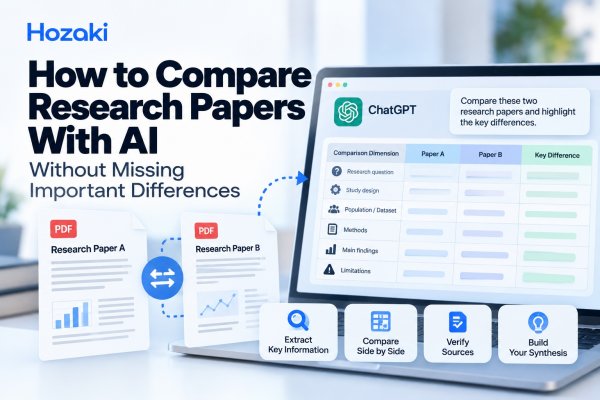
Comparing research papers is not simply a matter of asking which study has the better conclusion.
Two papers may investigate the same topic but use different populations, research methods, outcome measures, or definitions. Their findings may appear contradictory even when they answer different questions.
AI can help organize this work. It can extract study details, create comparison tables, highlight possible differences, and help draft a literature synthesis. But it can also misread source documents, overlook limitations, and produce comparisons that sound reasonable without being supported by the papers.
The most reliable approach is to use AI to structure the comparison while keeping the original research papers as the source of evidence.
This guide shows you how to compare research papers with AI step by step, using a practical comparison matrix, reusable prompts, and a verification workflow.
Quick Answer: How to Compare Research Papers With AI
To compare two or more research papers with AI:
-
Define the comparison question. Decide whether you want to compare findings, methodologies, populations, or the strength of evidence.
-
Collect the original papers. Prefer complete, authoritative versions rather than relying on abstracts alone.
-
Check that the documents are readable. Verify that text, tables, and relevant figures can be accessed.
-
Extract information from each paper separately. Record the research question, design, sample, methods, outcomes, results, and limitations.
-
Create a standardized comparison matrix. Use the same fields for every paper.
-
Identify meaningful similarities and differences. Pay particular attention to whether the studies are actually comparable.
-
Verify important claims against the originals. Check numbers, quotations, methods, and source locations.
-
Write a synthesis. Explain what the combined evidence suggests, where the studies disagree, and what remains uncertain.
Do not begin by asking AI to declare a winner.
The first goal is to understand what each paper actually investigated.
What Should You Compare Between Research Papers?
A useful comparison goes beyond titles, publication dates, and conclusions.
The appropriate dimensions depend on your research question, but most empirical studies can be compared across several core categories.
| Comparison dimension | Questions to ask |
|---|---|
| Research question | What specific question does the study investigate? |
| Study design | Is it experimental, observational, qualitative, or another design? |
| Population or dataset | Who or what was studied? |
| Sample size | How much evidence was collected? |
| Methods | How were the data gathered and analyzed? |
| Outcome measures | What was actually measured? |
| Main findings | What results did the authors report? |
| Uncertainty | Are confidence intervals, variability, or other uncertainty measures reported? |
| Limitations | What weaknesses or constraints do the authors acknowledge? |
| Generalizability | To whom or what might the findings apply? |
| Evidence location | Where can each statement be verified? |
Not every category applies equally to every paper.
For example, a qualitative interview study and a randomized controlled trial require different forms of appraisal. A theoretical paper may not have a sample size at all.
Use the comparison framework to expose important differences, not to force every paper into an inappropriate template.
Step 1: Choose Papers That Can Be Meaningfully Compared
Before uploading anything to an AI tool, define the purpose of your comparison.
You might want to answer one of these questions:
-
Do two studies report similar findings?
-
Why do their conclusions differ?
-
Which research design is better suited to a particular question?
-
How has a research topic developed over time?
-
What limitations appear repeatedly across the literature?
-
Which unanswered questions deserve further investigation?
These are different tasks and may require different evidence.
Start with a focused comparison question
A vague question:
Compare these two papers about remote work.
A more useful question:
Compare how these two studies measured productivity in remote-work settings, including their samples, research designs, outcome measures, and limitations.
The second question tells you what information to extract and what differences matter.
Check basic comparability
Before interpreting results, examine:
Population: Are the studies investigating similar participants or settings?
Intervention or exposure: Are they evaluating the same activity, condition, or treatment?
Outcome: Do they measure the same result using comparable definitions?
Time frame: Were the outcomes measured over similar periods?
Research design: Could differences in design explain differences in the reported findings?
Two papers do not need to be identical to be compared. But differences must be acknowledged before conclusions are combined.
Avoid comparing abstracts alone
An abstract may omit important methodological details, subgroup findings, statistical uncertainty, or limitations.
Use the full paper whenever possible.
If only an abstract is available, label the comparison as preliminary and explain what could not be verified.
Step 2: Prepare and Check Your Source Documents
AI comparisons are only as reliable as the information available from the source documents.
A PDF can upload successfully while some of its contents remain difficult to extract.
Before analysis, check:
-
Whether the text is selectable and readable.
-
Whether tables retain their row and column structure.
-
Whether charts contain information unavailable in the text.
-
Whether footnotes and appendices are relevant.
-
Whether the document is complete.
-
Whether page references are consistent.
If ChatGPT misreads the source, it may carry those errors into the comparison.
For detailed troubleshooting, see Why ChatGPT Misreads PDFs and How to Fix It.
If the problem occurs before the file attaches, use ChatGPT File Upload Not Working? Causes and Fixes.
Create a source inventory
Give every paper a stable identifier.
| Paper ID | Title | Publication year | Source file | Verification status |
|---|---|---|---|---|
| P01 | Full paper title | Year | P01.pdf | Pending |
| P02 | Full paper title | Year | P02.pdf | Pending |
| P03 | Full paper title | Year | P03.pdf | Pending |
Use real titles and bibliographic details from the original sources.
Do not ask AI to invent missing author names, DOIs, or publication information.
If you are working with many papers, a reference manager can help maintain accurate source records.
Step 3: Extract Key Information From Each Paper Separately
This is one of the most important steps.
Do not immediately upload several papers and request a combined summary.
First, create a verified extraction record for each paper.
This reduces the risk of confusing a finding from Paper A with a finding from Paper B.
Use a consistent extraction template
For every paper, record:
-
Full citation and source identifier.
-
Research question or objective.
-
Study design.
-
Population or dataset.
-
Sample size, when applicable.
-
Methods and analytical approach.
-
Outcome measures.
-
Main findings.
-
Statistical uncertainty or qualitative evidence, as appropriate.
-
Author-reported limitations.
-
Relevant source passages and locations.
Prompt: Extract research information
Copy and adapt this prompt for one paper at a time.
Analyze the attached research paper without comparing it with other papers yet.
Extract:
Research question and objective
Study design
Population, sample, or dataset
Data collection and analysis methods
Main outcome measures
Key findings
Uncertainty measures, where applicable
Limitations acknowledged by the authors
Relevant page, section, or table references
Separate information explicitly reported in the paper from your own interpretation.
If a detail cannot be verified, write "Not verified." Do not guess.
Verify the extraction before proceeding
Choose several important details and check them directly in the paper.
Prioritize information that could change your interpretation:
-
Sample size.
-
Research design.
-
Main outcome measure.
-
Key numerical result.
-
Important limitation.
If these details are wrong, correct the extraction before asking AI to compare the papers.
Step 4: Build an AI Research Comparison Matrix
Once the individual extraction records are checked, combine them into a standardized table.
A comparison matrix makes differences easier to inspect and reduces the temptation to rely on a single fluent paragraph.
Research paper comparison template
| Dimension | Paper A | Paper B | Interpretation | Evidence |
|---|---|---|---|---|
| Research question | — | — | Same or different question? | Source locations |
| Study design | — | — | How do the designs differ? | Methods sections |
| Population | — | — | Are the populations comparable? | Source locations |
| Sample size | — | — | What does each sample represent? | Source locations |
| Outcome measure | — | — | Are the measures equivalent? | Source locations |
| Main finding | — | — | Similar, different, or not comparable? | Results sections |
| Limitations | — | — | Which limitations affect interpretation? | Discussion sections |
| Verification status | — | — | What remains uncertain? | Original documents |
Prompt: Create the comparison matrix
Compare Paper A and Paper B using the verified extraction records.
Create a table with these columns:
Comparison dimension
Paper A
Paper B
Similarity or difference
Supporting source location
Verification status
Compare research questions, study designs, samples, methods, outcome measures, findings, and limitations.
Do not treat results as directly comparable unless the studies investigate sufficiently similar questions using appropriate measures.
Flag any difference that prevents a straightforward comparison.
Why a matrix works better than a general summary
A general summary might say:
Both papers found positive results, although Paper B reported a stronger effect.
But this statement may hide important differences.
Did both papers measure the same outcome?
Were the populations comparable?
Did one report a percentage change while the other reported a standardized effect size?
Were the results statistically uncertain?
A structured matrix makes these questions visible.
Step 5: Compare Research Methods and Results
The next step is interpretation.
This is where AI can help identify patterns, but human judgment becomes especially important.
Compare the research designs
Different designs support different kinds of conclusions.
For example, a randomized experiment may be designed to estimate a causal effect under particular conditions.
An observational study may identify associations but face different confounding risks.
A qualitative study may provide detailed insights into experiences and processes rather than estimating the same numerical effect.
It would be misleading to rank these designs using a single universal rule.
Instead, ask whether each design is appropriate for the question it attempts to answer.
Compare outcome definitions
Two papers may both use the word "productivity" while measuring different things.
One might use tasks completed per hour.
Another might use a self-reported productivity score.
Even if both report improvements, their results are not automatically interchangeable.
Compare populations and settings
A finding from a small sample of university students may not generalize to an international workforce.
Similarly, results obtained in a controlled laboratory setting may not directly predict real-world outcomes.
Compare uncertainty, not just point estimates
If two studies report numerical effects, inspect confidence intervals, variability, sample size, and analytical assumptions where applicable.
A larger point estimate does not automatically mean a stronger or more reliable finding.
Ask whether the apparent disagreement is real
When studies seem to disagree, investigate whether the difference could be explained by:
-
Different research questions.
-
Different participants.
-
Different interventions or exposures.
-
Different measurement methods.
-
Different follow-up periods.
-
Different analytical approaches.
-
Random uncertainty.
-
Study limitations or bias.
AI can help organize these possibilities, but it should not assert an explanation that the evidence does not support.
Step 6: Worked Example — Comparing Two Research Papers
The following example is fictional and intended only to demonstrate the comparison process. The study names, methods, and results are illustrative; they do not refer to published research.
Research question
Does a digital study-planning tool improve student performance?
Fictional Paper A
Paper A reports a randomized study involving 120 university students.
Participants were assigned to use a study-planning tool or continue their usual study routines.
The researchers measured performance on a course assessment after six weeks.
The paper reports a difference favoring the tool group, while also noting uncertainty around the estimate.
Fictional Paper B
Paper B reports an observational survey of 450 students.
It examines whether students who report using digital planning tools also report higher study productivity.
The study uses self-reported productivity rather than assessment scores.
It identifies a positive association but cannot establish that the planning tool caused the difference.
Comparison matrix
| Dimension | Fictional Paper A | Fictional Paper B |
|---|---|---|
| Research question | Does tool use improve assessment performance? | Is tool use associated with perceived productivity? |
| Design | Randomized study | Observational survey |
| Participants | 120 students | 450 students |
| Outcome | Course assessment score | Self-reported productivity |
| Finding | Reported difference favoring the tool group | Reported positive association |
| Main limitation | Short follow-up and limited sample | Self-reporting and confounding |
| Causal interpretation | Potentially supports a causal estimate within its design | Does not establish causation |
What can we conclude?
The papers both concern digital planning tools, but they measure different outcomes using different designs.
It would be inappropriate to conclude that Paper B "confirms" the causal result in Paper A.
A more defensible synthesis is:
The fictional studies suggest that digital planning tools may be associated with favorable student outcomes, but they provide different forms of evidence. Paper A evaluates assessment performance in a randomized design, while Paper B examines self-reported productivity in an observational sample. Their results should not be treated as direct replications.
This is the kind of distinction a good research comparison should preserve.
The example also demonstrates why AI-generated statements need verification: a polished summary can easily erase methodological differences.
Step 7: Verify Every Important Comparison
An AI-generated comparison is a draft, not a validated research finding.
Before using it in an assignment, literature review, report, or publication, check the evidence.
Verify source attribution
Make sure every finding is attributed to the correct paper.
When comparing several documents, AI may accidentally blend information from different sources.
Verify quotations
Search the original paper for any quotation used in the comparison.
Confirm the exact wording and surrounding context.
Verify numbers and units
Check numerical findings against the original results tables.
Watch for differences between:
-
Percentages and percentage points.
-
Absolute and relative changes.
-
Mean values and median values.
-
Raw scores and standardized measures.
-
Associations and causal estimates.
Verify page and section references
A generated page number may be wrong or refer to a different pagination system.
Do not treat a citation as valid until you can locate the supporting passage.
Verify the interpretation
Ask whether the evidence actually supports the comparison.
For example, a statistically non-significant result should not automatically be described as proof that an effect does not exist.
Similarly, overlapping confidence intervals do not, by themselves, settle every question about whether two estimates differ.
Prompt: Audit the comparison
Audit this research comparison for unsupported claims.
For every major conclusion:
Identify the supporting passage in the original paper.
Confirm that the finding is attributed to the correct source.
Check numerical values, units, and outcome definitions.
Flag claims that go beyond the reported evidence.
Identify studies whose results should not be directly compared.
Label each conclusion as:
Verified against source
Partially supported
Not verified
Contradicted by source
Do not invent quotations, page numbers, citations, or missing results.
The model's labels are suggestions for your review, not independent proof of verification. Check the underlying evidence yourself.
Step 8: Turn the Comparison Into a Literature Synthesis
A comparison table is useful, but a literature review usually requires more than listing similarities and differences.
The next task is synthesis.
Synthesis means explaining what the studies collectively suggest, how their methods affect interpretation, and which questions remain unresolved.
Organize the synthesis by themes
Possible themes include:
-
Areas of agreement.
-
Areas of disagreement.
-
Methodological differences.
-
Differences in populations or settings.
-
Limitations across the evidence.
-
Research gaps.
Avoid paper-by-paper repetition
A weak synthesis might read:
Paper A found X. Paper B found Y. Paper C found Z.
A stronger synthesis explains the relationship between findings:
Across the studies, the reported outcomes differ partly because the researchers used different measures and study designs. The experimental evidence addresses assessment performance, while the observational evidence concerns self-reported productivity. These differences limit direct comparison.
This statement should only be used when supported by the actual papers.
Prompt: Draft a literature synthesis
Using only the verified comparison matrix and source notes, draft a literature synthesis.
Organize the discussion around:
Main areas of agreement
Important disagreements
Methodological differences
Limitations affecting interpretation
Remaining research gaps
Distinguish direct findings from interpretations.
Do not introduce studies, statistics, or citations that are absent from the verified source material.
Flag conclusions that require additional evidence.
A note about systematic reviews
This workflow is useful for organizing and comparing research, but it is not a substitute for a formal systematic review or meta-analysis.
Those methods may require predefined eligibility criteria, comprehensive search strategies, duplicate screening, risk-of-bias assessment, appropriate quantitative synthesis, and transparent reporting.
If your project requires systematic review standards, use a suitable review protocol and established reporting guidance, such as PRISMA 2020, rather than treating an AI-generated comparison as sufficient.
Which AI Tools Can Help Compare Research Papers?
The best tool depends on the stage of your workflow.
Rather than selecting a tool based only on how fluent its summaries sound, evaluate whether it helps you maintain a clear connection between claims and original sources.
| Tool or approach | Potential use | What to verify |
|---|---|---|
| ChatGPT | Structured extraction, comparison tables, synthesis drafts | Document readability, attribution, source accuracy |
| NotebookLM | Source-grounded exploration of uploaded material | Whether cited passages support the answer |
| Research discovery tools | Finding relevant papers and related studies | Coverage, relevance, and bibliographic accuracy |
| Reference managers | Organizing citations and source records | Metadata and source completeness |
| Spreadsheets | Maintaining comparison matrices | Data entry and version control |
Product capabilities, available plans, and file-processing features can change. Check current official documentation before choosing a workflow.
A practical combination is often more useful than relying on one tool for every step.
For example, you might use a reference manager to organize papers, an AI assistant to prepare extraction drafts, and a spreadsheet to maintain the verified comparison matrix.
The essential requirement is that the original papers remain available for checking.
Common Mistakes When Comparing Papers With AI
Mistake 1: Asking AI to compare papers before checking the files
If the documents are not readable, the comparison may be built on incomplete information.
Better approach: Test extraction and verify key passages first.
Mistake 2: Comparing conclusions without comparing methods
Two similar conclusions may come from very different types of evidence.
Better approach: Compare study design, population, measures, and limitations alongside the findings.
Mistake 3: Treating larger samples as automatically better evidence
Sample size matters, but it does not replace appropriate design, measurement quality, or bias assessment.
Better approach: Evaluate whether the evidence is suitable for the research question.
Mistake 4: Trusting generated citations
An AI model may provide incorrect page references or unsupported quotations.
Better approach: Locate important claims in the original documents.
Mistake 5: Treating correlation as causation
Observational associations do not automatically establish causal relationships.
Better approach: Preserve the interpretation supported by each study design.
Mistake 6: Forcing incompatible results into one conclusion
Studies with different outcomes, populations, or methods may not support a direct comparison.
Better approach: Explain the incompatibility rather than hiding it.
Mistake 7: Using AI-generated synthesis without human review
A coherent paragraph can still misrepresent the evidence.
Better approach: Review the comparison matrix, verify claims, and edit the synthesis yourself.
Frequently Asked Questions
Can AI compare two research papers?
Yes. AI can help extract information, organize similarities and differences, and draft comparison tables.
However, its output should be checked against the original papers, particularly for methods, statistics, quotations, and conclusions.
What is the best way to compare multiple research papers with AI?
Extract each paper separately, verify the information, and combine the records into a standardized comparison matrix.
Then analyze the differences and write a synthesis based on the verified evidence.
Can ChatGPT compare research methodologies?
ChatGPT can help identify and describe methodological differences when the relevant source material is available.
You should still verify study designs, sampling methods, outcome definitions, analytical techniques, and limitations against the papers.
Can AI create a literature review from research papers?
AI can assist with organizing notes and drafting a synthesis.
A credible literature review still requires appropriate source selection, accurate citations, critical appraisal, and human review.
A formal systematic review involves additional methodological requirements.
How many research papers can AI compare at once?
The practical number depends on the tool, account, file limits, document length, and task complexity.
For reliable work, consider extracting and verifying individual papers before combining them, even if your tool supports multiple documents.
Can AI identify contradictions between studies?
It can highlight apparent disagreements.
However, a difference in findings is not necessarily a contradiction. The studies may use different populations, methods, or outcome measures.
Check comparability before describing the results as conflicting.
How do I stop AI from inventing research citations?
Use complete source documents, request evidence locations, and verify important references manually.
Explicitly instruct the model not to invent missing citations, but do not rely on the instruction alone.
Should I use AI to decide which research paper is better?
AI can help structure a critical appraisal, but there is no universal ranking rule that applies to every research question and study design.
Evaluate each paper's methodological suitability, evidence quality, limitations, and relevance to your specific question.
Final Checklist: Compare Research Papers Reliably
Before using an AI-generated research comparison, confirm that you have:
-
Defined a focused comparison question.
-
Collected appropriate source papers.
-
Checked that the documents are readable.
-
Extracted information from each paper separately.
-
Verified important methods, numbers, and findings.
-
Built a standardized comparison matrix.
-
Identified differences that affect comparability.
-
Distinguished reported findings from interpretation.
-
Checked quotations and citations against the originals.
-
Explained uncertainty and limitations.
-
Reviewed the final synthesis yourself.
The goal is not to make AI decide what the research says. It is to use AI to organize the evidence so you can compare studies more carefully, transparently, and efficiently.
Sources and Further Reading
Editorial note: The worked example in this guide is fictional and provided for teaching purposes. No empirical findings are claimed from the example. Product descriptions and research methods should be checked against current official documentation before publication.
Comments 0