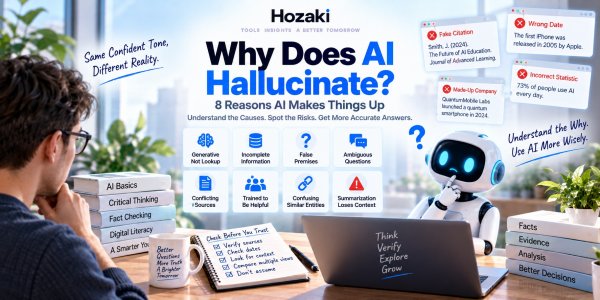
You've probably seen it happen.
You ask an AI assistant a question and receive an answer that sounds completely reasonable.
It includes a date.
A company name.
Maybe even a study.
Then you check.
The date is wrong.
The company doesn't exist.
And the study appears to have been invented.
So why does AI do this?
The short answer is that systems such as ChatGPT aren't built like traditional databases that simply retrieve one verified fact for every question.
Large language models generate responses based on learned patterns, the information available in the conversation, and—depending on the product—external tools such as search, retrieval or code execution.
That makes them remarkably good at generating useful language.
It doesn't guarantee that every generated statement corresponds to reality.
Understanding that difference explains a lot about why AI hallucinations happen.
What Does It Mean When AI Hallucinates?
An AI hallucination is generally an output that appears plausible but contains information that is inaccurate, fabricated, unsupported or inconsistent with the available evidence.
For example, an AI may invent:
- A research paper
- A statistic
- A historical event
- A company
- A product feature
- A quote
- A URL
- A legal case
- An API method
- Details missing from a document
The difficult part isn't simply that AI can be wrong.
Humans, databases, websites and search results can all be wrong.
The difficult part is that AI can produce incorrect information using the same fluent language it uses for correct information.
If you want the broader definition and examples first, see What Is an AI Hallucination?
Now let's look at why it happens.
Reason 1: AI Generates Language Rather Than Looking Up Every Fact
This is the most important concept.
A large language model doesn't necessarily process your question like:
User asked for Fact X → retrieve Fact X from verified database → display Fact X.
At a simplified level, an LLM generates a sequence of tokens based on patterns learned from training data and information available in its current context.
That makes it very good at predicting what a useful response should look like.
But:
linguistically plausible
doesn't automatically mean:
factually verified
Suppose you ask for the author of an obscure paper.
The model may recognize patterns such as:
- Common researcher names
- Typical paper titles
- Journal naming conventions
- Citation structures
If it lacks sufficient grounding, it can produce a citation that looks completely normal.
But normal-looking isn't the same as real.
Reason 2: The Model Has Incomplete Information
No AI model knows everything.
Information may be:
- Too recent
- Too obscure
- Private
- Poorly documented
- Missing from available sources
- Outside the model's useful knowledge
- Ambiguous
Consider:
Who is the marketing director of a small local company?
There may be almost no reliable public information.
The correct response may be:
I can't verify that.
But if the model attempts to fill the information gap, it can produce a plausible but unsupported name.
This is one reason hallucination risk often rises as questions become more obscure and specific.
Reason 3: Your Question May Contain a False Premise
Sometimes the problem begins before the AI answers.
Imagine asking:
Why did Einstein receive the Nobel Prize for relativity?
The question assumes something incorrect.
Einstein's Nobel Prize in Physics was awarded for his services to theoretical physics and especially his discovery of the law of the photoelectric effect.
A robust answer should notice the faulty premise.
But an AI can sometimes accept the premise and continue generating an explanation around it.
This produces a particularly convincing hallucination because the answer may be internally coherent.
The foundation is simply wrong.
Another Example
Ask:
Why did Apple release the first iPhone in 2005?
The first iPhone was introduced in 2007.
If the model doesn't challenge "2005," the rest of the explanation can drift from reality.
A useful prompt is:
Before answering, check whether the assumptions in my question are correct.
That small change can help.
Reason 4: Ambiguous Questions Force the Model to Infer
Ask:
When did Mercury launch?
What does Mercury mean?
- The planet?
- NASA's Project Mercury?
- A software product?
- A company?
- A car?
- A cryptocurrency?
Without context, the model needs to infer your intention.
The inference may be wrong.
Better Prompt
Instead of:
When did Mercury launch?
write:
When did NASA officially begin Project Mercury, the first U.S. human spaceflight program?
More context reduces the amount of guessing required.
This doesn't guarantee accuracy.
But it removes one source of uncertainty.
Reason 5: Training Data Can Contain Conflicting Information
The internet isn't a perfectly curated encyclopedia.
Different sources can disagree.
One page says a company was founded in 2016.
Another says 2017.
A third describes 2016 as the year the founders began working together and 2017 as the official incorporation date.
Which date is correct?
It depends on the definition.
AI can sometimes flatten these distinctions into:
The company was founded in 2016.
The response sounds definitive even though the underlying information is more complicated.
This Happens With Statistics Too
One source estimates a market at:
$18 billion
Another:
$24 billion
Another:
$31 billion
They may use different:
- Definitions
- Geographies
- Years
- Methodologies
- Market boundaries
A generated answer may select one number without communicating that uncertainty.
Reason 6: The Model May Try Too Hard to Be Helpful
Imagine this conversation:
Give me five academic papers proving that Product X improves memory.
There may not be five strong papers.
But the wording pushes toward a particular output:
five papers
proving the claim
A model that prioritizes satisfying the request may generate weak, irrelevant or nonexistent evidence.
A better prompt is:
Find credible research investigating whether Product X affects memory. Do not assume the effect exists. If fewer than five relevant studies are available, say so.
Now you've removed pressure to manufacture a predetermined answer.
Give AI Permission to Say "I Don't Know"
Try:
If you cannot verify the information, say that you cannot verify it rather than guessing.
That doesn't eliminate hallucinations.
It gives the system a better fallback behavior.
Reason 7: AI Can Confuse Similar Entities
This is common with:
- People with similar names
- Products with similar names
- Research papers on similar topics
- Software versions
- Companies
- Historical events
Suppose two researchers share the same surname.
The AI may combine:
Researcher's paper
with:
another researcher's university
and:
a third person's publication year
The result becomes a synthetic biography that belongs to nobody.
Software Has the Same Problem
A model might combine:
Feature from Version 4
with:
pricing from Version 3
and:
documentation from Version 5 beta
Each piece exists.
The combined answer doesn't.
Reason 8: Summarization Can Remove Critical Qualifications
Hallucination doesn't always mean inventing something from nothing.
Sometimes the AI starts with correct information and changes its meaning while compressing it.
Suppose a study concludes:
A statistically significant effect was observed among participants aged 18–24, but no significant overall effect was found across the full population.
AI summarizes:
The study found a statistically significant effect.
That's not completely fabricated.
But it removes the qualification that determines how the result should be interpreted.
Compression Is Useful—but Dangerous
Users often ask:
Summarize this 80-page report in five bullets.
The AI must discard enormous amounts of context.
Important qualifications can disappear.
For document-heavy research, see How to Summarize a PDF With AI.
Why Does ChatGPT Hallucinate?
ChatGPT can hallucinate for many of the reasons above.
Potential problems become more likely when the task involves:
- Obscure information
- Exact citations
- Unclear questions
- Very recent events
- Missing context
- Long chains of reasoning
- Unavailable information
- False assumptions
The solution isn't to assume every ChatGPT response is wrong.
Instead, match verification effort to the importance of the information.
A brainstorming idea requires less verification than a medical claim, financial number or academic citation.
Our How to Fact-Check AI Answers guide explains how to make that distinction.
Why Does AI Invent Sources?
This is one of the strangest hallucination behaviors.
Ask AI for academic references and it may produce:
Smith, J. & Chen, L. (2024). The Cognitive Effects of Generative AI Assistance. Journal of Digital Cognition, 18(2), 113–129.
That looks convincing.
It has:
- Authors
- Year
- Paper title
- Journal
- Volume
- Issue
- Pages
But the entire citation could be fabricated.
Why?
Because the model has learned what academic references look like.
Generating a citation-shaped sequence of text is different from verifying that the citation corresponds to an actual publication.
How to Check It
Search:
- Exact title
- Authors
- Journal
- DOI
Then open the original paper.
Never cite a paper solely because AI formatted it beautifully.
For research workflows involving large numbers of papers, see Best AI Literature Review Tools.
Why Does AI Invent URLs?
URLs also follow predictable patterns.
Suppose a company uses:
company.com/blog/
An AI may generate:
company.com/blog/2026-ai-report
because the URL looks plausible.
That doesn't mean the page exists.
The same can happen with:
- Documentation pages
- Government pages
- Academic links
- Product pages
- News articles
Open the URL.
A link-shaped answer isn't proof of a real destination.
Why Does AI Give Wrong Statistics?
Statistics are particularly vulnerable because numbers need context.
AI may:
- Recall the wrong percentage
- Combine two reports
- Use an outdated figure
- Confuse actual data with a forecast
- Misstate the population
- Change the denominator
- Drop important qualifications
Suppose a report says:
58% of surveyed U.S. workers aged 18–29 had experimented with an AI tool.
AI might compress this into:
58% of workers use AI.
That's a very different claim.
Whenever AI gives a statistic, check:
Who?
Where?
When?
How many?
Measured how?
Actual or forecast?
Original source?
Why Does AI Hallucinate Research Papers?
Academic content combines several hallucination risks at once.
Research papers contain predictable structures:
- Authors
- Abstract
- Methodology
- Results
- Citations
- DOI
And users often request very specific evidence.
For example:
Give me a 2024 randomized trial proving X.
If such a paper doesn't exist, a model can still generate something that looks like one.
That's why a stronger research workflow is:
AI discovers candidate paper
↓
You verify paper exists
↓
Open original
↓
Verify relevant finding
↓
Use the source
For the full workflow, see How to Use AI for Research.
Why Can AI Hallucinate About Current Events?
Fresh information creates a different problem.
The world changes continuously.
Examples:
- Elections
- Sports
- Product releases
- Company leadership
- Software pricing
- Regulations
- Financial results
- Breaking news
Even when an AI system can search the web, it still needs to:
- Find the right sources.
- Understand them.
- Resolve conflicting reports.
- Distinguish old from current information.
- Generate an accurate synthesis.
Search helps.
It doesn't make the reasoning chain infallible.
Why Can AI Hallucinate Even With Web Search?
This surprises people.
If AI can browse the web, shouldn't hallucinations disappear?
Not necessarily.
Web access solves one problem:
access to external information
It doesn't automatically solve:
correct interpretation of external information
An AI can still:
- Choose a weak source
- Misread a source
- Use an outdated page
- Combine conflicting sources
- Attach a citation to the wrong claim
- Draw an unsupported conclusion
Web search reduces some knowledge limitations.
Verification still matters.
Why Can AI Hallucinate With RAG?
RAG stands for retrieval-augmented generation.
In simplified terms:
- A system retrieves relevant information.
- That information is provided to the language model.
- The model generates an answer using the retrieved context.
This can significantly improve grounding.
But several things can still go wrong.
Retrieval Failure
The system retrieves the wrong document.
Missing Information
The required answer isn't in the retrieved material.
Poor Chunking
Important context gets separated.
Conflicting Documents
Sources disagree.
Generation Error
The model misinterprets otherwise correct evidence.
So RAG can reduce hallucination risk.
It doesn't create a mathematical guarantee of truth.
Why Can AI Hallucinate From an Uploaded PDF?
You gave the AI the original document.
Surely that's enough?
Not always.
Possible problems include:
- Bad text extraction
- Scanned pages
- Complex tables
- Charts
- Footnotes
- Multiple columns
- Very long documents
- Missing pages
- Ambiguous questions
There's another important failure:
The Answer Isn't in the PDF
You ask:
What was the company's profit margin in Germany?
The report doesn't provide Germany-specific margin data.
The correct answer should be:
The document doesn't provide that information.
But a hallucinating system may calculate, infer or invent a number.
A useful instruction is:
Answer only from the supplied document. If the information isn't explicitly available, say so.
For PDF workflows, see Best AI PDF Tools.
Does Temperature Cause AI Hallucinations?
You may see claims that simply setting model temperature to zero eliminates hallucinations.
That's too simplistic.
Sampling settings can affect output variability.
But hallucinations can arise from deeper issues such as:
- Missing knowledge
- False premises
- Retrieval problems
- Ambiguous context
- Conflicting evidence
- Incorrect reasoning
A more deterministic answer can still be consistently wrong.
So model settings can influence generation behavior without turning the system into a guaranteed fact database.
Does a Bigger AI Model Hallucinate Less?
More capable models can improve factuality, reasoning, instruction following and tool use.
But model size or capability doesn't guarantee zero hallucinations.
A stronger model can still fail.
And there is an interesting practical problem:
A more capable model may produce a more convincing wrong answer.
That's why fluency shouldn't be used as a proxy for truth.
Can AI Know When It Is Hallucinating?
Sometimes AI systems can express uncertainty.
For example:
I can't verify this information.
That's useful.
But self-reported confidence isn't a perfect accuracy measure.
An AI may be:
- Confident and correct
- Confident and wrong
- Uncertain and correct
- Uncertain and wrong
So:
Are you sure?
isn't a strong fact-checking strategy.
Instead ask:
What evidence supports this claim?
Then inspect the evidence.
Which Questions Are Most Likely to Trigger Hallucinations?
Be especially cautious with questions involving:
Obscure Facts
Little available information.
Nonexistent Entities
The prompt itself may be fictional.
Exact Academic Citations
Highly structured and easy to fabricate convincingly.
Precise Statistics
Context matters.
Current Information
Changes quickly.
Ambiguous Names
Multiple possible entities.
Forced Lists
Give me exactly 20 examples.
There may not be 20 good examples.
False Premises
The question assumes something untrue.
Information Outside the Supplied Document
The AI may fill gaps.
These aren't reasons not to use AI.
They're signals to increase verification.
How Can You Reduce AI Hallucinations?
A practical workflow:
Give More Context
Tell the AI exactly what you're asking about.
Ask for Evidence
Request sources for important claims.
Prioritize Primary Sources
Original papers, reports, datasets and documentation.
Allow Uncertainty
Tell the AI not to guess.
Challenge Assumptions
Ask it to check whether the question contains a false premise.
Restrict the Source Set
For document analysis:
Use only these sources.
Separate Evidence From Interpretation
This prevents inference from masquerading as fact.
Search for Contradictions
Don't only collect confirming evidence.
Verify Important Claims
Especially:
- Numbers
- Dates
- Quotes
- Citations
- Prices
- Current features
The next page in this series goes deeper into exactly how to reduce these errors.
A Better Prompt to Reduce Hallucinations
Try:
Answer using verifiable evidence. Before answering, check whether my question contains any unsupported assumptions. Use authoritative sources for important factual claims. Clearly separate source-supported facts from your interpretation. If information is unavailable, uncertain or conflicting, state that instead of guessing. Do not invent citations, statistics, quotes, names or URLs.
This won't eliminate every mistake.
But it creates a much better research environment than:
Just give me the answer.
AI Hallucination vs Human Error
Humans also:
- Misremember
- Confuse names
- Repeat false information
- Misread studies
- Use outdated statistics
So hallucination isn't evidence that AI is uniquely incapable of useful research.
The difference is scale and presentation.
AI can generate thousands of polished words almost instantly.
That means a single error can be wrapped inside a large amount of convincing content.
The correct response isn't:
Trust humans, distrust AI.
It's:
Build verification into information work regardless of who—or what—produced the claim.
Will AI Hallucinations Ever Go Away?
AI systems continue improving through:
- Better models
- Search
- Retrieval
- Tool use
- Source grounding
- Structured data
- Verification
- Improved training
- Better uncertainty handling
These techniques can reduce errors significantly.
But for users, waiting for a hypothetical zero-hallucination system isn't a useful strategy.
The better skill is learning to work with AI while maintaining an evidence trail.
That means:
AI answer
↓
claim
↓
source
↓
verification
↓
conclusion
Once you work this way, hallucination becomes less mysterious.
It's simply another failure mode your workflow is designed to catch.
Frequently Asked Questions
Why does AI hallucinate?
AI hallucinations can result from the generative nature of language models, incomplete information, ambiguous prompts, false premises, conflicting data, retrieval failures and errors during summarization or reasoning.
Why does ChatGPT make things up?
ChatGPT can generate unsupported information when it lacks reliable grounding, misunderstands a question, encounters ambiguous or conflicting information, or generates a plausible continuation that isn't factually correct.
Why does AI invent citations?
Language models learn the patterns of academic references and can generate citation-shaped text even when it doesn't correspond to a real publication. Every important AI-generated citation should therefore be verified.
Why does AI give fake links?
URLs have predictable linguistic patterns, allowing an AI to generate a plausible-looking address without confirming that the page exists.
Does AI hallucinate because it doesn't know the answer?
Lack of reliable information is one cause, but hallucinations can also occur when information is available but misunderstood, retrieved incorrectly or synthesized poorly.
Does web search stop AI hallucinations?
Web search can improve grounding and freshness, but the AI can still select poor sources, misinterpret them or make unsupported conclusions.
Does RAG eliminate hallucinations?
No. Retrieval-augmented generation can reduce hallucinations by grounding responses in retrieved material, but retrieval and generation can both still fail.
Can AI hallucinate from uploaded documents?
Yes. Problems can arise from document extraction, tables, scans, missing information, conflicting sources and model interpretation.
Do more powerful AI models hallucinate?
They can. More capable models may reduce some error types, but capability doesn't guarantee factual accuracy.
How can I tell if AI is hallucinating?
Verify important factual claims against authoritative sources, especially citations, statistics, dates, quotes and current information.
Continue Exploring
What Is an AI Hallucination?
Learn what AI hallucinations are and see common examples involving facts, citations, documents and software.
How to Fact-Check AI Answers
Use a practical verification workflow for checking AI-generated facts, sources, statistics and citations.
How to Use AI for Research
Learn how to combine AI with source discovery, evidence verification, comparison and synthesis.
Best AI Research Tools
Compare AI tools for web research, academic research, documents, citations and deeper investigation.
Best AI Literature Review Tools
Explore AI tools for paper discovery, screening, evidence extraction and literature synthesis.
How to Summarize a PDF With AI
Learn how to analyze long documents while preserving important context and evidence.
Best AI PDF Tools
Compare AI tools for reading, summarizing and analyzing PDFs.
ChatGPT vs Claude
Compare AI assistants for research, documents, writing, coding and everyday workflows.
ChatGPT vs Gemini
Compare ChatGPT and Gemini for research, productivity and general AI use.
Best AI Tools in 2026
Explore AI tools across research, writing, coding, documents, images and productivity.
Comments 0