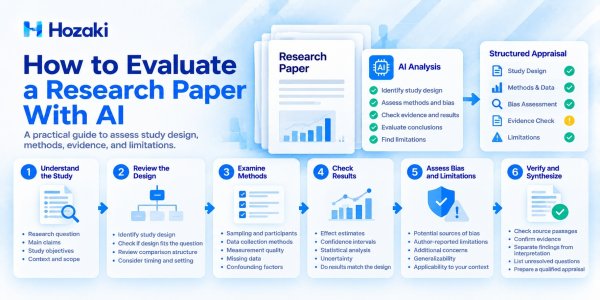
AI can summarize a research paper in seconds. But can it tell you whether the research is trustworthy?
That is a much harder question.
A paper may present convincing conclusions while relying on a small sample, an unsuitable research design, incomplete reporting, or statistical results that do not fully support its claims. An AI-generated summary may repeat those conclusions without identifying the underlying problems.
To evaluate a research paper with AI, you need a process that goes beyond asking whether the study is “good” or “bad.”
You need to examine how the research question was framed, whether the methods were appropriate, how the evidence was collected and analyzed, and whether the conclusions reflect the actual findings.
AI can help organize this work, generate review questions, and locate relevant passages. However, its judgments still require verification, and formal critical appraisal should follow criteria appropriate to the study design.
This guide provides a practical, step-by-step workflow for AI-assisted research paper evaluation, including reusable prompts, an illustrative example, and a critical appraisal checklist.
What Does It Mean to Evaluate a Research Paper?
Evaluating a research paper means examining the quality, relevance, and limitations of its evidence and methods.
It is different from summarizing a paper.
A summary describes what the authors reported.
A critical appraisal asks whether the study's design and evidence justify those claims.
Research Paper Summary vs. Critical Appraisal
| Task | Main Question | Typical Output |
|---|---|---|
| Summarization | What does the paper say? | Summary of aims, methods, and findings |
| Citation verification | Does a cited source exist and support a claim? | Verified or disputed citation |
| Paper comparison | How do two or more studies differ? | Comparison matrix |
| Critical appraisal | How credible and applicable are the methods and findings? | Structured assessment of strengths, limitations, and potential bias |
For example, a study might report that a training program improved employee performance.
A summary would describe the reported improvement.
A critical appraisal would investigate whether the study had an appropriate comparison group, how performance was measured, whether important confounding factors were considered, and whether the reported difference was meaningful.
Three Questions Every Appraisal Should Answer
A useful research paper evaluation should address:
-
Validity: Could the methods or biases have distorted the results?
-
Results: What did the study actually find, and how uncertain are those findings?
-
Applicability: Do the findings apply to the population, setting, or decision you care about?
These questions are related but distinct.
A carefully conducted study can still have limited applicability to a different population.
Likewise, a statistically significant result does not automatically establish a meaningful practical benefit.
Can AI Reliably Evaluate Research Quality?
AI can assist with critical appraisal, but it should not be treated as an independent authority on research quality.
What AI Can Help With
AI can help you:
-
Identify the stated research question.
-
Extract study design and participant information.
-
Locate descriptions of methods and outcomes.
-
Organize potential sources of bias.
-
Compare claims with reported results.
-
Create structured appraisal tables.
-
Generate questions for further review.
-
Draft a clearly qualified evaluation.
These tasks are especially useful when a paper is long, technically dense, or unfamiliar.
What AI Cannot Reliably Establish on Its Own
An AI system may fail to detect missing methodological details or misunderstand statistical analyses.
It may also infer procedures that the authors never described.
For example, a model might assume that a clinical trial used appropriate allocation concealment simply because the authors called it randomized.
But randomization and allocation concealment are different methodological issues.
The appropriate response to missing information is not to assume that the procedure was performed correctly.
It is to record the information as unclear and, where necessary, consult additional materials.
Use AI as an Appraisal Assistant, Not a Final Judge
A defensible workflow separates three things:
Reported information: What the paper explicitly states.
Appraisal judgment: What that information suggests under a relevant appraisal framework.
Verification status: Whether the judgment has been checked against the original source and any necessary supplementary materials.
AI can help with all three stages, but it should not automatically mark its own conclusions as verified.
Before You Start: Identify the Study Design
The study design determines which appraisal questions are appropriate.
A randomized controlled trial, a cross-sectional survey, a qualitative interview study, and a systematic review cannot all be evaluated using identical methodological criteria.
Common Study Designs
| Study Design | Typical Purpose | Important Appraisal Areas |
|---|---|---|
| Randomized controlled trial | Evaluate an intervention | Randomization, allocation concealment, missing outcomes, outcome measurement, selective reporting |
| Cohort study | Examine outcomes over time | Participant selection, exposure measurement, confounding, follow-up |
| Case-control study | Compare prior exposures | Case/control selection, exposure assessment, confounding |
| Cross-sectional study | Examine a population at one point | Sampling, measurement, confounding, interpretation of associations |
| Qualitative study | Explore experiences or meanings | Methodological fit, sampling rationale, data collection, reflexivity, analysis |
| Systematic review | Synthesize existing research | Search strategy, eligibility criteria, study appraisal, synthesis methods |
These are starting points, not complete appraisal instruments.
Choose an Appropriate Framework
Established resources include:
The appropriate framework depends on the research design and appraisal purpose.
A general-purpose AI checklist can help organize observations, but it should not replace a validated or established domain-specific appraisal process when formal assessment is required.
Prompt: Identify the Study Design
Examine the methods section of this research paper.
Identify:
The stated study design.
The research question.
The study population.
The intervention or exposure, if applicable.
The comparison group, if applicable.
The primary outcomes.
Any uncertainty about the design.
Quote or reference the passages supporting your classification.
Do not infer methodological procedures that the paper does not report.
Recommend the type of critical appraisal framework that may be appropriate, but do not perform a formal risk-of-bias assessment yet.
Verify the identified design before proceeding.
Step 1: Identify the Research Question and Main Claims
Begin by determining what the study actually intended to investigate.
Extract the Research Question
A clearly defined research question often specifies:
-
Population or participants.
-
Intervention, exposure, or phenomenon.
-
Comparison, where relevant.
-
Outcomes or research objectives.
-
Setting and time frame.
For quantitative intervention studies, a PICO-style structure can be helpful.
For other designs, a different framework may be more appropriate.
Do not force every paper into a PICO template.
Separate Objectives From Conclusions
The study objective is what the authors set out to investigate.
The conclusion is what they believe the results demonstrate.
Those statements may differ in scope.
For example:
Objective: Determine whether a six-week training program improves performance scores among employees in one organization.
Conclusion: Training programs improve workplace productivity.
The conclusion is broader than the objective.
That does not automatically make it false, but it raises questions about generalizability and the outcome actually measured.
Prompt: Extract the Main Claims
Identify the paper's research question, objectives, hypotheses, primary outcomes, and main conclusions.
Create a table showing:
Claim ID.
Claim wording.
Where the claim appears.
Whether it is a research objective, reported result, or interpretation.
Whether the claim appears broader than the study's design or population.
Preserve important qualifiers.
Do not judge the study's overall quality at this stage.
Step 2: Evaluate the Research Design
Next, assess whether the chosen design is suitable for the research question.
Does the Design Support the Type of Claim?
Different study designs support different forms of inference.
A cross-sectional study may identify associations but generally cannot establish temporal order between exposure and outcome.
A randomized trial may provide stronger evidence about the effects of an intervention when appropriately designed and conducted, but its validity still depends on execution, measurement, missing data, and other factors.
Check the Comparison Structure
Ask:
-
Was a comparison group needed?
-
Was one included?
-
Were groups comparable?
-
Were differences addressed appropriately?
-
Were relevant baseline characteristics reported?
For nonrandomized studies, examine how potential confounding factors were identified and handled.
Check Timing
A study may measure outcomes immediately after an intervention without examining whether the effect persists.
If the conclusion implies a long-term benefit, short follow-up may limit that inference.
Prompt: Review the Design
Evaluate whether the reported study design is appropriate for the stated research question.
Identify:
What the design can reasonably establish.
What it cannot establish without additional evidence.
Important comparison or timing issues.
Potential threats to validity.
Support each observation with information from the paper.
Distinguish confirmed methodological limitations from questions caused by incomplete reporting.
Step 3: Examine Sampling and Data Collection
Even a suitable study design can produce misleading results if participant selection or measurement is problematic.
Review the Sample
Check:
-
Inclusion and exclusion criteria.
-
Recruitment method.
-
Sample size.
-
Participant characteristics.
-
Response or participation rate, where applicable.
-
Missing data.
-
Differences between participants and nonparticipants.
A large sample does not automatically eliminate selection bias.
A small sample does not automatically make a study invalid, either.
The significance of sample size depends on the research question, design, expected effects, variability, and analytical approach.
Review Measurement Quality
Ask whether the outcomes and exposures were measured appropriately.
Potential issues include:
-
Self-reported outcomes.
-
Unvalidated measurement instruments.
-
Inconsistent measurement procedures.
-
Lack of blinding where relevant.
-
Changes in outcome definitions.
-
Measurement error.
Look for Missing Information
If the paper does not explain how participants were recruited, record that limitation.
Do not assume the authors used random sampling or representative recruitment.
Prompt: Sampling and Measurement Review
Examine the paper's sampling and data collection methods.
Create a table containing:
Methodological feature.
What the paper reports.
Potential concern.
Why the concern matters.
Source location.
Verification status.
Do not classify missing information as confirmed methodological failure.
Use "Not Reported" or "Unclear" where appropriate.
Step 4: Check Statistical Analysis and Results
Statistical evaluation requires care because AI may produce convincing explanations of methods it has not interpreted correctly.
Identify the Main Results
Extract:
-
Primary and secondary outcomes.
-
Effect estimates.
-
Confidence intervals or other uncertainty measures.
-
Reported p-values, where applicable.
-
Sample sizes used in each analysis.
-
Missing-data handling.
-
Adjustment variables.
-
Relevant sensitivity analyses.
Do not interpret statistical significance as the same thing as practical importance.
Check Effect Size and Uncertainty
Suppose a paper reports a statistically significant improvement.
You still need to know:
-
How large was the improvement?
-
What outcome scale was used?
-
How precise was the estimate?
-
Was the difference meaningful in context?
-
Were multiple outcomes tested?
-
Was the analysis prespecified?
A small p-value does not answer all these questions.
Check Whether the Analysis Matches the Design
For example, clustered data may require methods that account for clustering.
Repeated measurements may require methods that account for within-participant dependence.
A study with missing outcomes may require appropriate missing-data handling and sensitivity analysis.
The relevant checks depend on the design.
Avoid Unsupported Statistical Judgments
AI may flag a method as inappropriate without enough information.
It may also incorrectly calculate or interpret statistics.
Use AI to identify questions and organize reported results, but verify calculations and technical judgments with suitable statistical expertise when they matter.
Prompt: Statistical Results Review
Review the paper's statistical analysis and reported results.
Extract:
Primary outcomes.
Effect estimates.
Confidence intervals or uncertainty measures.
Reported p-values.
Analysis sample sizes.
Adjustment variables.
Missing-data methods.
Sensitivity analyses.
Identify potential issues that require verification.
Do not invent missing statistics.
Do not conclude that a statistical method is incorrect without explaining the specific concern and the information needed to evaluate it.
Step 5: Assess Risk of Bias
Risk of bias concerns systematic problems that may distort study results.
It is not the same as whether the authors seem trustworthy or whether the paper is well written.
Different Designs Have Different Bias Concerns
Examples include:
Randomized trials
-
Problems with randomization.
-
Deviations from intended interventions.
-
Missing outcome data.
-
Outcome measurement.
-
Selective reporting.
Observational studies
-
Confounding.
-
Participant selection.
-
Exposure classification.
-
Missing data.
-
Outcome measurement.
-
Selective reporting.
Qualitative research
Qualitative appraisal requires attention to methodological congruity, sampling, data collection, researcher influence, interpretation, and representation of participants' perspectives.
It should not simply reuse quantitative trial bias categories.
Distinguish Risk From Confirmed Error
Suppose a paper does not clearly report allocation concealment.
You may need to classify that information as unclear or insufficiently reported under the relevant framework.
You should not automatically conclude that allocation concealment was absent.
Prompt: Bias Assessment Support
Using the selected study-design-specific appraisal framework, help me identify relevant risk-of-bias questions.
For each applicable domain, report:
The domain or appraisal question.
Evidence from the paper.
Information that is missing.
Potential concern.
What additional information is needed.
Do not assign an overall risk-of-bias rating unless the framework's required criteria have been systematically applied and independently reviewed.
Distinguish lack of reporting from evidence of a methodological problem.
For formal assessments, follow the relevant tool's official guidance and decision rules.
Important: Evidence Verification Is Not the Same as Risk-of-Bias Assessment
Confirming that an AI-generated statement matches a passage in the paper does not establish that the underlying study is methodologically sound.
Source verification checks whether the appraisal accurately represents the reported information. Risk-of-bias assessment examines whether aspects of the study's design, conduct, analysis, or reporting could systematically distort its results.
These are separate tasks.
For formal assessments, use an appropriate study-design-specific framework, follow its official decision rules, and document the evidence supporting each judgment. Where required by the review protocol, involve independent reviewers and resolve disagreements through a defined process.
AI can assist with extracting and organizing information, but it should not independently certify a study as low risk of bias.
Step 6: Compare Conclusions With the Evidence
A paper's discussion section often goes beyond simply restating the results.
That is not inherently problematic, but conclusions should remain consistent with the available evidence.
Watch for Overgeneralization
A study of one population may make claims about a broader population.
A short-term intervention may be described as producing lasting benefits.
An observational association may be discussed in causal language.
Each case requires closer inspection.
Build a Claims-to-Evidence Matrix
| Claim | Supporting Evidence | Potential Concern | Review Status |
|---|---|---|---|
| Intervention improved measured scores | Reported group comparison | Effect size and uncertainty need review | Needs Review |
| Benefits persist long-term | Short follow-up only | Duration not established | Unsupported by available follow-up |
| Findings apply broadly | Single-site sample | Generalizability uncertain | Needs Review |
This table is illustrative and does not describe an actual study.
Prompt: Claims-to-Evidence Check
Compare the paper's main conclusions with its reported results.
For each conclusion, identify:
The claim.
The specific supporting result.
Source location.
Whether the claim is directly supported, partially supported, or unsupported by the reported evidence.
Important qualifications.
Any difference between the study population and the population mentioned in the conclusion.
Do not strengthen the authors' claims.
Do not treat an absence of evidence as proof that the opposite conclusion is true.
This step helps prevent an AI-generated appraisal from merely repeating the paper's discussion.
Step 7: Identify Limitations and Generalizability
A paper may acknowledge some limitations while leaving others unstated.
The appraisal should distinguish these categories.
Author-Reported Limitations
Extract limitations explicitly discussed by the authors.
Examples might include:
-
Limited sample size.
-
Short follow-up.
-
Single-site recruitment.
-
Measurement uncertainty.
-
Missing observations.
-
Potential residual confounding.
Reviewer-Identified Concerns
Additional concerns may emerge from the methods or results.
These should be presented as appraisal questions or evidence-based judgments, not as established facts without support.
Assess Applicability
Ask:
-
Does the study population resemble the population of interest?
-
Is the setting comparable?
-
Are interventions or exposures relevant?
-
Are the outcomes meaningful for the intended decision?
-
Are there contextual factors that limit transferability?
Prompt: Limitations and Applicability
Create two separate lists:
Limitations explicitly acknowledged by the authors.
Additional potential limitations identified during appraisal.
For every item, explain the supporting evidence and possible effect on interpretation.
Then assess applicability to [TARGET POPULATION OR SETTING].
Do not assume that findings generalize beyond the studied population.
Step 8: Verify AI Findings Against the Original Paper
Verification is essential because an AI-generated appraisal may include errors even when its overall structure looks convincing.
Verify Source Locations
For every important appraisal claim:
-
Locate the relevant passage.
-
Check whether the cited page or table exists.
-
Compare the AI's description with the original wording.
-
Review nearby context.
-
Confirm that the interpretation is justified.
Check Tables and Supplementary Materials
Important methodological details may appear in:
-
Supplementary appendices.
-
Trial registrations.
-
Protocols.
-
Statistical analysis plans.
-
Data dictionaries.
-
Additional tables.
-
Reporting checklists.
Where relevant and accessible, these materials may be necessary for a proper appraisal.
Use an Evidence Verification Log
| Appraisal Finding | Source | Verification Status |
|---|---|---|
| Study uses convenience sampling | Methods section | Verified |
| Missing-data approach is unclear | Methods and supplementary material | Needs Review |
| Conclusion exceeds measured outcome | Results and discussion | Needs Review |
All entries are fictional examples.
For detailed source checking, see How to Verify Citations With AI Without Missing Fake or Misleading References.
Download the Research Paper Critical Appraisal Checklist
Evaluating a research paper requires more than summarizing its findings. You need to examine the study design, assess methodological limitations, identify potential bias, and verify whether the conclusions are supported by the reported evidence.
Download the free Hozaki Research Paper Critical Appraisal Checklist, an editable Excel workbook designed to organize AI-assisted research paper evaluation.
The workbook includes seven worksheets covering paper registration, study design identification, methods and bias review, evidence verification, limitations tracking, and reusable AI appraisal prompts.
Use it to document what the paper reports, which appraisal questions remain unresolved, and which findings have been independently checked.
Download the Excel checklist:
This workbook is an organizational aid, not a validated universal research quality scoring instrument. It does not replace study-design-specific critical appraisal guidance or expert review. All prefilled examples are fictional.
Reusable AI Prompts for Research Paper Evaluation
The following prompts work best when used in sequence.
Prompt 1: Extract Study Information
Read the research paper and extract its title, authors, publication year, research question, study design, population, sample size, methods, primary outcomes, and main conclusions.
Include source locations.
Mark information as "Not Reported" when it cannot be found.
Do not infer missing methods.
Prompt 2: Generate Appraisal Questions
Based on the verified study design, generate critical appraisal questions appropriate to that design.
Organize them by methods, sampling, measurement, analysis, bias, and applicability.
Identify established appraisal tools that may be relevant.
Do not assign quality scores.
Prompt 3: Identify Potential Bias
Identify possible sources of bias using the selected appraisal framework.
For each concern, provide supporting evidence, missing information, and the reason it may matter.
Distinguish confirmed issues from unclear reporting.
Prompt 4: Check Statistical Claims
Extract the study's principal effect estimates, uncertainty measures, sample sizes, and statistical conclusions.
Compare the discussion's claims with the reported results.
Flag calculations or interpretations requiring independent statistical review.
Prompt 5: Review Limitations
Separate author-reported limitations from additional potential appraisal concerns.
Explain how each issue may affect interpretation or applicability.
Do not invent limitations without a reason grounded in the paper.
Prompt 6: Prepare a Qualified Appraisal
Produce a structured critical appraisal using only the findings supported by the evidence log.
Include:
Research question and design.
Methodological strengths.
Potential risks of bias.
Important results and uncertainty.
Evidence-to-conclusion alignment.
Limitations and applicability.
Unresolved questions.
Distinguish verified findings from pending judgments.
Do not assign an overall trustworthiness percentage.
Practical Example: Evaluating a Fictional Research Study
Consider a fictional paper titled:
“Effects of a Six-Week Workplace Training Program on Employee Task Performance.”
The study reports that employees participating in a training program achieved higher performance scores than a comparison group.
This example is entirely fictional. The details below are designed to demonstrate the appraisal process and are not results from an actual study.
Study Overview
| Feature | Fictional Study Details |
|---|---|
| Research question | Does the training program improve task performance? |
| Design | Nonrandomized controlled study |
| Sample | 80 employees from one organization |
| Intervention | Six-week training program |
| Comparison | Employees receiving usual training |
| Outcome | Task performance score |
| Follow-up | Immediately after training |
Appraisal Question 1: Is the Design Appropriate?
A nonrandomized comparison may provide useful evidence, but group differences could affect the results.
The reviewer should ask whether the groups differed in experience, job role, baseline performance, or other relevant characteristics.
Appraisal Question 2: How Were Participants Selected?
Suppose employees volunteered for the training.
Participation may then be associated with motivation or other characteristics that influence performance.
This raises a potential selection or confounding concern.
It does not prove that the reported effect is invalid.
Appraisal Question 3: Was Performance Measured Appropriately?
The reviewer should examine:
-
How scores were calculated.
-
Whether assessors knew group assignments.
-
Whether the measure was appropriate.
-
Whether both groups were assessed consistently.
Appraisal Question 4: Does the Evidence Support the Conclusion?
If performance was measured only immediately after training, the study cannot establish whether benefits persist over the long term.
A conclusion about sustained productivity improvement would require additional evidence.
Appraisal Question 5: Can the Results Be Generalized?
The sample comes from one organization.
Applicability to other workplaces may depend on job type, workforce characteristics, training implementation, and other contextual factors.
Example Appraisal Matrix
| Domain | Potential Finding | Status |
|---|---|---|
| Study design | Nonrandomized comparison may be affected by confounding | Requires assessment |
| Sampling | Volunteer recruitment may introduce selection differences | Potential concern |
| Measurement | Assessment procedures need inspection | Unclear |
| Follow-up | Long-term effects not measured | Limitation |
| Applicability | Single-organization setting limits direct generalization | Potential limitation |
This example demonstrates how to develop an evidence-based review without reducing the study to a simplistic score.
Common Mistakes When Using AI to Evaluate Research Papers
1. Asking Whether a Paper Is “Good”
The question is too vague.
A paper can be strong in one domain and limited in another.
Use specific appraisal questions instead.
2. Applying One Checklist to Every Study
Different research designs require different criteria.
Select a framework appropriate to the design.
3. Treating Missing Reporting as Proof of Poor Methods
A procedure may have been performed but inadequately reported.
Record uncertainty rather than inventing a conclusion.
4. Confusing Statistical Significance With Practical Importance
A statistically significant result may have limited practical value.
Examine effect size, uncertainty, and context.
5. Treating AI-Generated Citations as Verified
Source references can be inaccurate or misleading.
Check important claims against the paper.
6. Inventing a Universal Quality Score
An overall percentage may imply precision that the appraisal does not support.
Use transparent domain-level findings instead.
7. Ignoring Supplementary Materials
Important details may appear outside the main paper.
Check relevant protocols, appendices, and supplementary tables when available.
8. Confusing Critical Appraisal With Peer Review
AI-assisted appraisal can support learning, evidence screening, and structured review.
It does not automatically replace expert peer review, methodological assessment, or formal evidence synthesis.
Frequently Asked Questions
Can ChatGPT evaluate a research paper?
ChatGPT can help extract study information, generate appraisal questions, organize evidence, and identify potential concerns.
Its judgments should be checked against the original paper and appropriate methodological guidance.
What is the best AI tool for research paper evaluation?
The best tool depends on the task.
Some tools are useful for document analysis, others for source organization or literature discovery.
No tool should be assumed to provide reliable formal appraisal without verification.
Can AI detect bias in research papers?
AI can help identify potential sources of bias, but formal risk-of-bias assessment requires study-design-specific criteria and careful interpretation.
Can AI determine whether a paper is trustworthy?
AI can support the assessment of methodological strengths and limitations.
A single AI-generated judgment or percentage should not be treated as proof of trustworthiness.
Is a peer-reviewed paper automatically high quality?
No.
Peer review is an important part of scholarly publishing, but it does not guarantee that a study is free from bias, errors, or limitations.
How do I evaluate a paper without advanced statistical knowledge?
Start with the research question, design, population, methods, reported results, and limitations.
Use established appraisal checklists and seek statistical expertise when technical judgments are important.
Should I use JBI, CASP, or Cochrane tools?
Choose based on the study design, review purpose, and applicable guidance.
These resources are not interchangeable in every situation.
Can AI help with systematic reviews?
AI can assist with tasks such as information extraction and appraisal preparation.
Formal systematic review methods may require independent reviewers, predefined protocols, and appropriate risk-of-bias tools.
Can I use AI to compare the quality of multiple papers?
Yes, AI can help organize appraisal findings across studies.
However, comparisons should account for differences in study design, research question, outcomes, and evidence quality.
For a related workflow, see How to Compare Research Papers With AI Without Missing Important Differences.
Final Research Paper Evaluation Checklist
Before relying on an AI-assisted appraisal, confirm that:
-
The research question has been identified.
-
The study design has been verified.
-
An appropriate appraisal framework has been selected.
-
The population and sampling methods have been reviewed.
-
The intervention, exposure, or phenomenon is clearly described.
-
The comparison structure is understood where applicable.
-
Outcome measurements have been examined.
-
Important effect estimates and uncertainty measures have been recorded.
-
Potential confounding and other bias concerns have been considered.
-
Missing information has not been treated as confirmed methodological failure.
-
Conclusions have been compared with reported results.
-
Author-reported limitations are documented.
-
Additional appraisal concerns are supported by evidence.
-
Applicability to the intended context has been considered.
-
Important AI-generated claims have been verified.
-
Supplementary materials have been checked where relevant.
-
Unresolved questions remain visible.
-
No unsupported universal quality score has been assigned.
Conclusion
AI can make research paper evaluation more organized and efficient, but it cannot turn a weak appraisal process into a reliable one.
The most useful approach is to combine AI-assisted information extraction with established critical appraisal principles.
Start by identifying the study design and selecting appropriate evaluation criteria. Examine the research question, sampling, methods, results, potential bias, and limitations. Then compare the authors' conclusions with the evidence and verify important findings against the original paper.
Keep uncertainty visible. Do not allow AI to fill reporting gaps with assumptions or replace methodological judgment with an unsupported score.
A useful appraisal does not simply label a paper as good or bad.
It explains what the study investigated, what its evidence supports, where uncertainty remains, and how confidently its findings can be applied.
For broader research workflows, you can also explore How to Find Academic Papers With AI and How to Create a Literature Review Matrix With AI.
Comments 0