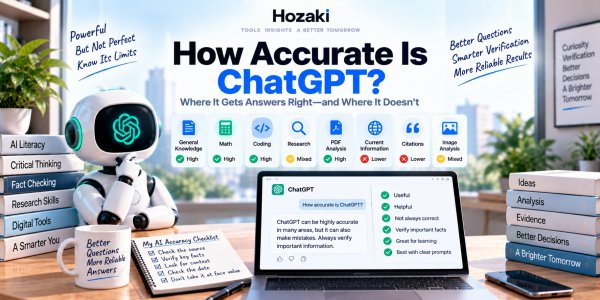
ChatGPT can explain calculus.
Write Python.
Summarize a 100-page document.
Help research a company.
Translate an email.
Analyze an image.
And then confidently give you the wrong date for something you could verify in 20 seconds.
So how accurate is ChatGPT, really?
There's no useful universal percentage.
ChatGPT's accuracy depends heavily on what you're asking, which model and tools are being used, what information is available, how current the question is, and what you mean by "accurate."
It can be extremely useful for one task and surprisingly unreliable for another.
That's why the better question isn't:
Is ChatGPT accurate?
It's:
When should I trust a ChatGPT answer, and when should I verify it?
This guide breaks that down.
Quick Answer: How Accurate Is ChatGPT?
ChatGPT can be highly capable at many language, reasoning, coding, document and research tasks, but it isn't guaranteed to produce factually correct answers.
Accuracy varies depending on:
- The question
- The model
- Available context
- Source quality
- Whether current information is required
- Whether external tools are available
- Prompt clarity
- Task complexity
ChatGPT may:
know the correct information and answer correctly
or:
have incomplete information and express uncertainty
or:
misunderstand the question
or:
reason incorrectly
or:
generate a plausible but unsupported answer
That last behavior is commonly described as an AI hallucination.
The practical rule is simple:
Use ChatGPT for assistance. Verify consequential facts.
Is ChatGPT Always Right?
No.
ChatGPT can make mistakes.
These may include:
- Incorrect facts
- Wrong dates
- Outdated information
- Calculation errors
- Coding errors
- Invented citations
- Incorrect quotes
- Misread documents
- Unsupported conclusions
- Misinterpreted questions
The tricky part is that incorrect answers don't necessarily look incorrect.
A wrong response can be:
- Detailed
- Well written
- Structured
- Confident
- Supported by apparent reasoning
Presentation quality isn't evidence of factual accuracy.
Why Doesn't ChatGPT Have One Accuracy Percentage?
Imagine someone asks:
How accurate is a calculator?
You would immediately ask:
For what calculation?
ChatGPT has the same problem, but on a much larger scale.
Consider these tasks:
Task A
Rewrite this sentence more clearly.
There's no single factual answer to verify.
Task B
What is 12 × 17?
There is.
Task C
What does this research paper conclude?
Accuracy depends partly on whether the paper was interpreted correctly.
Task D
What's the current price of this software?
Now freshness matters.
Task E
Which project-management tool is best?
That's partly evaluative.
Task F
What will this company be worth in five years?
Now we're dealing with uncertainty about the future.
Putting all six into one "ChatGPT accuracy score" would tell you very little.
What Does "Accurate" Mean for ChatGPT?
There are several types of accuracy worth separating.
1. Factual Accuracy
Are names, dates, events and facts correct?
Example:
Who wrote Pride and Prejudice?
This has a verifiable answer.
2. Numerical Accuracy
Are calculations and numerical interpretations correct?
Example:
What is a 17% increase on $84?
3. Citation Accuracy
Do cited sources actually exist and support the claim?
4. Currentness
Is the answer correct now?
Software prices are a good example.
5. Reasoning Accuracy
Does the conclusion logically follow from the available information?
6. Instruction Accuracy
Did ChatGPT actually do what you requested?
7. Document Grounding
When given a source document, does the answer accurately reflect that document?
A response can succeed in one category and fail in another.
How Accurate Is ChatGPT for General Knowledge?
For common, well-established information, ChatGPT can often provide useful answers.
Examples include:
- Basic historical information
- Common scientific concepts
- Definitions
- Established terminology
- Widely documented events
But even familiar topics can contain traps.
Ask for:
- An exact date
- An obscure detail
- A quotation
- A specific statistic
and verification becomes more important.
General Rule
The more specific the factual claim, the easier it is to check—and often the more worthwhile it is to check.
How Accurate Is ChatGPT for Current Information?
This depends heavily on whether the ChatGPT experience you're using has access to current information and whether it actually uses appropriate sources for the question.
Fast-changing information includes:
- News
- Product pricing
- Software features
- AI models
- Company executives
- Financial results
- Regulations
- Sports
- Events
Even when current web information is available, an answer can still be wrong because the system may:
- Select an outdated page
- Misinterpret a source
- Combine information from different dates
- Miss a recent update
For current claims, always pay attention to the date of the evidence.
How Accurate Is ChatGPT for Research?
ChatGPT can be extremely useful for research.
It can help with:
- Research planning
- Search
- Source discovery
- Document analysis
- Comparing evidence
- Organizing findings
- Identifying contradictions
- Synthesis
But using ChatGPT for research isn't the same thing as treating ChatGPT itself as the evidence.
A stronger workflow is:
Question
↓
ChatGPT research assistance
↓
Original sources
↓
Verification
↓
Analysis
↓
Conclusion
Our How to Use AI for Research guide explains this workflow in detail.
How Accurate Are ChatGPT Citations?
This is an area where verification matters a lot.
An AI-generated citation can fail in several ways.
The Source Doesn't Exist
A fabricated reference.
The Source Exists but Doesn't Support the Claim
Probably the most dangerous version.
The Citation Details Are Wrong
Wrong:
- Author
- Date
- Title
- Journal
- URL
The Source Is Outdated
Real source, wrong time period.
The AI Overstates the Evidence
A paper says:
The result suggests...
AI writes:
The study proves...
Those are different.
Never treat a citation as verified simply because it looks academic.
For a complete workflow, see How to Fact-Check AI Answers.
How Accurate Is ChatGPT for Academic Research?
ChatGPT can help students and researchers:
- Understand difficult concepts
- Develop research questions
- Generate search terminology
- Explain methodologies
- Analyze supplied papers
- Compare studies
- Organize literature
- Improve writing
But academic work has several accuracy-sensitive areas:
Citations
Verify every important reference.
Research Findings
Read the original paper.
Statistics
Check population, sample and methodology.
Quotes
Confirm exact wording.
Interpretation
Distinguish the authors' conclusion from the AI's interpretation.
For literature-heavy work, specialized tools may also be useful.
See Best AI Literature Review Tools.
How Accurate Is ChatGPT for Math?
ChatGPT can solve many mathematical problems, especially when the task is clearly stated.
But errors can still occur in:
- Arithmetic
- Multi-step calculations
- Unit conversions
- Probability
- Complex algebra
- Long reasoning chains
One advantage of math is that results are often independently testable.
For important calculations:
- Check the formula.
- Recalculate independently.
- Verify units.
- Test the result for plausibility.
Don't trust a number merely because the explanation around it is long.
How Accurate Is ChatGPT for Coding?
ChatGPT can be highly useful for:
- Writing code
- Explaining code
- Debugging
- Refactoring
- Generating tests
- Learning programming
But generated code can include:
- Syntax errors
- Logic bugs
- Nonexistent functions
- Deprecated APIs
- Security problems
- Incorrect library usage
- Version incompatibilities
Fortunately, code offers something factual prose doesn't:
you can run it.
Better Coding Workflow
Use:
Generate
↓
Inspect
↓
Run
↓
Test
↓
Check documentation
↓
Revise
Executable verification beats asking:
Are you sure this code works?
How Accurate Is ChatGPT When Summarizing PDFs?
Providing the original document can improve grounding considerably.
But document analysis can still fail.
Problems may include:
- Missing text
- Complex tables
- Scanned pages
- Charts
- Footnotes
- Multi-column layouts
- Very long documents
- Ambiguous questions
The AI can also infer information that isn't actually in the document.
A useful prompt is:
Answer only from this document. If the requested information isn't available, say so rather than inferring it.
For the complete process, see How to Summarize a PDF With AI.
How Accurate Is ChatGPT With Statistics?
Treat statistics as verification triggers.
Suppose ChatGPT says:
68% of workers use generative AI weekly.
Before using it, ask:
68% of whom?
Which country?
Which year?
Sample size?
Who conducted the survey?
What counted as "use"?
Was it weekly use?
Is the number actual or forecast?
A percentage without its denominator and context can be misleading even when the number itself appears in a real source.
How Accurate Is ChatGPT With Quotes?
Direct quotations should almost always be checked.
AI may:
- Paraphrase something as a quote
- Attribute it incorrectly
- Combine similar statements
- Invent wording
- Remove context
Search the exact quote and locate the original source.
If you can't verify it, don't present it as an exact quotation.
How Accurate Is ChatGPT for Software Information?
Software is especially difficult because it changes constantly.
AI tools may change:
- Pricing
- Plans
- Limits
- Features
- Models
- Integrations
- Interfaces
- APIs
Suppose ChatGPT says:
Tool X costs $20/month and includes unlimited generations.
That could have been correct six months ago.
It might be wrong today.
For software comparisons, verify volatile facts against current official documentation before making a decision or publishing the information.
How Accurate Is ChatGPT for Product Recommendations?
Product recommendations combine facts with judgment.
For example:
What's the best AI research tool?
There isn't necessarily one objectively correct answer.
It depends on:
- Use case
- Budget
- Required features
- Research type
- Source requirements
- Workflow
Instead of asking only for "the best," define criteria.
For example:
Compare AI research tools for academic literature review, prioritizing citation traceability, paper discovery, evidence extraction and free-plan usefulness.
Now the answer has something concrete to evaluate.
Our Best AI Research Tools guide uses this kind of use-case approach.
How Accurate Is ChatGPT When Analyzing Images?
Image analysis can be useful for:
- Describing objects
- Reading visual structure
- Explaining charts
- Examining diagrams
- Interpreting screenshots
But errors can happen when:
- Text is tiny
- Image quality is poor
- Objects are obscured
- Context is missing
- Precise measurement is required
- Visual details are ambiguous
If the answer depends on a tiny visual detail, zooming, cropping or providing a higher-quality image can help.
How Accurate Is ChatGPT at Reasoning?
This question is different from factual accuracy.
ChatGPT may receive correct facts but draw an incorrect conclusion.
For example:
Fact A: Company revenue increased.
Fact B: The overall market also grew.
Incorrect conclusion:
Therefore the company gained market share.
Not necessarily.
The company may have grown more slowly than the overall market.
Reasoning needs verification too.
A useful question is:
What assumptions are required for this conclusion to be true?
Why Does ChatGPT Give Wrong Answers?
There isn't one cause.
Common reasons include:
- Missing information
- Ambiguous prompts
- False premises
- Outdated information
- Conflicting sources
- Retrieval errors
- Reasoning mistakes
- Misinterpreted documents
- Hallucinations
For the deeper explanation, see Why Does AI Hallucinate?
What Is a ChatGPT Hallucination?
A hallucination is generally an AI-generated statement that appears plausible but is inaccurate, unsupported or fabricated.
For example, ChatGPT might produce:
A 2025 Harvard study involving 12,000 participants found...
The citation sounds credible.
But if the study doesn't exist, that's a hallucination.
Hallucinations can involve:
- Facts
- Studies
- Authors
- URLs
- Quotes
- Product features
- Events
See What Is an AI Hallucination? for examples and a full explanation.
Does ChatGPT Know When It's Wrong?
Not reliably.
Sometimes ChatGPT correctly expresses uncertainty:
I can't verify that.
That's useful.
But confidence isn't a perfect indicator of correctness.
An answer can be:
Confident + correct
Confident + incorrect
Uncertain + correct
Uncertain + incorrect
That's why asking:
Are you sure?
isn't strong verification.
Ask instead:
What evidence supports this claim?
Can You Ask ChatGPT to Check Its Own Answer?
Yes, and it can be useful.
Try:
Identify the five factual claims in your previous answer most likely to require verification.
Then:
Which conclusions depend on assumptions?
Then:
What evidence could contradict your answer?
This is useful for finding weak spots.
But self-review isn't independent verification.
If ChatGPT generated a false claim, asking ChatGPT about the same claim doesn't automatically create new evidence.
Does Using Search Make ChatGPT More Accurate?
Access to current web information can improve answers for many factual and time-sensitive questions.
It helps especially with:
- Current events
- Pricing
- Product information
- Recent research
- Company information
But search introduces a new chain:
Search
↓
Source selection
↓
Source interpretation
↓
Answer generation
Errors can occur at any stage.
So browsing improves grounding without creating a guarantee of correctness.
Does Giving ChatGPT Sources Make It More Accurate?
Often.
Providing:
- Research papers
- Reports
- Documentation
- Datasets
- Articles
gives the model a defined evidence base.
You can strengthen this further:
Answer only from the supplied sources. If the evidence doesn't support an answer, say so.
This reduces the need to fill gaps from general model knowledge.
But you should still check consequential interpretations against the original material.
How to Make ChatGPT More Accurate
There are several practical improvements.
1. Be Specific
Provide the exact question and context.
2. Include a Date
For current information:
As of September 2026...
3. Ask for Primary Sources
Prefer original evidence.
4. Allow Uncertainty
If you can't verify it, say so.
5. Challenge the Premise
Check whether my assumptions are correct first.
6. Separate Facts and Analysis
Don't let inference masquerade as evidence.
7. Break Complex Tasks Apart
Research first.
Write second.
8. Verify High-Risk Claims
Especially numbers, quotes and citations.
For a deeper workflow, see How to Reduce AI Hallucinations.
A Better Accuracy Prompt
Try this:
Answer using reliable and current evidence. Before answering, check whether my question contains any false assumptions. Separate verified facts from interpretation. Provide authoritative sources for important factual claims. If the evidence is insufficient, uncertain or conflicting, say so instead of guessing. Do not invent citations, quotes, statistics or URLs.
It won't guarantee a perfect answer.
But it establishes much better conditions for accuracy.
When Should You Trust ChatGPT Without Checking?
For low-stakes generative tasks, extensive fact-checking may not be necessary.
Examples:
- Brainstorming names
- Rewriting your own text
- Formatting
- Generating ideas
- Creating outlines
- Practicing conversation
- Explaining a concept you already understand
Even here, review the result.
But the verification burden is much lower.
When Should You Always Verify ChatGPT?
Verification becomes more important for:
- Medical information
- Legal information
- Financial information
- Safety-critical instructions
- Academic citations
- Published statistics
- Direct quotes
- Current prices
- Current regulations
- Important business decisions
Think in terms of consequence:
What happens if this is wrong?
The bigger the consequence, the stronger your verification process should be.
ChatGPT Accuracy Checklist
Before relying on an important answer, check:
Is the question clear?
Does the answer contain factual claims?
Are sources provided?
Do those sources exist?
Do they actually support the claims?
Are the sources current enough?
Are important numbers verified?
Are quotes exact?
Is fact separated from interpretation?
Could credible evidence contradict the conclusion?
If several answers are "no," you're not finished researching.
Frequently Asked Questions
Is ChatGPT accurate?
ChatGPT can provide accurate and useful answers across many tasks, but it isn't guaranteed to be correct. Reliability varies by question, model, context, tools and information freshness.
What percentage of ChatGPT answers are correct?
There isn't one meaningful universal percentage because accuracy varies substantially across tasks, benchmarks, models and definitions of correctness.
Can ChatGPT give wrong answers?
Yes. It can make factual, numerical, citation, reasoning, coding and interpretation errors.
Does ChatGPT lie?
A false ChatGPT answer doesn't necessarily imply intent to deceive. Generative AI can produce inaccurate or unsupported output without an intention comparable to human deception.
Does ChatGPT make up information?
It can generate plausible but unsupported or fabricated information, commonly described as hallucination.
Can ChatGPT make up sources?
Yes. AI-generated citations should be independently verified before being relied upon.
Is ChatGPT accurate for research?
It can be a powerful research assistant, but important claims should be checked against original or authoritative sources.
Is ChatGPT accurate for math?
It can solve many mathematical tasks but may make calculation or reasoning errors. Important results should be independently checked.
Is ChatGPT accurate for coding?
It can produce useful code, but generated code should be inspected, executed and tested.
Is ChatGPT accurate with PDFs?
Providing the original document can improve grounding, but extraction and interpretation errors can still occur.
How can I make ChatGPT more accurate?
Use clear prompts, provide context and sources, allow uncertainty, ask for evidence and independently verify consequential claims.
Should I trust ChatGPT?
Trust should depend on the task and evidence rather than the fluency of the response. Low-stakes creative assistance requires less verification than consequential factual claims.
Continue Exploring
What Is an AI Hallucination?
Learn why AI can generate plausible information that isn't actually supported.
Why Does AI Hallucinate?
Understand the major causes behind fabricated or inaccurate AI answers.
How to Reduce AI Hallucinations
Use practical techniques to get more grounded and verifiable AI responses.
How to Fact-Check AI Answers
Learn how to verify statistics, citations, quotes and factual claims produced by AI.
How to Use AI for Research
Build a structured AI-assisted research workflow based on evidence rather than generated answers alone.
Best AI Research Tools
Compare AI tools for web research, academic research, citations and document analysis.
Best AI Literature Review Tools
Explore tools designed for paper discovery, evidence extraction and literature synthesis.
How to Summarize a PDF With AI
Learn a structured workflow for analyzing long reports and research papers.
Best AI Tools in 2026
Explore AI tools for research, writing, coding, documents, images and productivity.
Comments 0