A literature review isn't just a pile of paper summaries.
You need to find relevant research, decide which studies belong in your review, understand their methods, extract evidence, compare findings, follow citations, identify disagreements, and eventually explain what the literature actually tells us.
That can mean working through dozens—or hundreds—of papers.
AI can make parts of this process dramatically faster.
But there's an important catch:
Different AI literature review tools solve completely different parts of the problem.
One may be excellent at finding papers but weak at analyzing your own PDF collection.
Another may help extract study characteristics but isn't designed for citation analysis.
A third may help you understand a difficult paper but shouldn't be used as your only literature-search database.
So instead of looking for one AI that will "do the literature review," it makes more sense to build a workflow.
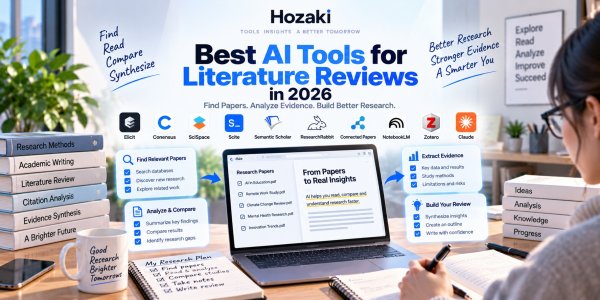
This guide compares 10 useful tools for literature reviews in 2026 and explains where each fits.
Best AI Literature Review Tools at a Glance
| Tool | Particularly Useful For | Main Role |
|---|---|---|
| Elicit | Structured literature reviews | Search, screening & extraction |
| Consensus | Research questions | Evidence discovery |
| SciSpace | Understanding papers | Reading & analysis |
| Scite | Citation context | Evidence checking |
| Semantic Scholar | Finding papers | Academic discovery |
| ResearchRabbit | Exploring related literature | Citation mapping |
| Connected Papers | Discovering related studies | Literature mapping |
| NotebookLM | Your selected papers | Source synthesis |
| Zotero | Managing references | Reference management |
| Claude | Synthesizing selected documents | Analysis & writing support |
These tools shouldn't automatically replace established academic databases such as PubMed, Web of Science, Scopus, Google Scholar, IEEE Xplore, or databases required by your discipline.
Think of AI as another layer in the research workflow.
1. Elicit — Structured Literature Review Workflows
Elicit is one of the most directly relevant AI products for literature reviews.
Rather than behaving like a generic chatbot, it focuses on scientific research workflows.
It can help researchers with tasks around:
- Paper discovery
- Screening
- Structured extraction
- Comparing studies
- Evidence tables
- Systematic reviews
In 2026, Elicit expanded its systematic-review workflow with support for PRISMA 2020, including traceability and auditability across the review process.
That makes it particularly interesting when your project needs more structure than:
Find me some papers about X.
Where Elicit Fits
Imagine you're investigating:
How does remote work affect employee productivity?
Instead of receiving one synthesized AI answer, you may need to build a set of relevant studies and compare characteristics such as:
- Population
- Sample size
- Study design
- Intervention
- Outcome
- Findings
- Limitations
That's much closer to the real work of a literature review.
Don't Treat Extraction as Ground Truth
Even structured AI extraction needs checking.
If Elicit extracts a sample size, methodology, or outcome, verify important information against the original paper before using it in your review.
AI can accelerate extraction.
It doesn't transfer responsibility for accuracy.
2. Consensus — Start With a Research Question
Consensus takes a somewhat different approach.
It's especially useful when your literature search starts as a question:
Does meditation reduce anxiety?
Does remote work increase productivity?
Does creatine affect cognition?
The system searches scholarly research and helps users investigate the evidence around the question.
In September 2026, Consensus described its product as moving beyond a basic academic search engine toward a Research Agent capable of multi-step tasks involving semantic search, paper search, DOI lookup, and citation-graph traversal.
Citation Grounding Matters
Consensus has also introduced Citation Grounding, which maps citations in AI summaries back to supporting text in the underlying paper when available.
That's an important direction for research AI.
The question shouldn't only be:
What did the AI say?
It should be:
Where did this claim come from?
Where Consensus Fits
It can be particularly useful near the beginning of a literature review when you're:
- Exploring a research question
- Testing terminology
- Identifying relevant papers
- Investigating whether evidence exists
- Looking for different directions in the literature
Then move from the AI synthesis into the actual papers.
3. SciSpace — Understand Difficult Research Papers
Sometimes finding the paper is easy.
Understanding it is the problem.
Research papers may contain:
- Dense methodology
- Statistical terminology
- Equations
- Specialized vocabulary
- Complicated figures
- Long literature reviews
SciSpace focuses strongly on paper reading and academic research workflows.
This makes it useful after you've already identified relevant literature.
Ask Better Questions
Don't stop at:
Summarize this paper.
Try:
Explain exactly how participants were selected.
Then:
What potential selection bias does that create?
Then:
Which conclusion depends most heavily on this methodology?
Now AI is helping you interrogate the study.
Where SciSpace Fits
Use it when the bottleneck is:
I found the paper, but I need to understand it faster.
For broader document workflows, see our Best AI PDF Tools guide.
4. Scite — Check How Papers Are Cited
Citation count alone tells an incomplete story.
Imagine Paper A has 500 citations.
That sounds impressive.
But later researchers may cite it because they:
- Support its conclusion
- Challenge it
- Extend it
- Criticize its methodology
- Mention it as background
Those are very different relationships.
Scite is designed around citation context.
This can help you investigate how later research interacts with a paper or claim.
Why This Matters for Literature Reviews
A literature review should not simply say:
Smith et al. is highly cited.
You want to understand how the paper influenced the field and whether later evidence strengthened or challenged its conclusions.
Scite can become useful during that evaluation stage.
Use Citation Analysis as Evidence, Not a Verdict
Citation context can help you discover important relationships.
You should still read the relevant papers yourself before making strong conclusions about the state of the evidence.
5. Semantic Scholar — Find Relevant Academic Papers
Semantic Scholar is valuable because literature reviews still require good old-fashioned paper discovery.
AI interfaces don't eliminate academic search.
You need to locate:
- Relevant papers
- Authors
- Related research
- Citation relationships
- Newer work
- Foundational studies
Semantic Scholar provides a broad academic search environment that can help during this discovery stage.
Improve Searches Iteratively
Your first search might be:
AI education
That's extremely broad.
After reading a few papers, your terminology improves.
You might move to:
generative AI tutoring higher education learning outcomes
Then:
generative AI tutoring randomized controlled trial undergraduate students
This is how literature search normally develops.
The research question and search vocabulary improve together.
6. ResearchRabbit — Explore Literature Visually
ResearchRabbit approaches discovery differently.
Rather than only returning a linear list of results, literature-mapping tools can help researchers explore relationships between papers.
This is useful when you've found one strong paper and want to know:
- What did it cite?
- Who cited it?
- What papers are related?
- Which authors work in this area?
- How has the topic developed?
Think of this as exploring a research neighborhood rather than repeatedly typing isolated keywords.
Seed Paper Workflow
Start with one or several papers you already know are relevant.
Then use citation-network exploration to discover adjacent literature.
This can uncover papers that don't use exactly the terminology you originally searched.
That's important because keyword searches can miss conceptually related research.
7. Connected Papers — Discover the Research Neighborhood
Connected Papers is another useful literature-mapping approach.
Give it a relevant paper and explore related work around it.
This can be helpful when you're new to a research field.
Instead of staring at hundreds of search results, you can begin to understand:
- Important papers
- Related clusters
- Earlier research
- Later developments
Mapping Isn't Screening
Finding a related paper doesn't mean it belongs in your literature review.
You still need inclusion and exclusion criteria.
Literature maps are discovery tools.
They are not substitutes for a documented screening process.
8. NotebookLM — Work With the Papers You've Selected
At some point, the problem changes.
You've found the papers.
Now you have 25 PDFs sitting in a folder.
NotebookLM becomes interesting here because you can work from a controlled collection of sources.
You might ask:
Which papers in this collection report a statistically significant improvement in outcome X?
Or:
Compare how these papers define student engagement.
Or:
Which methodological limitations appear repeatedly across these studies?
This is different from open-web AI research.
You're asking questions about a source collection you selected.
Where NotebookLM Fits
Use it during:
- Reading
- Note taking
- Cross-source comparison
- Study
- Synthesis
It can be especially useful when you want AI grounded in a defined body of material.
Our How to Summarize a PDF With AI guide explains similar source-based document workflows.
9. Zotero — Keep Your References Under Control
Zotero isn't primarily an AI literature-review generator.
It belongs here because literature reviews can become a complete mess without reference management.
By paper number 40, manually managing:
- Authors
- Titles
- Journals
- DOIs
- PDFs
- Notes
- Citations
- Bibliographies
becomes increasingly painful.
A reference manager provides a source of truth for your research library.
Why AI Doesn't Replace Reference Management
An AI assistant may tell you:
Here's the citation.
But generated citations can contain errors.
A safer workflow is:
Discover paper → verify paper → save verified metadata → cite from reference manager
rather than:
Ask AI to invent formatted references at the end.
Citation formatting is easy.
Citation accuracy is the part that matters.
10. Claude — Synthesize the Literature You've Verified
Claude can become useful later in the workflow.
Suppose you've already:
- Found the papers
- Screened them
- Verified them
- Extracted important evidence
- Organized your notes
Now you need to understand patterns across a large amount of text.
A long-context general AI assistant can help with synthesis.
For example:
Based only on these notes and papers, identify the four major areas of disagreement in the literature. For each disagreement, list which sources support each position.
Then:
Which disagreement appears to result primarily from different study populations?
That's a useful synthesis task.
Don't Ask AI to Invent the Literature Review
There's a big difference between:
Write a literature review about AI in education.
and:
Based only on these 28 verified sources and my extraction table, help me organize the evidence into themes.
The second keeps the research grounded in material you actually selected.
See our ChatGPT vs Claude and Claude vs Gemini comparisons if you're evaluating general AI assistants for research work.
Literature Review Tools Solve Different Stages
One reason "best literature review AI" is a tricky question is that literature reviews contain several distinct jobs.
Discovery
Find relevant papers.
Useful tools include:
- Academic databases
- Semantic Scholar
- Elicit
- Consensus
Expansion
Discover related papers and citation networks.
Useful approaches include:
- ResearchRabbit
- Connected Papers
- Citation searching
Screening
Decide which papers meet your criteria.
Structured literature-review tools can assist here.
Reading
Understand the papers.
Tools such as SciSpace and document AI can help.
Extraction
Record:
- Sample
- Methodology
- Variables
- Results
- Limitations
Citation Checking
Investigate how important papers and claims are treated in later literature.
Synthesis
Identify:
- Patterns
- Themes
- Agreements
- Contradictions
- Research gaps
Writing
Turn your verified evidence into a coherent review.
No single tool needs to dominate every stage.
Best AI Tool for Systematic Reviews
Systematic reviews require a higher level of methodological discipline than an ordinary narrative literature review.
The workflow may involve:
- Predefined research question
- Search strategy
- Multiple databases
- Inclusion criteria
- Exclusion criteria
- Deduplication
- Screening
- Data extraction
- Quality assessment
- Documented study selection
Elicit is particularly relevant because its systematic-review workflow now supports PRISMA 2020 processes.
But using software that supports systematic reviews doesn't automatically make your review systematic.
You still need an appropriate methodology.
Best AI Tool for Finding Research Papers
Don't rely on one discovery system.
Different databases index different material.
A useful discovery stack might include:
Discipline database
plus:
Semantic Scholar
plus:
AI research tool
plus:
Citation-network exploration
For medical research, for example, PubMed may remain essential.
For computer science, other databases and conference indexes may matter.
AI should expand your search process, not silently narrow it.
Best AI Tool for Reading Research Papers
If you already have a PDF, the problem is no longer search.
It's comprehension.
SciSpace, NotebookLM, Claude, and other document-capable AI tools can help with questions such as:
Explain the methodology.
What does Table 3 show?
What are the limitations?
How does this paper differ from Paper B?
For more document-oriented options, see Best AI PDF Tools.
Best AI Tool for Comparing Research Papers
Comparing studies is where structured extraction becomes useful.
Instead of generating ten independent summaries, build a matrix.
For example:
| Study | Population | Method | Sample | Outcome | Main Finding | Limitation |
|---|
Then compare rows.
This makes differences visible.
AI tools can help extract the information, but important cells should be verified against the source papers.
Best AI Tool for Citation Checking
Scite is particularly relevant when you want to investigate citation context.
But citation checking also requires basic verification.
For every important source:
- Confirm the paper exists.
- Check authors.
- Check title.
- Check year.
- Check DOI where applicable.
- Open the paper.
- Verify that it supports your claim.
Never assume a citation is correct because it looks academically formatted.
Best AI Tool for Research Synthesis
Once you have a curated and verified evidence set, general AI becomes much more useful.
Instead of allowing AI to choose the evidence, give it the evidence.
For example:
These are my verified extraction notes from 34 studies. Identify recurring findings, contradictions, methodological differences, and gaps. Cite only the source IDs I've provided.
This reduces one of the biggest risks of generative research:
inventing plausible-looking sources.
Can ChatGPT Do a Literature Review?
ChatGPT can assist with parts of a literature review.
It can help:
- Refine a question
- Develop search terms
- Explain papers
- Analyze supplied documents
- Compare evidence
- Organize notes
- Build an outline
- Improve writing
But don't use:
Write me a literature review and include 20 citations.
as your entire research method.
The problem isn't whether ChatGPT can generate the text.
The problem is whether you can defend where the evidence came from.
Our Best AI Research Tools guide covers broader research workflows beyond academic literature reviews.
Can AI Find Research Gaps?
AI can help identify possible gaps.
For example:
Across these papers, which populations appear underrepresented?
Or:
Which questions are repeatedly mentioned as future research?
Or:
Which combinations of variables have rarely been studied?
That's useful.
But "AI found a research gap" isn't enough.
A genuine research gap needs to be supported by a sufficiently comprehensive review of the relevant literature.
Treat AI-generated gaps as hypotheses to investigate.
Can AI Write a Systematic Review?
AI can assist many steps.
That doesn't mean you should press a button and publish the output.
A systematic review needs transparent, reproducible methods.
AI assistance should be documented where required, and researchers remain responsible for:
- Search completeness
- Screening
- Extraction accuracy
- Quality assessment
- Interpretation
- Citations
Automation can reduce workload.
It doesn't eliminate methodological responsibility.
A Practical AI Literature Review Workflow
Here's a workflow that combines the strengths of different tool types.
Step 1 — Define the Research Question
Make it specific enough to search.
Step 2 — Develop Search Terms
Identify:
- Synonyms
- Technical terminology
- Related concepts
- Exclusion terms
Step 3 — Search Academic Databases
Use the databases appropriate to your field.
Step 4 — Use AI Discovery
Use tools such as Elicit or Consensus to discover additional candidates.
Step 5 — Expand Through Citation Networks
Use citation searching and literature maps.
Step 6 — Save Everything
Store verified papers in a reference manager.
Step 7 — Screen
Apply your inclusion and exclusion criteria.
Step 8 — Read
Use paper-reading AI where helpful.
Step 9 — Extract
Build a structured evidence table.
Step 10 — Verify
Check AI-extracted information against the original papers.
Step 11 — Compare
Look for:
- Agreement
- Contradiction
- Methodological differences
- Evidence quality
- Gaps
Step 12 — Write
Write from the verified evidence set.
That's much more defensible than asking a chatbot for "a literature review."
How to Avoid Fake AI Citations
This deserves its own section because it can destroy an otherwise good research project.
Never assume a citation exists.
Check:
Title
Search the exact title.
Authors
Do they match?
Journal
Is it real?
Year
Correct publication date?
DOI
Does it resolve to the claimed paper?
Claim
Does the paper actually support what you're saying?
A fake citation with perfect APA formatting is still fake.
Common AI Literature Review Mistakes
Using Only AI Search
Important papers may be missing.
Trusting Every Summary
Read the relevant parts of the original paper.
Ignoring Methodology
Two studies can reach different conclusions because they studied different populations.
Treating Citation Count as Quality
Highly cited doesn't automatically mean correct.
Asking AI to Generate References
Verify every reference independently.
Skipping Search Documentation
You may later be unable to reproduce your own process.
Confusing Summary With Synthesis
Twenty paper summaries are not automatically a literature review.
A review needs connections between the studies.
Frequently Asked Questions
What is the best AI tool for literature reviews?
Different tools fit different stages. Elicit focuses on structured literature-review workflows, Consensus on scholarly questions and evidence discovery, SciSpace on paper understanding, Scite on citation context, and literature-mapping tools on discovery.
Can AI do a literature review?
AI can assist discovery, screening, reading, extraction, synthesis, and writing, but researchers still need to verify evidence and follow appropriate research methodology.
What AI can find academic papers?
Tools such as Elicit, Consensus, Semantic Scholar, SciSpace, and other academic search systems can help discover scholarly literature.
Is Elicit useful for systematic reviews?
Elicit provides a systematic-review workflow and announced PRISMA 2020 support in May 2026. Researchers still need to ensure their methodology meets the requirements of their discipline and project.
Is Consensus useful for literature reviews?
Consensus can help explore research questions and discover scholarly evidence. Its 2026 Research Agent also supports multi-step research operations such as paper search and citation-graph traversal.
Can ChatGPT write a literature review?
It can assist with organization, synthesis, supplied documents, and writing, but automatically generating a review with unverified references is risky.
How do I know if an AI citation is real?
Search for the original paper, verify its bibliographic information, open it, and confirm that it actually supports the claim.
Can AI identify research gaps?
AI can suggest potential gaps across a body of literature, but those suggestions need to be verified through sufficiently comprehensive research.
Continue Exploring
Best AI Research Tools
Compare AI tools for web research, academic research, papers, citations, source analysis, and deep research.
Best AI PDF Tools
Find AI tools for reading, summarizing, comparing, and asking questions about PDFs.
How to Summarize a PDF With AI
Learn a structured workflow for summarizing research papers and long documents without losing important information.
Best AI Tools for Students
Explore AI tools for research, studying, writing, notes, PDFs, math, and presentations.
Best AI Writing Tools
Compare AI tools for drafting, editing, academic writing, reports, blogs, and professional content.
ChatGPT vs Claude
Compare ChatGPT and Claude for research, documents, writing, coding, and other workflows.
Best AI Tools in 2026
Explore the wider AI software landscape across research, writing, coding, PDFs, images, and productivity.
Comments 0