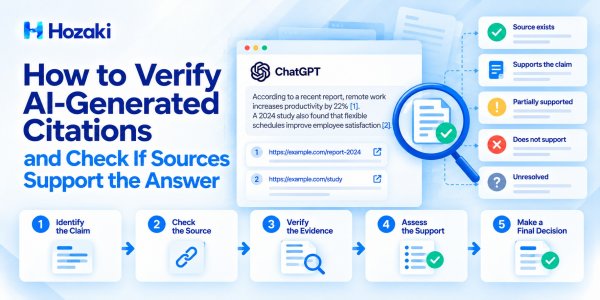
AI-generated answers often look more trustworthy when they include citations. A response may contain numbered references, links to official websites, research papers, news articles, or reports.
But a citation is not proof that the answer is correct.
An AI system may cite a page that does not exist, link to a real source that discusses a different topic, misinterpret what a report says, or present outdated information as current.
If you want to know how to verify AI citations, you need to check more than whether a link opens. You need to determine whether the source is authentic, relevant, current, and capable of supporting the specific claim attached to it.
This guide provides a practical verification workflow for AI-generated answers, including ChatGPT Search results, research summaries, and source-backed explanations.
Quick Answer: How to Verify AI Citations
Use this six-step process:
-
Identify the claim. Write down exactly what the AI answer is asserting.
-
Find the cited source. Open the original webpage, report, or document.
-
Confirm the source exists. Check its title, publisher, URL, and identity.
-
Locate the supporting evidence. Find the passage, table, or data that addresses the claim.
-
Check the match. Decide whether the evidence fully supports, partially supports, contradicts, or fails to address the statement.
-
Verify important claims independently. Compare the information with another reliable source when the stakes justify it.
If the cited material cannot be accessed or evaluated, mark the claim as unresolved, not verified.
The central rule is simple:
A citation is useful only when the underlying source supports the specific statement being made.
What Counts as an AI Citation?
An AI citation is a reference presented alongside an AI-generated statement to indicate where information may have come from.
Depending on the tool, citations may appear as:
-
Clickable links to webpages.
-
Numbered source markers.
-
Article titles and publisher names.
-
Research paper references.
-
Reports or official documents.
-
Quoted passages attributed to a source.
-
File references in document-analysis tools.
These formats are not interchangeable.
A clickable web citation may identify a retrieved webpage. A reference in a PDF analysis may point to an uploaded document. A generated bibliography may contain text that looks like a conventional academic reference.
Each requires a slightly different verification method.
Citation Presence vs. Citation Reliability
Consider these two statements:
Statement A: "According to a government report, the policy changed in 2025."
Statement B: "The policy changed in 2025, and the cited government report explicitly confirms the effective date and scope."
Statement B describes the level of verification you want to achieve.
Simply mentioning a government report does not establish that the report contains the claimed information.
Why AI Citations Need Independent Checking
OpenAI's official guidance acknowledges that ChatGPT can produce incorrect information, including fabricated citations or references.
See: Does ChatGPT tell the truth?
The practical implication is that citation checking should be treated as a separate task from answer generation.
Five Ways AI Citations Can Be Misleading
Not every problematic citation is completely fabricated. Some errors are more subtle.
1. The Source Does Not Exist
An AI answer may provide a plausible-looking title, publication, or URL that cannot be confirmed.
For example, it might attribute a statement to a report whose title does not appear on the publisher's website.
A failed search does not always prove fabrication, but it means the reference has not been verified.
What to do: Search the exact title, publisher, and distinctive phrases. If the source cannot be located, record it as unresolved.
2. The Source Exists but Says Something Else
This is one of the most important problems to catch.
The cited webpage may be real and relevant to the general topic, yet it may not support the particular statement.
For example:
-
AI claim: "The report found that every participant improved."
-
Source: The report says improvement was observed in one subgroup.
The source exists, but the claim overstates the findings.
What to do: Compare the precise wording of the claim with the relevant passage.
3. The Citation Removes Important Context
A sentence may be technically related to the cited source while omitting qualifications.
Common missing details include:
-
Geographic restrictions.
-
Study population.
-
Sample size.
-
Time period.
-
Exceptions.
-
Statistical uncertainty.
-
Whether the finding is observational or causal.
What to do: Read the surrounding paragraphs, methods, notes, and limitations—not only the highlighted sentence.
4. The Source Is Outdated
A source can be authentic and accurately quoted but no longer reflect current conditions.
This is especially important for:
-
Software features.
-
Pricing.
-
Product availability.
-
Regulations.
-
Government guidance.
-
Technical documentation.
-
Current events.
What to do: Check publication dates, update dates, version numbers, and newer authoritative sources.
5. The AI Makes a Stronger Claim Than the Evidence Allows
An AI answer may transform a limited finding into a broad conclusion.
For example:
-
Source: "The intervention was associated with improved outcomes in this sample."
-
AI answer: "The intervention is proven to improve outcomes for everyone."
The problem is not necessarily the source. It is the unsupported inference.
What to do: Identify whether the source provides direct evidence, limited evidence, or only background context.
Step 1: Extract Every Important Claim From the AI Answer
Before opening sources, separate the AI response into individual claims.
This is important because one paragraph may contain several statements supported by different sources.
Consider this illustrative AI-generated answer:
A software company introduced a new search feature in 2025. The feature is available to all users, reduces research time by 50%, and is supported on mobile devices.
That paragraph contains at least four separate claims:
-
A new search feature was introduced.
-
The introduction happened in 2025.
-
The feature is available to all users.
-
It reduces research time by 50%.
-
It is supported on mobile devices.
Each claim may require different evidence.
A product announcement might support the launch date but not the performance claim.
Build a Claim List
Use a table like this:
| Claim ID | Exact AI Claim | Evidence Needed |
|---|---|---|
| C01 | Feature launched in 2025 | Official announcement |
| C02 | Available to all users | Current availability documentation |
| C03 | Reduces research time by 50% | Published study or measurement methodology |
| C04 | Supported on mobile | Official platform documentation |
These are hypothetical claims for demonstrating the method, not verified statements about a real product.
Which Claims Should You Prioritize?
Start with claims that are:
-
Numerical or unusually specific.
-
Time-sensitive.
-
Central to the answer's conclusion.
-
Relevant to an important decision.
-
Presented with strong language such as "always," "proven," or "all users."
-
Supported by a citation you cannot immediately identify.
You do not necessarily need to verify every minor background statement with equal effort.
The verification depth should reflect the importance of the information.
Step 2: Check Whether the Cited Source Actually Exists
Open the citation and identify the original source.
Check:
-
Page or document title.
-
Publisher or organization.
-
Author, where relevant.
-
Publication or update date.
-
URL and domain.
-
Document version, where applicable.
Start With the Original Publisher
If an AI answer attributes a claim to a government agency, look for the document on that agency's official website.
If it cites a company's feature announcement, check the company's official documentation or announcement.
For a news article, confirm that the article appears on the publication's website and matches the cited title.
Search for Missing Sources
If the link is broken or absent, try searching for:
-
The exact title in quotation marks.
-
The publisher and report name.
-
A distinctive phrase from the cited passage.
-
A document identifier or publication date.
Do not invent a replacement citation merely because you found a page on the same topic.
Distinguish Three Outcomes
Confirmed: You found the source and its identity matches the citation.
Unresolved: You cannot confirm the source from the available evidence.
Incorrect: The citation clearly points to a different source or contains demonstrably false identifying information.
A broken link alone is not sufficient to prove that the source was fabricated.
Step 3: Verify That the Source Supports the Specific Claim
This is the most important stage of AI citation verification.
A source can be real, reputable, and relevant while still failing to support the AI-generated statement.
Find the Relevant Passage
Use the source's search function to locate the terms associated with the claim.
For long reports or PDFs, search for:
-
The specific metric.
-
A distinctive phrase.
-
The relevant feature name.
-
A date or policy identifier.
-
The population or geographic region.
If the source contains tables or figures, inspect them directly.
Compare Claim and Evidence
Ask:
-
Does the source explicitly state the same fact?
-
Does it refer to the same product, population, or event?
-
Does it use the same measurement?
-
Does it cover the same time period?
-
Are there qualifications the AI answer omitted?
-
Is the AI presenting an inference as a direct finding?
Use Consistent Verification Labels
| Status | Meaning |
|---|---|
| Fully Supported | Source directly supports the claim with necessary context |
| Partially Supported | Some elements are supported, but the claim needs qualification |
| Contradicted | Source provides evidence inconsistent with the claim |
| Not Supported | Source does not provide evidence for the claim |
| Unresolved | Source or relevant evidence cannot be adequately checked |
Not Supported and Contradicted are not the same.
If a webpage does not mention a statistic, that does not necessarily prove the statistic is false. It means that webpage does not establish the claim.
Step 4: Check Dates, Versions, and Context
AI answers can combine information from different periods without clearly identifying the difference.
This is particularly problematic when researching software, regulations, pricing, or current events.
Check the Source Date
Look for a publication date and, if available, an update date.
But remember:
A recent update date does not guarantee that every statement on the page is current.
A webpage may have been updated for formatting or unrelated information.
Check the Version
For software documentation, determine whether the source describes:
-
The current product.
-
A previous interface.
-
A beta feature.
-
A discontinued feature.
-
A feature available only in selected environments.
Check the Scope
A claim may be accurate for one country, account type, or user group but incorrect when generalized.
For example:
The feature is available to all users.
A source that confirms availability to a specific group does not necessarily support universal availability.
Record Important Limitations
Your verification notes should preserve restrictions and qualifications that affect how the claim should be interpreted.
Step 5: Cross-Check Important Claims With Independent Sources
For important factual claims, a second source can strengthen confidence.
However, two webpages are not necessarily independent.
One article may simply repeat information from another.
Prefer Sources Close to the Original Evidence
Depending on the claim, useful sources include:
-
Official product documentation.
-
Original research publications.
-
Government data.
-
Regulatory documents.
-
Primary reports.
-
Direct statements from responsible organizations.
Secondary reporting can provide context, but trace important claims back to their original evidence whenever possible.
Avoid Circular Verification
Suppose three blogs repeat the same unsupported statistic.
That does not create three independent confirmations.
Try to identify where the number originally came from.
When Cross-Checking Is Especially Important
Apply additional verification to information involving:
-
Health or safety.
-
Financial decisions.
-
Legal or regulatory obligations.
-
Important business commitments.
-
Academic research conclusions.
-
Breaking news or rapidly changing events.
For consequential decisions, AI citation checking is an aid to due diligence, not a substitute for qualified professional review.
Step 6: Record the Final Verification Decision
After checking the claim and source, record the result.
A useful verification record should contain:
| Field | What to Record |
|---|---|
| Claim ID | Unique identifier |
| AI Claim | Exact statement being checked |
| Citation URL | Source provided by the AI |
| Original Source | Confirmed publisher and title |
| Source Status | Confirmed, unresolved, or incorrect |
| Evidence Location | Relevant section, paragraph, table, or page |
| Support Status | Fully Supported, Partially Supported, Contradicted, Not Supported, or Unresolved |
| Important Limitation | Missing context, date, scope, or uncertainty |
| Recommended Action | Keep, revise, remove, or investigate |
| Checked Date | When verification was performed |
Recommended Final Actions
Keep: The claim is accurately supported.
Revise: The source supports a narrower or more qualified statement.
Remove: The claim is contradicted or cannot be responsibly retained.
Investigate: Additional evidence is needed before deciding.
A useful verification workflow produces an actionable editorial decision—not just a collection of links.
Download the AI Citation and Claim Verification Tracker
Checking AI-generated citations becomes much easier when every claim, source, and verification decision is documented in one place.
Download the free Hozaki AI Citation and Claim Verification Tracker, an editable Excel workbook designed to help you:
-
Check whether AI-generated citations refer to identifiable sources.
-
Compare individual claims with the evidence in cited webpages or documents.
-
Record missing context, outdated information, and unsupported statements.
-
Track independent source checks.
-
Decide whether to keep, revise, remove, or investigate each claim.
-
Review verification progress through an automatic summary dashboard.
The workbook includes illustrative examples to demonstrate the workflow. Replace these with your own claims and sources before conducting a real verification.
This is an independent editorial verification tool, not an automated fact-checking service. Verification statuses must be assigned after reviewing the underlying evidence.
Download the Excel tracker:
How to Verify ChatGPT Search Citations
ChatGPT Search can provide source links with its answers, but those links still require evaluation.
If you are unfamiliar with the search interface or encounter a technical problem, see ChatGPT Search Not Working? Causes and Fixes.
For citation verification, use this process.
1. Ask a Specific Question
For example:
Search official sources for the current availability of a software feature. Provide the relevant documentation and identify any account or regional restrictions.
Specific questions make verification easier.
2. Identify the Important Statements
Separate the answer into factual claims.
Do not assume one citation supports an entire paragraph.
3. Open the Linked Sources
Check that each source is accessible and matches the subject of the answer.
4. Locate the Supporting Text
Find the exact evidence.
If a citation points to a general homepage or unrelated article, do not treat it as adequate support.
5. Check Whether the Answer Overstates the Evidence
Look for omitted limitations, incorrect dates, or unsupported generalizations.
6. Ask ChatGPT to Revise the Answer
You can ask:
Rewrite the answer using only the claims that are supported by the cited sources. Identify any statements that remain unverified.
Then independently check the revised answer.
AI self-review can help organize corrections, but it does not replace external verification.
How to Handle Broken, Missing, or Inaccessible Citation Links
A citation link may fail for reasons unrelated to fabrication.
Possible explanations include:
-
The page was moved.
-
The publisher changed its URL structure.
-
The content was removed.
-
Access requires a subscription or login.
-
The website temporarily fails.
-
The link was generated incorrectly.
Try to Recover the Original Source
Search the title, publisher, and identifying details.
Check whether the publisher provides a newer location for the same document.
Where appropriate, an archived copy may help establish what a webpage previously said.
Do Not Treat an Archive as Automatically Current
Archived pages may be useful for historical verification but may not represent the current version of a policy, product feature, or regulation.
What If You Cannot Access the Source?
Record the limitation.
Do not claim to have verified a passage you could not inspect.
A suitable note is:
Source identity appears plausible, but the supporting passage could not be independently reviewed.
This is more accurate than marking the claim as verified.
Practical Example: Verifying an AI-Generated Answer
Consider this hypothetical AI answer:
A productivity application introduced an AI research feature in 2025. According to the company's documentation, the feature is available to every account and reduces research time by 50%.
The AI answer provides one citation to a product announcement.
Step 1: Split the Claims
| Claim | Verification Question |
|---|---|
| Feature introduced in 2025 | Does the announcement confirm the launch date? |
| Available to every account | Does current documentation confirm universal availability? |
| Reduces research time by 50% | Is there a study or measurement supporting the statistic? |
Step 2: Review the Source
Assume, for this illustrative example, that the announcement confirms the feature launch but says availability is limited to selected accounts.
It does not mention a 50% reduction in research time.
Step 3: Assign Statuses
| Claim | Finding | Status |
|---|---|---|
| Introduced in 2025 | Announcement confirms the date | Fully Supported |
| Available to every account | Source specifies limited availability | Contradicted |
| Reduces research time by 50% | Source contains no supporting measurement | Not Supported |
Step 4: Rewrite the Answer
A more defensible version would be:
The company announced the feature in 2025. The cited announcement describes availability for selected accounts. The source does not establish the claimed 50% reduction in research time.
This example is hypothetical and demonstrates the verification method rather than reporting findings about an actual company.
The important lesson is that one valid citation may support only part of an AI-generated answer.
Useful Prompts for AI Citation Verification
AI can assist with the organization of verification work.
However, prompts should require the system to identify uncertainty rather than invent missing evidence.
Prompt 1: Extract Claims and Citations
Break the following AI-generated answer into individually verifiable factual claims. For each claim, list the citation attached to it. Do not infer missing sources. Mark claims without citations as uncited.
Prompt 2: Build a Verification Matrix
Create a table with these columns: Claim, Citation, Source Identity, Evidence Location, Support Status, Missing Context, and Recommended Action. Use "Unresolved" when the evidence cannot be accessed or checked.
Prompt 3: Check Source-to-Claim Alignment
Compare each claim against the supplied source text. Identify the exact supporting passage where available. Distinguish direct support, partial support, contradiction, and absence of support. Do not treat topical similarity as evidence.
Prompt 4: Find Unsupported Numbers
Identify every numerical claim, percentage, date, and universal statement in this answer. Explain what evidence would be required to verify each one. Do not invent supporting studies or statistics.
Prompt 5: Rewrite Only Supported Claims
Rewrite the answer using only information supported by the verified sources. Preserve important qualifications and dates. Remove or clearly label unsupported claims. Do not create replacement citations.
Prompt 6: Prepare a Human Review Checklist
List the remaining verification tasks that require opening original sources, checking tables or figures, confirming publication dates, or obtaining independent evidence.
These prompts can reduce organizational effort, but they cannot guarantee that a source has been genuinely verified.
When You Should Not Trust AI Citations Without Additional Review
Some situations require a higher verification standard.
High-Stakes Decisions
If a citation affects medical treatment, legal obligations, investment decisions, or safety, do not rely on an AI-generated summary alone.
Consult authoritative sources and appropriate qualified professionals.
Claims Based on Inaccessible Sources
If you cannot review the underlying evidence, you cannot confidently establish what it supports.
Exact Statistics Without Methodology
A precise percentage may sound convincing.
Check the population, sample size, measurement method, date, and original publication before using it.
Breaking News
Early reporting can change quickly.
Verify timestamps and compare authoritative updates.
Academic Claims
Research citations often require additional checks of bibliographic details, methodology, and interpretation.
For a dedicated academic workflow, see How to Verify Citations With AI Without Missing Fake or Misleading References.
If you need to locate original studies, see How to Find Academic Papers With AI: A Practical Research Workflow.
Frequently Asked Questions
Can AI generate fake citations?
Yes. AI systems can produce plausible-looking but nonexistent references, as well as real citations that do not support the attached statements. Important references should be checked against original sources.
How do I verify citations from ChatGPT?
Open the cited source, confirm its identity, locate the relevant evidence, compare it with the exact claim, and check dates and qualifications. Record any uncertainty rather than assuming the citation is correct.
Is a working citation link proof that an AI answer is accurate?
No. A working link establishes only that a webpage is accessible. The content must still support the specific statement.
What is the difference between a fake citation and a misleading citation?
A fake citation may refer to a nonexistent or incorrectly identified source. A misleading citation may point to a real source but misrepresent what it says.
Can an AI citation checker verify sources automatically?
Some tools can assist with finding references, checking metadata, or comparing text. Their output still needs evaluation, especially when evidence is inaccessible, ambiguous, or consequential.
What if a citation leads to a paywalled article?
You may be able to verify the source's identity and metadata, but you should not claim to have verified evidence contained in inaccessible full text. Look for a legitimate accessible version or record the limitation.
Should I trust citations from official websites?
Official sources can be authoritative for their own policies, products, and announcements, but you must still check whether the cited page supports the claim and whether the information is current.
Can I use ChatGPT to check its own citations?
You can use it to organize claims, flag potential mismatches, and prepare a verification table. However, self-checking is not independent verification. Open and inspect the original sources.
How many sources are needed to verify an AI claim?
There is no universal number. A primary source may be sufficient for a straightforward factual statement, while contested or high-stakes claims may require multiple independent sources and additional scrutiny.
What should I do if a source does not support the AI claim?
Mark the claim as partially supported, not supported, or contradicted, depending on the evidence. Revise or remove the statement rather than retaining the citation for appearance.
Final AI Citation Verification Checklist
Before relying on an AI-generated answer, confirm that:
-
Important factual claims have been identified individually.
-
Each cited source has been opened or its accessibility limitation recorded.
-
Source titles, publishers, and identifying details have been checked.
-
Relevant supporting passages have been located.
-
The evidence addresses the exact claim, not merely the general topic.
-
Numerical statements and dates have been checked.
-
Important limitations and qualifications have been preserved.
-
Outdated information has been identified.
-
High-impact claims have received appropriate independent verification.
-
Unsupported claims have been revised, removed, or clearly marked.
-
The final answer does not imply a higher level of certainty than the evidence supports.
Conclusion
Learning how to verify AI citations means moving beyond the question of whether a source link exists.
A reliable verification process examines the exact claim, identifies the original source, checks the relevant evidence, and determines whether the citation supports the statement with the necessary context.
Some citations will be accurate. Others will support only part of an answer. Some will be unrelated, inaccessible, outdated, or impossible to confirm.
The goal is not to label every questionable citation as fake. It is to make careful, evidence-based decisions about which claims can be trusted, which need revision, and which remain unresolved.
Use a repeatable claim-to-source verification process whenever an AI-generated answer informs research, publishing, or important decisions.
A credible AI answer is not one that merely contains citations. It is one whose important claims can be independently supported by the evidence those citations identify.
Comments 0