AI can write an essay in seconds.
But that's probably one of the least interesting ways for a student to use it.
The more useful applications happen before the final answer: understanding a difficult concept, finding reliable sources, turning a long reading into useful notes, practicing for an exam, checking a draft, solving a math problem step by step, or organizing weeks of course material.
Used well, AI can function as a tutor, research assistant, editor, study partner, and productivity tool.
Used badly, it can become a shortcut that produces confident answers without helping you understand anything.
So this guide isn't simply a list of tools that can "do homework."
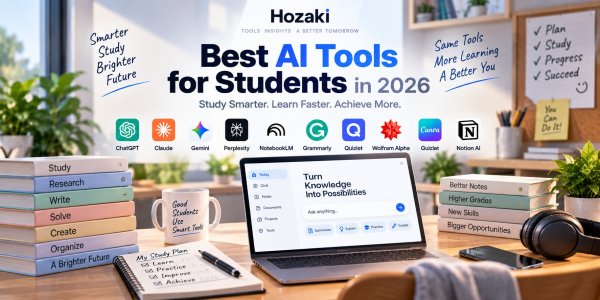
We've selected 10 types of AI tools that solve different student problems, from research and writing to math, notes, presentations, and studying.
Best AI Tools for Students at a Glance
| Tool | Particularly Useful For | Free Access |
|---|---|---|
| ChatGPT | General study and tutoring | Yes |
| Gemini | Google-based student workflows | Yes |
| Claude | Long readings and writing | Yes |
| Perplexity | Research and source discovery | Yes |
| NotebookLM | Studying your own sources | Yes |
| Grammarly | Writing and editing | Yes |
| Quizlet | Flashcards and practice | Yes |
| Wolfram Alpha | Math and technical subjects | Limited/free access |
| Canva | Presentations and visual projects | Yes |
| Notion AI | Notes and study organization | Notion plan dependent |
Free plans and feature limits change frequently, so check the current provider information before choosing a tool primarily because it is free.
1. ChatGPT — Best All-Purpose AI Study Assistant
ChatGPT can cover a surprisingly large part of a student's workflow.
You can use it to:
- Explain difficult concepts
- Create practice questions
- Review notes
- Brainstorm essay ideas
- Analyze files
- Practice languages
- Debug code
- Work through math concepts
- Create study plans
- Review writing
The biggest advantage is flexibility.
A biology student might use ChatGPT to explain cellular respiration in the morning and then use the same assistant to review a lab report later.
A computer science student might ask it to explain recursion, debug Python, and generate practice questions from lecture notes.
Don't Use ChatGPT Only for Answers
Compare these two prompts:
What's the answer to question 7?
and:
Don't give me the answer. Ask me one question at a time until I can solve question 7 myself.
The second prompt turns the AI into a tutor.
Another useful approach is:
I think the answer is B. Challenge my reasoning before telling me whether I'm correct.
This forces you to participate rather than simply consume an answer.
2. Gemini — Best for Students Using Google
Gemini becomes particularly interesting for students whose schoolwork already revolves around Google's ecosystem.
That may include:
- Gmail
- Google Drive
- Docs
- Slides
- YouTube
- Google Search
- Android
Instead of treating AI as another isolated website, Gemini can participate more closely in Google-centered workflows.
This matters because students often spend more time moving information between applications than they realize.
A typical assignment might involve:
Search → sources → Drive → notes → Docs → Slides → email
An AI that sits closer to those applications can reduce some of that friction.
Who Should Try Gemini?
Students whose school or university already relies heavily on Google services.
If you're choosing between Google's ecosystem and OpenAI's, our ChatGPT vs Gemini comparison explores the differences in more detail.
3. Claude — Best for Long Readings and Writing
Claude is particularly worth testing when your coursework involves large amounts of text.
For example:
- Research papers
- Long readings
- Essays
- Reports
- Source documents
- Lecture notes
- Draft revision
Instead of asking Claude to write an essay, use it to help you understand the material first.
Upload or provide your course material and ask:
Identify the author's central argument, the three strongest pieces of evidence, and two assumptions the author doesn't fully defend.
Then ask:
Give me three questions that would test whether I actually understood this reading.
That's far more educational than asking for a summary and never opening the original material.
Claude can also be useful during revision.
For example:
Read my essay and identify where my argument becomes weakest. Don't rewrite it yet.
That preserves the student's role in the writing process.
For a broader comparison of these assistants, see ChatGPT vs Claude and Claude vs Gemini.
4. Perplexity — Best for Starting Research
One of the hardest parts of academic work is figuring out where to start.
Perplexity can be useful for research discovery because its experience emphasizes finding information and exposing sources.
Students can use it to:
- Explore a topic
- Find terminology
- Discover sources
- Identify competing arguments
- Understand an unfamiliar field
- Build an initial reading list
But there's an important distinction:
AI research is not the same as academic research.
A citation displayed by an AI system isn't automatically:
- Peer reviewed
- Reliable
- Relevant
- Correctly interpreted
- Appropriate for your assignment
Use AI to discover material.
Then open the original source.
A Better Research Prompt
Instead of:
Write my research paper about renewable energy.
try:
Help me map the major academic debates around grid-scale battery storage. Give me search terms and primary or scholarly sources I should investigate.
Now AI is helping you research rather than replacing the research.
5. NotebookLM — Best for Studying Your Own Sources
NotebookLM solves a different problem from a general chatbot.
Instead of starting primarily from an open-ended conversation, you give it sources you want to work with.
That can make it useful for:
- Lecture notes
- PDFs
- Reading packets
- Study materials
- Research collections
- Course documents
The key idea is simple:
Study from the material you're actually supposed to learn.
That is especially useful before exams.
Imagine adding your lecture notes, assigned readings, and course materials, then asking:
Create 20 questions covering the concepts most likely to reveal whether I understand this material.
Or:
Compare how these three readings define the same concept.
Or:
Which ideas appear repeatedly across my course materials?
This can turn a pile of files into a more interactive study environment.
6. Grammarly — Best for Editing Student Writing
Grammarly is most useful after you've already written something.
That might be:
- An essay
- Report
- Application
- Research paper
- Personal statement
- Discussion post
Its traditional strength is helping improve:
- Grammar
- Clarity
- Sentence structure
- Spelling
- Tone
- Readability
That makes it different from using a general AI assistant to generate an entire assignment.
Use Editing AI Carefully
Don't automatically accept every suggestion.
Sometimes a grammatically cleaner sentence is less precise.
Academic writing also uses terminology that a general editing system may misunderstand.
Treat suggestions as suggestions.
Ask:
Does this change preserve exactly what I mean?
If not, keep your version.
Our Best AI Writing Tools guide compares Grammarly with broader writing assistants such as ChatGPT, Claude, Gemini, and other specialized products.
7. Quizlet — Best for Flashcards and Practice
Students have used Quizlet for years, but AI makes study sets increasingly interactive.
The core use case remains extremely useful:
retrieval practice.
Reading notes repeatedly can create the feeling that you know something.
Being forced to recall it is different.
Useful workflows include:
- Flashcards
- Practice questions
- Vocabulary
- Definitions
- Exam preparation
- Repeated review
Instead of simply asking AI to summarize a chapter, turn the chapter into questions.
For example:
Create 25 questions from these notes. Don't show the answers until I respond.
That transforms passive reading into active recall.
8. Wolfram Alpha — Best for Math and Technical Subjects
General-purpose AI assistants are increasingly capable at mathematics, but specialized computational tools still deserve attention.
Wolfram Alpha is particularly relevant for subjects involving:
- Mathematics
- Algebra
- Calculus
- Statistics
- Physics
- Chemistry
- Engineering
The most useful student workflow isn't:
Give me the answer.
It's:
Help me understand the steps.
When using any AI or computational system for technical subjects, check the method rather than trusting a polished final number.
A wrong answer with convincing notation is still wrong.
Use AI as a Second Explanation
If your textbook explanation doesn't make sense, ask:
Explain this derivative geometrically rather than algebraically.
Then:
Now show how that interpretation connects to the formula.
Different explanations can help a concept click.
9. Canva — Best for Presentations and Visual Assignments
Not every assignment ends with an essay.
Students also create:
- Presentations
- Posters
- Infographics
- Visual reports
- Social projects
- Videos
Canva's AI features can help students move from ideas to visual materials faster.
That might include:
- Layout
- Images
- Presentation structure
- Design suggestions
- Visual assets
- Draft slides
But AI-generated design still needs human editing.
A presentation with beautiful graphics and 80 words on every slide is still a bad presentation.
Use AI to accelerate the first draft of the visual structure, then simplify.
10. Notion AI — Best for Organizing Study Material
Students often have information scattered everywhere:
- Lecture notes
- Tasks
- Reading lists
- Deadlines
- Research
- Project notes
- Exam plans
Notion can act as the organizational layer.
AI becomes more useful when it works close to that existing information.
Possible workflows include:
- Summarizing notes
- Creating study plans
- Organizing information
- Finding material
- Drafting from notes
- Turning meetings or lectures into actions
This makes Notion AI most relevant to students who already use Notion.
If you don't use the platform, adopting an entire workspace just for one AI feature may create more friction than it removes.
Best AI Tool for Studying
The best study tool isn't necessarily the one with the most powerful model.
Studying requires retrieval, not just information consumption.
A useful AI study loop looks like this:
Learn → Recall → Check → Explain → Repeat
For example:
- Read a section of your textbook.
- Close it.
- Ask AI to quiz you.
- Answer without looking.
- Ask AI to explain what you missed.
- Return to the original material.
- Try again later.
Tools such as ChatGPT, Claude, Gemini, NotebookLM, and Quizlet can all participate in this process.
The important part is the learning method.
Best AI Tool for Research
For starting broad web research, Perplexity is worth testing.
For working deeply with a controlled set of your own materials, NotebookLM takes a different approach.
General assistants such as ChatGPT, Claude, and Gemini can also perform research-oriented tasks.
Instead of looking for one universal research winner, distinguish between:
Discovery
Finding information and sources.
Reading
Understanding the original material.
Synthesis
Connecting information across sources.
Writing
Turning your understanding into an argument.
Different AI tools may fit different stages.
Best AI Tool for Writing Essays
There is a tempting answer:
The one that writes the essay fastest.
That's also probably the wrong criterion.
For academic writing, AI is more useful when it helps with:
- Brainstorming
- Outlining
- Argument testing
- Source discovery
- Draft feedback
- Grammar
- Clarity
- Counterarguments
For example, after writing a thesis, ask:
Act as a skeptical reader. Give me the three strongest objections to this argument.
That's useful because it forces you to strengthen your reasoning.
For a deeper look at writing-specific products, see Best AI Writing Tools.
Best AI Tool for PDFs
Students deal with a lot of PDFs.
Research papers. Textbooks. Reports. Lecture slides. Reading packets.
General AI assistants can help summarize and analyze supported files, while source-centered products such as NotebookLM provide another way to work with collections of course material.
But don't reduce every PDF to a summary.
Try questions such as:
What evidence does the author use for the central claim?
Which part of this paper contains the biggest limitation?
Explain Figure 4.
How does this paper disagree with the previous reading?
Give me five questions I should be able to answer after reading this.
Our upcoming Best AI Tools for PDFs guide will explore this category separately.
Best AI Tool for Taking Notes
AI can help clean and organize notes, but there is a trap here.
Taking notes is itself part of learning.
If an AI records, summarizes, and organizes everything while you mentally check out, you may end up with excellent notes and weak understanding.
Use AI after active participation.
For example:
Here are my rough lecture notes. Organize them without removing any ideas, then identify three areas where my notes seem incomplete.
That preserves your engagement while using AI for organization.
Best AI Tool for Math
Wolfram Alpha remains highly relevant for computational subjects, while general AI assistants can be particularly useful for explanations.
A useful combination is:
Specialized computational tool → verify calculation
AI assistant → explain concept
For difficult problems, ask the AI to show multiple approaches.
For example:
Solve this using substitution, then explain how the same problem could be understood geometrically.
The goal isn't only to arrive at the answer.
It's to understand why the method works.
Best AI Tool for Presentations
Canva is particularly relevant when presentation design is the main problem.
General AI assistants can help earlier in the workflow:
Research → outline → story → slides → visual design
Before generating slides, ask:
Turn this report into a 7-minute presentation. Give each slide one purpose and no more than three supporting points.
Then move into design.
This prevents AI from generating a 25-slide deck for a five-minute presentation.
Best Free AI Tools for Students
A student doesn't need ten paid AI subscriptions.
In fact, a useful starting setup can be built almost entirely around free tiers.
A simple stack might include:
General AI: ChatGPT, Gemini, or Claude
Research: Perplexity
Source-based study: NotebookLM
Writing: Grammarly
Practice: Quizlet
Math: Wolfram Alpha
Presentations: Canva
Start free.
Upgrade only when you repeatedly hit a limit that affects real schoolwork.
How Students Should Use AI Without Hurting Learning
AI becomes dangerous to learning when it removes the mental work you're supposed to practice.
Consider these two workflows.
Workflow A
Assignment → AI → answer → submit
Very little learning occurs.
Workflow B
Assignment → attempt → AI feedback → revision → verification → final work
The student still does the thinking.
A useful rule is:
Try first. Ask second. Verify third.
This works for writing, math, coding, research, and many other subjects.
Can Teachers Detect AI Writing?
Students should not approach academic AI use as a game of avoiding detection.
The more important issue is whether your school, course, or assignment permits the way you're using AI.
Policies differ.
One professor may allow AI for brainstorming but not drafting.
Another may allow AI if its use is disclosed.
Another may prohibit it for a particular assignment.
Check the actual rules.
Also remember that AI detection systems are not perfect enough to replace evidence or clear academic procedures.
The safest approach is simple:
Understand the assignment policy and keep ownership of your work.
What Students Should Never Upload to AI Tools
Be careful with:
- Private student records
- Passwords
- Personal identification documents
- Confidential research
- Unpublished exam material
- Other people's personal information
- Restricted university documents
Before uploading sensitive material, understand the service's current privacy settings and your institution's policies.
Convenience isn't a reason to ignore data protection.
How to Choose an AI Tool for School
Don't choose based on whichever tool is trending this week.
Start with the problem.
If You Don't Understand the Lesson
Use a general AI assistant as a tutor.
If You Have Too Much Reading
Test Claude or a source-based workflow such as NotebookLM.
If You Need Sources
Start with a research-oriented tool and verify the originals.
If Your Essay Is Weak
Use an AI writing assistant as an editor rather than a ghostwriter.
If You Can't Remember Material
Use flashcards and active recall.
If Math Doesn't Make Sense
Combine computational verification with AI explanations.
If Your Notes Are a Mess
Use an organizational tool after taking the notes yourself.
If Your Presentation Looks Terrible
Use AI-assisted design after you've figured out what you want to say.
The best AI tool is the one that removes friction without removing the learning.
Frequently Asked Questions
What is the best AI tool for students?
There isn't one universal option. ChatGPT, Gemini, and Claude are flexible general assistants, while NotebookLM, Perplexity, Grammarly, Quizlet, Wolfram Alpha, and Canva solve more specialized student problems.
What is the best free AI for students?
Several major AI services offer useful free access. Instead of choosing based only on the word "free," compare the features and limits needed for your actual coursework.
Can students use ChatGPT for studying?
Yes. It can explain concepts, generate quizzes, review writing, analyze files, and act as an interactive tutor. Asking for hints and questions rather than direct answers generally creates a more useful learning workflow.
Is Gemini good for students?
Gemini can be especially convenient for students already working heavily with Google's ecosystem. See our ChatGPT vs Gemini comparison for a broader look at the two platforms.
Is Claude good for students?
Claude can be particularly useful for long readings, document analysis, writing, explanations, and research synthesis.
Is AI allowed for homework?
That depends on the school, course, teacher, and assignment. Students should check the applicable academic-integrity policy before using AI for assessed work.
Can AI summarize textbooks?
AI can summarize supported text and documents, but summaries shouldn't replace reading when understanding the original material is part of the learning objective.
What AI is best for writing essays?
General assistants and specialized writing tools can help with brainstorming, structure, feedback, and editing. See our Best AI Writing Tools guide for a broader comparison.
Continue Exploring
Best AI Writing Tools
Compare AI assistants and specialist tools for drafting, editing, blogs, marketing, and other writing.
ChatGPT vs Gemini
See how ChatGPT and Google's AI ecosystem compare for studying, research, documents, and everyday use.
ChatGPT vs Claude
Compare ChatGPT and Claude for writing, research, files, coding, and learning.
Claude vs Gemini
Compare Claude and Gemini across documents, research, writing, coding, and ecosystem integration.
Best AI Tools in 2026
Explore AI tools across writing, research, coding, images, productivity, and more.
Comments 0