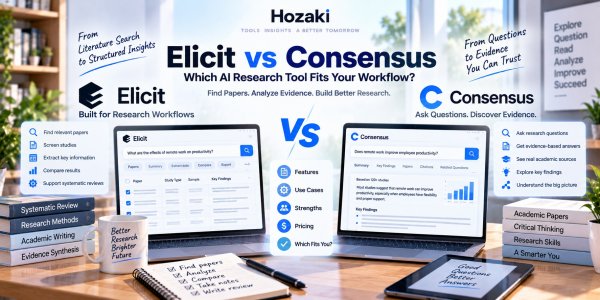
Elicit and Consensus are often mentioned in the same conversation.
That makes sense.
Both use AI to help people work with academic research. Both can reduce the time spent searching through papers. And both are considerably more research-focused than asking a general chatbot a question and hoping its are real.
But Elicit and Consensus aren't simply two versions of the same product.
Their workflows emphasize different parts of the research process.
Consensus is particularly approachable when your starting point is a research question and you want to explore what scientific literature says about it.
Elicit becomes especially interesting when the job starts looking more like a structured literature review involving paper discovery, screening, extraction, comparison, and systematic review workflows.
That distinction matters.
The better choice depends less on which product has "better AI" and more on what you're actually trying to accomplish.
Let's compare them.
Elicit vs Consensus: Quick Comparison
| Feature | Elicit | Consensus |
|---|---|---|
| Main focus | Structured research workflows | Research questions and evidence discovery |
| Academic paper search | Yes | Yes |
| Natural-language questions | Yes | Yes |
| Literature review workflow | Strong focus | Useful for discovery/research |
| Structured data extraction | Major use case | Less central |
| Systematic review workflow | Yes | Not its primary positioning |
| Research synthesis | Yes | Yes |
| Citation/evidence grounding | Yes | Strong emphasis |
| Best suited to | Researchers doing structured evidence work | Users exploring what research says |
| Learning curve | More workflow-oriented | More search-oriented |
Features and plan limits can change, so always check each service's current product information before choosing based on a specific capability.
What Is Elicit?
Elicit is an AI research assistant built around scientific literature.
Its workflows are designed to help researchers do more than simply search for papers.
Depending on the workflow and available features, researchers can use Elicit for tasks such as:
- Finding papers
- Screening studies
- Extracting information
- Comparing papers
- Building structured research tables
- Literature reviews
- Systematic review workflows
The important word here is structured.
Imagine you need to review 80 papers and record:
- Study population
- Sample size
- Methodology
- Intervention
- Outcome
- Main finding
- Limitations
A traditional chatbot conversation isn't necessarily the best interface for that task.
You need repeatable extraction across many papers.
That's where Elicit's research-oriented workflow becomes more relevant.
What Is Consensus?
Consensus also uses AI to help people explore scientific research, but the experience can begin much more naturally from a question.
For example:
Does remote work improve employee productivity?
or:
Does creatine improve cognitive performance?
or:
Does meditation reduce anxiety?
Consensus can help users discover research related to the question and understand what the available scientific literature says.
This makes it particularly approachable for someone who knows the question but doesn't yet know the relevant papers.
Consensus has also been expanding beyond simple question-and-answer search toward more agentic research workflows.
The underlying idea remains attractive:
Start with a question → find relevant scientific evidence → inspect the sources.
The Biggest Difference Between Elicit and Consensus
The Practical Difference: Structured Evidence Work vs. Research Exploration
Elicit and Consensus now overlap in more areas than a simple "review tool versus search engine" comparison suggests.
Both can help researchers discover papers, explore evidence, and work through research questions. Both also offer capabilities that extend beyond basic academic search.
The distinction is better understood through their workflow emphasis.
| Research Need | Elicit | Consensus |
|---|---|---|
| Explore a broad scientific question | Useful | A natural starting point |
| Discover relevant research papers | Supported | Supported |
| Screen papers against explicit eligibility criteria | A central workflow | Evaluate the available workflow for your review requirements |
| Extract consistent variables across many studies | A central workflow | Supports research analysis and structured outputs |
| Produce a research synthesis | Supported | Supported, including multi-step research workflows |
| Review the evidence behind generated claims | Verify source-linked evidence | Verify grounded citations and source passages |
| Conduct a formal systematic review | Evaluate dedicated review, screening, and extraction features | Evaluate research workflows alongside your required review methodology |
Neither product should be assumed to provide exhaustive literature coverage or independently validate a systematic review.
Choose based on the work you need to complete: If your priority is managing eligibility criteria, screening decisions, and structured evidence extraction, investigate Elicit's dedicated workflows first. If your priority is exploring a question, tracing evidence, and generating research overviews, investigate Consensus first.
For larger projects, test both products against your review protocol, source requirements, and verification process before subscribing.
Elicit vs Consensus for Finding Research Papers
Both can help with paper discovery.
But don't confuse AI discovery with exhaustive academic search.
If you're doing a formal review, you may still need databases relevant to your discipline, such as:
- PubMed
- Scopus
- Web of Science
- IEEE Xplore
- Google Scholar
- Discipline-specific databases
AI tools can help discover additional papers and improve search efficiency.
They shouldn't silently determine the boundaries of your evidence base.
When Consensus Makes Sense
Consensus can be particularly useful when you're starting with a broad question and want to see what research exists.
For example:
Does using AI tutors improve student learning outcomes?
This can help you:
- Discover terminology
- Find relevant studies
- Identify subtopics
- Understand how the question has been studied
When Elicit Makes Sense
Elicit becomes especially useful when you want to turn paper discovery into a more structured collection.
For example:
Find studies examining generative AI tutoring in higher education and compare sample size, study design, intervention, outcome measures, and results.
Now you're moving from discovery toward evidence extraction.
Elicit vs Consensus for Literature Reviews
This is where the distinction becomes clearer.
A literature review requires more than finding papers.
You may need to:
- Define the research question.
- Create a search strategy.
- Find candidate papers.
- Screen papers.
- Apply inclusion criteria.
- Extract information.
- Compare findings.
- Identify themes.
- Find disagreements.
- Synthesize the literature.
Elicit is particularly relevant to this structured workflow.
Consensus can still be extremely useful earlier in the process for exploring the research landscape and discovering evidence.
A practical combination might therefore be:
Consensus → explore the question
then
Elicit → structure the review
This doesn't mean everyone needs both products.
For a small project, one may be enough.
For a serious review, you may use several research tools alongside academic databases and a reference manager.
For a broader comparison of this category, see our Best AI Literature Review Tools guide.
Elicit vs Consensus for Systematic Reviews
A systematic review is not simply a very long literature review.
It requires a documented methodology.
Depending on the project, that may include:
- Protocol
- Search strategy
- Multiple databases
- Inclusion criteria
- Exclusion criteria
- Screening
- Deduplication
- Data extraction
- Risk-of-bias assessment
- Study selection documentation
- Transparent reporting
Elicit has been building dedicated systematic-review functionality, making it the more directly workflow-oriented option of these two for this type of work.
But there's an important qualification:
Using an AI systematic-review feature does not automatically make your work a valid systematic review.
Researchers remain responsible for methodology, search completeness, screening decisions, extracted data, and interpretation.
AI assists the workflow.
It doesn't certify the research.
Elicit vs Consensus for Academic Search
Consensus can feel more familiar to someone accustomed to search.
Ask a natural-language research question and explore the resulting evidence.
This can make it useful for:
- Students
- Journalists
- Analysts
- Researchers exploring a new field
- Professionals looking for scientific evidence
Elicit can also search academic literature, but its value becomes more obvious when search results need to move into a structured research process.
So ask yourself:
Do I primarily want answers and papers?
or:
Do I need to build and analyze a dataset of papers?
That question often points toward the more suitable workflow.
Elicit vs Consensus for Data Extraction
Suppose you have 30 studies.
For every study, you need:
| Paper | Sample | Method | Intervention | Outcome | Finding |
|---|
This is a fundamentally different problem from:
What does research say about this topic?
Structured extraction is one of the areas where Elicit's workflow is particularly relevant.
AI can help populate a research table much faster than manually reading every paper from beginning to end.
But don't skip verification.
Why Extraction Errors Matter
Imagine AI extracts:
Sample size: 450
The actual paper says:
450 participants were recruited, but only 317 completed the study.
Those numbers aren't interchangeable.
For important evidence, open the source.
How to Test Elicit and Consensus With the Same Research Task
Before paying for either product, compare how each handles a research question relevant to your work.
The goal is not to decide which interface produces the most convincing paragraph. It is to assess source quality, evidence extraction, verification, and workflow fit.
Test 1: Research Discovery
Choose a focused question, such as:
"Among university students, what does published research suggest about the relationship between sleep duration and academic performance?"
Use the same question in both tools.
Record:
-
Which relevant papers are discovered.
-
Whether the results include appropriate study designs.
-
Whether the tools identify important limitations.
-
Whether cited papers can be located and verified.
-
Whether relevant contradictory findings are included.
Check a sample of results against suitable academic databases. Do not assume that either AI search system provides a complete evidence base.
Test 2: Structured Evidence Extraction
Select five accessible research papers on the same topic.
Where the product and your plan support the necessary workflow, ask each tool to extract:
| Field | Information Required |
|---|---|
| Study | Author, year, and DOI or stable identifier |
| Population | Who was studied |
| Sample size | Recruited and analyzed participants, where reported |
| Study design | Observational, experimental, or other design |
| Exposure or intervention | What was investigated |
| Outcome | What was measured |
| Main result | Finding, including numerical results when available |
| Limitations | Important qualifications or sources of uncertainty |
| Evidence location | Supporting passage, page, or section |
Compare the extracted information with the original papers.
A missing field should be marked as missing rather than filled with a plausible guess.
Record Your Results
| Evaluation Criterion | Elicit | Consensus |
|---|---|---|
| Relevant paper discovery | Pass / Partial / Fail | Pass / Partial / Fail |
| Accurate study metadata | Pass / Partial / Fail | Pass / Partial / Fail |
| Correct extraction of key variables | Pass / Partial / Fail | Pass / Partial / Fail |
| Source evidence is inspectable | Pass / Partial / Fail | Pass / Partial / Fail |
| Important limitations preserved | Pass / Partial / Fail | Pass / Partial / Fail |
| Export and workflow suitability | Record | Record |
| Relevant feature or plan limitations | Record | Record |
| Manual correction time | Record | Record |
Record the test date, product plan, available features, and number of papers examined.
If a feature is unavailable under one subscription, record that as a plan or workflow limitation—not automatically as evidence of poorer model performance.
Editorial note: This is a reader testing framework. It does not represent an independent benchmark performed by Hozaki.
Elicit vs Consensus for Research Questions
Consensus is particularly intuitive when you have a question that resembles something a researcher might investigate.
Examples:
Does caffeine improve memory?
Does social media affect adolescent mental health?
Does working from home increase productivity?
Does intermittent fasting improve metabolic health?
This question-first interface can help users move from curiosity toward scientific literature.
But avoid turning complex evidence into a binary answer too quickly.
Research often depends on:
- Population
- Intervention
- Study design
- Duration
- Outcome measure
- Effect size
"What does science say?" can have a much more complicated answer than yes or no.
Elicit vs Consensus for Students
Students don't necessarily need the most sophisticated research workflow.
The right tool depends on the assignment.
Use Consensus When You Need to Explore
For example:
I need to write about whether social media affects sleep.
Consensus can help you discover relevant research and terminology.
Use Elicit When You Need to Compare Papers
For example:
I have to compare ten studies and explain differences in their methods and findings.
A structured research workflow becomes more useful.
Use Neither as a Citation Generator
Whichever tool you use:
Open the paper.
Verify the metadata.
Read the relevant section.
Then cite the original source.
For more study-specific recommendations, see our Best AI Tools for Students guide.
Elicit vs Consensus for Researchers
Professional researchers may care about things students don't.
For example:
- Search transparency
- Screening workflow
- Extraction
- Reproducibility
- Auditability
- Reference management
- Export
- Team collaboration
- Methodological documentation
For structured evidence work, Elicit's workflow orientation becomes particularly relevant.
Consensus can still be useful as a discovery layer or for quickly investigating research questions.
The products don't necessarily need to be mutually exclusive.
They can occupy different points in the same research stack.
Elicit vs Consensus for Research Paper Summaries
Both can reduce the time needed to understand academic literature.
But "summarizing papers" shouldn't be your only test.
A better test is whether the tool helps you answer:
- What was studied?
- Who was studied?
- How was it studied?
- What was measured?
- What did the researchers find?
- How large was the effect?
- What were the limitations?
- Does the conclusion match the results?
A five-sentence summary may be less useful than a structured evidence table.
If you're primarily working with individual PDFs rather than searching literature, see How to Summarize a PDF With AI and Best AI PDF Tools.
Elicit vs Consensus for Citations and Source Verification
Research AI is moving toward stronger citation grounding because users need to know where claims came from.
But citation visibility doesn't eliminate the need for verification.
For every important claim:
Step 1: Open the cited paper.
Step 2: Locate the relevant passage.
Step 3: Check whether the paper actually supports the claim.
Step 4: Check whether the AI omitted qualifications.
Step 5: Cite the original paper.
This matters because a citation can be real while the AI's interpretation of it is still wrong.
Which Is Easier to Use?
Consensus can be easier to understand immediately because the basic interaction resembles a research-oriented search engine:
Ask question → inspect evidence
Elicit's more structured workflows may require slightly more understanding of what you want to accomplish.
But that additional structure becomes useful as the research project becomes more complicated.
A simple way to think about it:
Lower workflow complexity → Consensus can feel more immediate
Higher workflow complexity → Elicit's structure becomes more valuable
That's not a quality judgment.
It's a workflow difference.
Which Is Better for Beginners?
A beginner researching a topic for the first time may find the question-driven approach easier to understand.
For example:
Does exercise improve academic performance?
The user doesn't need to know:
- Database syntax
- Boolean operators
- Screening procedures
- Extraction schemas
to begin exploring the literature.
But as soon as the assignment becomes:
Compare the methodology and findings of 15 papers,
the value of a more structured research environment increases.
The tool should grow with the complexity of the task.
Elicit vs Consensus vs Google Scholar
This comparison is important because AI research tools don't exist in a vacuum.
Google Scholar is primarily an academic search and discovery system.
Elicit and Consensus add AI-oriented layers to research workflows.
A strong process may use both types.
For example:
AI tool → discover terminology
Google Scholar / academic database → expand search
Citation network → discover related work
AI tool → help organize or understand papers
Don't assume that using a newer AI interface means established academic search tools are obsolete.
Elicit vs Consensus vs ChatGPT
ChatGPT is a much broader AI platform.
It can help with:
- Research planning
- Web research
- Documents
- Writing
- Data analysis
- Coding
- Synthesis
Elicit and Consensus are more specifically oriented toward scientific literature.
This creates an important tradeoff.
General AI
More flexible.
Specialized Research AI
More focused.
If your work is:
Research this topic and then turn it into a presentation, analyze my spreadsheet, and help write a report,
a general AI assistant can be convenient.
If your work is:
Find, screen, compare, and understand scientific literature,
a specialized research product becomes more attractive.
For a broader comparison of academic research platforms and general-purpose AI assistants, explore our Best AI Tools for Research guide.
Elicit vs Consensus vs SciSpace
SciSpace solves another adjacent problem.
Think of the three like this:
Consensus: What does research say?
Elicit: How can I systematically work through this literature?
SciSpace: Help me understand this paper.
There's overlap.
But those starting points explain why all three products can coexist.
A researcher might discover papers in one environment, organize evidence in another, and use a third to understand a particularly difficult paper.
Elicit vs Consensus Pricing
Pricing should be checked directly before subscribing because AI products frequently change:
- Plans
- Usage limits
- Feature access
- Credit systems
- Research limits
- Team features
Instead of asking only:
Which one is cheaper?
ask:
Which paid limitation am I actually trying to remove?
For example:
If the free plan already covers your occasional research questions, paying may accomplish nothing.
If you're processing hundreds of papers, workflow limits become much more important.
Compare the Limits That Matter to Your Research
Before subscribing, review the official plans:
| What to Compare | Why It Matters |
|---|---|
| Free research access | May be sufficient for occasional research questions |
| Advanced research credits | Can limit the number of in-depth investigations |
| Systematic review features | May require a higher-tier plan |
| Screening and extraction capacity | Important when processing large collections of papers |
| Research report limits | Affects repeated evidence synthesis |
| Export formats | Matters for reference managers and downstream analysis |
| Collaboration features | Important for research groups and shared projects |
| API or automation access | Relevant to repeatable or integrated workflows |
Do not compare subscription prices without checking which features are included.
For example, an occasional student research question and a project screening hundreds of papers create very different usage requirements.
Pricing and availability note: Subscription costs, research credits, supported workflows, and feature limits can change. Confirm current terms on the official pricing pages before making a purchase decision.
Can You Use Elicit and Consensus Together?
Yes.
And this may actually make more sense than treating them as strict substitutes.
Here's one possible workflow.
Step 1 — Explore With Consensus
Ask broad research questions.
Identify terminology and interesting papers.
Step 2 — Expand the Search
Use academic databases and citation searching.
Step 3 — Move Into Elicit
Create a more structured collection of relevant studies.
Step 4 — Screen
Apply your criteria.
Step 5 — Extract
Build a table of study characteristics and results.
Step 6 — Verify
Open the original papers.
Step 7 — Synthesize
Compare the verified evidence.
The important part isn't using both tools.
It's understanding that discovery and evidence synthesis are different jobs.
When Elicit Makes More Sense
Consider Elicit when your workflow emphasizes:
- Structured literature reviews
- Systematic review support
- Screening
- Evidence extraction
- Comparing many papers
- Research tables
- Repeated academic workflows
When Consensus Makes More Sense
Consider Consensus when your workflow emphasizes:
- Asking research questions
- Quickly exploring scientific evidence
- Discovering relevant papers
- Understanding what research says about a topic
- Lower-friction academic search
When You May Need Something Else
Neither product is automatically the right solution for every research problem.
You may prefer:
SciSpace for deeply reading papers.
Scite for citation context.
Semantic Scholar for academic discovery.
ResearchRabbit for literature mapping.
NotebookLM for your own source collection.
ChatGPT / Claude / Gemini for broader AI workflows.
Our Best AI Literature Review Tools guide compares tools across discovery, screening, evidence extraction, citation analysis, and literature mapping.
A Simple Decision Framework
Ask these four questions.
1. Am I Exploring a Question?
Start with a question-oriented research workflow.
2. Am I Building a Literature Review?
Prioritize structured paper workflows.
3. Am I Processing Many Papers?
Look closely at screening and extraction.
4. Am I Mostly Trying to Understand PDFs?
A document-oriented AI may make more sense.
This prevents you from buying software simply because someone called it "the best AI research tool."
Frequently Asked Questions
Is Elicit better than Consensus?
They emphasize different workflows. Elicit focuses more heavily on structured literature-review and evidence workflows, while Consensus provides a question-driven way to explore scientific research.
What is the main difference between Elicit and Consensus?
A useful distinction is that Consensus often begins with a research question, while Elicit becomes especially valuable when the research needs structured screening, extraction, and comparison.
Is Elicit good for literature reviews?
Elicit is specifically designed for research workflows that include literature discovery, screening, extraction, comparison, and systematic-review-related tasks.
Is Consensus good for literature reviews?
Consensus can be useful for discovering papers, exploring research questions, and understanding the evidence landscape. More structured review workflows may require additional tools.
Can students use Elicit?
Yes. It can be useful when students need to find, organize, extract, and compare information from academic research.
Can students use Consensus?
Yes. Its natural-language research-question workflow can be particularly useful for exploring academic topics and discovering relevant papers.
Can Elicit replace Google Scholar?
They serve different functions. Formal academic research may benefit from using Elicit alongside established databases and academic search systems rather than treating one as a complete replacement.
Can Consensus replace Google Scholar?
Similarly, Consensus adds an AI-oriented research interface but doesn't necessarily eliminate the need for broader academic search tools.
Can I use Elicit and Consensus together?
Yes. One possible workflow is to use Consensus for early exploration and Elicit for more structured evidence processing, while still verifying papers through original sources and appropriate academic databases.
Continue Exploring AI Research Tools
Best AI Literature Review Tools
Compare tools for finding, screening, reading, and synthesizing academic research.
Best AI Literature Review Tools
Best AI Research Tools
Explore research platforms for academic search, source discovery, citations, and evidence analysis.
Best AI PDF Tools
Find tools for reading, questioning, summarizing, and analyzing research documents.
How to Summarize a PDF With AI
Learn how to preserve important findings, figures, and limitations when summarizing documents.
How to Summarize Any PDF With AI
Best AI Tools for Students
Explore tools for studying, academic research, writing, notes, and learning.
ChatGPT vs Claude
Compare two general-purpose AI assistants for research, writing, documents, and everyday work.
Best AI Tools in 2026
Explore AI software across research, writing, coding, documents, and productivity.
Comments 0