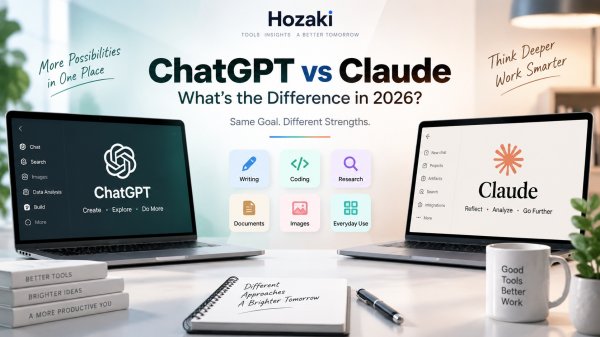
ChatGPT and Claude are two of the most capable general-purpose AI assistants available today, but choosing between them isn't as simple as asking which one is "smarter."
Both can write, analyze documents, help with code, research information, brainstorm ideas, and work through complex questions. The bigger differences show up in how they approach those tasks, the tools surrounding the core AI models, and the workflows they are designed to support.
ChatGPT has developed into a broad AI platform with tools spanning writing, coding, web research, files, images, data analysis, voice, and other multimodal tasks.
Claude has increasingly developed around knowledge work, documents, writing, research, coding, and agent-style workflows.
That means the useful question isn't simply "Is Claude better than ChatGPT?"
It's:
Which one fits the work you actually want to do?
This ChatGPT vs Claude comparison breaks down the differences that matter in everyday use.
ChatGPT vs Claude at a Glance
| Feature | ChatGPT | Claude |
|---|---|---|
| Best suited to | Broad, general-purpose AI use | Writing, documents and knowledge work |
| Free access | Yes | Yes |
| Writing | Strong | Strong |
| Coding | Strong | Strong |
| Web research | Yes | Yes |
| File analysis | Yes | Yes |
| Image understanding | Yes | Yes |
| Image generation | Available within ChatGPT | Not a primary Claude workflow |
| Voice | Available | More limited as a core workflow |
| Data analysis | Strong integrated workflow | Available through Claude's tool capabilities |
| Long-form document work | Strong | Particularly well suited |
| Ecosystem | Broad multimodal AI platform | Knowledge work, coding and agent workflows |
| Best choice depends on | Need for versatility | Need for focused text/document workflows |
The table is only the starting point. Many of these capabilities overlap, so the more useful differences become visible when you compare specific tasks.
What Is ChatGPT?
ChatGPT is OpenAI's general-purpose AI assistant.
What began primarily as a conversational interface has expanded into a much broader platform for working with text, files, code, images, web information, data, and voice.
You can use ChatGPT to:
- Ask questions
- Draft and rewrite content
- Brainstorm ideas
- Analyze documents
- Work with spreadsheets and data
- Write and debug code
- Research information on the web
- Work with images
- Generate images
- Use voice conversations
- Build repeatable AI workflows
This breadth is one of ChatGPT's biggest strengths.
Instead of requiring a separate AI tool for every small task, many users can use ChatGPT as their central general-purpose assistant.
That also explains why ChatGPT appears as the Best Overall pick in our guide to the Best AI Tools.
What Is Claude?
Claude is Anthropic's AI assistant.
It overlaps heavily with ChatGPT in basic conversational use, but its product direction has become particularly interesting for writing, documents, research, coding, and other forms of knowledge work.
Claude can help with:
- Writing and editing
- Document analysis
- Research
- Coding
- File creation
- Web search
- Complex reasoning tasks
- Working with connected information sources
- Longer knowledge-work workflows
Claude is therefore much more than a text chatbot.
For someone who spends much of the day reading, writing, analyzing information, or working through documents and code, Claude can feel especially well aligned with the task.
For a deeper look at the product itself, see our Claude Review.
ChatGPT vs Claude for Everyday Use
For general everyday AI use, ChatGPT has an advantage in breadth.
A typical user might ask ChatGPT to summarize a document in the morning, troubleshoot a spreadsheet after lunch, generate an image later in the day, and use voice mode on a phone in the evening.
Those tasks are quite different, but they can happen inside the same AI ecosystem.
Claude can also handle a broad range of everyday questions and tasks, but its strongest identity is less about being an everything-in-one consumer AI environment and more about working through information.
If you want one AI account to cover as many different kinds of tasks as possible, ChatGPT is likely to feel more versatile.
If most of your daily AI work involves text, documents, analysis, research, and coding, the difference becomes much smaller.
ChatGPT vs Claude for Writing
Writing is one of the most interesting areas of this comparison because both tools are highly capable.
Both can:
- Draft articles
- Rewrite paragraphs
- Improve clarity
- Change tone
- Summarize text
- Brainstorm headlines
- Develop outlines
- Edit existing drafts
- Analyze writing
- Work from source documents
The difference is often less about whether a feature exists and more about the workflow and output style you prefer.
Claude is particularly appealing for long-form, document-heavy work. It can be a natural fit when you want to give an AI substantial context and work through a draft iteratively.
ChatGPT is also a strong writing tool, but its broader toolset can make it more useful when the writing task connects to research, data, images, or other forms of content.
For example, a marketer might use ChatGPT to research a topic, analyze a CSV, draft a report, and then create supporting visuals.
A writer primarily working with long documents may care less about those additional capabilities and prefer Claude's workflow.
Which is better for writing?
There isn't a universal answer.
Choose based on what happens around the writing.
If your work is primarily:
Long drafts + documents + editing + analysis
Claude is particularly worth testing.
If your work is:
Writing + research + data + images + mixed AI tasks
ChatGPT's wider environment may be more convenient.
Our upcoming Best AI Writing Tools guide compares both with more specialized writing products such as Grammarly.
ChatGPT vs Claude for Coding
Coding is another area where the simple "which AI is better?" question becomes misleading.
Both ChatGPT and Claude can:
- Explain code
- Generate code
- Debug errors
- Refactor functions
- Explain unfamiliar repositories
- Suggest implementations
- Help learn programming concepts
But developers increasingly use AI through more than a browser chat window.
ChatGPT connects general AI capabilities with coding workflows, while OpenAI's broader coding tools extend beyond ordinary chat.
Claude similarly extends into Claude Code and other developer-oriented workflows.
For developers, the real comparison therefore includes:
model capability + project context + editor integration + agents + workflow.
A developer who occasionally asks programming questions may be perfectly happy using either assistant in a browser.
Someone using AI throughout an entire development session should also compare dedicated coding environments.
See Best AI Tools for Coding for our broader comparison of ChatGPT, Claude, Cursor, GitHub Copilot, and other coding tools.
We also have a dedicated Claude vs ChatGPT for Coding comparison for users whose primary decision is development work.
ChatGPT vs Claude for Research
Both ChatGPT and Claude can now participate in research workflows rather than simply answering questions from their underlying models.
This matters because good AI research isn't just about generating a confident-looking paragraph.
A useful research workflow should help you:
- Find relevant information
- Examine sources
- Compare conflicting information
- Ask follow-up questions
- Analyze documents
- Organize findings
- Identify uncertainty
ChatGPT offers web-connected research capabilities as part of its broader tool environment.
Claude also provides web search and research capabilities, including more advanced research functionality on eligible plans.
For casual research, either can be sufficient.
For serious research, don't choose solely on which answer sounds better. Look at the quality of the sources, whether important claims can be verified, and how well the tool handles follow-up investigation.
If web research is your main reason for using AI, also consider a research-focused tool such as Perplexity rather than limiting the decision to ChatGPT and Claude.
ChatGPT vs Claude for PDFs and Documents
Both tools can work with uploaded documents, which makes them useful for tasks such as:
- Summarizing PDFs
- Asking questions about a document
- Extracting key points
- Comparing documents
- Rewriting sections
- Analyzing reports
- Finding information in uploaded material
Claude's document-oriented workflow makes it particularly attractive for users whose AI work revolves around reading and writing.
ChatGPT, meanwhile, can be useful when document analysis needs to connect to other tasks such as data analysis, web research, or content creation.
The better choice depends on what you want to do after the document has been analyzed.
If PDFs are a major part of your workflow, don't stop at general AI assistants. Our Best AI Tools for PDFs guide compares more document-focused options.
You can also read How to Upload a PDF to ChatGPT and How to Summarize a PDF with ChatGPT for practical workflows.
ChatGPT vs Claude for Images
This is an area where the two products diverge more clearly.
Both can work with visual input in supported workflows, allowing users to ask questions about images and other visual material.
ChatGPT, however, also integrates image generation into its broader product experience.
That matters if you want one assistant for tasks such as:
- Brainstorming an idea
- Writing copy
- Generating an image
- Revising the concept
- Analyzing the final result
Claude is not primarily positioned as an image-generation platform.
So users whose AI workflow includes significant visual creation may find ChatGPT's broader multimodal environment more convenient.
For serious image generation, however, dedicated tools such as Midjourney and Adobe Firefly are also worth comparing.
See Best AI Image Generators for that category.
ChatGPT vs Claude for Data Analysis
ChatGPT has developed a particularly convenient workflow around uploaded datasets, spreadsheets, calculations, charts, and code-assisted analysis.
This makes it useful for users who don't necessarily want to set up a separate programming environment just to explore a dataset.
Typical tasks include:
- Inspecting a CSV
- Cleaning data
- Calculating metrics
- Finding patterns
- Creating charts
- Explaining spreadsheet logic
- Generating formulas
- Writing analysis code
Claude can also perform analytical and code-based tasks, including code execution in supported workflows.
The deciding factor again comes down to workflow.
If data analysis is a regular part of a mixed set of tasks, ChatGPT can be particularly convenient because the analysis sits alongside its other multimodal capabilities.
For high-stakes or professional analysis, outputs from either tool should still be checked against the underlying data rather than accepted automatically.
ChatGPT vs Claude for Students
Students can use both tools for legitimate learning tasks such as:
- Explaining difficult concepts
- Creating study questions
- Summarizing notes
- Brainstorming
- Understanding code
- Comparing ideas
- Working through practice problems
- Researching a topic
The biggest mistake is using either AI simply to produce answers that the student submits without understanding.
A better workflow is to ask the AI to explain reasoning, quiz you, challenge an answer, or show multiple approaches.
Claude can be appealing for reading and working through longer source material.
ChatGPT's broader set of tools can be useful when study involves mixed media, data, images, or other formats.
Students should also check their school's policies on AI-assisted work before using generated material in assignments.
Our Best AI Tools for Students guide explores the broader category.
ChatGPT vs Claude for Work
For professional use, the choice depends heavily on the type of work.
ChatGPT may fit better when your work involves:
- Many different task types
- Data analysis
- Images
- General research
- Writing
- Brainstorming
- Voice
- Mixed file formats
Claude may fit better when your work involves:
- Long documents
- Writing
- Editing
- Research
- Analysis
- Coding
- Knowledge-intensive tasks
This doesn't mean one tool can't perform the tasks in the other list.
There is substantial overlap.
The point is to identify which product's surrounding workflow reduces the most friction in your day.
For a wider selection of workplace tools, see Best AI Tools for Work.
ChatGPT vs Claude: Free Plans
Both ChatGPT and Claude offer free access, which makes the easiest comparison surprisingly simple:
Try both before paying.
Don't test them with random trivia questions.
Use three or four tasks you actually perform.
For example:
Test 1: Rewrite a real piece of your writing.
Test 2: Analyze a document you understand well.
Test 3: Ask a difficult question from your field.
Test 4: Give both the same multi-step task.
Then compare:
- Accuracy
- Writing quality
- Instruction following
- Ease of use
- Speed
- Workflow
- How much editing you need afterward
That personal comparison is more useful than choosing based only on benchmark charts.
Free-plan limits and included features can change, so always check the current plan details before making a long-term decision.
ChatGPT vs Claude Pricing
Both companies use tiered pricing rather than offering a single paid plan.
The important mistake to avoid is comparing only the headline monthly subscription price.
Instead, look at:
- Usage limits
- Models included
- Research features
- Coding tools
- File capabilities
- Additional agents or tools
- Team features
- Whether your usage regularly reaches limits
For a light user, the free version may be enough.
For a professional who uses AI throughout the day, the practical value of higher limits can matter more than a small difference in monthly price.
Because AI pricing and plan structures change frequently, Hozaki recommends checking the current official pricing pages before subscribing rather than relying on an old comparison table.
ChatGPT vs Claude: Privacy and Sensitive Information
AI assistants should not automatically be treated as private notebooks for confidential information.
Before uploading sensitive business documents, customer data, proprietary code, personal information, or regulated material, check:
- The plan you're using
- Current data controls
- Retention policies
- Organizational settings
- Your employer's AI policy
- Applicable legal or contractual requirements
Business and enterprise offerings can have different data terms from consumer products.
This is especially important for teams evaluating AI for company-wide deployment.
The convenient rule is simple:
Don't upload sensitive information merely because an AI tool makes uploading easy.
Understand the data policy first.
Where ChatGPT Has an Advantage
ChatGPT's strongest advantage is breadth.
It can serve as a central AI workspace across many kinds of tasks rather than requiring a different interface for every use case.
Its advantages are especially noticeable for users who combine:
- Writing
- Coding
- Data
- Images
- Files
- Research
- Voice
- General problem solving
This makes ChatGPT particularly attractive as a first general-purpose AI subscription.
Where Claude Has an Advantage
Claude is particularly compelling for text-heavy and knowledge-intensive workflows.
Its strengths become more noticeable when the work involves:
- Long-form writing
- Documents
- Editing
- Analysis
- Research
- Coding
- Extended context
- Iterative knowledge work
For users who spend most of their AI time reading, thinking, writing, and working through complex information, Claude deserves serious consideration rather than being treated merely as a ChatGPT alternative.
Can You Use ChatGPT and Claude Together?
Yes, and for some professional users this is more useful than treating the products as mutually exclusive.
One workflow might be:
Claude → Develop and edit a long draft
ChatGPT → Analyze data or create supporting material
Another could be:
ChatGPT → Initial research and brainstorming
Claude → Work through a long document
You can also use a second model to challenge or review an answer from the first.
However, paying for overlapping AI subscriptions only makes sense if the second tool solves a recurring problem.
Don't subscribe to both just because both are popular.
ChatGPT vs Claude: Which One Fits Which User?
A practical way to decide is to start with your main workflow.
Consider ChatGPT if you want:
- One general-purpose AI assistant
- Broad multimodal capabilities
- Image generation
- Data analysis
- Writing and research in the same environment
- A tool for many unrelated everyday tasks
Consider Claude if you want:
- A strong writing and document workflow
- Long-form knowledge work
- Research and analysis
- Coding-oriented workflows
- An AI assistant centered heavily on text and information
Consider testing both if:
- AI is central to your work
- Writing quality matters heavily
- You regularly handle complex documents
- You code frequently
- You're unsure which interface and output style fits you
Because both provide free access, there is little reason to make the decision purely from someone else's preference.
Use the same real tasks in both products and compare the results yourself.
ChatGPT vs Claude for Different Tasks
| Task | What to consider |
|---|---|
| Everyday AI | ChatGPT's broader tool environment |
| Long-form writing | Claude's document-focused workflow |
| Research | Source quality and research workflow in both |
| Coding | Both are capable; also compare dedicated coding tools |
| Images | ChatGPT offers a broader creation workflow |
| PDFs | Both can analyze documents |
| Data analysis | ChatGPT provides a convenient integrated workflow |
| Knowledge work | Claude is particularly well aligned |
| Mixed media | ChatGPT's breadth becomes useful |
| Students | Depends on subject and learning workflow |
| Professional work | Depends heavily on task and data requirements |
There is no need to turn every row into a "winner."
For many categories, the difference isn't large enough to matter more than your personal workflow.
Frequently Asked Questions
Is Claude better than ChatGPT?
Not universally. Claude and ChatGPT overlap in many tasks but emphasize different workflows. Claude is particularly compelling for writing, documents, analysis, and knowledge work, while ChatGPT provides a broader general-purpose environment spanning text, files, data, images, voice, and other tasks.
Is ChatGPT or Claude better for writing?
Both are strong writing assistants. Claude is especially worth considering for long-form and document-heavy workflows, while ChatGPT can be convenient when writing needs to connect with research, data, images, or other tools.
Is ChatGPT or Claude better for coding?
Both can help generate, explain, debug, and refactor code. Developers using AI heavily should also consider how each product connects to dedicated coding workflows rather than comparing browser-chat answers alone.
Can Claude generate images like ChatGPT?
Claude can work with visual inputs in supported contexts, but it is not primarily positioned as an image-generation platform. ChatGPT includes image creation as part of its broader multimodal experience.
Can ChatGPT and Claude analyze PDFs?
Both can work with uploaded documents in supported plans and workflows. The better choice depends on the document, account limits, and what you want to do with the information afterward.
Are ChatGPT and Claude free?
Both offer free access, although available models, tools, usage limits, and other capabilities vary by plan and can change over time.
Should I pay for both ChatGPT and Claude?
Most casual users probably don't need two overlapping AI subscriptions. Using both can make sense when each product solves a recurring part of your workflow or when AI is central to professional work.
Continue Exploring
Best AI Tools in 2026
Compare ChatGPT and Claude with AI tools for research, coding, images, video, productivity, PDFs, and automation.
Claude Review
Take a closer look at Claude's features, strengths, limitations, and use cases.
ChatGPT vs Gemini
Compare two major general-purpose AI ecosystems and the workflows they support.
Claude vs Gemini
See how Claude and Gemini differ for writing, research, productivity, and everyday AI use.
Claude vs ChatGPT for Coding
Compare the two assistants specifically from a developer's perspective.
Comments 0