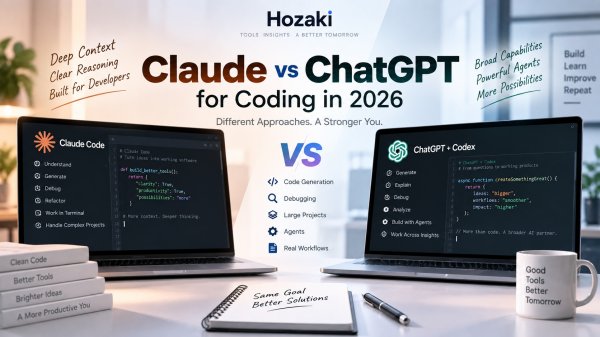
Claude and ChatGPT can both write code. That is no longer the interesting part of the comparison.
The more useful question in 2026 is what happens after you ask the AI to write the first function.
Can it understand a larger project? Can it find the right files to change? Can it debug a problem across multiple components? Can it work from the terminal? Can it review its own changes? And how well does it fit into the development environment you already use?
That's where the Claude vs ChatGPT coding comparison becomes much more interesting.
Anthropic has expanded Claude into developer workflows through Claude Code, while OpenAI has developed Codex as a dedicated software-development agent alongside ChatGPT. Coding with either ecosystem can therefore go well beyond pasting snippets into a chatbot.
This guide compares Claude vs ChatGPT for coding, focusing on code generation, debugging, project understanding, agents, developer workflow, and the situations where each approach makes sense.
If you're comparing more than these two products, see our Best AI Tools for Coding guide.
Claude vs ChatGPT for Coding at a Glance
| Area | Claude | ChatGPT |
|---|---|---|
| General coding questions | Strong | Strong |
| Code generation | Strong | Strong |
| Debugging | Strong | Strong |
| Code explanation | Strong | Strong |
| Large-context coding | Strong focus | Strong |
| Dedicated coding workflow | Claude Code | Codex |
| Terminal-oriented work | Claude Code | Codex CLI |
| Agentic development | Yes | Yes |
| General AI outside coding | Yes | Yes |
| Data analysis | Capable | Broad integrated workflow |
| Multimodal work | Supported | Broad multimodal workflow |
| Best fit | Text and code-heavy development | Coding combined with broader AI tasks |
This table shouldn't be interpreted as a scorecard.
The two products overlap heavily. The biggest differences appear in how you work with them, rather than whether they can generate a particular piece of code.
What Is Claude for Coding?
Claude is Anthropic's general-purpose AI assistant, but coding has become an increasingly important part of its ecosystem.
At the basic level, you can use Claude conversationally to:
- Generate code
- Explain unfamiliar code
- Debug errors
- Refactor functions
- Discuss architecture
- Write tests
- Review code
- Learn programming concepts
- Plan implementations
For occasional programming questions, that may be enough.
Claude Code takes things further by bringing Claude into a developer-oriented workflow where the AI can work much closer to the codebase and terminal.
That distinction matters.
As AI development shifts from "give me a code snippet" toward "help me complete this engineering task," access to project context and development tools becomes increasingly important.
For Claude's broader strengths outside programming, see our ChatGPT vs Claude comparison.
What Is ChatGPT for Coding?
ChatGPT can also be used as a conversational coding assistant.
Developers can ask it to:
- Generate functions
- Explain errors
- Review code
- Refactor
- Write tests
- Create SQL queries
- Explain APIs
- Work through algorithms
- Analyze files
- Help learn a programming language
But OpenAI's coding ecosystem now extends beyond ordinary ChatGPT conversations.
Codex is OpenAI's dedicated coding agent for software-development work. It can be used for writing, reviewing, and shipping code, and current OpenAI documentation says Codex is included across ChatGPT plans, although available usage depends on the plan.
This means a modern Claude vs ChatGPT coding comparison is increasingly also a comparison between:
Claude + Claude Code
and
ChatGPT + Codex
rather than simply comparing two chatbot windows.
Claude Code vs Codex: Why This Matters
Traditional AI coding looks like this:
Developer asks question → AI generates code → developer copies code → developer tests it.
Agentic coding can look more like this:
Developer describes task → agent inspects project → edits files → runs tools → tests changes → reports results.
That is a substantial change.
The unit of AI assistance is moving from a piece of code toward an engineering task.
Claude Code and Codex both participate in that shift.
The practical comparison therefore includes much more than output quality:
- Repository understanding
- Terminal access
- Multi-file editing
- Tool use
- Test execution
- Agent autonomy
- Review workflow
- Model selection
- Context management
- Usage limits
- How easily developers can inspect what changed
If you primarily want an AI-native editor rather than a standalone coding agent, our Best AI Tools for Coding comparison also covers Cursor, GitHub Copilot, and other development tools.
Claude vs ChatGPT for Code Generation
For straightforward code generation, both tools are capable enough that small benchmark-style prompts often don't reveal the most meaningful difference.
Ask either tool to write a simple Python function, and both can usually produce a useful answer.
But professional coding rarely consists of isolated functions.
A better test is something like:
Add pagination to this existing API while preserving the current response format and tests.
Now the AI needs to understand:
- Existing architecture
- Dependencies
- Naming conventions
- Multiple files
- Tests
- Side effects
- Existing behavior
This is where context and workflow become more important than whether the model can write valid syntax.
How to Test Code Generation Properly
Give both tools the same real task from a project you understand.
Then compare:
- Does the code compile?
- Does it follow existing patterns?
- Does it introduce unnecessary dependencies?
- Does it handle edge cases?
- Does it change unrelated code?
- Do existing tests still pass?
- How much manual correction is required?
The answer that looks cleaner in a chat window isn't necessarily the better implementation.
Claude vs ChatGPT for Debugging
Debugging is one of the strongest reasons to use an AI coding assistant.
Both Claude and ChatGPT can help interpret:
- Stack traces
- Compiler errors
- Runtime errors
- Logic bugs
- Test failures
- Unexpected output
- API errors
- Configuration problems
But there is an important difference between explaining an error and diagnosing a system.
Consider this error:
TypeError: Cannot read properties of undefined
A chatbot may explain what the error means.
That's useful.
But the real development task may be:
Find where this undefined value originates across the application and fix it without breaking existing behavior.
That requires project context.
When evaluating Claude Code or Codex, test whether the agent can trace the problem through the relevant files rather than simply explaining the error message.
Use Better Debugging Prompts
Instead of:
Fix this error.
try:
Investigate the root cause of this error. Explain what is happening before changing anything. Identify the relevant files, propose the smallest safe fix, then tell me which tests should verify it.
This makes it easier to evaluate the AI's reasoning and reduces the chance of blindly accepting a patch.
Claude vs ChatGPT for Understanding Existing Code
Writing new code is only part of software development.
A large amount of engineering time is spent understanding code someone else wrote—or code you wrote six months ago and no longer remember.
AI can be especially useful here.
Useful questions include:
Where is authentication handled?
Explain the request flow from this route to the database.
Which component controls this state?
What depends on this function?
Where could this value become null?
Explain this repository to a new developer.
Both Claude and ChatGPT can perform this type of analysis when given sufficient context.
The practical difference increasingly depends on how easily the coding workflow can expose the relevant repository information to the model.
For larger projects, avoid judging either tool based solely on isolated code snippets.
Claude vs ChatGPT for Large Projects
Large projects create a different challenge from small coding exercises.
An AI may need to understand:
- Directory structure
- Shared utilities
- Internal libraries
- API contracts
- Database models
- Tests
- Configuration
- Build tools
- Coding conventions
- Documentation
The more context required, the more important context management becomes.
Claude is particularly interesting for context-heavy code and text workflows, while Claude Code brings that model into a development-oriented environment.
ChatGPT and Codex likewise support more sophisticated repository and agentic development workflows.
Rather than relying on advertised context-window numbers alone, test the actual project.
Ask each tool to explain relationships between several distant parts of the repository.
A useful test might be:
Trace how a user goes from submitting the signup form to having a database record created. Identify every major file involved.
If the AI misses an important layer of the application, a large theoretical context window hasn't solved the practical problem.
Claude vs ChatGPT for Refactoring
Refactoring is a good AI test because the goal isn't simply to produce code that works.
The AI must preserve behavior while improving structure.
Both Claude and ChatGPT can help with tasks such as:
- Breaking up large functions
- Removing duplication
- Improving naming
- Simplifying logic
- Migrating APIs
- Reorganizing modules
- Improving readability
- Adding types
- Modernizing older code
For small refactors, either assistant can work well.
For larger refactors, agentic workflows become more useful because changes may span many files.
Give the AI Clear Refactoring Constraints
Don't ask:
Make this code better.
Define what "better" means.
For example:
Refactor this module to reduce duplication without changing its public API. Preserve current behavior and existing tests. Explain each structural change.
That gives the AI a constraint instead of inviting unnecessary rewrites.
Claude vs ChatGPT for Writing Tests
Both tools can generate tests quickly.
This is useful for:
- Unit tests
- Integration-test ideas
- Edge-case discovery
- Mock generation
- Test-data creation
- Explaining failed tests
But AI-generated tests create an unusual risk.
If the same AI writes both the implementation and the tests, it can encode the same incorrect assumption twice.
You can end up with:
wrong implementation + wrong test = green test suite.
For important software, developers should still understand what behavior the tests are supposed to protect.
A better workflow is to ask the AI to identify edge cases before it sees the implementation.
Then compare those cases with the tests it eventually generates.
Claude vs ChatGPT for Learning to Code
Beginners don't necessarily need the most autonomous coding agent.
In fact, too much automation can make learning harder.
Both Claude and ChatGPT can work well as interactive programming tutors.
Instead of asking:
Build this project for me.
try:
Don't give me the answer yet. Explain why my approach fails and give me one hint.
Or:
Ask me questions that help me debug this myself.
Or:
Explain this function line by line as if I know basic Python but don't understand recursion.
That changes AI from a code generator into a tutor.
For beginners, conversational quality and explanation may matter more than whether an agent can autonomously modify twenty files.
Claude vs ChatGPT for Front-End Development
Front-end development combines several different tasks:
- HTML
- CSS
- JavaScript
- Frameworks
- Components
- State
- APIs
- Accessibility
- Responsive design
- Visual debugging
Both Claude and ChatGPT can generate and debug front-end code.
ChatGPT's broader multimodal environment can be useful when the task crosses from code into visual analysis or other content workflows.
Claude can be particularly useful for reasoning through components, architecture, and larger code contexts.
But neither should replace actual browser testing.
AI-generated interfaces still need to be checked for:
- Mobile behavior
- Accessibility
- Browser compatibility
- Layout problems
- Performance
- Keyboard navigation
- Real user interactions
Code that looks correct in a generated response can still produce a broken interface.
Claude vs ChatGPT for Back-End Development
Back-end work is another strong use case for both.
They can help with:
- API endpoints
- Database queries
- Authentication logic
- Data models
- Validation
- Server errors
- Tests
- Migrations
- Documentation
But back-end code often involves higher-impact mistakes.
A seemingly small error can affect authentication, authorization, data integrity, payments, privacy, infrastructure, or production reliability.
Treat AI-generated back-end changes as code requiring review—not trusted output simply because it compiles.
For authentication, payments, cryptography, permissions, and other security-sensitive areas, manual review becomes especially important.
Claude vs ChatGPT for SQL and Data Work
ChatGPT provides a broad environment for work that crosses between coding and data analysis.
A user can work with datasets, ask questions, generate code, inspect results, and move between analytical and programming tasks.
Claude can also help write and explain:
- SQL
- Python
- Data transformations
- Queries
- Analysis logic
- Data-processing code
If your coding is heavily tied to analytics rather than application development, test the entire workflow instead of comparing SQL output alone.
For example:
Analyze this dataset, identify anomalies, explain the likely causes, then generate the SQL query I would use to reproduce the analysis in our warehouse.
That is more representative of real work.
Claude vs ChatGPT for Documentation
AI is extremely useful for the parts of development that developers often postpone.
Both tools can help produce:
- README files
- API documentation
- Function descriptions
- Migration notes
- Changelogs
- Onboarding documentation
- Code comments
- Architecture summaries
But documentation should be generated from the actual implementation whenever possible.
Otherwise the AI can create documentation for behavior the software doesn't actually have.
A useful workflow is:
Code → AI explanation → developer verification → documentation
rather than:
Idea → AI documentation → assume implementation matches it.
Claude vs ChatGPT for Developer Research
Programming frequently involves research.
Developers need to understand:
- Libraries
- Frameworks
- Error messages
- APIs
- Breaking changes
- Documentation
- Security advisories
- Version differences
Both ecosystems can participate in web-connected research workflows.
The important rule is to verify time-sensitive technical information against primary documentation.
Libraries change. APIs are deprecated. Functions disappear. Examples that worked two years ago may no longer compile.
For technical questions involving a specific library version, tell the AI the version and ask it to distinguish current documentation from older approaches.
Claude Code vs Codex for Agentic Coding
This is one of the most important parts of the Claude vs ChatGPT coding comparison.
An agentic coding tool isn't just answering questions.
Depending on the environment and permissions, it may be able to:
- Read project files
- Edit files
- Run commands
- Execute tests
- Inspect output
- Iterate on errors
- Review changes
- Work on delegated engineering tasks
OpenAI currently describes Codex as an AI coding agent for writing, reviewing, and shipping code. It can be used through multiple development surfaces, including CLI and other supported interfaces.
Claude Code similarly extends Claude into developer workflows rather than limiting coding to a browser conversation. Anthropic has continued expanding Claude Code capacity in 2026, including higher usage limits across Pro, Max, Team, and seat-based Enterprise plans.
The important principle applies to both:
Autonomy should increase review discipline, not reduce it.
Which Is Easier to Use?
For basic coding questions, both are straightforward.
Open a conversation, provide the relevant context, explain the problem, and ask for help.
The learning curve becomes steeper when you move into:
- CLI tools
- Repository permissions
- Agents
- Tool integrations
- MCP
- Cloud environments
- Automated workflows
At that point, the better tool is often the one that fits your existing habits.
A developer who loves terminal workflows may judge usability very differently from someone who prefers a graphical editor.
Which Is Better for Non-Developers Who Occasionally Code?
If coding is only a small part of your work, you may not need a dedicated coding tool at all.
For example, a marketer might occasionally need:
- Regex
- SQL
- Spreadsheet formulas
- Small Python scripts
- HTML edits
- JavaScript snippets
Both ChatGPT and Claude can handle these kinds of tasks without requiring an AI-native IDE.
The broader choice then becomes about what else you use AI for.
ChatGPT may be attractive if your work regularly crosses into data, images, research, and mixed-media tasks.
Claude may be attractive if your work is primarily text, documents, analysis, and code.
See our broader ChatGPT vs Claude comparison if programming isn't your primary use case.
Should You Use Claude, ChatGPT, or a Dedicated Coding Tool?
You don't have to choose only between Claude and ChatGPT.
Dedicated coding products such as Cursor and GitHub Copilot may fit better when AI needs to live directly inside your everyday development environment.
A practical way to think about the categories is:
ChatGPT / Claude
General-purpose AI assistants that are also capable coding tools.
Codex / Claude Code
Coding-oriented agents associated with those broader AI ecosystems.
Cursor
An AI-native coding editor.
GitHub Copilot
An AI development layer integrated into established developer workflows.
The right category may matter more than the specific model.
Compare these approaches in our Best AI Tools for Coding guide.
How to Test Claude vs ChatGPT for Your Own Code
Don't decide based on one benchmark.
Create a small evaluation using your real work.
Use the same five tasks in both tools:
- Explain a section of unfamiliar code.
- Diagnose a real bug.
- Add a small feature.
- Refactor an existing module.
- Generate tests for a known behavior.
Then evaluate:
Correctness — Does the result actually work?
Context — Did it understand the surrounding project?
Restraint — Did it avoid unnecessary changes?
Debugging — Did it find the root cause rather than patch the symptom?
Explanation — Can you understand why it made the change?
Iteration — How well does it respond when the first approach fails?
Workflow — How much manual copying and context setup did you need?
Cost — Does your typical usage fit comfortably within the plan?
The last metric becomes increasingly important as coding agents perform larger tasks.
Claude vs ChatGPT Pricing for Coding
Pricing is harder to compare than simply putting two monthly subscription prices beside each other.
Coding usage can depend on:
- Subscription tier
- Model
- Included limits
- Agent usage
- Task complexity
- Context size
- Additional credits
- API usage
OpenAI's current Codex usage varies according to the plan, task, model, context, reasoning settings and tools being used. Additional credit-based usage is available in supported plans and environments.
Claude Code usage similarly depends on the Claude plan and usage limits. Anthropic has continued adjusting these limits as the product evolves.
That means the cheapest headline subscription isn't necessarily the cheapest coding workflow.
A developer running agents throughout the workday has very different usage from someone asking three coding questions per week.
Always check current official pricing and usage limits before subscribing.
Claude vs ChatGPT for Coding: How to Decide
Start with your workflow rather than looking for a universal winner.
Consider Claude if you primarily want:
- Code-heavy reasoning
- Large document and code workflows
- Text-oriented development assistance
- Claude Code as part of your developer workflow
- Coding combined with writing and knowledge work
Consider ChatGPT if you primarily want:
- Coding plus a broad general-purpose AI environment
- Data-analysis workflows
- Multimodal work
- Codex for agentic software development
- One AI platform covering many unrelated tasks
Consider a dedicated coding product if you primarily want:
- AI embedded directly into your editor
- Continuous repository context
- IDE-centered autocomplete
- Agentic editing throughout the development day
In that case, compare Cursor and GitHub Copilot alongside Claude and ChatGPT.
The important point is that the right coding AI depends on how reliably it performs inside your actual development workflow.
Can You Use Claude and ChatGPT Together for Coding?
Yes.
One useful approach is to use a second model as a reviewer.
For example:
Claude → propose implementation
ChatGPT → review assumptions and identify edge cases
Or:
ChatGPT → generate initial approach
Claude → analyze architecture and suggest improvements
But this doesn't mean every developer needs two paid subscriptions.
Using two models becomes valuable when independent review regularly improves your work enough to justify the extra cost.
For casual programming, one strong AI assistant may be enough.
Frequently Asked Questions
Is Claude or ChatGPT better for coding?
Both are capable coding assistants. The more important differences appear in their surrounding developer workflows, including Claude Code and Codex. Test both on a real repository and compare correctness, project understanding, edits, debugging, and workflow rather than isolated code-generation prompts.
Is Claude Code the same type of tool as ChatGPT?
Not exactly. Claude Code is designed specifically around software-development workflows, while ChatGPT is a broader general-purpose AI assistant. OpenAI's more direct coding-agent counterpart is Codex.
What is the ChatGPT equivalent of Claude Code?
Codex is OpenAI's dedicated coding agent. OpenAI describes it as an AI agent that helps users write, review, and ship code.
Can Claude and ChatGPT debug code?
Yes. Both can explain errors, inspect code, suggest fixes, and reason through bugs. Results generally become more useful when the AI has enough project context rather than only an isolated error message.
Which is better for beginner programmers?
Both can be useful learning tools. Beginners should use them for explanations, hints, debugging guidance, and step-by-step learning rather than automatically accepting complete generated solutions.
Can Claude or ChatGPT replace a coding IDE?
Their general chat interfaces aren't direct replacements for an IDE. Claude Code and Codex provide more developer-oriented workflows, while tools such as Cursor integrate AI directly into the coding environment.
Should I use Cursor instead of Claude or ChatGPT?
It depends on the workflow. Cursor is an AI-native coding editor, whereas Claude and ChatGPT are broader AI ecosystems with dedicated coding capabilities. Developers who want AI continuously integrated into editing may prefer an AI-native editor.
Continue Exploring
Best AI Tools for Coding
Compare Claude and ChatGPT with Cursor, GitHub Copilot, and other AI coding assistants.
ChatGPT vs Claude
Compare the two AI assistants beyond coding, including writing, research, files, and everyday use.
Best AI Tools in 2026
Explore AI tools for coding, research, writing, images, productivity, video, and automation.
ChatGPT Alternatives
Explore other general-purpose AI assistants and specialist alternatives.
Comments 0