Searching the web used to follow a predictable pattern.
Type a few words into Google.
Scan the results.
Open several tabs.
Read different pages.
Piece together the answer yourself.
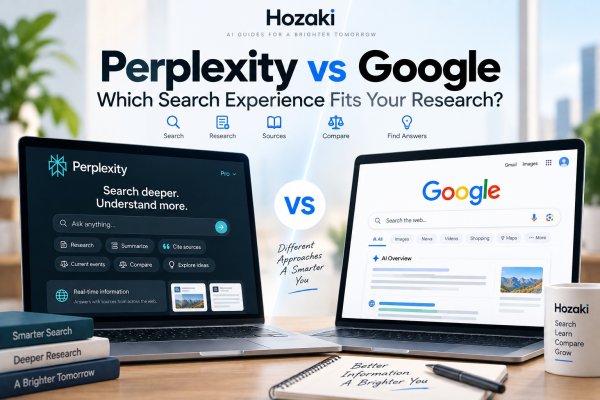
Perplexity approaches that process differently.
Instead of making the search results page the center of the experience, it can search for information, synthesize what it finds and present a direct answer with citations you can inspect.
At first, that makes the Perplexity vs Google comparison sound simple:
Google helps you find webpages.
Perplexity gives you answers.
But that distinction is becoming outdated.
Google Search now includes increasingly conversational AI experiences that can answer complex questions, surface supporting links and continue through follow-up questions.
Perplexity, meanwhile, has expanded beyond basic question answering into deeper research and multi-step AI workflows.
So the useful question is no longer:
Which one gives AI answers?
Both can.
The more useful question is:
Which information workflow fits what you're trying to accomplish?
Perplexity vs Google: The Short Answer
Perplexity and Google both help users discover information from the web, but they organize that experience differently.
Perplexity is built around an AI-first answer and research workflow.
You ask a question, it searches relevant information, generates a response and provides citations that allow you to inspect the underlying sources.
Google is built around a much broader search and discovery ecosystem.
Depending on the query, Google can help you access:
- Webpages
- AI-generated answers
- Images
- Videos
- Maps
- Local businesses
- News
- Products
- Shopping information
- Forums
- Original sources
Google has also become increasingly conversational, reducing the old distinction between a traditional search engine and an AI answer engine.
In practice, Perplexity often feels like:
Ask → Search → Synthesize → Cite → Follow Up
Google often feels more like:
Search → Discover → Explore → Refine
But modern versions of both products increasingly overlap.
What Is Perplexity?
Perplexity is an AI-powered answer and research platform built around retrieving information and generating source-backed responses.
Instead of simply returning a conventional list of search results, Perplexity can combine information from multiple sources into a direct response.
A typical interaction might look like:
What factors are currently affecting lithium prices?
Perplexity can search for relevant information, summarize the major factors and attach citations to statements in the response.
You can then ask:
Which of these factors has changed most over the last year?
And continue:
Find recent evidence supporting that.
This makes search part of a larger conversational research process.
Perplexity also supports deeper research workflows for questions that require broader investigation rather than a single quick answer.
Is Perplexity a Search Engine?
Perplexity performs many functions people traditionally associate with search engines, but describing it only as a traditional search engine doesn't capture the full experience.
Traditional web search usually centers on retrieving and ranking documents.
Perplexity places more emphasis on:
- Understanding the question
- Retrieving relevant information
- Synthesizing sources
- Generating an answer
- Providing citations
- Supporting follow-up questions
This is why Perplexity is often described as an AI answer engine.
The distinction matters because the user isn't always expected to build the answer manually from a page of results.
The AI performs part of that synthesis.
How Is Perplexity Different From Traditional Search?
Consider a research question:
Why have electricity prices changed in Europe?
A traditional search workflow might look like:
Search query
↓
Search results
↓
Open several articles
↓
Read
↓
Compare
↓
Build your conclusion
An AI answer workflow can look more like:
Question
↓
Retrieve relevant sources
↓
Analyze information
↓
Generate synthesis
↓
Attach citations
↓
Ask follow-up questions
The second approach can reduce the amount of manual searching required to understand a topic.
But it introduces another responsibility.
You need to evaluate whether the generated synthesis accurately represents the sources.
That becomes one of the most important differences between searching and AI-assisted research.
How Google Search Works
Google Search operates on a much broader information-discovery system.
At a simplified level, Google discovers web content, indexes information and uses ranking systems to determine what may be useful for a particular query.
But the visible search experience now extends far beyond a list of webpages.
Depending on what you search for, Google may display:
- Traditional search results
- AI-generated information
- News
- Images
- Videos
- Maps
- Shopping results
- Local businesses
- Knowledge information
- Discussions
- Other specialized results
Google's AI search experiences also allow users to ask increasingly complex questions and continue with follow-ups.
This is important because comparing Perplexity with an older version of Google Search produces the wrong conclusion.
Both platforms now combine search with AI.
They simply arrive there from different starting points.
Perplexity vs Google for Simple Searches
Not every question needs AI synthesis.
Suppose you search:
YouTube
You probably aren't looking for an explanation of what YouTube is.
You want the website.
Or consider:
Python documentation
Again, the useful result may simply be a direct link to the official documentation.
The same applies to many searches involving:
- Login pages
- Known websites
- Official documentation
- Brand pages
- Simple navigation
For these tasks, generating a synthesized answer can create an unnecessary step.
Sometimes the most useful search result really is just a link.
Perplexity vs Google for Complex Questions
The difference becomes more interesting as questions become more complicated.
Consider:
What factors caused lithium prices to decline, and how has that affected electric vehicle battery costs?
This isn't simply a navigational query.
You need several pieces of information:
- Lithium supply
- Demand
- Commodity prices
- Battery manufacturing
- EV market trends
- Time-sensitive evidence
Google can help you discover reports, news articles, industry analysis and primary sources covering each part of the question.
Perplexity can help retrieve relevant material and combine it into an initial synthesis.
You can then continue:
Which factors appear most important?
Or:
Show me the sources behind the claim about battery costs.
For exploratory research, that conversational progression can reduce friction.
Perplexity vs Google for Research
Research isn't one activity.
It usually involves several stages.
You may need to:
- Understand the topic.
- Identify useful terminology.
- Find relevant sources.
- Compare evidence.
- Identify disagreements.
- Verify claims.
- Organize findings.
Google and Perplexity can contribute differently across those stages.
Google is particularly useful for broad source discovery.
You can explore different websites, publishers, academic material, government sources and perspectives directly.
Perplexity can reduce the work required to form an initial picture of the topic.
For example, you might ask:
What are the main competing explanations for declining bee populations?
Then:
Which explanations have the strongest recent evidence?
Then:
Find primary research for each one.
That creates a research path instead of a sequence of isolated searches.
Which Is Better for Finding Sources?
Perplexity makes sources unusually visible because citations are integrated into the answer experience.
That is useful.
If a statement says:
Recent studies have found...
you can inspect the citation rather than wondering where the information came from.
But an important rule still applies:
A citation isn't automatically proof that a claim is correct.
You need to check whether:
- The source actually supports the statement
- The source is current enough
- The publication is credible for the claim
- The citation points to original evidence
- Important context was omitted
- The AI interpreted the source correctly
Google takes a different approach.
Instead of starting with synthesis, it gives users extensive ways to discover the underlying web itself.
For research where the source is more important than the summary, that direct discovery process can be extremely useful.
Citation Does Not Mean Verified
This deserves special attention because citation-heavy AI answers can create a strong impression of reliability.
Imagine an AI answer says:
Remote workers are 18% more productive than office workers. [1]
The citation makes the statement look well supported.
But opening Source 1 might reveal that:
- The study measured a different population
- The number referred to one company
- The research is several years old
- The study measured output rather than overall productivity
- The source doesn't contain the 18% figure at all
This is why good research requires more than checking whether a citation exists.
You need to ask:
Does this source actually support this claim?
That principle applies to Perplexity, ChatGPT, Google AI results and any other AI system that provides source links.
Perplexity vs Google for Current Information
Both platforms can work with current web information.
That makes them useful for topics such as:
- Recent news
- Product announcements
- Software updates
- Market changes
- Current events
- New research
But freshness still needs to be evaluated.
A search result can be old.
An AI answer can retrieve an old source.
A recently published article can itself rely on outdated information.
For time-sensitive questions, check:
Publication date
Event date
Source
Whether newer information exists
This is particularly important in fast-moving areas such as artificial intelligence, software and technology.
Perplexity vs Google for News
News is a good example of why search and synthesis aren't identical.
Google can expose users to:
- News publishers
- Original reporting
- Multiple outlets
- Breaking coverage
- Local reporting
- Different perspectives
Perplexity can help answer questions such as:
What happened today in this story?
or:
Summarize the major developments and show me the sources.
That can be useful for quickly understanding an evolving event.
But summaries compress information.
They may remove:
- Uncertainty
- Source disagreements
- Important qualifiers
- Context
- Differences in reporting
For consequential news, the better workflow is often:
Use AI to understand the story
↓
Open original reporting
↓
Compare important claims
Perplexity vs Google for Academic Research
Perplexity can help with early-stage academic research.
For example:
What are the major research questions around microplastics and human health?
It can help identify:
- Terminology
- Themes
- Research directions
- Potential sources
- Follow-up questions
Google can then be used to search for:
- Academic institutions
- Research papers
- Author pages
- Journals
- Government publications
- Research organizations
Google Scholar is also a separate specialized Google service designed around scholarly literature.
Neither general Google Search nor Perplexity should automatically be treated as a replacement for specialized academic databases or systematic-review workflows.
If you're conducting serious academic research, you may also need dedicated tools and databases appropriate to the discipline.
Perplexity vs Google for Finding Primary Sources
Suppose an article says:
A new government report shows a 20% increase.
You could ask Perplexity to find the report.
Or you could search Google using:
site:gov report topic
The important part isn't which interface gets you there.
It's reaching the original evidence.
Primary sources can include:
- Research papers
- Government data
- Official documentation
- Court documents
- Regulatory filings
- Company reports
- Original datasets
- Official announcements
AI synthesis is useful for understanding these sources.
It should not become a reason to stop opening them.
Perplexity vs Google for Follow-Up Questions
Follow-up questions are central to Perplexity's experience.
Suppose you begin with:
What causes coral bleaching?
After receiving an answer, you might ask:
Which cause has become more significant since 2000?
Then:
Find recent research about ocean temperature.
Then:
Are there important studies that disagree?
The context of the investigation carries forward.
Traditional search historically required users to translate each stage into another query.
Google's AI search experiences have narrowed this gap considerably by allowing conversational follow-ups and retaining more context during exploration.
So follow-up conversation is no longer exclusive to AI answer engines.
The difference is increasingly about how central that interaction is to the overall product experience.
Perplexity vs Google for Local Search
Local information is a different kind of search problem.
Suppose you need:
Coffee shops near Shinjuku Station open after 10 p.m.
Google's broader ecosystem includes:
- Maps
- Locations
- Opening hours
- Reviews
- Directions
- Photos
- Business information
Those structured local-search capabilities can be particularly useful.
Perplexity can help with more conversational local questions, especially when several requirements need to be combined.
For example:
Find areas near Shinjuku Station with late-night cafés and explain which neighborhoods are easiest to reach on foot.
But local information changes frequently.
Opening hours, closures and availability should be verified before making plans.
Perplexity vs Google for Shopping
Shopping also combines several different information tasks.
Google can help users discover:
- Retailers
- Product pages
- Prices
- Reviews
- Images
- Shopping results
- Product specifications
Perplexity can help with requirements analysis.
For example:
I need a monitor for programming and photo editing. I care about text clarity and color accuracy more than gaming. What specifications should I prioritize?
Once you understand the requirements, you can investigate specific products.
A sensible workflow might be:
Define needs
↓
Find products
↓
Check current specifications
↓
Check current prices
↓
Compare
↓
Verify before buying
AI can make the comparison easier.
It doesn't make changing prices or specifications permanent.
Perplexity vs Google for Navigational Searches
Navigational searches have a clear destination.
Examples include:
Gmail
GitHub
Wikipedia
Apple Support
OpenAI documentation
The user's goal isn't:
Research this subject for me.
It's:
Take me there.
Traditional search remains naturally suited to this type of query.
This illustrates a useful rule:
The more obvious the destination, the less synthesis you may need.
Perplexity vs Google for Broad Web Exploration
Sometimes browsing itself is valuable.
You may want to see:
- Different opinions
- Independent websites
- Community discussions
- Niche blogs
- Specialist publications
- Unexpected perspectives
A synthesized answer can save time, but synthesis necessarily filters information.
Search results allow you to explore the information environment more directly.
This matters when you're not yet sure what matters.
Research isn't always about getting to the answer as quickly as possible.
Sometimes discovering the landscape is part of the work.
How Reliable Are Perplexity Citations?
Perplexity's citation-first interface makes verification easier than an AI answer with no visible sources.
But citation quality can vary.
When evaluating a citation, consider five questions.
Is the Source Relevant?
Does it actually discuss the claim?
Is It Current?
Could the information have changed?
Is It Authoritative?
Is the source appropriate for this particular subject?
Is It Primary?
Is there a closer original source?
Does It Support the Exact Claim?
This is the most important question.
A citation can be related to the topic without proving the sentence attached to it.
Can Perplexity Hallucinate?
Any generative AI system can produce inaccurate or unsupported output.
Web retrieval can help ground an answer in current information, but retrieval doesn't eliminate every possible failure.
Problems can still occur during:
- Source selection
- Interpretation
- Synthesis
- Citation matching
- Reasoning
- Generation
For example, an AI system could retrieve three accurate sources and still draw a conclusion that none of them supports.
That's why:
Web-grounded
doesn't mean:
guaranteed correct.
The presence of sources improves transparency.
Verification remains necessary when accuracy matters.
Is Google Automatically More Reliable Because It Shows Websites?
No.
A webpage isn't automatically correct simply because a search engine indexed it.
Search results can include:
- Outdated content
- Weak sources
- Incorrect claims
- Commercially motivated content
- Poorly supported opinions
- AI-generated material
- SEO pages written primarily to attract traffic
Google's ranking systems attempt to surface useful information, but users still need to evaluate what they read.
So Perplexity and Google expose users to different information risks.
With an AI answer, the risk may be incorrect synthesis.
With conventional search, the risk may be selecting a poor source.
Neither tool removes the need for source judgment.
Perplexity vs Google for Fact-Checking
Suppose someone claims:
Company X became the world's largest battery manufacturer in 2025.
Don't simply ask:
Is this true?
and accept the first answer.
Instead, break the verification process down.
Identify the Exact Claim
What does "largest" mean?
Revenue?
Production capacity?
Units shipped?
Market share?
Find Strong Sources
Look for:
- Company filings
- Industry data
- Original reports
- Credible research
- Regulatory information
Compare Evidence
Do different sources use the same measurement?
Check Dates
Could the ranking have changed?
Reach a Conclusion Based on Evidence
The search tool helps you find evidence.
The evidence determines whether the claim holds up.
When Perplexity Makes Sense
Perplexity's workflow can be particularly useful when you need to quickly develop an understanding of a topic.
Examples include:
Exploratory Research
You don't yet know the terminology or important subtopics.
Source-Backed Summaries
You want an overview while retaining access to supporting links.
Complex Questions
The question requires information from several sources.
Follow-Up Investigation
Each answer creates the next question.
Fast Synthesis
You want help combining multiple pieces of information into a coherent starting point.
The key phrase is:
starting point.
For important research, synthesis should lead toward evidence rather than replace it.
When Google Search Makes Sense
Google can be particularly useful when the goal is discovery, navigation or exploring the web directly.
Examples include:
Finding a Known Website
You know where you're trying to go.
Local Search
Maps, directions, businesses and reviews matter.
Shopping Discovery
You want current products, retailers and prices.
Image and Video Search
The content format itself matters.
Finding Original Sources
You want to inspect documents directly.
Exploring Multiple Perspectives
You don't want an AI system to synthesize everything before you've seen the source landscape.
Broad Web Discovery
You want to find material you didn't already know existed.
Why Researchers May Want Both
A strong research workflow doesn't require loyalty to one search interface.
You can use different tools for different stages.
Step 1: Explore With Perplexity
Ask a broad research question.
Identify:
- Important concepts
- Terminology
- Potential sources
- Areas of disagreement
Step 2: Broaden With Google
Search the terminology you've discovered.
Look for:
- Primary sources
- Alternative perspectives
- Specialist publications
- Research not included in the first answer
Step 3: Read Original Evidence
Don't stop at snippets or summaries.
Open the important sources.
Step 4: Use AI to Synthesize
Ask AI to:
- Compare evidence
- Build tables
- Identify disagreements
- Explain terminology
- Organize notes
Step 5: Verify the Final Claims
Before relying on an important statement, trace it back to the evidence.
This creates a much stronger process:
Discover → Retrieve → Read → Synthesize → Verify
Perplexity vs Google: Key Differences
| Area | Perplexity | |
|---|---|---|
| Core experience | AI answer and research workflow | Broad search and discovery ecosystem |
| Web retrieval | Central to the experience | Fundamental to Search |
| Generated answers | Central interface | Integrated through AI search experiences |
| Citations and links | Integrated into generated answers | Links appear throughout search and AI experiences |
| Follow-up questions | Core conversational workflow | Supported through AI search experiences |
| Traditional web results | Less central to the experience | Major part of Search |
| Source discovery | Integrated with synthesis | Major strength |
| Research synthesis | Central use case | Increasingly integrated |
| Local search | More conversational | Deep Maps and local ecosystem |
| Shopping | Useful for research and comparison | Dedicated search and shopping ecosystem |
| Navigation | Possible | Natural strength |
| Images and videos | AI capabilities available | Broad dedicated discovery surfaces |
| Primary-source discovery | Can locate and cite sources | Strong direct discovery workflow |
| Main information risk | Incorrect synthesis or citation interpretation | Source quality and selection can vary |
Perplexity vs Google vs ChatGPT
Perplexity isn't the only AI product changing how people search.
ChatGPT also supports web search and source-backed research workflows.
That creates three overlapping approaches.
Think:
Discover the web.
Google combines conventional search, specialized search surfaces and increasingly sophisticated AI experiences.
Perplexity
Think:
Research the web through a source-oriented AI answer interface.
Search, synthesis and citations are central to the experience.
ChatGPT
Think:
Work with information through a general-purpose conversational AI.
Web search is one capability within a broader environment that can also involve writing, coding, documents, analysis and other tasks.
These aren't rigid categories.
All three continue to evolve.
The more useful distinction is what you're trying to accomplish after entering the question.
Is Perplexity Better Than Google?
There isn't one useful universal answer.
Consider three searches:
Amazon
Restaurants near Tokyo Station
Explain the latest research on solid-state batteries and show me the sources.
They represent completely different information problems.
The first is navigation.
The second relies heavily on local information.
The third requires research and synthesis.
Trying to declare one search experience universally superior ignores those differences.
A better question is:
Do I need navigation, discovery, synthesis, source inspection or a combination of them?
That makes the choice much easier.
Frequently Asked Questions
Is Perplexity a search engine?
Perplexity combines web search and retrieval with generative AI to produce source-backed answers. It is commonly described as an AI answer engine rather than a conventional search engine.
Is Perplexity better than Google?
That depends on the task. Perplexity emphasizes conversational, cited synthesis, while Google provides a broader search ecosystem covering web discovery, AI search, Maps, shopping, images, video, news and other search experiences.
Does Perplexity use the internet?
Yes. Web retrieval is central to Perplexity's answer and research experience.
Does Perplexity use Google Search?
You shouldn't assume that Perplexity simply sends every query to Google. Perplexity operates its own search and retrieval infrastructure and develops technology for web retrieval and ranking.
Is Perplexity more accurate than Google?
There is no useful universal accuracy comparison. Perplexity can make errors while synthesizing information, and Google can surface webpages containing inaccurate or outdated claims. Reliability depends on the question, source quality and verification process.
Can Perplexity hallucinate?
Yes. Web retrieval and citations can ground AI responses, but generative systems can still misinterpret sources, make unsupported inferences or generate inaccurate information.
Are Perplexity citations reliable?
Citations make the underlying sources easier to inspect, but each citation should still be evaluated. Check whether the source is credible, current and actually supports the claim.
Is Perplexity good for research?
It can be useful for exploratory research, source discovery, synthesis and follow-up questions. For rigorous research, important claims should still be checked against original evidence and appropriate specialized databases.
Can Perplexity replace Google?
The products overlap, but their broader ecosystems and information workflows remain different. Some tasks are primarily navigational or local, while others benefit from AI-assisted research and synthesis.
Is Perplexity better than ChatGPT for search?
Perplexity is strongly centered on web research and cited answers, while ChatGPT is a broader conversational AI environment in which web search is one capability. Which experience fits better depends on the task.
Should students use Perplexity or Google?
Both can support research and learning. Students should use AI-generated summaries as starting points, inspect original sources and follow their school's policies regarding AI-assisted work.
A Better Way to Think About Perplexity vs Google
Perplexity vs Google isn't really a battle between:
AI
and:
search.
Google itself now uses generative AI extensively.
Perplexity itself depends heavily on search and retrieval.
The more meaningful difference is the workflow.
Perplexity tends to move you toward:
Ask → Retrieve → Synthesize → Cite → Follow Up
Google provides a broader path through:
Search → Discover → Explore → Verify
Those paths increasingly intersect.
For a quick navigational query, you may want nothing more than a search result.
For a complex research question, an AI-generated synthesis with visible sources can save considerable time.
For serious research, you may want both.
Use AI to understand the landscape.
Use search to broaden discovery.
Open the original sources.
Then verify the claims that matter.
The future of finding information is unlikely to be just "search" or just "AI."
For users, the more useful skill is knowing how to combine retrieval, synthesis and verification without confusing any one of them with the truth.
Comments 0