You type:
Why is the sky blue?
A few seconds later, ChatGPT gives you a clear explanation.
It feels simple.
Question in.
Answer out.
But behind that little chat box is a much more interesting process involving language models, tokens, training, context, prediction and—in some situations—external tools and current information.
ChatGPT doesn't search through a giant database containing a prewritten answer to every possible question.
It also doesn't "think" exactly the way a human does.
Instead, it uses a large language model to process your input and generate a response based on patterns, context and available information.
So how does ChatGPT actually work?
Let's follow a question from the moment you press Enter to the moment an answer appears.
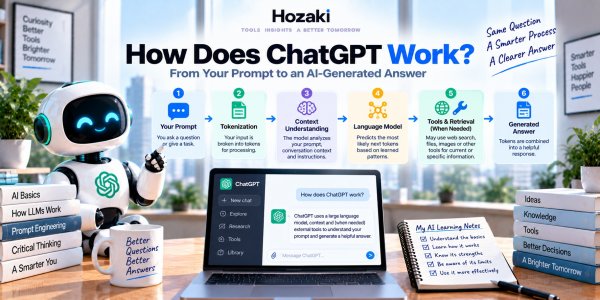
Quick Answer: How Does ChatGPT Work?
At a simplified level, ChatGPT works like this:
You enter a prompt
↓
The input is processed into tokens
↓
A language model analyzes the context
↓
The model predicts useful next tokens
↓
Those predictions build a response
↓
Available tools or external information may be used when needed
↓
You receive the generated answer
The process happens rapidly enough that it feels like a normal conversation.
But understanding each stage explains a lot about what ChatGPT can—and cannot—do.
What Is ChatGPT?
ChatGPT is an AI assistant built around generative AI models that can understand and produce language and work across different kinds of tasks.
Depending on the available capabilities, ChatGPT can help with things such as:
- Answering questions
- Explaining concepts
- Writing
- Coding
- Research
- Documents
- Images
- Data analysis
- Brainstorming
- Problem solving
The word ChatGPT is useful to break apart.
Chat
The system is designed for conversational interaction.
You can ask follow-up questions instead of starting over every time.
GPT
GPT stands for Generative Pre-trained Transformer.
Those three words tell us a lot about how the underlying technology works.
What Does "Generative" Mean?
Generative means the model can produce new output.
For example, you can ask:
Write a short explanation of photosynthesis for a 10-year-old.
The system generates a response appropriate to that request.
It's not limited to choosing one answer from a fixed menu.
Generative AI can create:
- Explanations
- Summaries
- Code
- Outlines
- Stories
- Tables
- Analyses
- Other forms of output
This flexibility is one of its biggest strengths.
It's also one reason accuracy needs attention.
A system capable of generating new text can sometimes generate unsupported text too.
What Does "Pre-Trained" Mean?
Before you ever open ChatGPT, the underlying model has gone through a development and training process.
During training, the model learns patterns from large amounts of data.
This helps it learn relationships involving:
- Language
- Grammar
- Concepts
- Facts
- Code
- Reasoning patterns
- Writing styles
- Relationships between ideas
"Pre-trained" means much of this learning occurs before your particular conversation begins.
Your prompt doesn't train an entirely new model from scratch.
Instead, you're interacting with an already-developed model.
What Does "Transformer" Mean?
A transformer is a type of neural-network architecture that became foundational to modern large language models.
One of its important abilities is processing relationships between pieces of information in context.
Consider:
Sarah put the laptop in her bag because she needed it for work.
To interpret "it," the model needs to understand the surrounding words and their relationships.
Transformers use mechanisms including attention to model relationships within the input.
You don't need to understand the underlying mathematics to use ChatGPT.
The important idea is:
ChatGPT doesn't process each word as if everything around it were irrelevant.
Context matters.
Step 1: You Give ChatGPT a Prompt
Everything begins with your input.
A prompt can be:
Explain quantum computing.
Or much more detailed:
Explain quantum computing to a nontechnical business owner in under 500 words. Compare classical bits and qubits and avoid unnecessary mathematics.
The second prompt gives ChatGPT much more information about:
- Audience
- Length
- Scope
- Style
- Required comparison
Prompt quality matters because the model needs to infer less.
Does ChatGPT Understand Your Question?
"Understand" needs some care here.
ChatGPT can process language well enough to identify:
- Intent
- Context
- Relationships
- Instructions
- Relevant concepts
That can look remarkably similar to conversational understanding.
But it shouldn't automatically be assumed to experience meaning or comprehension in exactly the same way humans do.
From a practical user perspective, what matters is that the model can map your input to patterns and representations that allow it to generate relevant responses.
Step 2: Your Prompt Is Broken Into Tokens
Language models don't simply treat every sentence as a list of ordinary dictionary words.
Text is processed into units commonly called tokens.
A token might correspond to:
- A whole word
- Part of a word
- Punctuation
- Another piece of text
For example, a word such as:
unbelievable
might be represented as one or several tokens depending on the tokenizer.
The exact tokenization isn't important for everyday use.
But tokens matter because they are the units the model processes.
Why Do Tokens Matter?
Tokens affect things such as:
- How much context a model can process
- Input length
- Output length
- API usage in some systems
- How text is represented internally
When you hear:
This model has a large context window.
that generally relates to how much tokenized information it can work with at once.
Step 3: ChatGPT Uses Context
Your latest message isn't necessarily the only information available.
ChatGPT may also use relevant context from:
- Earlier messages
- Instructions
- Uploaded material
- Other information available to the interaction
Suppose you say:
My company sells accounting software to small businesses.
Then ask:
Give me five blog ideas for our customers.
ChatGPT understands that "our customers" refers to small businesses using or considering accounting software.
That comes from context.
Why Context Makes ChatGPT Feel Conversational
Traditional search often looks like:
Query
↓
Results
Then you start another query.
ChatGPT can maintain a conversational thread.
You can say:
Make the second idea more practical.
The model can infer what "second idea" refers to from the previous response.
That's a major part of the chat experience.
Step 4: The Model Processes Relationships in the Context
Once the input and context are represented, the model processes relationships between the tokens.
A simplified way to think about this is:
Which parts of the available context matter most for generating the next part of the response?
This is where attention mechanisms become important.
Words and concepts don't all contribute equally.
The model needs to identify useful relationships.
A Simple Attention Example
Consider:
The trophy didn't fit in the suitcase because it was too large.
What was too large?
Probably the trophy.
Now:
The trophy didn't fit in the suitcase because it was too small.
What was too small?
Probably the suitcase.
The words are similar.
The relationships change the interpretation.
Modern language models are designed to model these kinds of contextual relationships at very large scale.
Step 5: ChatGPT Predicts What Comes Next
This is one of the most important concepts.
At its core, a language model generates text by predicting likely next tokens based on the context.
Suppose we begin:
The capital of France is...
A likely continuation is:
Paris
Then the model generates the next token.
And another.
And another.
Very rapidly.
Until a complete response emerges.
Is ChatGPT "Just Predicting the Next Word"?
You'll often hear:
ChatGPT is just autocomplete.
That's useful as a starting intuition, but it's also too simplistic.
Modern language models perform next-token prediction using extremely complex learned representations.
Those capabilities can support:
- Explanation
- Translation
- Coding
- Summarization
- Reasoning
- Planning
- Classification
- Analysis
So yes, token prediction is central.
But comparing modern LLMs to the autocomplete on an old smartphone dramatically understates what the learned system can do.
Step 6: The Response Is Generated Token by Token
ChatGPT doesn't necessarily write the entire response somewhere internally and then reveal it.
Output can be generated progressively.
That's why you often see text appear as if it's being typed.
Conceptually:
Context
↓
Predict token
↓
Add token to context
↓
Predict next token
↓
Repeat
This continues until the response is complete.
Why Can ChatGPT Give Different Answers to the Same Question?
Generation isn't always perfectly deterministic.
Different outputs can result from:
- Prompt wording
- Context
- Model configuration
- Available tools
- Retrieved information
- Generation behavior
For example:
Give me five names for a coffee shop.
There's no reason the system must always produce the exact same five names.
Variation is useful for creative tasks.
For factual tasks, however, we care much more about grounding and verification.
Step 7: ChatGPT May Use External Tools
Modern AI assistants aren't limited to what the language model itself can generate.
Depending on the task and available capabilities, ChatGPT may work with tools.
Examples can include:
- Web information
- Calculations
- Files
- Data analysis
- Other specialized capabilities
This matters because different problems need different tools.
Why Not Make the Language Model Do Everything?
Imagine asking:
What is the weather in Tokyo right now?
A language model's previously learned information cannot tell you today's live weather.
You need current data.
Or:
Analyze this spreadsheet containing 100,000 rows.
Specialized data-processing capabilities may be more appropriate than relying only on language generation.
This leads to a useful principle:
Language model + appropriate tools can be more capable than language model alone.
Does ChatGPT Search the Internet?
Sometimes current web information can be used when appropriate capabilities are available.
But ChatGPT doesn't need to search the internet for every question.
Ask:
What is a triangle?
No current search is necessary.
Ask:
What happened in AI news today?
Now current information is essential.
We explain this distinction in detail in Does ChatGPT Use the Internet?
Where Does ChatGPT Get Its Information?
This is closely related, but it's a different question.
Information available to an answer can come from several places, including:
- Model training
- Conversation context
- User-provided material
- Current retrieval
- Tools
- Authorized connected sources
Our Where Does ChatGPT Get Its Information? guide breaks these information layers down in detail.
Does ChatGPT Have a Database of Answers?
Not in the simple sense many people imagine.
Think of a traditional database:
Question
↓
Find matching record
↓
Return stored answer
A generative model works differently.
It generates an answer based on learned patterns and available context.
This allows ChatGPT to respond to questions it has never seen in exactly the same form before.
How Was ChatGPT Trained?
At a very high level, language-model development involves learning patterns from large amounts of data.
During pre-training, the model learns to predict missing or subsequent pieces of information.
Over enormous numbers of examples, this helps it develop useful representations of language and concepts.
But pre-training alone isn't the whole story.
Models can undergo additional development to make them more useful for interaction.
What Is Fine-Tuning?
Fine-tuning broadly refers to additional training or adaptation after initial pre-training.
The goal can include improving behavior for particular tasks or desired response characteristics.
Rather than learning language entirely from scratch, the already-trained model is further adapted.
What Is Human Feedback Used For?
Human feedback has played an important role in the development of conversational AI systems.
Humans can evaluate responses and help training processes distinguish between outputs that are more or less useful.
This can help systems become better at:
- Following instructions
- Producing useful responses
- Avoiding some undesirable behaviors
- Interacting conversationally
The exact training techniques can differ across model generations.
Does ChatGPT Think Like a Human?
Not in a straightforward sense.
Humans have:
- Biological brains
- Sensory experiences
- Personal histories
- Emotions
- Physical interaction with the world
Language models operate differently.
They process representations and generate outputs through computational systems.
That doesn't make their capabilities trivial.
It means we should be careful about assuming that human words such as:
- Think
- Know
- Understand
- Remember
map perfectly onto AI mechanisms.
Does ChatGPT Actually Reason?
ChatGPT can perform tasks that require reasoning-like operations.
For example:
If a train travels 60 miles per hour for 2.5 hours, how far does it travel?
It can work through the relationship and answer 150 miles.
Modern models can also handle substantially more complex tasks.
But reasoning performance isn't perfect.
Models can make:
- Logic errors
- Arithmetic mistakes
- False assumptions
- Unsupported leaps
So reasoning ability doesn't eliminate the need for verification.
Why Is ChatGPT So Good at Language?
Scale is one major factor.
During development, large language models learn from huge numbers of examples involving how language is structured and how concepts relate.
They learn patterns involving:
- Syntax
- Semantics
- Style
- Structure
- Context
- Common reasoning patterns
This allows a model to generalize to prompts that may never have appeared exactly during training.
How Does ChatGPT Answer Questions It Has Never Seen Before?
This is one of the most interesting parts.
Suppose nobody trained the model on the exact sentence:
Explain inflation using an imaginary pizza shop run by penguins.
ChatGPT can still produce an answer.
Why?
Because it can combine learned patterns involving:
- Inflation
- Pizza shops
- Penguins
- Explanations
- Storytelling
Generative AI can recombine learned capabilities in new ways.
That's why prompt flexibility is so powerful.
How Does ChatGPT Write Code?
Code is also structured information.
During development, models can learn patterns involving:
- Programming languages
- Syntax
- Functions
- Libraries
- Common algorithms
- Debugging patterns
When you ask:
Write a Python function that removes duplicates from a list.
the model generates code based on those learned relationships and the context of your request.
But generated code isn't automatically correct.
It should still be tested.
How Does ChatGPT Summarize Documents?
When you provide a document, its contents can become part of the context available for analysis.
The model can identify:
- Important concepts
- Repeated themes
- Key claims
- Relationships
- Relevant sections
and generate a condensed representation.
But summarization can fail if:
- The document is poorly extracted
- Important information is in tables
- Context is missed
- The document is too complex
- The prompt is vague
See How to Summarize a PDF With AI for a more reliable workflow.
How Does ChatGPT Work With Images?
Multimodal AI systems can process more than text.
Depending on the model and capabilities, visual information can be represented in a form the system can reason over alongside language.
This enables tasks such as:
- Image description
- Chart explanation
- Screenshot analysis
- Visual question answering
Again, this doesn't imply perfect visual perception.
Poor image quality or ambiguous details can still produce errors.
How Does ChatGPT Remember What I Said?
Within a conversation, relevant earlier information can remain part of the available context.
That's why you can say:
My dog's name is Max.
and later ask:
What name did I tell you?
The model can use the earlier message.
Some ChatGPT experiences may also include product-level memory features.
That's different from ordinary conversation context, and it deserves a separate explanation.
We'll cover that in Does ChatGPT Remember Conversations?
Does ChatGPT Learn From Every Conversation?
Conversation context and model training shouldn't be treated as the same thing.
ChatGPT can adapt its answer based on what you tell it during an interaction.
That doesn't mean the underlying model is being retrained from scratch after every message.
This distinction is important enough that we'll cover it separately in Does ChatGPT Learn From Users?
Why Does ChatGPT Make Mistakes?
Now we reach the weakness created by the same mechanism that makes generative AI flexible.
The model is generating a plausible response.
It isn't simply retrieving guaranteed facts from a perfect database.
Problems can arise from:
- Missing information
- Ambiguous questions
- Incorrect assumptions
- Outdated information
- Reasoning errors
- Retrieval failures
- Unsupported generation
This can produce AI hallucinations.
What Is an AI Hallucination?
An AI hallucination occurs when a generative system produces information that appears plausible but is inaccurate, unsupported or fabricated.
For example:
A 2024 MIT study involving 14,000 participants found...
Sounds convincing.
But what if that study doesn't exist?
That's why factual-looking output needs appropriate verification.
See What Is an AI Hallucination? for examples.
Why Does ChatGPT Hallucinate?
Next-token generation is optimized to produce useful continuations, not to function as a perfect factual database.
If the model lacks sufficient grounding, it may sometimes produce a plausible continuation instead of correctly expressing uncertainty.
Other factors can contribute too, including:
- Prompt ambiguity
- False premises
- Retrieval problems
- Complex reasoning
- Conflicting evidence
See Why Does AI Hallucinate? for the full explanation.
Does Web Search Stop Hallucinations?
No.
Web access can help by providing current external evidence.
But the AI can still:
- Choose a poor source
- Misread information
- Miss context
- Combine incompatible facts
- Draw the wrong conclusion
So:
retrieval improves grounding
but:
retrieval does not guarantee truth
This is why fact-checking remains important.
How Accurate Is ChatGPT?
There is no useful universal accuracy percentage.
Performance varies depending on:
- Task
- Model
- Prompt
- Context
- Tools
- Source quality
- Information freshness
ChatGPT might perform very well on one benchmark or task and less reliably on another.
See How Accurate Is ChatGPT? for a task-by-task breakdown.
Can You Trust ChatGPT?
A better approach than giving ChatGPT one universal trust score is to consider the consequence of the task.
For:
Give me ten birthday party ideas.
the cost of an error is low.
For:
Interpret this important medical result.
the stakes are much higher.
Verification should increase with consequence.
Our Can You Trust ChatGPT? guide provides a practical framework.
How to Get Better ChatGPT Answers
Understanding how ChatGPT works immediately gives you several practical advantages.
Give Clear Context
Instead of:
Write an email.
Use:
Write a short follow-up email to a B2B prospect who received our quotation three days ago but hasn't replied. Keep it professional and under 120 words.
Define the Goal
Tell the model what success looks like.
Provide Source Material
If the answer should come from a document, provide the document.
Ask for Current Sources
If freshness matters, say so.
Allow Uncertainty
Tell ChatGPT not to guess.
Verify Important Claims
Especially:
- Statistics
- Quotes
- Dates
- Citations
- Current information
Better input and better verification produce a much stronger workflow.
A Simple Model of How ChatGPT Works
If you remember only one diagram from this article, make it this:
YOUR PROMPT
↓
TOKENIZATION
↓
CONTEXT
↓
LANGUAGE MODEL
↓
PREDICTION
↓
TOOLS / RETRIEVAL WHEN NEEDED
↓
GENERATED RESPONSE
↓
YOUR VERIFICATION
That last step matters.
The user is still part of the system.
ChatGPT Is Better Understood as a System, Not Just a Model
This is becoming increasingly important.
When people say:
ChatGPT did this.
they may actually be describing the combined behavior of:
- A language model
- System instructions
- Conversation context
- Tools
- Search
- Files
- Other capabilities
So ChatGPT as a product can do things that aren't explained solely by saying:
It's a language model.
The model is the core engine.
The surrounding system expands what that engine can do.
Frequently Asked Questions
How does ChatGPT work in simple terms?
ChatGPT processes your prompt and context using a generative AI model, then produces a response by generating tokens based on learned patterns and available information. Additional tools or current information may also be used when appropriate.
What does GPT stand for?
GPT stands for Generative Pre-trained Transformer.
Does ChatGPT search the internet for answers?
Not for every question. Current web information can be used when appropriate capabilities are available and the task requires fresh information.
Does ChatGPT have a database of answers?
Not in the conventional sense of storing a prewritten answer for every possible question. It generates responses based on learned patterns and available context.
How does ChatGPT understand questions?
It processes tokens and their contextual relationships to infer the intent and relevant concepts needed to generate a response.
How does ChatGPT generate answers?
The underlying language model generates tokens sequentially based on the prompt, context and other information available to the system.
Is ChatGPT just predicting the next word?
Next-token prediction is fundamental to language models, but modern models use complex learned representations that support capabilities far beyond simple phone-style autocomplete.
Does ChatGPT think like a human?
ChatGPT's computational processes are different from human cognition. Human mental concepts shouldn't automatically be assumed to map directly onto AI mechanisms.
Does ChatGPT remember conversations?
It can use relevant conversation context, and some product experiences may have additional memory functionality. Conversation context and persistent memory are different concepts.
Does ChatGPT learn from users?
Using information during a conversation isn't the same as retraining the underlying model in real time. Data practices and model development are separate topics.
Why does ChatGPT sometimes give wrong answers?
Errors can result from missing context, ambiguous prompts, outdated information, reasoning mistakes, retrieval problems or hallucinations.
Can ChatGPT use tools?
Depending on the available capabilities, ChatGPT can work with tools and external information to perform tasks that go beyond pure text generation.
Continue Exploring
Where Does ChatGPT Get Its Information?
Learn how training, conversation context, files, current retrieval and tools contribute to AI answers.
Does ChatGPT Use the Internet?
Understand when ChatGPT can work with current web information and when it doesn't need to search.
How Accurate Is ChatGPT?
Explore where ChatGPT tends to perform well and where verification becomes important.
Can You Trust ChatGPT?
Learn when AI answers can be used with basic review and when stronger verification is necessary.
What Is an AI Hallucination?
Understand why AI can produce convincing information that isn't actually supported.
Why Does AI Hallucinate?
Explore the mechanisms and situations behind inaccurate AI-generated information.
How to Reduce AI Hallucinations
Learn practical methods for producing more grounded AI answers.
How to Fact-Check AI Answers
Build a workflow for checking AI-generated facts, statistics, sources and citations.
How to Use AI for Research
Learn how to combine AI assistance with original evidence and verification.
Best AI Tools in 2026
Explore AI tools for research, writing, coding, documents, images and productivity.
Comments 0