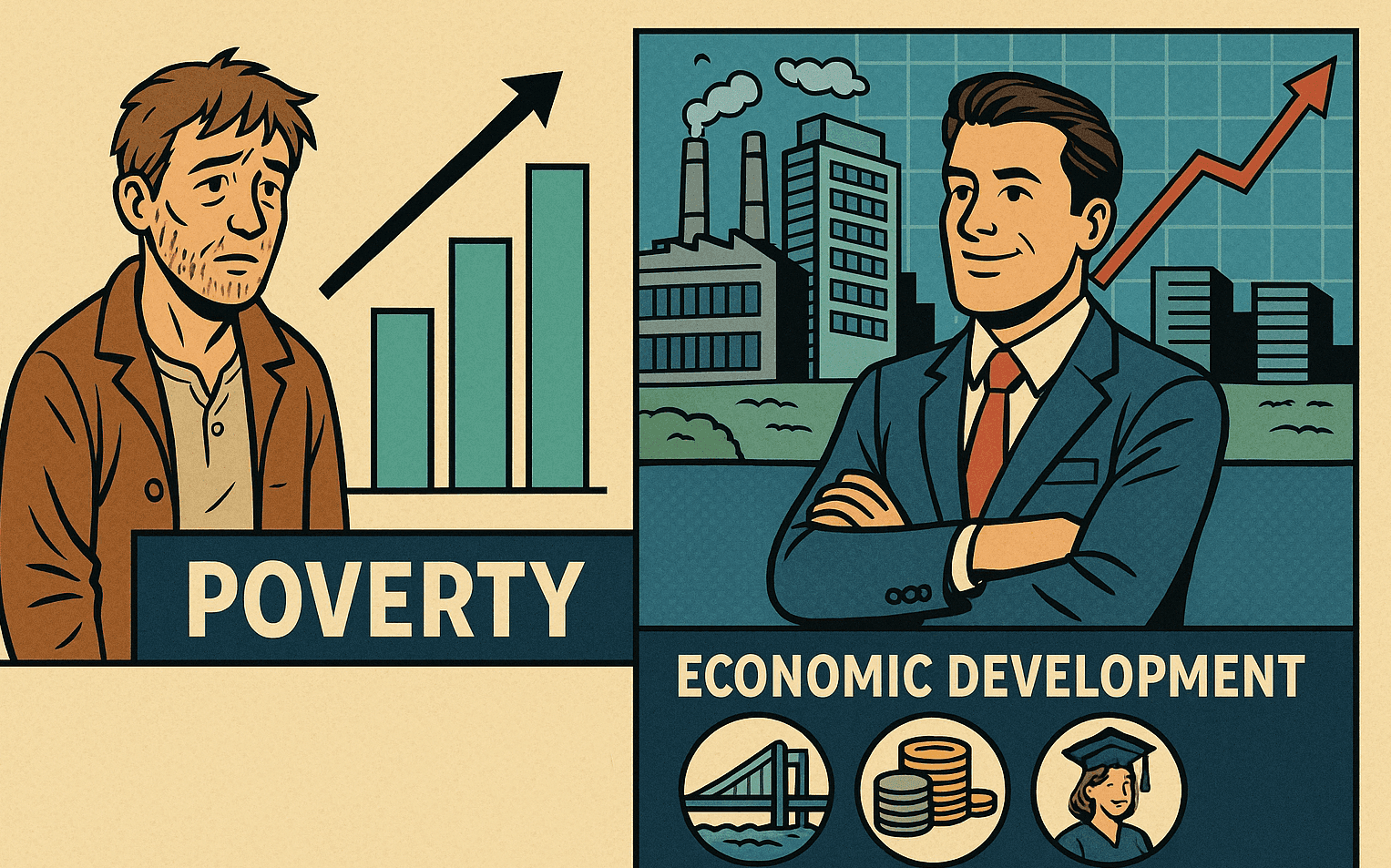
Why 700 Million People Still Live on Less Than $2.15 a Day
In 2022, the World Bank estimated that roughly 712 million people survived on less than $2.15 per day in purchasing-power-parity terms. That figure had been falling for three decades, dropping from 1.9 billion in 1990, but the COVID-19 pandemic reversed years of progress in a single quarter. Between March and June 2020, an estimated 70 million people fell back into extreme poverty as lockdowns shut informal markets, remittance corridors dried up, and health systems buckled. The number matters, but the texture matters more. Poverty is not one shortage. It is a tangle of deprivations that reinforce each other: unreliable meals, unsafe water, weak schools, distant clinics, no collateral, and zero margin for absorbing a shock without losing what little you have built.
Economic development is the coordinated push that untangles that web. It raises productivity, widens opportunity, and builds systems strong enough to carry households over setbacks instead of letting setbacks erase years of gains. Think of it as five levers that must turn at the same time: jobs that pay a living wage, human capital that qualifies people for those jobs, infrastructure connecting producers to markets, rules that keep transactions honest, and safety nets that prevent one bad season from becoming a permanent exit from the workforce. Miss a single lever and the whole flywheel stalls.
712 M — People living in extreme poverty (below $2.15/day) as of 2022 - down from 1.9 billion in 1990, but still rising since 2019
Measuring Poverty: Why the Yardstick Shapes the Policy
Before proposing fixes, fix the measurement. Absolute poverty lines ask whether a person can afford a basic basket of food and nonfood essentials. The World Bank's international poverty line of $2.15 per day (updated from $1.90 in September 2022) converts local prices into comparable purchasing-power units so you can track progress across countries. Relative poverty lines set the bar as a fraction of median income inside a single country, capturing social exclusion even in wealthier settings. The European Union, for instance, flags anyone living below 60% of their nation's median equivalized income. Both lenses are useful. Absolute lines tell you whether families can afford calories, shelter, and a basic clinic visit. Relative lines tell you whether a child can show up at school with the tools their classmates take for granted.
One number hides depth. The headcount ratio says what share of people falls below the line. The poverty gap index shows how far below the line they sit on average, measured as a percentage of the threshold. The squared poverty gap weights the very poorest more heavily, penalizing deeper deprivation. These distinctions matter for budgeting. If most households cluster just below the line, a modest cash transfer or tax credit can push them over. If many are far below, the outlay climbs and the timeline stretches.
Threshold: Fixed basket of goods (World Bank: $2.15/day PPP). Comparable across countries. Tells you who cannot afford basic survival needs. Best for tracking global progress and allocating international aid budgets.
Threshold: Percentage of national median income (EU uses 60%). Shifts as a country grows richer. Tells you who is excluded from normal participation in their own society. Best for domestic policy design in middle- and high-income countries.
Income alone does not capture every constraint. A household can earn just enough cash and still be deprived across multiple dimensions. That reality motivated the Multidimensional Poverty Index (MPI), developed by the Oxford Poverty and Human Development Initiative and the UN Development Programme. It tracks deprivations in ten indicators spanning health, education, and living standards: nutrition, child mortality, years of schooling, school attendance, cooking fuel, sanitation, drinking water, electricity, housing quality, and assets. As of the 2023 global MPI report, about 1.1 billion people were multidimensionally poor across 110 countries, and nearly two-thirds of them lived in middle-income nations, not just the poorest ones. If you want policy that hits the target, use both money metrics and capability metrics. The blend tells you whether to prioritize clinics, roads, crop price support, or direct cash.
How Growth Actually Cuts Poverty: The Production Engine
The most reliable anti-poverty force in economic history is sustained growth in output per worker. More output per hour means more value created, which means more cash at the end of the week. Productivity gains flow through better tools, stronger skills, higher-quality management, and access to bigger markets. China's experience illustrates the scale: between 1990 and 2015, over 750 million Chinese citizens crossed above the extreme poverty line as real GDP per capita grew at roughly 9% annually. India pulled 270 million people out of poverty between 2006 and 2019, with the fastest reductions in states that attracted manufacturing and service-sector investment.
In countries where half the labor force works on small plots far from paved roads, early gains come from improved seeds, basic machinery, and storage that limits spoilage. As people shift from subsistence farming to towns and small factories, output rises again because workers specialize and firms spread fixed costs over more units. Economists call this structural transformation. You do not need the label to grasp the motion: families move from low-productivity activities into higher-output ones, and the entire distribution of earnings shifts upward.
This transition needs a foundation. Reliable power changes production schedules from daylight-only to round-the-clock. All-weather roads shorten delivery times and widen sales arcs. Ports and border posts that clear goods quickly connect farmers and workshops to buyers beyond the local market. Digital payment rails speed settlement and create transaction histories that serve as informal collateral. These are not glamorous projects. They are the backbone that lifts rural wages and lowers prices for urban households. A 2020 World Bank study across 15 African countries found that every 10% improvement in road quality correlated with a 2.5% reduction in local poverty rates, because transport costs fell and farmers could reach higher-paying buyers before produce spoiled.
Human Capital: Education and Health as Productive Assets
Children who can read fluently by the end of primary school are on a trajectory to absorb new skills throughout their working lives. Children who cannot read at that stage fall behind permanently. UNESCO's 2022 data showed that 57% of ten-year-olds in low- and middle-income countries could not read and understand a simple story, a share that worsened after pandemic school closures. That is why foundational literacy and numeracy sit at the top of any serious development agenda.
You cannot fix everything simultaneously. Fix the basics and lock them in with honest measurement. Short, frequent assessments that teachers use for real-time course correction beat long annual exams whose results arrive after the school year ends. Teacher attendance, peer coaching, and structured lesson plans raise time on task. Where classes are large, scripted teaching guides and small-group tutoring help the average child move from guessing to genuine comprehension.
The World Bank's Human Capital Index estimates that a child born in a low-income country today will, on average, be only 40% as productive as they could be if they received full education and health. In high-income countries, that figure is 80%. Closing this gap would boost GDP in low-income countries by an estimated factor of 1.4 within a generation.
Health pulls in the same direction. A community with functional vaccine programs, clean water, and antenatal care sees fewer missed school days and fewer expensive emergencies. Nutrition in the first 1,000 days from conception to age two affects brain architecture in ways that reverberate across an entire lifetime. Iron deficiency alone reduces cognitive test scores by an average of half a standard deviation. Safe births keep mothers alive to raise their children and remain in the labor force. Public health is not a soft add-on to development strategy. It is payroll support and school performance wearing a lab coat.
Financial Inclusion: Turning Small Surpluses Into Lasting Assets
Households near the poverty line live with volatile cash flows. A late payment from a buyer, a clinic bill for a child's fever, or a broken tool can erase months of slow accumulation. Two financial products change that story dramatically. Basic transaction accounts with no surprise fees let people store value safely and receive payments digitally. Simple insurance products for health emergencies and weather shocks support recovery without forcing distress sales of livestock or equipment.
Mobile money rewrote the playbook in East Africa. Kenya's M-Pesa system, launched in 2007, reached over 50 million active accounts across several countries by 2023. Research published in Science in 2016 found that access to M-Pesa lifted roughly 194,000 Kenyan households (about 2% of the country's total) out of poverty, with the largest effects on female-headed households. The mechanism was straightforward: families could receive remittances faster, save in small increments, and smooth consumption after shocks without selling productive assets.
A smallholder dairy farmer outside Nairobi receives payment for her morning milk delivery via M-Pesa at 10:00 AM. By 10:15, she has paid her children's school fees digitally and set aside KES 200 (about $1.50) into a mobile savings wallet. Six months of those small deposits create a transaction record that qualifies her for a KES 30,000 ($225) micro-loan to buy a second cow. Her daily output doubles, and her household crosses the poverty line within a year. None of this required a bank branch within 40 kilometers of her village.
Credit by itself does not guarantee growth. It must arrive alongside genuine demand for what the borrower produces and with basic coaching on costs and recordkeeping. The strongest programs combine credit with market access. A dairy cooperative that guarantees pickup and sets transparent quality rules makes loans for cattle sensible. A warehouse receipt system that allows maize to be stored and used as collateral makes loans for seed sensible. Finance is a bridge. It has to land on solid ground at both ends.
Property Rights, Contracts, and the Cost of Staying Informal
Secure rights to land and housing encourage families to improve dwellings and invest in fields. Clear titles also enable mortgages and long-term leases that help firms scale up. Hernando de Soto's research, while debated in academic circles, highlighted a striking figure: informal property in developing countries may represent trillions of dollars in "dead capital" that cannot be used as collateral because ownership is not legally recognized. You do not need to survey every square meter to see gains. Even simple, low-cost registries and recognized occupancy permits reduce disputes and bribe demands.
Contract enforcement sits directly beside property rights on the priority list. If resolving a simple commercial dispute takes three years and costs more than the claim is worth, small firms avoid formal contracts and stay small by design. The World Bank's Doing Business surveys (before their discontinuation in 2021) found that countries in the bottom quartile for contract enforcement had 30-40% fewer registered small businesses per capita. Introducing specialized commercial courts, standardized contract templates, and mediation programs shortens timelines and pulls more transactions into the open.
Formality must be achievable without elite connections. One-stop registration portals, time-limited approval windows, published fee schedules, and mobile payment options remove the friction that keeps micro-enterprises in the shadow economy. When the cost of being formal drops below the cost of being informal, businesses register because the benefits, including access to credit, legal protection, and government contracts, visibly outweigh the tax burden.
Gender Gaps Are Not Footnotes
When women lack identification documents, property rights, or safe transport, households lose a potential second earner and the economy loses future entrepreneurs. The numbers are blunt. McKinsey's 2015 estimate pegged the cost of gender inequality at $12 trillion in forgone annual GDP globally. Even conservative academic estimates place the figure in the trillions. Access to affordable childcare and safe commuting options raises female labor force participation and reduces measured poverty because total productive hours per household climb.
Legal reforms that recognize female ownership of assets and allow women to sign contracts or open businesses without a male co-signer double the probability that a new firm forms and survives its first three years. Credit programs that deposit funds into accounts controlled by women raise spending on children's nutrition and education. The data repeat the same finding across dozens of countries and time periods. When constraints on women shrink, household income rises and child health metrics improve. It is common sense and labor market economics arriving at the same conclusion simultaneously.
Agriculture as the First Engine
In many low-income regions, raising yields on small plots delivers the fastest poverty reduction per dollar spent. Farmers respond to three inputs: information on what to plant and when, tools and seed varieties suited to local conditions, and assured markets with fair grading and timely payment. The pivotal institution is agricultural extension that meets farmers in fields, not only in district offices. Demonstration plots beat lectures. Weather and price alerts delivered by phone beat posters nailed to market stalls. Storage that prevents post-harvest losses, which the FAO estimates at 30-40% for some crops in sub-Saharan Africa, and credit that arrives before planting season turn advice into actual output.
Keep your eyes on incentives. If procurement is monopolized by a single buyer with erratic payment schedules, farmer adoption of new techniques will stall. If border rules flip unpredictably, exporters will not build stable relationships with foreign buyers. If counterfeit seed and fertilizer flood the market, yields will disappoint and trust collapses. Governance and last-mile logistics decide whether good agronomy actually translates into higher income.
Urbanization: Climbing the Productivity Ladder
Cities concentrate buyers, suppliers, and workers. That density raises productivity through better matching, knowledge spillovers, and specialization. By 2050, the UN projects that 68% of the world's population will live in urban areas, up from 56% in 2022. But density without planning creates slums far from jobs and choked by traffic. Lagos, Dhaka, and Kinshasa illustrate the pattern: millions of productive people trapped in informal settlements with two-hour commutes and no reliable water.
The tactical moves are conceptually simple and operationally brutal. Zone for employment near transit corridors. Allow mid-rise housing so workers can live near those jobs. Lay sewer and water mains before settlements sprawl outward. Create serviced plots where informal builders can plug into basic infrastructure legally. Give slum upgrading programs real budgets and property documents that underpin household savings. When cities manage these fundamentals, the shift from low-output rural work to higher-output urban employment accelerates, and wages follow the productivity curve upward.
Trade, Regional Markets, and the Hard Math of Logistics
Access to larger markets lets firms spread fixed costs, specialize in what they do best, and ratchet up quality. Regional trade agreements help, but they must be paired with trade facilitation on the ground. Border posts with single-window inspection, harmonized paperwork, and digital pre-clearance cut waiting times from days to hours. Cold chains prevent losses for perishable goods. Standards bodies that test and certify quality on a predictable schedule let small producers bid on cross-border contracts for the first time.
Without this logistical plumbing, grand trade announcements do little for household income. The African Continental Free Trade Area (AfCFTA), launched in 2021, covers 1.3 billion people and a combined GDP of $3.4 trillion. The World Bank estimated it could lift 30 million people out of extreme poverty by 2035, but only if non-tariff barriers fall and transport infrastructure improves. With the plumbing fixes, a farmer's harvest reaches new buyers and a small factory runs a second shift because orders are steady. Without them, the agreement is a signed document gathering dust.
Macroeconomic Stability: The Oxygen Supply
Inflation that swings wildly and exchange rates that lurch unpredictably raise uncertainty and punish wage earners hardest. Stability protects the poor disproportionately because they hold more cash and fewer hedging instruments. When Turkey's annual inflation topped 85% in October 2022, real wages for low-income workers collapsed even as nominal pay rose. When Zimbabwe's hyperinflation peaked in 2008 at an estimated 79.6 billion percent per month, an entire generation's savings vaporized overnight.
Sound fiscal management focused on core services, credible monetary policy, and sustainable public debt trajectories keep inflation low and predictable. The payoff is lower interest rates, longer planning horizons for firms, and less temptation for households to rush purchases or hoard goods. You cannot build long-term social programs if basic prices are moving like a seismograph during an earthquake. Stability is not exciting. It is the oxygen that every other development program breathes.
Social Protection That Prevents Backsliding
Even with robust growth, shocks will hit. Floods, droughts, disease outbreaks, and sudden job losses can shove families back below the poverty line in weeks. Three instruments form the defensive perimeter.
Conditional cash transfers (CCTs) tie regular payments to behaviors that build future human capital, like keeping children enrolled in school and completing vaccination schedules. Brazil's Bolsa Familia program, reaching roughly 14 million families at its peak, contributed to a 28% reduction in extreme poverty between 2001 and 2015, according to World Bank analysis. Mexico's Progresa/Oportunidades (now Prospera) showed similar results and inspired dozens of replications across Latin America, Africa, and South Asia.
Public works programs provide temporary employment that builds community assets while smoothing incomes during lean seasons. Ethiopia's Productive Safety Net Programme (PSNP), one of the largest in Africa, employs about 8 million people annually in activities like terracing hillsides, building feeder roads, and rehabilitating watersheds. Participants earn enough to cover food gaps, and the infrastructure they build raises agricultural productivity for the wider community.
Social pensions protect elderly citizens in settings where formal contributory schemes reach a small minority. South Africa's non-contributory Old Age Grant, worth about $105 per month in 2023, covers over 3.7 million recipients and has measurably improved nutrition and school enrollment among grandchildren living in recipient households.
Effective social protection programs share four features: strong digital identity systems for targeting, reliable payment rails (mobile money or bank transfers, not cash handouts vulnerable to leakage), built-in grievance mechanisms that actually resolve complaints, and clear graduation criteria so households that stabilize can exit the program and free resources for others still climbing.
Climate Risk and Resilience
Poor households face disproportionate climate exposure because they live in floodplains, work outdoors, and farm without irrigation. Adaptation is not an abstract policy term for these families. It is the difference between recovery and ruin. Three defensive lines matter most.
First, information. Early warning systems and seasonal forecasts delivered by phone help farmers adjust planting schedules and help towns evacuate before rivers crest. Bangladesh's Cyclone Preparedness Programme, built over decades after the devastating 1970 Bhola cyclone that killed an estimated 300,000 people, now evacuates millions within hours and has cut storm-related deaths by over 99% compared to events of similar magnitude.
Second, infrastructure. Drainage systems, embankments, drought-tolerant crop varieties, and small-scale irrigation reduce physical damage. The cost-benefit ratio is typically favorable: the Global Commission on Adaptation estimated in 2019 that investing $1.8 trillion in climate adaptation globally between 2020 and 2030 could generate $7.1 trillion in net benefits.
Third, finance. Weather-indexed insurance and emergency cash programs triggered by rainfall or temperature thresholds speed recovery. The African Risk Capacity (ARC) insurance pool, a sovereign disaster risk facility for African Union member states, has disbursed over $115 million since 2014, reaching affected populations weeks faster than traditional humanitarian appeals.
The goal across all three lines is to shrink the variance of outcomes so that a bad season does not erase years of slow, hard-won progress.
State Capability: Delivery Over Proclamation
Grand plans fail when agencies cannot execute. A health ministry that announces universal vaccination but cannot keep refrigerators running at district clinics delivers slogans, not needles. Performance management systems, transparent dashboards, and published service standards turn abstract reform into weekly delivery. Time-bound targets for school attendance, clinic supply chains, road maintenance quality, and business permit processing keep front-line teams focused on outputs rather than paperwork.
Civil service rules that reward competence and insulate professionals from political churn build institutional culture that outlasts electoral cycles. Rwanda's performance contracts (imihigo), which set measurable annual targets for each district and publish results publicly, contributed to the country reducing poverty from 57% in 2006 to 38% in 2017. Anti-corruption efforts that publish contract details and line-item spending data deter theft more effectively than sporadic crackdowns. Citizens need visible, repeated proof that their taxes become functioning services. Without that proof, tax compliance erodes and reforms become campaign slogans.
Data, Evaluation, and Staying Honest About Results
You cannot manage what you cannot measure, and you cannot measure what you do not fund. Household surveys, civil registration systems, and administrative records must be current, representative, and publicly available. Too many countries run their main household survey on a five-year cycle, which means policymakers are steering with a rearview mirror bolted to the windshield.
Use randomized controlled trials (RCTs) where feasible to test program design choices. The Abdul Latif Jameel Poverty Action Lab (J-PAL), founded at MIT in 2003, has run or supported over 1,000 RCTs across 90 countries, generating evidence on topics from deworming to microfinance to teacher incentives. When randomization is not possible, quasi-experimental methods like difference-in-differences and regression discontinuity designs offer credible alternatives.
Track outcomes, not only inputs. School kits shipped is an input. Reading levels by grade is an outcome. Money released to clinics is an input. Postnatal visits completed on schedule is an outcome. Publish results on a fixed calendar. Terminate programs that consistently fail to move core metrics and redirect those funds toward approaches with demonstrated results. That discipline builds public trust and protects scarce budgets from inertia.
Migration, Remittances, and the Links That Speed Development
People move toward opportunity. When they do, money flows home. Global remittance flows to low- and middle-income countries exceeded $656 billion in 2022, dwarfing official development assistance ($204 billion) by more than three to one. In several countries, remittances account for a quarter or more of GDP: Tajikistan (51%), Tonga (44%), Lebanon (36%), and Nepal (24%) among them.
Lower transfer fees directly increase the share that reaches families. The global average cost of sending $200 dropped from about 9.7% in 2011 to 6.2% in 2023, but it remains above the Sustainable Development Goal target of 3%. Mobile money corridors, especially within Africa, now process transfers for under 3.5%, proving the target is achievable. Cities and towns that welcome newcomers with orientation services, document support, and job matching reduce the initial period of informal employment and limit the growth of underserved settlements. Circular migration, where workers move seasonally and return with skills, capital, and commercial contacts, raises productivity in home communities. Respect it. Plan for it.
Aid, Philanthropy, and Alignment with Local Systems
External funding accelerates development when it aligns with domestic priorities and strengthens local institutions. It stalls progress when it bypasses national systems, creates parallel bureaucracies staffed by donor consultants, and evaporates when funding cycles end. The evidence on aid effectiveness is genuinely mixed, and honest analysis requires acknowledging that range.
On one hand, targeted health interventions funded by external donors have produced extraordinary results. The Global Fund to Fight AIDS, Tuberculosis and Malaria estimates it has saved over 50 million lives since 2002. The GAVI vaccine alliance has helped immunize nearly 1 billion children in lower-income countries since 2000. On the other hand, decades of general budget support in some countries produced few measurable improvements in governance or growth, fueling critiques from scholars like Dambisa Moyo and William Easterly.
The clean principle is to channel support through transparent national systems whenever possible, insist on independent audits, and co-finance with domestic revenue so both sides have genuine accountability. Short bursts of cash buy headlines. Long-term investment in data systems, supply chain logistics, and maintenance capacity buys results that persist long after the donor flag comes down.
Technology: Force Multiplier, Not Magic
Digital identity systems, electronic procurement, e-invoicing, and instant payments fix bottlenecks that disproportionately punish the poor. India's Aadhaar system, covering over 1.3 billion people, combined with the Jan Dhan bank account program and mobile-linked Direct Benefit Transfer (DBT), eliminated an estimated $24 billion in leakage from government welfare payments between 2014 and 2021. Telemedicine extends specialist consultations to remote clinics. Adaptive digital learning tools support teachers in under-resourced classrooms.
But technology wins only when it removes friction for the last user in the chain, not when it produces a polished demo in the capital. Drones do not fix bad roads, though they can deliver blood supplies when roads are washed out, as Zipline has demonstrated in Rwanda and Ghana. Always budget for maintenance, connectivity, and training. Without all three, pilot projects sparkle briefly and programs fade into abandoned hardware.
Poverty Traps and How to Break Them
Some families stay poor across generations because they cannot cross a critical threshold. The lump sum to connect to the electrical grid, buy an irrigation pump, or keep a child in secondary school long enough to change lifetime earnings sits just out of reach. Research by economists Chris Blattman, Nathan Fiala, and Sebastian Martinez in Uganda found that one-time grants of approximately $400 to young adults for vocational training and tools raised earnings by 38% and hours worked by 17% four years later. Once households cross the asset threshold, they do not fall back. The return on that single push compounded over years.
The same logic applies to communities. A single bridge connecting an isolated village to a market town can cut transport costs enough to attract buyers and suppliers, raising local wages and tax revenue. A functioning health clinic prevents the catastrophic medical expenses that drag families back below the line. Good policy hunts for these tipping points and funds them with clear accountability. The spending is small relative to the lifetime income gains it enables.
Conflict, Security, and the Cost of Violence
Conflict is the fastest generator of poverty and the most hostile environment for development investment. The World Bank's 2023 estimates showed that by 2030, up to two-thirds of the global extreme poor could live in fragile and conflict-affected settings. Schools close, clinics empty, firms withdraw, and human capital erodes at a pace that takes decades to reverse. Syria's GDP in 2020 was roughly one-third of its 2010 level. Yemen's poverty rate jumped from 49% before the civil war to an estimated 80% by 2022.
The first priority in any post-conflict setting is physical safety. After that, basic services must restart quickly to prevent permanent damage to children's education and health. Cash-for-work programs that clear debris, repair water systems, and prepare fields for planting restart local economies while providing immediate income. Reintegration programs for former combatants that combine vocational training with psychosocial support reduce the probability of relapse into violence. Every dollar spent on prevention and early diplomatic response saves an estimated $16 in post-conflict reconstruction costs, according to a 2018 study by the Institute for Economics and Peace. There is no development without security, and no lasting security without services and jobs.
Multiple Perspectives on the Path Forward
Reasonable people disagree about the relative weight of different strategies, and acknowledging those disagreements honestly is itself a form of analytical rigor.
Growth-first advocates argue that sustained economic expansion is the non-negotiable prerequisite. They point to the dramatic poverty reductions in China, South Korea, Botswana, and Vietnam as evidence that when GDP per capita rises fast enough, poverty falls even with imperfect institutions. Get the growth engine running, the argument goes, and distributional refinements can follow.
Institutionalists counter that growth without governance produces extraction, not development. They highlight resource-rich countries like Nigeria and the Democratic Republic of Congo where decades of GDP growth coexisted with persistent or worsening poverty because gains flowed to connected elites. Property rights, contract enforcement, and accountable public spending must come first or alongside growth, not after.
Capability theorists, following Amartya Sen and Martha Nussbaum, argue that income growth misses the point unless it expands real freedoms: the ability to be nourished, educated, healthy, and politically participating. Inequality of opportunity, not just income, is the binding constraint.
Aid skeptics contend that external assistance creates dependency, distorts local markets, and props up unaccountable governments. They prefer trade liberalization, diaspora investment, and removing barriers to entrepreneurship. Aid advocates respond that targeted interventions in health, education, and infrastructure have saved millions of lives and that the alternative, waiting for markets alone, condemns another generation to preventable suffering.
The takeaway: These perspectives are not mutually exclusive. The most successful development episodes, from Botswana to South Korea to Rwanda, combined rapid growth with institutional reform, human capital investment, and targeted safety nets. The data suggest you need all the levers pulling together. Arguing about which single lever matters most is a debate for seminars. Policymakers working against real deadlines need the full toolkit.
Three Narratives That Show the Engine in Motion
A landlocked district in East Africa with poor roads and weak schools was hemorrhaging its young people to migration. The regional plan attacked two fronts simultaneously. An all-weather road linked farms to a nearby city market, cutting travel time from four hours to two. In parallel, the school district zeroed in on early reading, deploying weekly coaching visits and five-minute fluency checks. Within two growing seasons, maize reached buyers before it spoiled and prices received per kilogram rose 35%. Two years later, reading scores jumped and dropout rates fell by half. Small shops opened along the new road. Poverty rates dropped because the production side and the human capital side moved together.
A coastal town in South Asia faced regular flooding that wiped out informal businesses every other year. The local council expanded drainage capacity, introduced a microinsurance product bundled with utility bills at roughly $2 per month, and established a rapid cash disbursement program triggered automatically when rainfall exceeded defined thresholds. Flood damage still occurred, but businesses reopened in weeks rather than months and households avoided distress sales. Over three years, market stalls graduated from temporary structures to permanent shops because risk had fallen enough to justify the investment. The transformation was not luck. It was a new risk architecture operationalized with clear triggers and pre-positioned funds.
A growing city in West Africa with thousands of informal vendors and scarce formal employment replaced random enforcement sweeps with same-day registration, designated vending zones, and QR-code payment support. Vendors who registered received access to a wholesale distribution market and a microcredit line underwritten by their digital transaction receipts. Within 18 months, formalization among targeted vendors climbed from 12% to 54%, and municipal fee collection stabilized. Complaints from residents dropped because zones were clean, well-lit, and predictable. Poverty among participating vendors narrowed because thousands of very small enterprises moved from bare survival to genuine accumulation, backed by simple rules and light-touch infrastructure.
Practical Checkpoints for Students and Junior Analysts
Before you assess any country's development trajectory, demand five facts. What share of the population falls below the poverty line, and how deep is the average gap? What are current reading scores by grade and vaccine coverage by district? What fraction of rural roads is passable year-round? What portion of the adult population has an account capable of receiving digital transfers? What share of social protection payments arrives on time and reaches the intended recipient?
These five indicators predict whether a development plan will actually land or just look good in a slide deck. If the data are missing or outdated, your first recommendation should be to fund measurement infrastructure. You cannot scale what you cannot see, and you cannot course-correct what you do not track.
The hardest discipline is killing programs that feel virtuous but fail to move outcomes. Political incentives favor announcing new initiatives over terminating old ones that are not working. Analysts who can read impact evaluations, distinguish outputs from outcomes, and present cost-effectiveness comparisons will always find work, because governments and organizations desperately need people willing to deliver uncomfortable truths backed by numbers rather than comfortable narratives backed by hope.
Poverty is not a permanent condition for the planet. The share of humanity living in extreme deprivation has fallen from 36% in 1990 to under 10% today. That trajectory bends further when productivity rises, human capital deepens, institutions deliver, and safety nets hold. The levers are not mysterious. The challenge is turning them consistently, year after year, in messy political environments where short-term pressures constantly compete with long-term investments. Countries that manage that discipline, boring as it sounds, are the ones whose wage slips, test scores, and business survival rates tell a story of compounding gains. That is development done the old-fashioned way: steady hands on the core mechanisms, week after week, until the results speak for themselves.