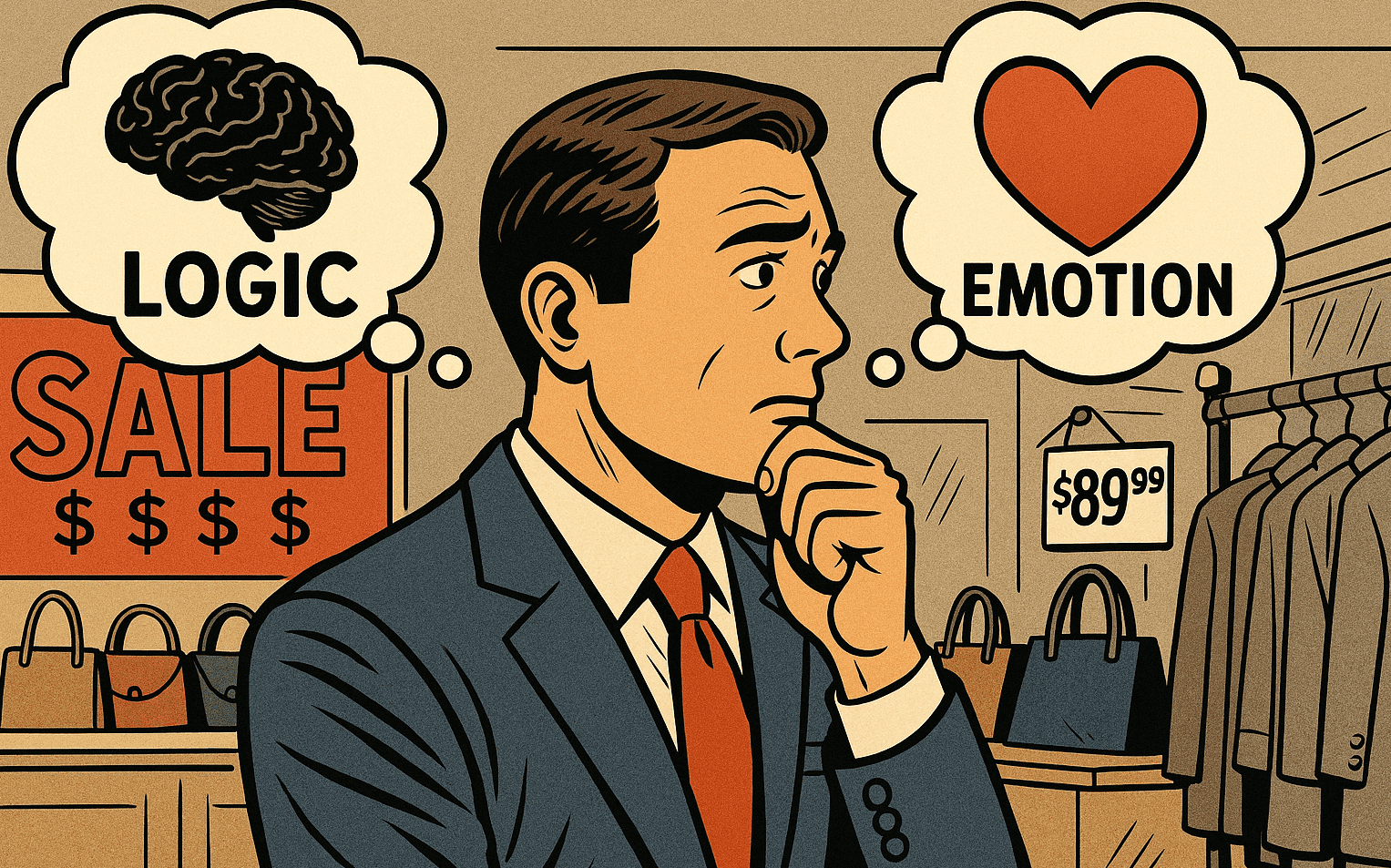
The Experiment That Rewrote Economics
In 1979, two psychologists with zero economics degrees published a paper that would eventually win a Nobel Prize in economics. Daniel Kahneman and Amos Tversky didn't build models of perfectly rational agents. They ran experiments on actual humans and watched those models collapse. Their subjects consistently chose a certain $500 over a 50% shot at $1,000, then flipped around and gambled wildly to avoid a sure $500 loss. Same math. Opposite behavior. The paper was called "Prospect Theory: An Analysis of Decision Under Risk," and it detonated a quiet revolution. Within two decades, governments were hiring "nudge units," tech companies were redesigning checkout flows, and the entire field of behavioral economics had moved from academic curiosity to operational toolkit.
That revolution matters to you directly. Every price you pay, every contract you sign, every saving plan you pick or skip runs through a brain riddled with shortcuts and blind spots. Understanding those patterns doesn't just make you a sharper thinker. It makes you harder to manipulate and better at designing systems that actually work with human nature rather than pretending it away.
Argued that humans cannot optimize perfectly and instead "satisfice" - choosing the first option that meets a minimum threshold. Won the Nobel in 1978.
Replaced the expected utility model with a reference-point framework showing loss aversion, diminishing sensitivity, and probability weighting. The single most cited paper in economics.
Showed that people treat money differently depending on its source, label, or intended use - violating the fungibility principle classical models assume.
Popularized "libertarian paternalism" and choice architecture. Influenced policy worldwide within five years.
The world's first government "nudge unit." Within its first two years, it boosted tax collection by millions of pounds using simple letter redesigns.
Recognized for integrating psychology and economics. Over 200 nudge units now operate globally, from the US to Singapore.
Bounded Rationality - Why "Good Enough" Beats "Perfect"
Classical economics hands you a beautiful fiction: the rational agent. This creature knows all available options, calculates their expected outcomes with flawless precision, and picks the best one every single time. Herbert Simon, a political scientist who wandered into economics and computer science, called this fiction what it was. In 1955 he proposed bounded rationality, the idea that real decision-makers face three hard constraints. Limited information, because the world is noisy and data costs time. Limited computation, because even a brilliant mind cannot process every variable. And limited time, because decisions have deadlines.
So what do people actually do? They satisfice. They scan options until one clears a minimum bar, and they stop. Think about the last time you searched for a restaurant on a Friday night. You did not read 2,000 reviews, weight ambiance against distance against menu variety, and compute the optimal Yelp-to-dollar ratio. You scrolled until something looked decent, checked two reviews, and booked.
That strategy works surprisingly often. But it leaves real money on the table when the search rule is weak, when options are deliberately arranged to exploit early stopping, or when the stakes vastly outweigh the effort of looking further. The gap between satisficing and optimizing is where behavioral economics operates - mapping the shortcuts, measuring their costs, and redesigning the environment so that good-enough and genuinely-good overlap more often.
Prospect Theory - The Engine Room of Behavioral Economics
If bounded rationality cracked the door, prospect theory kicked it wide open. Kahneman and Tversky didn't just say people are imperfect. They built a formal model of exactly how.
Three principles drive it. First, reference dependence: people evaluate outcomes as gains or losses relative to a starting point, not as absolute levels of wealth. Your mood after receiving a $5,000 bonus depends less on the $5,000 and more on whether you expected $3,000 or $8,000. Second, loss aversion: the psychological pain of losing $100 is roughly twice as intense as the pleasure of gaining $100. That asymmetry explains why investors cling to falling stocks, why employees reject beneficial policy changes that include any visible cost, and why "money-back guarantees" are so disproportionately powerful in marketing. Third, diminishing sensitivity: the jump from $0 to $100 feels enormous, but the jump from $900 to $1,000 barely registers. Sensitivity fades as you move further from the reference point in either direction.
Subjects were offered two choices. Option A: a guaranteed $500. Option B: a 50% chance of $1,000, 50% chance of nothing. Most chose the safe $500. Then a loss version: Option A: lose $500 for sure. Option B: 50% chance of losing $1,000, 50% chance of losing nothing. Now most gambled. The expected value is identical in both pairs. But the psychological machinery treats gains and losses as fundamentally different territories.
Then there's probability weighting. People don't process probabilities as raw numbers. They overweight tiny probabilities and underweight moderate ones. A 1% chance of disaster feels scarier than the math suggests. A 40% chance of rain barely changes your umbrella decision compared with 35%. This is why lottery tickets sell at all, why people buy insurance against fantastically rare events, and why a 0.01% chance of a cyberattack can dominate a boardroom discussion while a 30% chance of employee burnout gets a shrug.
Framing ties the whole system together. Present the same surgery as having a "90% survival rate" and approval climbs. Switch to a "10% mortality rate" - identical information - and patients hesitate. The reference point shifted, and with it, the entire decision. If you manage people, sell products, or design policy, framing isn't a trick. It's the lens through which every stakeholder will interpret your proposal whether you choose it deliberately or not.
The Heuristics Toolbox - Shortcuts That Help Until They Don't
Your brain runs dozens of mental shortcuts, and most of them are genuinely brilliant. They let you navigate a world of overwhelming complexity without freezing up. The trouble is they were calibrated for ancestral environments, not for modern financial products, data-rich dashboards, or algorithmically optimized marketing. When stakes are low and speed matters, heuristics shine. When stakes are high and the right answer is counterintuitive, they can wreck you.
Anchoring is the tendency to lock onto the first number you encounter and adjust insufficiently from there. In one famous study, Kahneman and Tversky spun a rigged wheel that landed on either 10 or 65, then asked subjects to estimate the percentage of African nations in the United Nations. The "65" group guessed a median of 45%. The "10" group guessed 25%. A completely random number moved expert estimates by 20 percentage points. Real estate agents shown a higher listing price consistently appraised the same house at a higher value, even when they insisted the listing didn't influence them.
Availability bias makes vivid, recent, or emotional events feel more probable than they are. After a plane crash dominates the news cycle, more people switch to driving - statistically far more dangerous per mile traveled. After a stock market crash, investors overestimate the probability of another crash for years afterward, missing recovery gains.
Representativeness leads you to judge probabilities by similarity rather than base rates. "Linda is 31, single, outspoken, and a philosophy major. Is she more likely to be a bank teller or a bank teller who is active in the feminist movement?" Most people pick the conjunction, even though a subset can never be more probable than the whole set. This same error makes investors pile into companies that "look like the next Amazon" without checking the base rate of startups that actually become Amazon-sized (roughly 0.00006%).
Low stakes, time pressure, familiar domains. Choosing lunch. Navigating a known commute. Scanning a crowd for a friend. The cost of a wrong shortcut is trivial, and the speed gain is enormous. Experts in their field (firefighters, chess masters, ER nurses) develop heuristics that outperform formal analysis under time pressure because their pattern library is deep and well-calibrated.
High stakes, no time pressure, unfamiliar domains. Choosing a mortgage. Evaluating a job offer. Pricing a new product. Investing retirement savings. Here the cost of a shortcut error can be thousands of dollars or years of regret, and you have time to analyze properly. These are exactly the situations where you should slow down, check base rates, and override your gut.
Confirmation bias sends you hunting for evidence that supports your existing belief while ignoring or discounting evidence that contradicts it. Overconfidence narrows the range of outcomes you consider plausible, leading to forecasts that miss the tails. Status quo bias keeps you in the default option not because you evaluated it and found it best, but because switching feels like effort and potential loss. And the endowment effect - demonstrated in experiment after experiment - makes you value things you already own roughly twice as much as identical things you don't. Kahneman and colleagues gave mugs to half a group and asked everyone to trade. Economic theory predicted heavy trading. Actual trades were about half the expected volume. People didn't want to let go of "their" mug, even though they'd owned it for ten minutes.
Mental Accounting - When Your Brain Runs Separate Budgets
Money is supposed to be fungible. A dollar is a dollar whether you earned it, found it, or received it as a gift. Richard Thaler showed that brains refuse to cooperate with this principle. People create mental buckets - rent, groceries, entertainment, vacation, "fun money" - and treat transfers between buckets as psychologically costly even when the math says they're irrelevant.
You saved $200 on a flight by booking a connection instead of a direct route. That evening, you spend $180 on an upgraded hotel room you wouldn't normally book. Why? The $200 "savings" landed in a mental windfall bucket, and windfall money gets spent more freely than salary money. Economically, you spent $180 on a nicer room. Psychologically, you spent "free money." Thaler's research found this pattern across domains: tax refunds, casino winnings, and year-end bonuses all get spent faster and less carefully than equivalent paycheck dollars.
Mental accounting is not always irrational. Separate budgets can serve as crude self-control devices. If your "eating out" budget is $300 per month and you track it, you've built a constraint that prevents food spending from silently crowding out savings. Payroll deductions for retirement work partly because the money never enters the "spending" mental account. The Christmas Club accounts that banks used to offer - locking funds until December - made zero financial sense (no interest, no liquidity) but tremendous psychological sense. People saved more because the label and the lock fought present bias on their behalf.
For leaders and designers, the lesson is direct. Separate recurring costs from one-off items in budgets and dashboards, because teams will unconsciously treat them differently anyway. Frame savings as protecting a named goal ("your emergency fund") rather than as generic surplus. And watch for the trap in reverse: employees who receive a "special" budget for innovation may underspend it because the label makes every dollar feel precious and risky to deploy.
Present Bias and the Commitment Problem
Here's a question. Would you rather have $100 today or $110 tomorrow? Most people grab the $100. Now: $100 in 30 days or $110 in 31 days? Most people are happy to wait the extra day. Same one-day delay, same $10 gain, but the pull of "right now" distorts the first pair in a way it doesn't distort the second. This is hyperbolic discounting, and it sits at the center of the consumer choice puzzle. We don't discount the future at a steady rate. We crush near-term delays with a brutal discount and treat distant delays as roughly equivalent.
The consequence: the plan you approve on Sunday night is almost never the plan you follow on Wednesday afternoon. Gym memberships sell in January and collect dust by March. Saving goals get set in December and abandoned by February. Diets start Monday and end Thursday.
Commitment devices are the counter-weapon. They work by removing the future choice point entirely or by making the bad option painful enough to deter your future self. Odysseus tied himself to the mast before sailing past the Sirens. Modern equivalents include automatic payroll deductions that hit your investment account before you see the cash, app-based savings tools that lock funds for a set period, and cooling-off periods that delay big purchases by 48 hours so impulse fades. The website stickK.com lets users pledge money to a cause they hate if they fail a personal goal - a loss-aversion-powered commitment device that has facilitated over $30 million in pledged stakes.
In workplaces, the same principle plays out through default meeting cadences, automatic code review assignments, and pre-scheduled training blocks. The leader who says "we value continuous learning" and then leaves training to individual initiative has ignored present bias entirely. The leader who blocks two hours every Thursday afternoon for the team to work on skill development has built a commitment rail. One of those approaches produces results. Guess which.
Social Preferences - Fairness, Reciprocity, and the Ultimatum Game
Classical models predict that people are indifferent to how outcomes are distributed, caring only about their own payoff. Decades of experimental evidence say otherwise.
The Ultimatum Game is the most replicated experiment in behavioral economics. Player A receives $10 and proposes a split to Player B. Player B can accept (both get the proposed amounts) or reject (both get nothing). Rational self-interest says Player B should accept any offer above $0. In practice, offers below 20-30% get rejected roughly half the time across cultures. People will sacrifice real money to punish what feels unfair. Studies at the University of Zurich using brain imaging showed that rejection of unfair offers activated the anterior insula, a region associated with disgust, while acceptance of fair offers activated reward circuits.
The Trust Game extends the story. Player A sends money to Player B, and the amount triples in transit. Player B decides how much to return. Purely selfish Player B returns nothing. In experiments, most Player Bs return about a third to a half. Trust begets reciprocity, especially when accompanied by signals of goodwill or shared group identity. But break trust once and the cycle collapses. Restoration takes dramatically longer than the initial violation took to commit.
Why does this matter outside a lab? Because businesses, teams, and policy institutions run on informal cooperation. A company that squeezes suppliers on price in a downturn may save 3% this quarter and lose the supplier relationship permanently when the market tightens. A manager who distributes bonuses visibly and explains the criteria preserves the perception of fairness. A manager who distributes bonuses behind closed doors with no rationale breeds the same anterior insula response as a low-ball ultimatum offer - disgust, resentment, and eventual exit.
Choice Architecture and the Power of Defaults
Every choice happens inside a structure someone designed. The order of items on a menu. The pre-checked boxes on a form. The layout of a cafeteria. The number of options in a retirement plan. Richard Thaler and Cass Sunstein formalized this as choice architecture, and the evidence for its power is staggering.
+50pp — Approximate increase in 401(k) enrollment when the default switches from opt-in to automatic enrollment (Madrian & Shea, 2001)
That single finding changed retirement policy globally. When employees had to actively sign up for a savings plan, participation hovered around 40%. When the default flipped to automatic enrollment with an easy opt-out, participation jumped above 90%. The same people, the same plan, the same financial incentives. Only the default changed, and it moved behavior by 50 percentage points. Similar effects appear in organ donation (countries with opt-out defaults have donation consent rates above 90%, while opt-in countries average around 15%), green energy programs, and insurance selections.
Defaults work because they combine three forces. Status quo bias makes switching feel effortful. Loss aversion makes anything you "give up" by changing feel painful. And implicit endorsement makes the default feel like the recommended option - "they must have set it this way for a reason." For any process you design, the most important question is not "what options do we offer?" It is "what happens if the person does nothing?"
Nudge Theory in the Wild - Government, Health, and Education
The UK's Behavioural Insights Team (BIT), launched in 2010 with a staff of seven, became the proof-of-concept for nudging at scale. Their early work on tax collection was almost embarrassingly simple. Standard HMRC letters told taxpayers they owed money and listed penalties. The BIT rewrote one sentence: "Nine out of ten people in your area pay their tax on time." That single line of social proof increased on-time payment by 5 percentage points across millions of letters, generating tens of millions of pounds in accelerated revenue at near-zero cost.
They kept going. Personalizing letters with the taxpayer's name and the exact amount owed increased response rates further. Adding a specific deadline ("pay by March 15") outperformed vague urgency ("pay immediately"). The mechanism was always the same: reduce ambiguity, invoke social norms, and make the desired action concrete.
In health, the applications multiply. Default appointment scheduling raises cancer screening rates far more effectively than mailed pamphlets. Pill packs with weekday labels printed on them reduce missed doses for chronic conditions. Placing fruit at eye level in hospital cafeterias increased fruit selection by 25% in a Cornell study. Text message reminders timed to a patient's daily routine outperform generic "remember to take your medication" alerts by a factor of three.
In education, text messages to parents that name the student, state the specific days missed, and ask for a plan for the coming week cut absenteeism more than generic "attendance matters" campaigns. Brief goal-setting exercises at the start of a semester, where students connect today's coursework to a specific future career, raise completion rates. These interventions don't require motivational speeches about grit. They require respect for limited attention and a plan to put the right prompt at the right moment.
Behavioral Finance - Where Bias Meets Your Portfolio
If heuristics can distort a $10 lab experiment, imagine what they do to a $500,000 retirement portfolio.
Disposition effect: investors sell winners too early (locking in gains feels good) and hold losers too long (selling at a loss means admitting failure). Terrance Odean's analysis of 10,000 brokerage accounts found that the stocks investors sold went on to outperform the stocks they kept by an average of 3.4 percentage points over the following year. People were systematically selling their best horses and riding their worst.
Recency bias: after a bull market, investors pile in expecting more gains. After a crash, they flee to cash and miss the recovery. The S&P 500 lost 34% from its February 2020 peak to its March trough. It then gained 68% over the following year. Investors who panicked and sold near the bottom locked in the loss and missed the recovery. Dalbar's annual studies consistently find that the average equity fund investor underperforms the S&P 500 by 3-4% annually over 20-year periods, largely due to poorly timed entries and exits driven by emotional reactions.
Home bias: despite the benefits of global diversification, US investors hold roughly 80% of their equity portfolio in domestic stocks, even though the US represents about 60% of global market capitalization. Japanese investors show even stronger home bias. The familiarity heuristic makes "known" feel "safe," even when the math argues for broader exposure.
The takeaway: The most effective behavioral finance interventions are boring by design. Automate contributions. Rebalance on a calendar, not a feeling. Use target-date funds that adjust automatically. Write an "if the market drops 20%, I will..." plan while calm, and tape it where you'll see it during panic. These rules won't make cocktail party stories, but they'll outperform 90% of hot takes because they were written before adrenaline showed up.
Pricing Psychology - How Every Number Tells a Story
Every pricing decision taps the full spectrum of behavioral bias. Understanding the machinery doesn't mean you have to use it cynically. It means you can make informed choices about which effects to deploy and which to avoid.
Charm pricing ($9.99 vs. $10.00) works because the left digit anchors perception. A 2005 study in the Quantitative Marketing and Economics journal found that dropping a price from $4.00 to $3.99 increased sales volume by about 24% in a controlled experiment, while a drop from $4.60 to $4.59 produced no significant effect. The left-digit change is what matters.
Decoy pricing uses a strategically inferior option to make the target option look better. The Economist once offered three subscription tiers: online only ($59), print only ($125), and print + online ($125). Nobody chose print-only, but its presence made the combo deal look like a steal. When the print-only option was removed, preference shifted away from the combo. The "useless" option was doing real work as an anchor.
Bundling exploits mental accounting by hiding the pain of individual prices inside a single number. Cable companies, software suites, and fast-food "value meals" all use this structure. The behavioral reasoning: paying once activates loss aversion once. Paying separately activates it for each item. A $15 bundle feels less painful than a $6 item, a $5 item, and a $4 item, even though the total is identical.
The ethical line sits between reducing friction for genuinely good products and exploiting cognitive limits to sell overpriced ones. Transparent all-in pricing, honest anchor comparisons (not inflated "original prices" nobody ever paid), and clear unit-cost displays respect the customer's bounded rationality instead of weaponizing it. Firms that grow through clarity generate lower churn, higher lifetime value, and stronger word-of-mouth than firms that grow through tricks.
Identity, Norms, and the "People Like Me" Effect
Behavior tracks identity more than we admit. If a message says "most homeowners in your neighborhood reduced energy use last month," you're more likely to follow. Opower's home energy reports, delivered to over 100 million households across nine countries, used exactly this mechanism - comparing your energy use to "efficient neighbors" and adding a smiley face if you beat the average. The result: a persistent 2% reduction in energy consumption across treated households. That sounds small until you multiply by 100 million homes.
The flip side is equally powerful. If the message says "many people didn't pay their tax on time," you've just broadcast a norm of non-compliance. Robert Cialdini's research on Arizona's Petrified Forest showed that signs reading "Many past visitors have removed petrified wood" actually increased theft compared to no sign at all. The intended deterrent became an implicit permission slip.
The design rule: publish the positive norm. Highlight the behavior you want. Suppress information about the prevalence of the behavior you're trying to curb. And invoke group identity - "people like you," "homeowners in your area," "professionals in your field" - because the closer the reference group feels, the stronger the pull. This connects directly to how labor markets function: workplace culture is essentially a set of behavioral norms that determine productivity, retention, and innovation far more than formal rules do.
Attention, Salience, and the War for Focus
Attention is the scarcest resource in a modern economy, and salient features capture it regardless of importance. A bold "ZERO FEES FIRST YEAR" can swamp the fine-print $250 annual charge that kicks in month thirteen. A flashy percentage discount hides a shrinking package size. A one-time introductory rate buries a variable rate that will double.
For designers with integrity, the fix is radical clarity. Unit prices next to shelf prices. All-in costs displayed before any upsell. One outcome chart instead of ten bullet points. Comparison tables that include the long-run total, not just the monthly payment. The UK's Financial Conduct Authority found that requiring credit card companies to display a "total cost of credit" figure on statements reduced minimum-payment-only behavior by 16%. One number, prominently placed, changed thousands of financial decisions.
For your own decisions, the habit that saves the most money is dead simple: before any purchase over $100, pause and calculate the total cost over the full ownership period. That $699 printer with $60 cartridges replaced four times a year costs $1,939 over five years. The $299 laser with $30 toner replaced once a year costs $449. The salient number ($699 vs. $299) points one direction. The total cost points the other. Training yourself to default to total cost over salient price is worth more than any budget app.
Behavioral Tools Inside Organizations
Pay design interacts with loss aversion in ways that can motivate or backfire. A bonus framed as "you have $5,000 that you'll lose if targets are missed" motivates more intensely than "you can earn $5,000 if targets are met." But research by Hossain and List (2012) also found that heavy loss frames increase stress and turnover if sustained. The balance point: use gain frames for stretch goals and mild loss frames for baseline expectations that people should be meeting anyway. Never make an employee's entire compensation feel precarious.
Recognition provides another case study. Immediate, specific praise ("your fix on the billing bug yesterday saved us three hours of customer support calls") activates reward circuits far more effectively than generic quarterly recognition ("great work this quarter, team"). The mechanism is feedback salience combined with attribution clarity - the person can connect a specific action to a specific outcome, which strengthens the behavior loop.
Culture, stripped of its motivational-poster coating, is choice architecture at scale. The meeting that always starts with a customer complaint shapes attention toward customer experience. The dashboard that shows four metrics instead of forty forces focus on what matters. The default calendar block for deep work protects concentration from interruption. Rituals, defaults, and information displays shape behavior more powerfully than values statements on a wall. Every organizational process is a nudge, whether it was designed as one or not.
Ethics, Guardrails, and the Dark Pattern Problem
Power over defaults, frames, and attention is real power. That power requires guardrails.
The ethical framework Thaler and Sunstein proposed is "libertarian paternalism" - design defaults that guide people toward outcomes they would choose if fully informed and fully rational, while preserving the freedom to choose otherwise. The test: if you explained the nudge transparently to the people being nudged, would they approve? Automatic retirement enrollment passes this test easily. Most people, when asked, agree they should be saving more. A subscription model that hides the cancel button behind seven screens does not pass the test. Neither does a cookie consent banner designed to make "Accept All" ten times easier than "Manage Preferences."
The European Union's Digital Services Act and the FTC's increasing enforcement against dark patterns reflect a growing policy consensus: exploiting cognitive limitations for profit is not a clever business strategy. It's a regulatory liability. Companies including Amazon, Epic Games, and Fortnite have faced fines totaling hundreds of millions of dollars for manipulative design patterns aimed at children and adults alike.
Before deploying any behavioral intervention, ask: "If we published a full description of this design choice and its intended effect on a billboard outside our office, would we be proud or embarrassed?" Interventions that survive daylight deserve a budget. Interventions that rely on secrecy deserve a delete key. This single question eliminates most dark patterns before they ship.
Practical guardrails include making opt-outs no more than one click away from opt-ins, publishing evaluation plans and results for all behavioral interventions, inviting external review, and separating the team that designs nudges from the team that profits directly from their adoption. The goal is to build trust so durable that users accept your defaults willingly - because your track record proves the defaults serve their interests, not just yours.
Measurement - Separating Signal from Wishful Thinking
A behavioral intervention is only as credible as the measurement behind it. The gold standard is the randomized controlled trial (RCT): randomly assign people to a treatment group (new letter, new default, new layout) and a control group (old design), measure the outcome difference, and test whether it's statistically significant. The UK's BIT ran over 750 RCTs in its first decade. Not every intervention worked. That was the point - rigorous testing kills bad ideas fast and amplifies good ones.
When randomization isn't possible, difference-in-differences compares the change in outcomes between a treated group and a comparison group over time. Regression discontinuity exploits sharp eligibility cutoffs. These methods aren't perfect, but they're vastly better than the alternative: launching an intervention, watching a number go up, and claiming credit without checking whether it would have gone up anyway.
Track heterogeneity. A text message that boosts attendance for mildly disengaged students might annoy and alienate severely disengaged ones. An energy report that motivates above-average consumers to conserve might cause below-average consumers to increase usage ("I'm already efficient, so I can afford to use more" - the boomerang effect documented in Schultz et al., 2007). The overall average can hide these opposite effects.
Track persistence. Did the behavior change stick after the nudge stopped? A one-time signup spike that fades after three months has a very different cost-benefit ratio than a permanent shift. And always calculate cost per outcome. A nudge that costs $0.50 per letter and generates $50 in additional tax revenue is a spectacular investment. A nudge that costs $10 per person and generates $2 in value is a waste, no matter how clever the behavioral mechanism.
Common Failures and How to Avoid Them
The most common failure mode isn't a bad nudge. It's bolting a clever nudge onto a broken process. If your onboarding flow crashes after step three, no amount of behavioral optimization on the welcome email will save you. Fix the infrastructure first, then tune the behavioral layer.
Second most common: overfitting to a one-time win. A message that worked in a pilot may lose its novelty effect at scale. Social proof messages decline in effectiveness over time as recipients habituate. The fix is a rotation strategy that tests new variants continuously rather than running the same creative until it flatlines.
Third: vanity metrics. A thousand clicks on a redesigned button look impressive in a slide deck. Connect those clicks to actual conversions, revenue, or behavioral change, and you might find a rounding error. Always trace the metric you're optimizing back to the outcome that actually matters for the user or the organization.
Fourth: ignoring the full funnel. Nudging someone to sign up for a savings plan means nothing if the plan interface is so confusing that 40% of enrollees never complete their first deposit. Map the full journey. Identify where dropout actually happens. Fix that bottleneck. Then - and only then - optimize the earlier steps.
A Field Practitioner's Toolkit
Every behavioral intervention follows the same basic sequence, whether you're optimizing a government form or a product checkout flow.
State the problem as a number. "Only 23% of eligible employees contribute to the pension plan" is actionable. "People don't save enough" is not. Name the specific behavior, the specific population, and the specific step where the process breaks down.
Is it friction (too many steps)? Information overload (too many options)? Present bias (the benefit is distant, the cost is now)? Social norms (nobody else is doing it)? Loss aversion (switching feels risky)? The diagnosis determines the intervention.
Change the default. Simplify the form. Add a social proof line. Reframe the cost. Reduce one step. The best interventions are embarrassingly simple. If your intervention requires a 40-page implementation guide, you're overengineering.
Split your population randomly. Measure the outcome that matters (not just clicks - actual behavior change). Run it long enough to detect both the effect and its decay. Report confidence intervals, not just point estimates.
If the intervention works, roll it out. If it doesn't, learn why and test the next variant. Do not keep zombie interventions alive out of sunk-cost loyalty. And continuously monitor - an intervention that works in month one may lose effectiveness by month six.
Where Behavioral Economics Meets Markets
Some students absorb the heuristics chapter and conclude that markets must be chaos. They're not. Markets do discipline consistent errors over time. Firms that systematically misprice assets eventually lose capital to firms that price more accurately. But "eventually" can be a very long time, and "discipline" doesn't mean "eliminate."
Herd behavior can sustain asset bubbles for years. Anchoring on recent performance drives momentum trading. Narrow framing leads fund managers to evaluate each quarter in isolation rather than assessing long-run strategy. Overconfidence packs traders into crowded positions that unwind violently when the consensus breaks. The 2008 financial crisis wasn't caused by a single cognitive bias, but the toxic cocktail of overconfidence, herd behavior, and inadequate loss-scenario thinking turned subprime mortgages from a regional risk into a global catastrophe.
The antidote, as usual, is boring. Write investment rules before emotions run hot. Diversify across uncorrelated assets. Test every thesis against base rates of similar situations. Run premortems - "assume this trade loses 30% in six months; what went wrong?" - before committing capital. Build review rituals that reward process quality, not just lucky outcomes. The behavioral finance literature is clear: the investors who outperform over decades are not the most brilliant. They're the most disciplined about overriding their own biases.
Behavioral economics doesn't replace the tools you find in supply and demand analysis, fiscal policy, or monetary policy. It upgrades them. It takes the elegant machinery of classical models and installs a realistic engine - one that accounts for the humans who actually operate the system. Treat people as they are: attentive in bursts, loss-averse by nature, influenced by peers, anchored by first impressions, and capable of extraordinary discipline when the environment is designed to support it. Build systems on that foundation, and your plans stop crashing into human nature. They ride with it. That's not a soft insight. That's the hardest edge in applied economics.