Why the Fourth Slice Never Tastes as Good
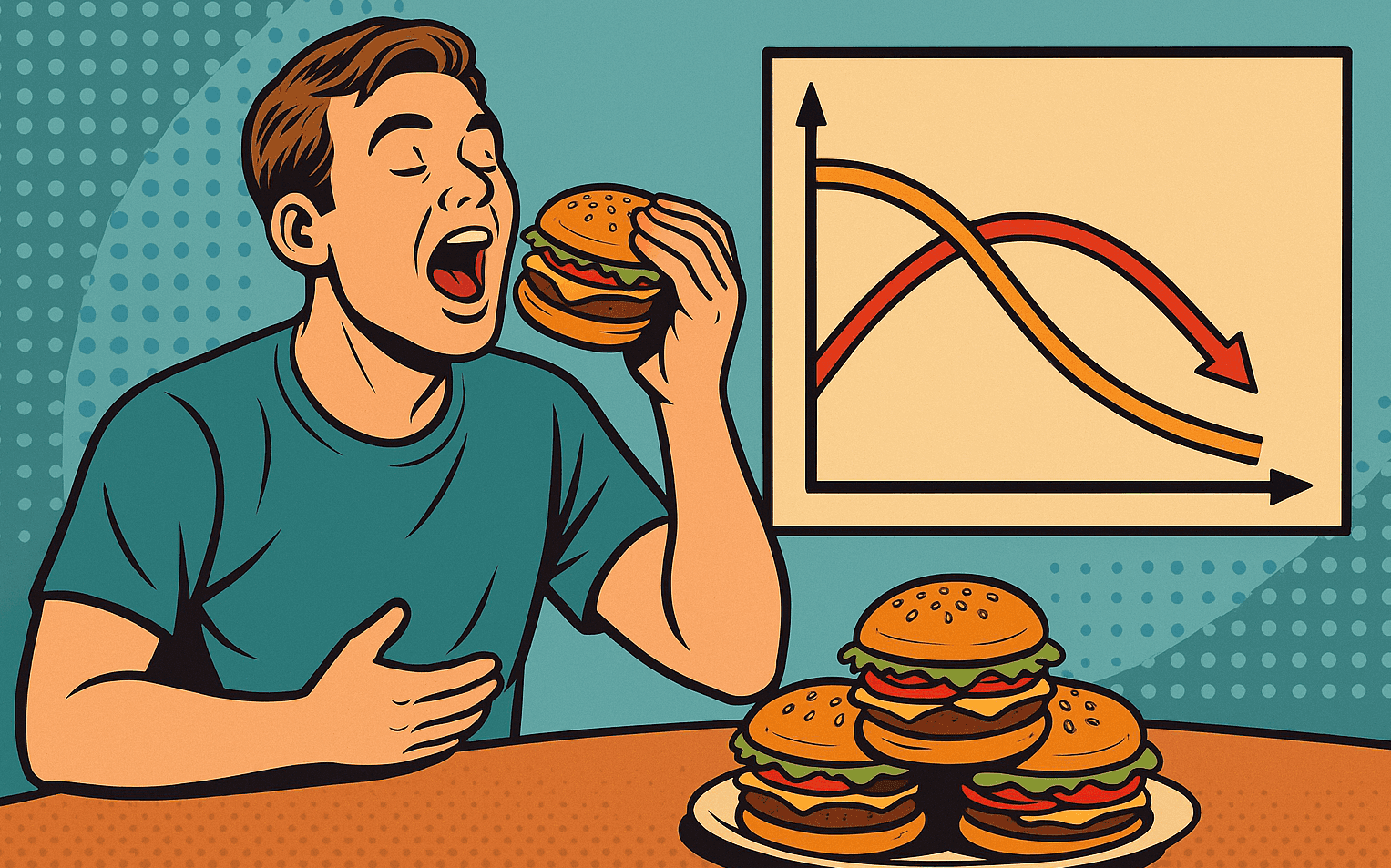
Picture yourself at a buffet. You load up plate one and every bite is brilliant. Plate two still holds some promise. By plate three, you are eating out of stubbornness, not hunger. That sliding scale of satisfaction is not a personality flaw. It is one of the most reliable patterns in all of economics, and it quietly governs everything from how Netflix decides what to recommend next to why your boss stops hiring after the seventh team member. The technical labels are marginal utility on the consumer side and diminishing returns on the production side. Together, they explain why demand curves slope downward, why costs eventually climb, and why "more" almost never means "proportionally better." Get comfortable with these two ideas and you will start spotting them in grocery aisles, ad budgets, workout routines, and government policy debates - sometimes all in the same afternoon.
Total Utility vs. Marginal Utility - The Numbers Behind Satisfaction
Total utility measures the cumulative satisfaction you pull from consuming a certain quantity of something within a given time window. Marginal utility is the change in that total when you add one more unit. If three cups of coffee give you 30 units of satisfaction and a fourth cup pushes the total to 33, the marginal utility of cup four is 3. Simple arithmetic, massive implications.
The pattern that economists keep rediscovering since Hermann Heinrich Gossen first formalized it in 1854 is the law of diminishing marginal utility. As you consume additional units in a short period, each unit typically adds less satisfaction than the one before it. Total utility can still be climbing - it just climbs more slowly with each step. Think of it like filling a swimming pool with a garden hose. The water level rises the whole time, but each additional hour of running the hose gets you closer to the top by a smaller margin than the last.
Diminishing marginal utility does not mean total satisfaction drops. It means the rate at which satisfaction grows is slowing down. You can still be happier with four slices than three - just not as much happier as the jump from two to three.
Exceptions exist, and they sharpen the principle. A new hobby can show increasing marginal utility in the early stages as skills develop and each session reveals more depth - a guitarist who just learned barre chords suddenly hears songs differently. Addictive goods produce messy curves in the short run. But physical limits, time scarcity, and the pull of other activities eventually bend every curve back toward diminishing returns. The gravity always wins.
From Satisfaction to Price Tags - How Marginal Utility Builds the Demand Curve
Here is where theory meets the cash register. Your demand curve slopes downward precisely because marginal utility declines. The maximum price you will pay for any unit equals the marginal utility of that unit expressed in money terms. The first unit tackles your most pressing need, so you pay the most for it. The second unit handles a less urgent use and commands a lower price. The tenth unit? You might only pick it up if there is a clearance sticker on it.
This is not abstract theory confined to textbooks. It is the operating logic behind every tiered pricing model on the planet. Spotify charges one flat rate because they know the marginal utility of your 500th stream is near zero in cash terms, but the subscription captures the huge surplus you get from your first hundred listens. Uber's surge pricing works in reverse - it rations scarce rides by raising the price until only those with the highest marginal utility (the person who absolutely must get to the airport) still say yes.
A craft brewery releases a limited-edition stout. The first 200 customers pay $18 per four-pack without blinking - they have been waiting months. The next 300 customers need a $14 price point to commit. By the time the brewery tries to move the final 500 units, they are running a $9 clearance. Same beer, same quality. The only thing that changed is the marginal utility of each successive buyer segment. The brewery that understands this plans three price tiers from day one instead of watching margins erode in a panic markdown.
Two practical wrinkles deserve attention. First, time resets the curve. Spread consumption across days and your marginal utility schedule shifts upward because saturation fades between uses. That is why subscription boxes ship monthly, not weekly. Second, context bends the curve. A phone without a data plan has stunted utility. Bundle the plan and a case, and the marginal utility of the phone itself jumps because complementary goods amplify each other. Product managers build entire strategies around this interaction.
Indifference Curves and the Geometry of Choice
Early economists tried to measure utility in precise units - "utils," they called them. Modern economics abandoned that idea in favor of ordinal preferences. You do not need to slap a number on your joy. You only need to rank bundles. If combination A beats combination B in your personal ranking, you prefer A. That is enough information to build powerful models.
Plot all the combinations of two goods - say, tacos and movie tickets - that give you equal satisfaction, and you trace an indifference curve. The slope at any point on that curve is the marginal rate of substitution (MRS), which reveals how many tacos you would sacrifice for one more movie ticket while staying equally happy. Diminishing marginal utility gives these curves their characteristic bowed shape. As you pile up movie tickets, each additional one is worth fewer tacos to you, because those tickets are delivering shrinking bursts of extra satisfaction.
Overlay a budget line whose slope reflects relative prices. The best bundle you can actually afford sits where that budget line just touches (is tangent to) the highest reachable indifference curve. At that sweet spot, your MRS equals the price ratio. Translated out of math: you have balanced the extra satisfaction per dollar across both goods so perfectly that no reallocation could make you better off without blowing your budget.
The Equi-Marginal Rule - Stretching Every Dollar
Scale the two-good logic up to the real world, where you juggle dozens of spending categories, and a powerful principle emerges. A consumer maximizes satisfaction by distributing spending so that the marginal utility per dollar is equalized across all goods. If the last dollar spent on streaming gives you more bang than the last dollar on dining out, shift money from restaurants to streaming until the marginal returns equalize.
People perform this calculation instinctively, even if they never write an equation. When gas prices spike, households cut discretionary driving before they cancel internet service - because the marginal utility per dollar on connectivity still towers over the marginal utility of a fifth errand run. Firms mirror the same logic when they balance ad spend across channels, labor hours across departments, or shelf space across product lines. The rule is universal: resources flow toward their highest marginal payoff until payoffs equalize across options. Price changes disrupt the equilibrium and trigger rebalancing - which is precisely why markets move when costs shift.
Diminishing Marginal Utility of Income - Why the First $10,000 Matters Most
Zoom out from individual goods to money itself. For most people, additional income raises well-being, but each added dollar raises it by less than the previous one. A $5,000 raise means something radically different to a family earning $25,000 versus a household pulling in $250,000. Research backs this up: a landmark 2010 study by Daniel Kahneman and Angus Deaton found that emotional well-being in the United States plateaued around $75,000 in annual income (roughly $95,000 in 2024 dollars after adjusting for inflation). Earnings above that threshold improved life evaluation scores but stopped boosting day-to-day emotional experience at the same rate.
~$95K — Approximate U.S. income threshold (2024 dollars) where day-to-day emotional well-being gains begin to flatten, per Kahneman-Deaton research
This pattern carries enormous practical weight. It explains why a $400 emergency expense can devastate a low-income household (the Federal Reserve's 2023 survey found that 37% of American adults could not cover a $400 surprise bill without borrowing) while barely registering for a high earner. It also provides the economic foundation for insurance. Paying a predictable premium smooths out the catastrophic utility loss of a bad outcome. The dollars you give up in good times have lower marginal utility than the dollars you would desperately need in a crisis. Building even a modest cash buffer of $1,000 to $2,000 captures outsized marginal utility because it covers the emergencies that carry the steepest emotional and financial cost.
Behavioral Twists That Bend the Curve
Clean diminishing marginal utility graphs assume cool, rational consumers. Real humans bring cognitive quirks to the table that warp the picture without breaking the underlying logic.
Present bias inflates the perceived marginal utility of immediate pleasures. That impulse buy at checkout feels like a 10 out of 10 in the moment and a 3 out of 10 when the credit card statement arrives. Reference dependence, documented extensively by Kahneman and Tversky, means people judge gains and losses relative to an anchor rather than in absolute terms. A coffee priced at $4.99 when the "regular" price is $5.49 generates satisfaction out of proportion to the fifty-cent gap - the reference point, not the absolute price, shapes the marginal utility you experience. Variety seeking drives people to rotate choices even when sticking with one option would score highest on average, because the marginal utility of novelty itself carries weight.
None of these quirks invalidate diminishing marginal utility. They enrich it. The core curve still bends downward, but framing, timing, and anchors can shift exactly where you sit on it at any given purchase. Smart product design anticipates these shifts. Subscription services rotate featured content because they know the marginal utility of the same recommendation drops fast, even if the content is objectively excellent. Behavioral economics does not replace the classical framework - it adds resolution to the picture.
Consumer Surplus - Measuring the Gap Between Value and Price
Every time you buy something for less than you would have been willing to pay, you pocket invisible profit. Economists call this consumer surplus, and it is the area between the demand curve and the price line, summed across all units sold. Diminishing marginal utility is what makes this area finite and predictable rather than infinite.
A price cut does two things: it transfers value from the seller to existing buyers (they now pay less for units they already wanted) and it unlocks new trades from buyers whose marginal utility only clears the lower price. A price increase does the opposite - it shrinks surplus and kills marginal transactions. If you can sketch a rough demand curve and estimate volumes, you can calculate how much value a promotion created or destroyed. That single skill separates rigorous planning from gut-feel marketing. When Amazon drops the price on a Kindle before the holiday season, they are deliberately sacrificing per-unit margin to harvest the consumer surplus of millions of buyers who would not have converted at $149 but will at $99.
Diminishing Returns on the Production Side
Flip from consumers to firms and you meet the same gravitational force wearing a different uniform. Diminishing returns (formally, the law of diminishing marginal product) describes what happens in the short run when at least one input is fixed and you keep adding more of a variable input.
Picture a commercial kitchen with four ovens. Hire the first two cooks and output surges - ovens that sat cold are now running, coordination is smooth, and each cook handles a full station. Hire a third and fourth, and they fill the remaining ovens. Output is still climbing. But hire a fifth and sixth cook, and the gains shrink. They are waiting for oven space, bumping into each other at the prep station, and spending time coordinating rather than cooking. Each additional cook adds some output, but less than the previous hire. That is diminishing marginal product in action.
Three curves show up in every production textbook for good reason. Total product rises and then flattens as crowding grows. Marginal product may rise briefly in the early phase (when adding workers enables specialization) but then falls persistently. Average product rises while marginal product sits above it and falls once marginal product drops below it. The pattern is indifferent to the input you are scaling. It holds for labor added to fixed equipment, fertilizer spread on fixed acreage, and ad spend targeting a fixed audience segment. At some point, the channel saturates and every extra unit of input buys less response.
How Diminishing Returns Shape Cost Curves
Tie the production story to costs and you get the curves that drive every pricing and output decision. If marginal product falls, marginal cost rises - because you need increasingly more of the variable input to squeeze out each additional unit of output while the fixed factor bottlenecks. This relationship gives cost curves their characteristic U shape in the short run.
Fixed costs spread across few units. Workers have slack capacity. Marginal product is high, so marginal cost per unit is low. Average total cost falls as volume rises.
Fixed factor is binding. Workers crowd the bottleneck. Marginal product collapses, so marginal cost per unit climbs sharply. Overtime, rush fees, and defect rates push costs higher.
Early units are cheap because the team is using idle capacity efficiently. Later units become expensive as overtime kicks in, equipment runs hot, and error rates climb. A flash sale that pushes volume past the efficient range can raise unit cost and destroy margin even while revenue looks impressive on the dashboard. This is the trap that catches growth-obsessed startups: they celebrate record orders while the fulfillment team burns cash at the margins. Smart operations teams know their capacity sweet spot, steer volume into that band, and charge premium rates for rush delivery when demand spikes beyond it.
Diminishing Returns vs. Returns to Scale - The Confusion That Trips Everyone
These two concepts get tangled constantly, even by people who should know better. They operate on different time horizons and answer different questions.
Diminishing returns is a short-run phenomenon. At least one input is locked in place. You are asking: "What happens when I pour more of one ingredient into a recipe where the pan size is fixed?" The answer is always the same eventually - each additional splash adds less.
Returns to scale is a long-run question where every input can change. You are asking: "What happens when I build a bigger kitchen with more ovens, more cooks, more everything?" The answer depends on the industry. Double all inputs at a semiconductor fab and output might more than double thanks to specialization and equipment synergies - that is increasing returns to scale. Double all inputs at an artisan pottery workshop and output might double almost exactly - constant returns to scale. Double all inputs at a sprawling bureaucracy and output might less than double because coordination overhead swallows the gains - decreasing returns to scale.
Input Optimization - Isoquants and the Cost-Minimizing Mix
Firms do not just add workers blindly. They choose the combination of labor and capital that produces their target output at the lowest possible cost. The geometry for this mirrors consumer choice almost exactly.
Isoquants plot combinations of two inputs (say, labor hours and machine hours) that yield identical output - the production analog of indifference curves. The slope of an isoquant at any point is the marginal rate of technical substitution (MRTS), which tells you how much capital you can sacrifice for one more unit of labor while holding output steady. Diminishing marginal product gives isoquants their bowed shape, ensuring that the firm does not corner into using only one input.
Overlay isocost lines (combinations of inputs costing the same total) and the cost-minimizing input mix sits where the isoquant is tangent to the lowest reachable isocost. The optimality condition mirrors the consumer's equi-marginal rule: the ratio of marginal products must equal the ratio of input prices. If an extra hour of labor produces more output per dollar than an extra machine-hour, shift spending toward labor. Keep shifting until the productivity-per-dollar equalizes across inputs. This is not just theory for graduate exams - it is the calculation behind every outsourcing decision, every automation investment, and every staffing model that weighs contractors against full-time hires.
Learning Curves - When Experience Fights Back Against Diminishing Returns
Production teams get better with practice. The learning curve (sometimes called the experience curve) observes that the cost per unit drops by a predictable percentage every time cumulative output doubles. In aircraft manufacturing during World War II, researchers at Wright-Patterson Air Force Base documented that labor hours per airframe fell by roughly 20% with each doubling of cumulative production. Modern data from Boston Consulting Group shows similar patterns across industries, with learning rates typically ranging from 10% to 30%.
This trend can offset diminishing returns for extended periods. Early in a production program, each batch teaches something that lowers cost for the next run - better jig design, faster setups, fewer defects. But learning itself eventually shows diminishing returns. After thousands of repetitions, the easy gains are captured and improvements require expensive R&D or capital redesign. Real factories live in both worlds simultaneously: long-run cost declines across product generations coexist with short-run congestion whenever a specific line is pushed past its comfortable throughput on a given shift.
Variety, Saturation, and the Demand Side Mirror
Diminishing marginal utility does not just slow down consumption of a single good. It actively pushes consumers toward variety. After a point, the marginal utility of another unit of Good A drops below the marginal utility of trying a little of Good B. This rotation instinct is why Netflix autoplay does not serve you twelve episodes of the same show in the recommendation bar - they know the marginal utility of one more episode of "that series you just binged" is lower than the marginal utility of something fresh.
Retailers exploit this rhythm by rotating promotions across categories. Content platforms allocate slots across genres. Restaurants refresh seasonal menus. The underlying economics is identical: the marginal utility of any single line declines with repeated exposure, so the portfolio must evolve to keep total engagement high. Teams that grasp this plan content and product calendars that avoid burning out their audience on any single offering - a principle that applies equally to a YouTube channel, a SaaS feature roadmap, or a fast-food chain's limited-time offers.
Price Discrimination and Quantity Discounts Through the Marginal Utility Lens
Because the first unit is worth more to the buyer than the tenth, firms that can segment willingness to pay capture more value. Quantity discounts offer a lower per-unit price for larger purchases, enticing buyers whose marginal utility on later units would not clear the full retail price. Costco's entire business model is a monument to this logic - pay a membership fee (capturing part of the high surplus on early purchases) and then buy in bulk at near-wholesale per-unit prices.
Two-part pricing formalizes this further. A fixed access fee plus a low per-unit charge extracts value from the high marginal utility of the first units via the fee, while keeping later units flowing at a price close to marginal cost. Gym memberships, amusement park wristbands, and Amazon Prime all follow this template. The access fee grabs consumer surplus from the top of the demand curve, and the low (or zero) per-unit cost ensures volume does not collapse.
The takeaway: Pricing that respects diminishing marginal utility - charging more for the first units and less for later ones, or bundling access fees with low per-unit prices - almost always outperforms a single flat rate. The buyer's declining willingness to pay is not an obstacle. It is the blueprint for better pricing architecture.
Diminishing Returns in Teams, Time, and Personal Productivity
Economics does not stay on spreadsheets. It follows you into your calendar.
The first focused hour on a difficult project delivers the most progress. Cognitive science research, including work by K. Anders Ericsson on deliberate practice, consistently finds that sustained focus beyond 90 to 120 minutes produces sharply diminishing returns. The fourth consecutive hour of deep work yields a fraction of what the first hour produced. Strategic breaks reset the curve by moving you back to a zone where marginal productivity is high again.
Teams show the same pattern. The third person assigned to a small project often adds tremendous value. The ninth person frequently slows everything down with coordination overhead, status meetings, and conflicting communication chains. Jeff Bezos famously encoded this as the "two-pizza rule" at Amazon - if a team cannot be fed by two pizzas, it is too large for effective marginal contribution. Fred Brooks documented the same phenomenon in software engineering back in 1975 with The Mythical Man-Month: adding engineers to a late project makes it later, because the communication overhead grows faster than the marginal output of each new person.
The practical lesson: staff projects to the point where each person's marginal contribution still exceeds the marginal coordination cost they impose. Add people in layers with clean interfaces between groups, and you keep marginal returns from collapsing under the weight of meetings and misaligned expectations.
Policy Applications - Where Marginal Thinking Saves Billions
Some of the most effective public policies trace directly back to diminishing marginal utility and diminishing returns. The reasoning is straightforward: push resources toward areas where the marginal gain per unit spent is still steep.
Congestion pricing in cities like London, Stockholm, and Singapore works because the marginal social cost of an extra car during peak hours is enormous - one additional vehicle in gridlock slows thousands of others. Stockholm's 2006 congestion charge trial cut city-center traffic by 22% and reduced emissions measurably, targeting precisely the zone where marginal damage per additional car was highest.
Vaccine subsidy programs target populations where the marginal utility of protection is highest but financial barriers are steepest. The first 60% of coverage produces the lion's share of herd immunity benefits. Pushing from 90% to 95% costs far more per marginal percentage point and yields diminishing epidemiological returns, which is why cost-effective programs prioritize early coverage rather than chasing the last few percent with equal intensity.
Investment in early childhood education shows some of the highest returns in all of social policy. The Perry Preschool Project, tracked over 40 years, estimated a return of $7 to $12 for every $1 invested - because early skill development compounds over a lifetime, while later remediation programs face sharply diminishing returns as neural plasticity declines with age.
A Worked Example That Locks the Concepts Together
Numbers cement intuition better than paragraphs. Say a student values cups of tea this hour with marginal utilities of 10, 7, 5, 3, and 1 (measured in dollar equivalents). The price per cup is $4.
| Cup | Marginal Utility ($) | Price ($) | Net Surplus | Buy? |
|---|---|---|---|---|
| 1st | 10 | 4 | +6 | Yes |
| 2nd | 7 | 4 | +3 | Yes |
| 3rd | 5 | 4 | +1 | Yes |
| 4th | 3 | 4 | -1 | No |
| 5th | 1 | 4 | -3 | No |
The student buys three cups. Total consumer surplus: $6 + $3 + $1 = $10. Drop the price to $3 and the fourth cup now clears with zero surplus - quantity rises to four and total surplus climbs. Raise the price to $6 and only the first cup makes the cut. These tiny numbers carry outsized lessons. Demand slopes down because later units deliver less. Prices hovering near the margin determine exactly how many units move. Promotions that push price temporarily lower unlock units with modest marginal utility that would never have sold otherwise.
Flip to production. A print shop with one press adds workers, with output per additional worker of 12, 10, 7, 5, and 3 units per day. If each worker costs $200 per day, the marginal cost per unit of output starts at $16.67 (200/12) and climbs to $66.67 (200/3) by the fifth worker. Quoting a rush order without checking where you sit on that curve is how projects hemorrhage money. Run the numbers before you quote. That is not sophisticated analytics. It is operational discipline.
Common Pitfalls and How to Dodge Them
Misapplying these concepts costs real money and real exam points. Watch for these traps.
Do not assume diminishing marginal utility means total utility is falling. It can still be rising - just more slowly. The curve is flattening, not dropping. Do not confuse one person's utility trajectory with another's. Preferences are heterogeneous. Some people extract enormous value from their third gym session of the week; others are done after one. Do not conflate diminishing returns (short run, fixed factor) with decreasing returns to scale (long run, all factors adjustable). They sound similar and describe fundamentally different situations. And do not treat a promotion-driven sales bump as proof that permanently higher volume is profitable. You may have pulled demand forward and shoved operations into the expensive zone where marginal costs are climbing. Check unit economics and cohort retention at the new volume level before declaring victory.
Field Diagnostics You Can Run Tomorrow
Marginal thinking becomes most valuable when you build the habit of spotting these patterns in real time. Three quick diagnostics will cover most situations.
Demand-side saturation check. Track unit usage or engagement by cohort over time. If the curve flattens faster than your model assumed, marginal utility is declining ahead of schedule. Time to adjust packaging, rotate features, or introduce a new tier before churn accelerates.
Supply-side bottleneck scan. Watch throughput against capacity. When lead times spike and defect rates creep up, you have pushed past the point of healthy productivity into the zone where the fixed factor binds hard. Either invest in expanding that fixed factor or pull volume back inside the efficient range.
Cross-channel equi-marginal audit. Before throwing more resources at any single initiative, compare marginal returns across all options. If the next dollar on Channel A yields less than the next dollar on Channel B, rebalance immediately rather than waiting for the quarterly review. That habit - small, continuous reallocation toward the highest marginal payoff - is the equi-marginal rule dressed in work clothes.
Where These Ideas Connect Next
Marginal utility and diminishing returns are not self-contained concepts. They are load-bearing pillars that support half of microeconomics. The demand curves built from marginal utility feed directly into price elasticity analysis. The cost curves shaped by diminishing returns determine where firms produce and how markets settle into equilibrium. And the behavioral wrinkles - present bias, reference dependence, variety seeking - push you toward the richer territory of behavioral economics, where the clean curves get the human texture they deserve.
The single most transferable skill from this entire topic is deceptively simple: before any decision, ask what the next unit gets you. Not the average unit. Not the first unit. The next one. That question - applied to hiring, spending, studying, investing, or eating - will make you sound like the sharpest person at the table when someone insists that "more must be better." The math does not lie. More is better only until the margin says otherwise.