In 1994, the U.S. government auctioned off radio spectrum licenses worth billions of dollars. The problem? Nobody knew how to run an auction that complex - thousands of overlapping licenses, bidders who valued bundles differently, and massive incentives to game the system. The Federal Communications Commission turned to game theorists. The simultaneous ascending auction they designed raised $7.7 billion in its first round and has since generated over $200 billion worldwide. That is game theory doing real work - not a thought experiment on a chalkboard, but a framework that moved hundreds of billions of dollars from theoretical deadlock into actual allocation.
Game theory studies what happens when your outcome depends on someone else's choices, and theirs depends on yours. That mutual dependency sits behind pricing wars, salary negotiations, patent races, climate treaties, even deciding who picks up the check at dinner. Master the vocabulary and the standard playbooks and you gain something rare: the ability to model a situation before you are trapped inside it, stress-test your plan against a smart opponent, and spot the structural flaws that keep teams stuck in loops of mutual suspicion.
$200B+ — Revenue generated worldwide using game-theory-designed spectrum auctions since 1994
Players, Strategies, and Payoffs - The Building Blocks
Every game reduces to three ingredients. Players are the decision-makers - could be two firms, ten bidders, or 195 countries at a climate summit. Strategies are complete plans that specify what a player will do in every situation that could arise, not just the first move but every contingency after that. Payoffs are the rewards or penalties tied to outcomes - profit in dollars, utility in satisfaction, votes gained, time saved, reputational capital earned or burned.
Two standard blueprints organize these ingredients. The normal form (or strategic form) puts choices in a matrix so you can read best responses off the rows and columns. Clean for static interactions where everyone moves simultaneously. The extensive form draws a decision tree - nodes show who moves when, branches show what each player knows at that point. This is the one you want when timing matters, when threats need to be tested for credibility, when "I'll respond if you do X" is the whole ballgame.
Best for simultaneous moves. Players choose without seeing the other's action. You scan rows and columns for best responses. Quick to build, easy to analyze for dominance and equilibrium. Think: sealed-bid auctions, simultaneous product launches.
Best for sequential moves. Nodes track who moves and what they know. Captures timing, information asymmetry, and credibility. Essential for entry deterrence, bargaining, and any game where "who goes first" changes everything.
Dominance provides the fastest filter. If one action gives you a payoff at least as good in every scenario and strictly better in at least one, it strictly dominates the alternative. Rational players never choose dominated strategies. Iterate that logic across all players and you often shrink a sprawling game to a manageable core - sometimes all the way down to a single outcome. When nothing is dominated, you graduate to equilibrium concepts.
Nash Equilibrium - Where No One Wants to Move
A Nash equilibrium is a set of strategies, one per player, where every strategy is a best response to the others. Nobody can improve their payoff by changing their own choice alone. John Nash proved in 1950 that every finite game has at least one such equilibrium (allowing for mixed strategies), a result that earned him the Nobel Prize in Economics in 1994.
Finding equilibria in matrix games is mechanical. Underline the best payoff in each row for the row player, then underline the best payoff in each column for the column player. Any cell where both payoffs are underlined is a Nash equilibrium. In continuous-strategy games you set first-order conditions and solve for mutual best responses - the math gets fancier but the logic stays identical. Keep what you would not regret after seeing what the other side did.
Nash equilibrium is a stability condition, not a fairness doctrine. Some equilibria are efficient - everyone does well. Others waste enormous potential because players cannot coordinate, information is hidden, or trust has eroded. Recognizing the difference lets you design institutions that shift the game toward better outcomes rather than accept bad ones as inevitable.
Consider the classic oligopoly pricing problem. Two gas stations across the street from each other both charge $3.50 per gallon. Neither can profit by raising the price alone (customers flee) or cutting it alone (the other matches instantly). That mutual trap is a Nash equilibrium - stable, but not necessarily the outcome either station prefers. Understanding this unlocks the question that actually matters: what structural change could shift the game?
Mixed Strategies - When Predictability Becomes a Weakness
If your best move depends on what the other side does, and they can read your patterns, predictability is a liability. A mixed strategy assigns probabilities to actions. In equilibrium, your randomization leaves opponents indifferent among their available responses. That indifference is precisely the point - your unpredictability destroys exploitable patterns.
Sports give the cleanest laboratory. Ignacio Palacios-Huerta, an economist at the London School of Economics, studied over 1,400 penalty kicks and found that professional soccer players randomize their shots almost exactly at the frequencies game theory predicts. Left-footed kickers go to the right 60% of the time when theory says 59.2%. Goalkeepers dive in the correct direction at rates that match minimax predictions within a percentage point. These athletes never sat down with a payoff matrix. Thousands of repetitions pushed them toward optimal mixing through pure competitive pressure.
In business, a mixed strategy might look like rotating promotional timing so competitors cannot anticipate your sales calendar. Or varying your bidding behavior in procurement auctions - sometimes aggressive, sometimes sitting out - to prevent rivals from calibrating their bids to yours. The principle holds everywhere: enough unpredictability to defeat a pattern detector, but enough structure to still lean on your genuine strengths.
The Prisoner's Dilemma - Why Smart People Get Stuck
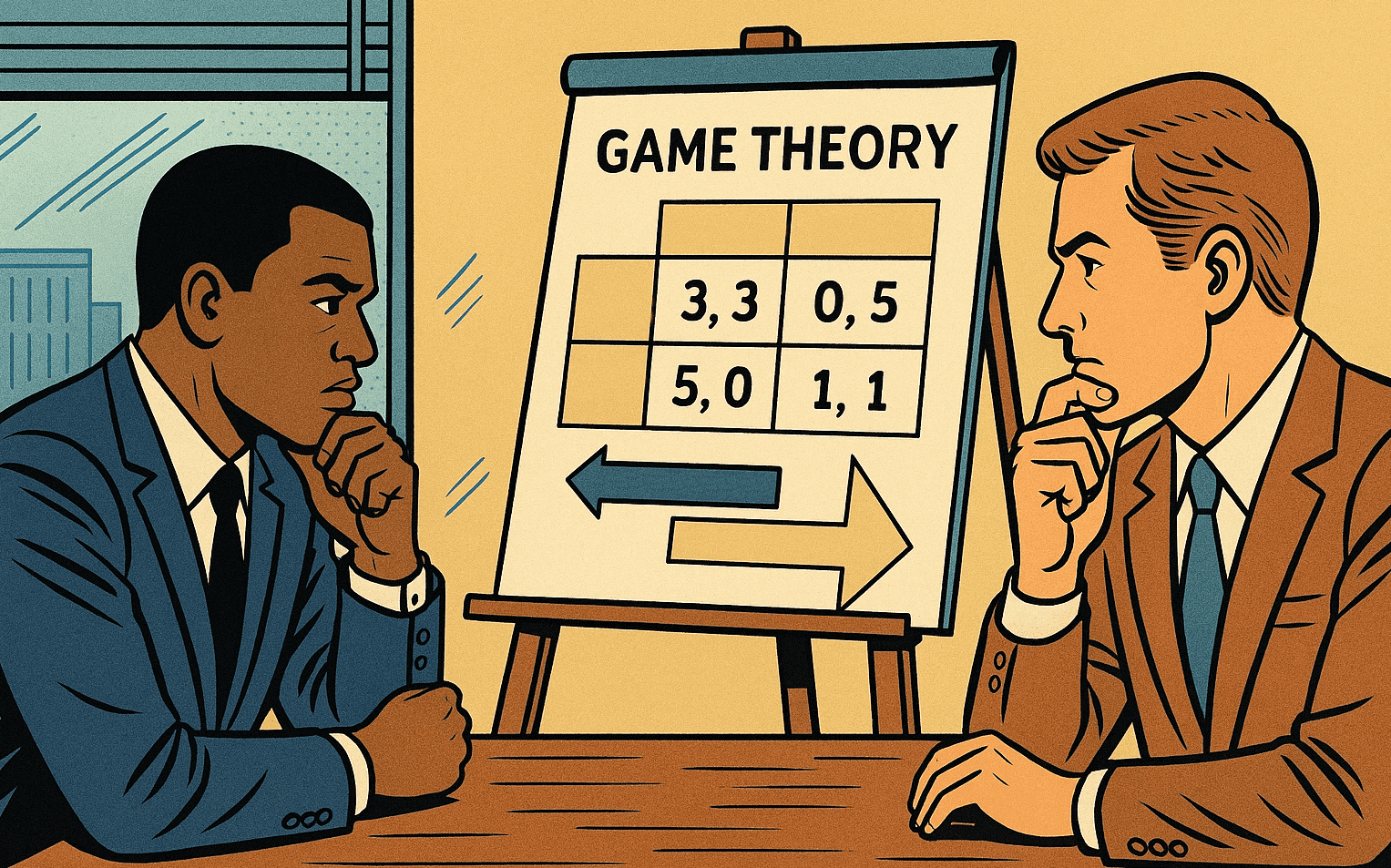
The most famous game in the entire discipline pits two players against a brutal choice. Cooperate or defect. If both cooperate, each earns a solid reward - say 3 points. If both defect, each gets a mediocre 1 point. But if one cooperates while the other defects, the defector scores 5 and the cooperator gets nothing.
Two suspects are arrested. Police separate them and offer each the same deal: testify against your partner (defect) and go free while they serve 10 years. If both testify, both serve 6 years. If neither testifies (cooperate), both serve only 1 year on a lesser charge. Each suspect reasons: "If my partner stays quiet, I should testify and walk free. If my partner testifies, I should also testify to avoid 10 years." Defection dominates. Both testify. Both serve 6 years. The rational individual outcome is collectively irrational.
Defection dominates for each player regardless of what the other does. The Nash equilibrium is mutual defection. Both players leave gains on the table - they would both prefer mutual cooperation, but the incentive structure makes it individually irrational to cooperate.
You see this structure everywhere it matters. Price-fixing cartels that unravel because each member has an incentive to secretly undercut. Study groups where everyone hopes someone else does the heavy reading. International climate agreements where each country prefers that others bear the cost of carbon reduction - a tension visible in the gap between the Paris Agreement's pledges and actual emissions, which hit 36.8 billion metric tons of CO2 in 2023. The cure is never a motivational speech about cooperation. The cure is a mechanism that changes payoffs: repeated interaction with credible punishment, monitoring systems that raise the odds of catching cheaters, side payments that reward cooperative behavior, or enforceable rules with genuine teeth.
Coordination Games and Focal Points
Not every strategic interaction is a conflict. Sometimes players desperately want to coordinate but need help landing on the same choice. Think of technology standards - VHS vs. Betamax, Blu-ray vs. HD DVD, USB-C vs. every other connector. These are coordination games with multiple Nash equilibria. Everyone prefers matching the crowd to going solo. History, expectations, and sheer luck determine which equilibrium wins.
Thomas Schelling, who shared the 2005 Nobel Prize for his work on conflict and cooperation, showed that people solve coordination problems by finding focal points - outcomes that are psychologically prominent. Asked to meet a stranger somewhere in New York City with no prior communication, most people say Grand Central Station at noon. No strategic calculation produces that answer. Cultural knowledge and shared expectations do. In markets, focal points include round-number price points, industry-standard contract terms, and de facto technology platforms.
Assurance games add a twist. Both players prefer the high-cooperation outcome, but only if they trust the other will show up. Without confidence, each retreats to a safe low-payoff action. The practical lesson for managers and policymakers is concrete: publish commitments early, stage visible wins, give signals that reduce doubt. Small assurances can tip an entire group toward the better equilibrium when underlying preferences already align. The problem was never willingness - it was uncertainty about everyone else's willingness.
Chicken, Brinkmanship, and the Art of Burning Bridges
In Chicken, two drivers speed toward each other on a narrow road. Swerve and you are the coward but you survive. Hold your course while the other swerves and you win. Both hold course and it is catastrophe. There are two pure-strategy Nash equilibria: one swerves, the other holds. Plus a terrifying mixed equilibrium where both take calculated risks.
The strategic innovation in Chicken is commitment. Players try to make yielding impossible for themselves - throw the steering wheel out the window, publicly swear they will never back down, sign contracts that lock them into a path. These moves raise credibility: "I literally cannot swerve, so you had better." But they also raise the risk of mutual destruction. The Cuban Missile Crisis in October 1962 is the textbook case - both the United States and the Soviet Union took steps that narrowed their own options, hoping the other would blink first. Khrushchev ultimately did, but the world came closer to nuclear exchange than most people realized at the time.
In business, brinkmanship shows up in labor negotiations where unions authorize a strike vote (burning their bridge to compromise) or in hostile takeovers where an acquirer announces a "final offer" to force a board decision. Use with extreme care. Reputation is at stake and so is your margin for error. A commitment device that works nine times out of ten still destroys you on the tenth.
Zero-Sum Games and Minimax Thinking
A zero-sum game sets one player's gain exactly equal to the other's loss. Poker within a table (after rake), head-to-head athletic competition, and many ranked allocation systems - law school class rankings, competitive grant funding - carry this flavor. What you gain, someone else loses.
John von Neumann proved the minimax theorem in 1928: in any two-player zero-sum game, each player can guarantee a value by choosing the strategy that minimizes their maximum possible loss. Your opponent simultaneously chooses the strategy that minimizes your maximum gain. The resulting strategies and payoff are unique - there is no ambiguity about the "solution." For small matrices, you solve by setting the opponent's expected payoffs equal across their actions. For larger games, linear programming handles it efficiently.
The takeaway: Zero-sum logic is stark. You cannot both walk away happier unless you find ways to grow the pie - new entrants, new rules, side deals that create value. When the game is genuinely zero-sum, discipline beats creativity. Avoid patterns that let others read you, and lock in your floor payoff.
Backward Induction and Credible Threats
Some strategies look powerful on paper and crumble in execution because they depend on threats that nobody would actually carry out when the moment arrives. Would a parent really cancel the entire family vacation because a child misbehaved at breakfast? Would a firm really slash prices below cost for two years to punish an entrant? Subgame perfect equilibrium filters out these hollow threats by requiring optimal play at every decision node in the game tree, not just the first move.
You find it through backward induction: start at the final decision nodes, determine what the player there would actually do, then roll back to the previous nodes with that knowledge. Anything that relies on a threat you would not execute collapses. The 1982 AT&T antitrust case illustrates this. The Department of Justice's threat to break up the company was credible precisely because the legal machinery was already in motion - AT&T could not treat it as a bluff, which forced settlement.
This is where commitment devices earn their keep. If you can bind your future self, you change the current game. Automatic price-matching guarantees that trigger without a committee meeting. Published return policies that eliminate case-by-case haggling. Escalation clauses in labor contracts that lay out predetermined steps. These commitments cost something upfront, but they convert cheap talk into structure - and structure is what makes threats credible.
Incomplete Information and Bayesian Games
Real strategic interactions almost never feature perfect knowledge. A bidder knows their own valuation but not yours. A firm knows its own production costs but can only guess at a rival's. A regulator knows how hard they are willing to push, but the regulated company does not. When players hold private information, the framework shifts from standard Nash equilibrium to Bayesian Nash equilibrium. Each player holds beliefs about the other players' hidden "types" and chooses a strategy that maximizes expected payoff given those beliefs and the anticipated strategies of others.
Two tools cut through the fog. Signaling lets an informed party send a costly message that credibly reveals their type. A company with genuinely low defect rates offers a long warranty - a signal that high-defect competitors cannot afford to mimic. Michael Spence won the 2001 Nobel Prize for formalizing how education works as a signal: not necessarily because school makes you more productive, but because completing a difficult degree is cheaper for high-ability workers, so employers use it as a sorting device.
Screening lets an uninformed party design a menu that induces self-selection. Insurance companies offer policies with different deductible levels - low-risk customers choose high deductibles (lower premiums), while high-risk customers reveal themselves by choosing low deductibles (higher premiums). The core idea is elegant: use actions that separate types so your counterpart reveals private information through their own choices, without you ever needing to ask directly.
Auctions - Game Theory's Greatest Applied Success
Auctions are games with explicit rules that map bids into allocations and payments. The four canonical formats each produce different strategic incentives.
| Auction Format | How It Works | Optimal Strategy |
|---|---|---|
| English (ascending) | Price rises until one bidder remains | Stay in until price hits your value |
| Dutch (descending) | Price drops until someone accepts | Shade bid below your value |
| First-price sealed | Highest bid wins, pays their bid | Shade bid below your value |
| Second-price sealed (Vickrey) | Highest bid wins, pays second-highest bid | Bid your true value |
William Vickrey, who shared the 1996 Nobel Prize, proved that in second-price auctions, bidding your true value is a dominant strategy - your bid determines only whether you win, not what you pay. This truth-telling property made the Vickrey auction the foundation for modern mechanism design. Google's original ad auction system, which generated over $200 billion in revenue by 2023, was built on a generalized second-price mechanism for exactly this reason.
The winner's curse haunts auctions where the item has a common value that nobody knows precisely - oil drilling rights, corporate acquisitions, spectrum licenses. The highest bidder likely overestimated the value. Correcting for this demands discipline: shade your bid more aggressively when your information is noisy and when the number of competing bidders is large. In the 2000 UK 3G spectrum auction, companies paid a combined 22.5 billion pounds - and many later wrote down billions in losses as actual revenues fell short of their optimistic projections. The winner's curse is not a theoretical curiosity. It is a budget-destroying reality.
Mechanism Design - Engineering the Rules
Mechanism design flips the game theory question on its head. Instead of optimizing within given rules, you design the rules so that self-interested players naturally produce the outcome you want. Leonid Hurwicz, Roger Myerson, and Eric Maskin shared the 2007 Nobel Prize for this work - the field is sometimes called "reverse game theory."
Two constraints drive every mechanism. Incentive compatibility makes honesty each player's best policy - lying or misrepresenting your type should never pay. Individual rationality (participation) ensures players voluntarily join rather than walk away. When both constraints hold, you get truthful behavior without coercion.
The National Resident Matching Program (NRMP) matches over 40,000 medical school graduates to hospital residencies each year using a deferred-acceptance algorithm. Before the mechanism was redesigned in 1998 using game-theoretic principles, the system was plagued by strategic manipulation - students and hospitals both had incentives to misrepresent their true preferences. The redesigned mechanism makes truthful preference reporting a dominant strategy for applicants. Result: less gaming, better matches, fewer people stuck in positions they hate.
The practical moral is direct: if you are constantly fighting with participants to behave honestly, the problem is not the people - it is the rules. Redesign the game so that cooperation aligns with self-interest, and the fighting stops. Vickrey auctions that reward truth-telling, public goods contribution mechanisms with matched funding, tax systems that use withholding rather than honor-system reporting - all mechanism design in action.
Repeated Games, Reputation, and the Shadow of the Future
Play a game once and defection often dominates. Play it indefinitely and the entire strategic calculus transforms. Cooperation becomes sustainable even among purely self-interested players, provided three conditions hold: the interaction has no known endpoint (the "shadow of the future" is long enough), behavior can be monitored, and punishment for deviation is credible.
Robert Axelrod's famous 1984 computer tournament invited game theorists to submit strategies for a repeated Prisoner's Dilemma. The winner, submitted by Anatol Rapoport, was breathtakingly simple: Tit for Tat. Cooperate on the first move. After that, mirror whatever the opponent did last round. It won not because it was clever but because it was clear - nice (never defects first), retaliatory (punishes immediately), forgiving (returns to cooperation after one punishment), and transparent (opponents quickly learn the pattern).
Trigger strategies like grim trigger (cooperate until the first defection, then defect forever) theoretically support cooperation but are fragile in practice - one mistake, even a misunderstanding, triggers permanent breakdown. Forgiving strategies that punish and then reset tend to outperform in noisy environments where signals are imperfect and people occasionally make errors. The lesson for managing supplier relationships, partnerships, or even friendships: punish deviations clearly but do not make punishment permanent. Leave a path back to cooperation.
Reputation adds another layer. A player known for following through on both rewards and punishments can shift expectations across multiple games simultaneously. OPEC's ability to influence oil markets, for instance, depends less on any single production agreement and more on the collective belief that Saudi Arabia will flood the market to punish cheaters - a reputation built over decades of occasionally doing exactly that.
Behavioral Game Theory - How Real Humans Actually Play
Standard game theory assumes perfect calculation and stable preferences. Real people bring loss aversion, fairness concerns, and limited attention to the table. The gap between theory and behavior is not a footnote - it is an entire research program.
The ultimatum game is the classic demonstration. One player proposes how to split $100. The other accepts or rejects. If rejected, both get nothing. Standard theory predicts the proposer offers $1 (the minimum the responder should accept, since $1 beats $0) and the responder accepts. In hundreds of experiments across dozens of cultures, the actual average offer is around $40-$45, and offers below $20 are rejected roughly half the time. People sacrifice money to punish what they perceive as unfairness.
Daniel Kahneman and Amos Tversky's prospect theory, which earned Kahneman the 2002 Nobel Prize, explains part of the puzzle. Losses loom about twice as large as equivalent gains. A $50 loss feels roughly as painful as a $100 gain feels good. In strategic settings this means players often fight harder to avoid losses than to capture gains - making threats of loss more powerful motivators than promises of reward, and making sunk-cost escalation a persistent trap.
You do not need to memorize every cognitive bias to be effective. The operational principle is simpler: build systems that make good behavior the easy default and bad behavior the hard exception. Pre-commit to rules. Use defaults that favor cooperation. Add friction to moves that risk escalation spirals. Give clear feedback dashboards so people see the link between their choices and outcomes. Structure beats willpower every time.
Price Wars, Entry Deterrence, and Market Strategy
Game theory strips the mystique from standard competitive tactics and exposes what actually works versus what sounds impressive in a boardroom. Predatory pricing - slashing prices below cost to destroy a rival - fails as a general strategy because it burns cash now for uncertain dominance later. The predator suffers losses in every period of the war, and financial markets know this. Between 1975 and 2015, the U.S. Supreme Court found in favor of the defendant in nearly every predatory pricing case, precisely because the economic logic so rarely holds up.
But price cuts can be rational when they serve as credible signals. A firm that cuts prices and sustains them reveals lower costs than competitors expected - which changes rival calculations without requiring a prolonged war. Entry deterrence through capacity expansion follows similar logic. Building excess capacity that is visible and costly to reverse serves as a commitment: "We will flood the market if you enter." The key word is "costly to reverse." Cheap talk that promises a fight without expensive commitment does not move sophisticated entrants.
Walmart's expansion strategy in the 1980s and 1990s is a case study in credible deterrence. By building distribution centers before stores, committing to regional density rather than cherry-picking individual markets, and maintaining a publicly known cost structure that made price wars survivable, Walmart signaled to potential entrants that competition would be expensive and sustained. Many regional chains chose not to fight. The strategy worked not because Walmart was bluffing, but because the commitments were verifiable and irreversible.
Bargaining Theory - Patience Wins
Two players dividing a pie illustrate bargaining in its purest form. In Ariel Rubinstein's 1982 alternating-offers model, each player takes turns proposing a split. Delay is costly - the pie shrinks with each round (or equivalently, future payoffs are discounted). The unique equilibrium gives a larger share to the more patient player - the one with a lower discount rate or, equivalently, a better outside option.
Three factors determine your share in any negotiation: patience (can you afford to wait?), outside options (what happens if you walk away?), and information (do you know the other side's constraints?). Improving any one of these before sitting down at the table does more than any clever tactic during the negotiation itself.
This is why deadlines matter so much in labor negotiations, licensing deals, and partnership terms. A union facing a strike deadline with limited savings has less patience than management with cash reserves. But a union whose members have strong alternative employment options shifts the balance back. The practical advice is less about clever opening moves and more about preparation: strengthen your alternatives, extend your time horizon, and research the other side's constraints. The split follows from these structural factors far more than from table-pounding rhetoric.
Public Goods, Free Riding, and the Multiplayer Trap
Public goods create value for everyone once they exist - clean air, national defense, open-source software, herd immunity. Contributions are costly, and the temptation to ride on others' efforts is overwhelming. In the standard model, the Nash equilibrium drastically underproduces the good because each person ignores the benefit their contribution creates for everyone else. Experiments confirm this: in one-shot public goods games, people contribute about 40-60% of their endowment. But across repeated rounds without enforcement, contributions decay toward near-zero as cooperators learn they are being exploited.
Fixing free-rider problems aligns directly with game theory principles. Matching contributions raise the effective return on each dollar given - if your $1 is matched, your personal cost-benefit calculation shifts. Linking club benefits to contribution levels (no contribution, no access) converts a public good into a club good with excludability. Repeated interactions with reputation tracking reward consistent contributors and sideline riders. Wikipedia, for example, sustains contribution through reputation (edit counts, barnstar awards), peer monitoring (recent changes patrol), and graduated sanctions (warnings before blocks). The structure, not the altruism, does the heavy lifting.
Contests, All-Pay Auctions, and Wasted Effort
In a contest, multiple players spend resources to increase their probability of winning a prize. An all-pay auction is the extreme version: everyone pays their bid, but only one person wins. Equilibrium spending in these games often dissipates a startling fraction of the prize value. In a two-player all-pay auction for a $1,000 prize, each player's expected expenditure in equilibrium is $500 - the entire value is burned through competitive spending.
Patent races capture this dynamic. Multiple pharmaceutical companies spend billions racing to develop the same class of drug. The winner earns patent exclusivity; the losers absorb their R&D costs. Lobbying battles have the same structure - the Center for Responsive Politics reported that U.S. lobbying expenditures reached $4.1 billion in 2022, much of it spent by competing interests that partially cancel each other out.
The management lesson is direct: avoid designing internal competitions that burn hours without raising total output. If you must run a contest, cap effort, set transparent criteria, and make some rewards proportional to measurable output rather than pure winner-take-all. A promotion system where only one person "wins" and fifteen others wasted months politicking is a poorly designed all-pay auction that destroys more value than it creates.
Information Design - Choosing What to Reveal
Sometimes the strategic variable is not what you do but what you disclose. A platform can show average ratings rather than full distributions. A company can publish revenue guidance in ranges rather than point estimates. A regulator can design disclosure rules that improve market efficiency without sparking herding behavior. Information design studies which signals produce the best outcomes given that receivers will react strategically to whatever you reveal.
Elinor Ostrom's research on common-pool resource management, which earned the 2009 Nobel Prize, demonstrated that communities often design information-sharing rules that sustain cooperation - public monitoring of fishing catches, transparent reporting of water usage, visible tracking of forest harvesting. The simple rule: share enough information to coordinate good behavior while guarding details that invite exploitation or short-termism. If full disclosure sparks a stampede (as it can in bank runs or speculative markets), adjust the format. If secrecy breeds distrust and rumors (as it often does in organizations), share more and set bright lines around what stays private.
Contracts as Commitment Technology
Contracts are game theory made enforceable. They convert promises and threats into binding structure with real consequences for deviation. Liquidated damages clauses raise the cost of defection - a construction firm that abandons a project mid-build faces predetermined financial penalties, not just reputation damage. Option clauses let parties expand cooperation once trust is proven - you commit to a small initial order with the right to scale up, reducing risk for both sides.
Automatic renewals with performance triggers reduce the renegotiation costs that plague long-term relationships. Escrow accounts tie payments to verified milestones so neither party carries all the risk at once - standard in real estate transactions, M&A deals, and software development contracts. Earn-out provisions in acquisitions solve the information asymmetry problem: the seller claims the company is worth $50 million, the buyer thinks $30 million, so they agree on $35 million upfront plus additional payments contingent on hitting revenue targets over three years. Both sides put their money where their beliefs are.
People talk about "win-win" outcomes frequently. Contracts are how you get there and stay there without relying on goodwill that evaporates under pressure.
Modeling a Real Situation - A Practical Checklist
Game theory is not reserved for Nobel laureates and tenure-track professors. Anyone can apply the framework to sharpen their strategic thinking before walking into a negotiation, launching a product, or designing an incentive system. Here is the process, stripped to essentials.
Who are the decision-makers? What can each one actually do? Be specific - "the competitor" is too vague. Which competitor, with what resources and constraints?
Who knows what, and when? Do players move simultaneously or sequentially? Does anyone have private information that others would pay to learn?
Write payoffs in relative terms if exact numbers are uncertain. What matters is the ranking - is mutual cooperation better than mutual defection? By how much?
Delete anything that is never optimal regardless of what others do. This often simplifies the game dramatically.
Check for pure-strategy Nash equilibria. If the game is sequential, apply backward induction. Ask: would I actually follow through on this threat if called on it?
If the equilibrium is bad, change the game. Add commitment devices, improve monitoring, create focal points, or redesign the mechanism to align incentives with desired outcomes.
Do this on one page before any meeting. You will spot blind spots in your plan, identify where your threats lack credibility, and avoid the loud-but-empty tactics that waste everyone's time.
Game Theory's Nobel Track Record
Few fields in economics have generated as many Nobel Prizes as game theory and its applications. The concentration of awards reflects how deeply strategic interaction analysis has reshaped economic thinking.
Foundational work on equilibrium concepts, incomplete information games, and subgame perfection.
Auction theory and incentive design under asymmetric information.
Repeated games, long-run cooperation, focal points, and conflict strategy.
Mechanism design theory - engineering rules that produce desired outcomes from self-interested players.
Stable matching theory and market design - connecting theory to real-world matching markets.
Auction theory innovations and design of new auction formats, including the spectrum auctions that opened this article.
Where Strategy Becomes a Habit
Game theory does not tell you what to want. It clarifies how choices interact, where traps hide, and which commitments actually hold weight. The discipline is not about outsmarting everyone in the room - it is about understanding the room well enough to avoid unnecessary fights, build structures that reward cooperation, and recognize when your own plan has a credibility gap you have not noticed.
Favor commitments you can keep over threats you will not execute. Favor mechanisms that reveal information over speeches that beg for trust. Favor repeated fair play with measured consequences over one-shot heroics. And when you spot a Prisoner's Dilemma, do not waste energy wishing people were more cooperative - change the payoffs, extend the time horizon, or redesign the rules. The strategic thinkers who generate the best outcomes are not the most aggressive or the most clever. They are the ones who see the game clearly, choose their commitments deliberately, and build systems where good behavior is the path of least resistance. That is how professionals make strategy a discipline rather than a drama.