The Price Tag Nobody Sees
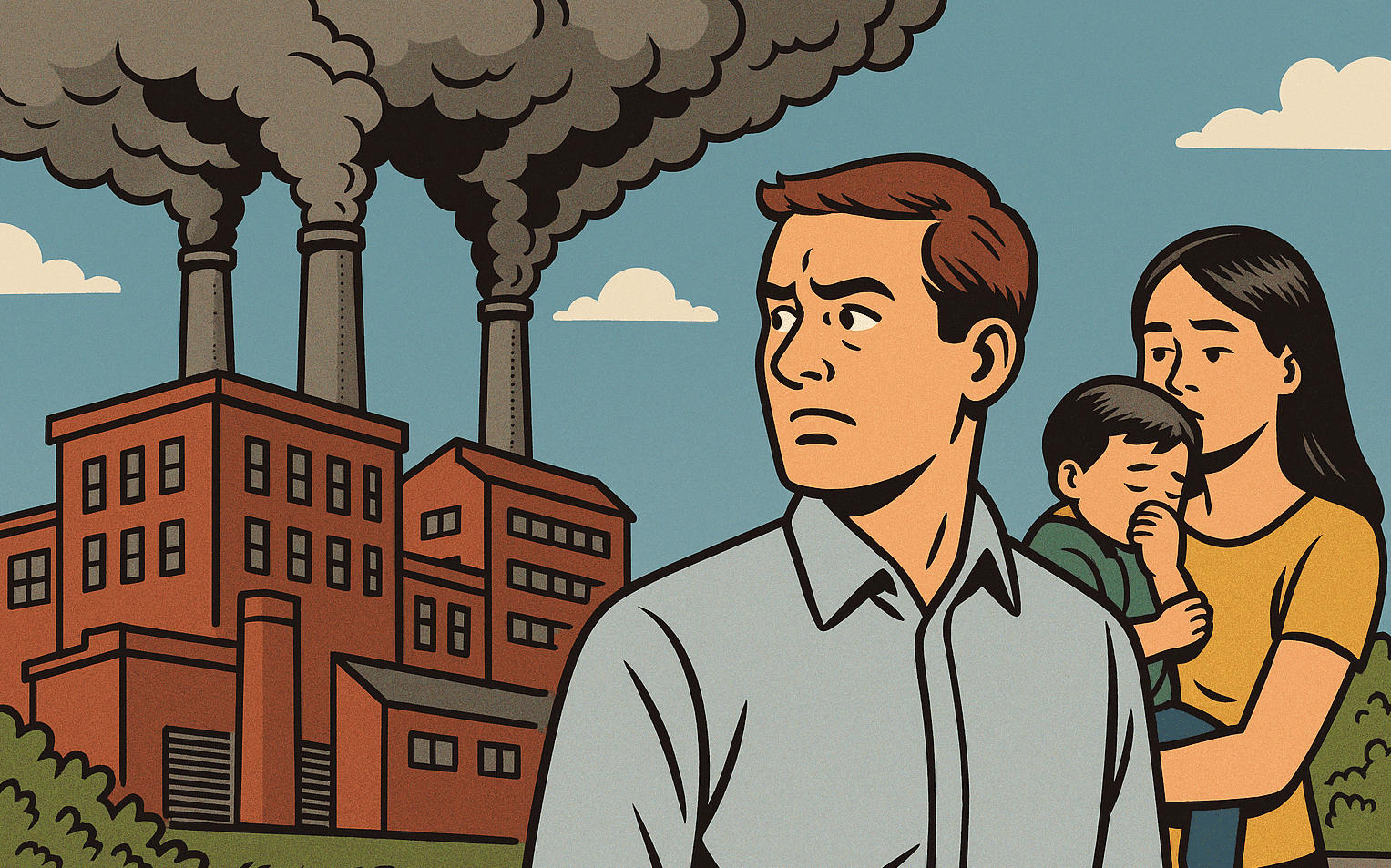
A coal plant in Ohio sells electricity at 6 cents per kilowatt-hour. The buyer pays 6 cents. The plant collects 6 cents. Clean transaction. Except it isn't. Sulfur dioxide drifts east, raising asthma hospitalization rates in Pennsylvania by an estimated $2.7 billion a year across the Appalachian corridor. Mercury settles into rivers, accumulating in fish tissue and eventually in the bloodstreams of children who will never see an invoice from that plant. The price was 6 cents. The cost was far higher.
That gap between what a decision maker pays and what society absorbs has a name: externalities. They are the uninvited guests at every market transaction, the hidden line items that never appear on a receipt but show up in hospital bills, traffic delays, climate projections, and - on the brighter side - in healthier neighborhoods, faster innovation, and diseases that never spread. Master this concept and you hold the decoder ring for nearly every policy debate worth following, from carbon taxes to vaccine mandates to congestion charges in downtown London.
$5.9 Trillion — Estimated annual cost of fossil fuel externalities worldwide (IMF, 2023) - roughly $11 million every minute in uncollected damages
What Externalities Actually Are - And Why Markets Cannot Fix Them Alone
Strip away the jargon and the idea is almost embarrassingly simple. An externality exists when one party's action changes another party's welfare and no money changes hands for that effect. Your neighbor plants a row of oak trees. Your summer cooling bill drops $40 a month. She never charges you. That is a positive externality. A rideshare driver idles outside your apartment at 2 a.m. with the bass rattling your windows. He never compensates you for the sleep you lost. That is a negative externality.
Simple, right? The trouble is scale. One idling car is a nuisance. Four million cars clogging a metro area's highways every weekday morning between 7 and 9 a.m. is an economic crisis that shaves billions in lost productivity. One beekeeper's hives pollinate a nearby orchard for free. An entire agricultural sector dependent on pollination services that no one explicitly pays for is a systemic vulnerability. Externalities become dangerous precisely when they aggregate across millions of individual decisions, each one rational in isolation, collectively irrational for everyone involved.
To think about this with precision, economists track four curves rather than two. In a standard supply and demand diagram, you have marginal private cost (MPC) - what producers actually spend per unit - and marginal private benefit (MPB) - what consumers actually gain per unit. Markets push quantity to where those two lines cross. Efficient, assuming nothing leaks.
But things leak constantly. So we add marginal social cost (MSC), which stacks the external harm on top of private cost, and marginal social benefit (MSB), which stacks the external gain on top of private benefit. Where MSC and MSB cross is the socially optimal quantity. The distance between that point and the market's natural resting place? That is the market failure. That is the policy problem.
Market produces too much. Social cost exceeds private cost. The MSC curve sits above the supply curve. Examples: pollution, congestion, noise, antibiotic overuse. The gap between market quantity and optimal quantity represents deadweight loss - real value destroyed.
Market produces too little. Social benefit exceeds private benefit. The MSB curve sits above the demand curve. Examples: education, vaccination, R&D, open-source software. The gap between market quantity and optimal quantity represents unrealized gains - value left on the table.
The Negative Side - Spillovers That Nobody Volunteered For
Pollution is the textbook poster child, and for good reason. The American Lung Association estimated that air pollution cost the United States roughly $150 billion in health expenses and lost productivity in 2022 alone. But negative externalities reach far beyond smokestacks.
Traffic congestion is one of the most measurable. The Texas A&M Transportation Institute calculated that the average American commuter lost 51 hours to traffic delays in 2022, costing $1,377 per driver in wasted time and fuel. Multiply that across 150 million commuters and you get a national externality bill north of $87 billion. Each driver who merges onto a crowded highway during rush hour imposes roughly 3 to 5 minutes of additional delay on every driver behind them. No one sends an invoice for those stolen minutes.
Antibiotic overuse is subtler but potentially more devastating. When a patient takes antibiotics for a viral infection - where they do nothing useful - bacteria in their system get a training session in resistance. That resistant strain can spread. The cost lands on future patients who need those antibiotics to work and discover they do not. The UK's O'Neill Review projected that antimicrobial resistance could cause 10 million deaths annually by 2050 and cost the global economy $100 trillion in cumulative GDP loss.
Data breaches belong on the modern list too. When Equifax's systems were compromised in 2017, the private data of 147 million Americans spilled into criminal hands. Equifax eventually paid $700 million in settlements. The actual downstream cost - identity theft, credit monitoring, fraud losses, and years of consumer anxiety - ran far higher. One firm's lax security became everyone's problem.
Negative externalities rarely exist in isolation. A factory that pollutes air also contaminates water runoff, lowers property values within a two-mile radius, and increases school absenteeism among nearby children. These cascading effects make single-metric measurement dangerously incomplete. Serious analysis tracks multiple pathways simultaneously.
The Positive Side - Quiet Wins That Markets Chronically Underfund
Positive externalities get less press coverage because nobody protests in the streets about benefits they received for free. But the underproduction problem is every bit as real as the overproduction problem on the negative side.
Education is the heavyweight example. A college graduate earns more, yes - that is the private return. But educated populations also generate lower crime rates, higher civic participation, better public health outcomes, and faster technology adoption. Economists at the Federal Reserve Bank of New York estimated that the social return on education exceeds the private return by 30% to 50%, depending on the field of study. Left purely to individual cost-benefit calculations, society would get less education than it needs.
Vaccination is the cleanest illustration of a positive externality in action. When 95% of a population is vaccinated against measles, herd immunity protects the remaining 5% who cannot be vaccinated for medical reasons. Each person's shot protects not just themselves but strangers they will never meet. The WHO estimates that vaccination programs prevent 3.5 to 5 million deaths per year worldwide. The private incentive - avoiding personal illness - understates the social value by a wide margin.
Then there is basic research. When scientists at CERN developed the protocols that became the World Wide Web in 1989, they were solving a data-sharing problem for physicists. The spillover created an industry worth trillions. Private firms chronically underinvest in basic research because the discoverer captures only a fraction of the value. The rest leaks to competitors, adjacent industries, and future generations. This is precisely why governments fund agencies like the NSF, DARPA, and the NIH - not charity, but rational response to a massive positive externality.
The Coase Theorem - When Private Deals Can Solve the Problem
Before reaching for taxes and regulations, it is worth asking: can the affected parties just work it out themselves? Ronald Coase thought so - under very specific conditions. His 1960 paper "The Problem of Social Cost" proposed that if property rights are clearly defined and transaction costs are low, private bargaining will produce the efficient outcome regardless of who holds the initial right.
Picture a rancher whose cattle trample a neighboring farmer's crops. If the rancher has the right to let cattle roam, the farmer can pay the rancher to build fences - but only if the crop damage exceeds the fencing cost. If the farmer has the right to undamaged crops, the rancher can pay the farmer for the privilege of letting cattle wander - but again, only if that is cheaper than fencing. Either way, the efficient level of trampling emerges through negotiation.
Elegant. Also largely theoretical in complex settings.
Three barriers cripple Coasean bargaining at scale. Transaction costs explode when thousands of people are affected - you cannot negotiate individually with 8 million residents of a metro area about their air quality. Information asymmetry means the polluter usually knows more about their emissions than the victims do. Free-rider problems mean each affected person wants others to bear the cost of negotiation. Coase gives us a benchmark for when government intervention is unnecessary. Most real-world externalities blow past those conditions within seconds.
Pigouvian Taxes and Subsidies - Pricing the Invisible
Arthur Pigou, writing in 1920, offered the solution that still anchors most externality policy: make the decision maker face the full social cost. If a factory's pollution inflicts $30 of health damage per ton of emissions, charge the factory $30 per ton. The factory's private cost now equals the social cost. It will reduce emissions to exactly the point where further reduction costs more than the damage it prevents. The market finds the efficient quantity on its own.
The mirror image works for positive externalities. If each flu vaccination generates $15 in herd immunity benefits beyond the private gain, subsidize the shot by $15. More people get vaccinated. The market reaches the socially optimal level.
The beauty of Pigouvian pricing is that it preserves choice. Nobody is forced to stop polluting - they just have to pay for the damage. Firms that can reduce emissions cheaply will do so. Firms for which reduction is expensive will pay the tax and fund cleanup elsewhere. The total reduction happens where it costs least. Compare that to a blanket mandate requiring every firm to cut emissions by 20%, which forces expensive cuts on some firms while leaving cheap opportunities untouched at others.
Real-world Pigouvian taxes are everywhere, though they rarely carry the name. Tobacco taxes internalize a portion of the healthcare costs smokers impose on public systems. Fuel excise taxes partially capture road damage and public infrastructure wear. Plastic bag charges in over 100 countries address litter and marine pollution externalities. The question is never whether to use pricing - it is whether the price is set close enough to the actual external cost to do its job.
Cap and Trade - Setting the Ceiling, Letting Markets Find the Floor
A Pigouvian tax fixes the price and lets the market determine the quantity. A cap and trade system does the reverse: it fixes the quantity and lets the market determine the price. The government sets a total emissions cap for a sector or region, distributes or auctions permits equal to that cap, and allows firms to buy and sell them freely.
The EU Emissions Trading System (EU ETS), launched in 2005, is the largest cap and trade program on the planet. It covers roughly 40% of the EU's greenhouse gas emissions across 10,000 installations in power generation, manufacturing, and aviation. By 2023, the carbon price under the EU ETS had risen above 80 euros per ton, driving a measurable shift from coal to natural gas and renewables across European electricity markets.
The US Acid Rain Program, established under the 1990 Clean Air Act Amendments, remains the gold standard for cap and trade design. It targeted sulfur dioxide emissions from power plants with a hard cap that ratcheted down over time. By 2010, SO2 emissions from covered sources had fallen 67% from 1990 levels - and by 2020, the reduction exceeded 93%. Here is the part that silenced skeptics: the actual cost of compliance came in roughly 75% below the industry's pre-regulation estimates. Trading allowed reductions to concentrate where they were cheapest, and the predictable tightening schedule gave firms years to plan investments in scrubbers and fuel switching.
Good cap and trade design requires five ingredients: accurate emissions monitoring, a credible registry to prevent double-counting, permit banking so firms can smooth investments across years, a long-term declining cap to signal the direction of travel, and penalties stiff enough that cheating is never the rational play.
Command and Control - When Blunt Rules Beat Clever Prices
Not every externality problem yields to pricing. Sometimes you need a bright line that nobody crosses.
Lead in gasoline is the definitive example. The health externality - cognitive damage in children, cardiovascular disease in adults - was so severe and so well-documented that no "optimal tax" made sense. The right quantity of lead in fuel was zero. The US phased it out between 1975 and 1996. Blood lead levels in American children dropped 75% within a decade. Sometimes a ban is not just simpler than a tax; it is the only defensible response.
Standards work best when the harm is catastrophic at any level (asbestos, CFCs), when monitoring individual emissions is impractical (vehicle tailpipe standards are cheaper to enforce at the manufacturing stage), or when the technology pathway is narrow enough that mandating a specific solution does not sacrifice much efficiency. They work poorly when firms vary wildly in their abatement costs, because a uniform standard forces expensive cuts on some while leaving cheap options untouched at others.
The real world uses layered approaches. Fiscal policy tools like carbon taxes coexist with fuel efficiency standards, building codes, and outright bans on the most dangerous substances. Viewing these as competing philosophies misses the point. They are complementary tools, each suited to a different slice of the problem.
Congestion Pricing - The Externality You Sit In Every Morning
Few externalities are as viscerally felt as traffic congestion. And few have been as successfully addressed by straightforward economic logic.
Stockholm introduced a congestion charge in 2006 as a seven-month trial. Traffic entering the central zone dropped 22% almost immediately. Average travel times fell by 30-50% on key routes. Air pollutant concentrations in the charging zone decreased by 8-14%. After the trial, the city held a referendum. Despite pre-trial opposition polling above 55%, voters approved making the charge permanent. People experienced the benefit and changed their minds.
Singapore has run congestion pricing since 1975 - longer than any other city on Earth. Its Electronic Road Pricing system adjusts tolls every 30 minutes based on real-time traffic flow, targeting a speed of 45-65 km/h on expressways and 20-30 km/h on arterial roads. When speeds fall below the target, prices rise. When speeds exceed it, prices drop. The result is one of the world's most functional urban road networks in one of the world's densest cities.
London's Congestion Charge (launched 2003): The daily charge for driving into central London during peak hours started at 5 pounds and has risen to 15 pounds as of 2024. Traffic volumes in the charging zone fell roughly 30% in the first year. Bus journey times improved 15-20%. The program generates over 200 million pounds annually in net revenue, funding bus service expansion and cycling infrastructure. Politically contentious at launch, it is now a fixture of London's transport planning.
The economics are textbook. During off-peak hours, adding one more car to a highway has minimal impact on other drivers - the marginal external cost is near zero. During rush hour on a capacity-constrained road, one more car ripples delay through thousands of vehicles behind it - the marginal external cost can exceed $5 per mile. A flat toll would overcharge off-peak drivers and undercharge peak drivers. Time-varying pricing, like Singapore's system, matches the charge to the actual externality. That is not just theoretically elegant. It measurably works.
Network Effects and Knowledge Spillovers - Externalities in the Digital Age
Not all externalities involve smokestacks or tailpipes. Some of the most economically significant ones are invisible, flowing through information networks and technology platforms.
A network effect occurs when the value of a product or platform increases as more people use it. The telephone was useless with one subscriber. With a million subscribers, it transformed commerce. Social media platforms, payment systems, and communication protocols all exhibit this property. The first users bear high costs and receive low value. Their participation generates enormous positive externalities for later users who join a mature, valuable network.
This creates a coordination problem that markets sometimes solve on their own - and sometimes do not. The QWERTY keyboard layout persists not because it is optimal, but because the switching cost for billions of trained typists exceeds any individual's incentive to change. Path dependence, driven by network externalities, can lock entire economies into suboptimal standards.
Knowledge spillovers are the other giant category. When a pharmaceutical company spends $2.6 billion developing a new drug (the average cost per approved molecule, according to Tufts Center for the Study of Drug Development), the knowledge generated - about molecular pathways, failed approaches, and testing methods - leaks to competitors and adjacent fields. The developing firm cannot capture more than a fraction of the total value created. Patent systems partially address this by granting temporary monopoly rights, but the tension between rewarding innovation and enabling productivity spillovers is permanent.
Public Goods and Common Resources - Externalities at Their Extremes
Externalities exist on a spectrum. At the far positive end sit public goods - things that are nonrival (one person's use does not diminish another's) and nonexcludable (you cannot easily prevent anyone from benefiting). National defense, street lighting, and basic scientific knowledge all qualify. The positive externality is so total that private markets collapse entirely. Why pay for something you get for free? Everyone waits for someone else to fund it. This is the free-rider problem, and it is why public goods require collective funding through taxation.
At the far negative end sit common resources - things that are rival (one person's use does reduce what is left) but nonexcludable (access is difficult to restrict). Ocean fisheries, aquifers, and atmospheric carbon capacity all qualify. Each user imposes a negative externality on every other user by depleting the shared stock. Without rules, the result is what Garrett Hardin called the "tragedy of the commons" - rational individual behavior producing collective ruin. Global fish stocks illustrate the pattern: the UN Food and Agriculture Organization reports that 35% of the world's assessed fish populations were overfished as of 2022, up from 10% in 1974.
The solutions map directly to externality logic. For public goods, fund them collectively and ensure the funding mechanism does not itself create worse distortions than the problem it solves. For commons, assign rights (fishing quotas, water allocations, emissions permits), monitor usage, and enforce limits with consequences that make overuse unprofitable.
Measuring What Markets Ignore
You cannot correct an externality you cannot size. And sizing externalities is genuinely difficult, which is why so many persist for decades before policy catches up.
The measurement process follows three steps. First, identify the physical unit - tons of CO2, decibels at a property line, cases of disease averted per thousand vaccinations, minutes of delay per additional vehicle. Second, trace the causal pathway from that unit to real outcomes using the best available science: epidemiology for health impacts, traffic engineering for congestion, climate models for emissions. Third, attach a dollar value to those outcomes using revealed or stated preference methods - what people actually pay to avoid similar harms, or what they say they would pay in carefully designed surveys.
The social cost of carbon (SCC) is the most prominent application of this framework. The US government's interagency working group estimated the SCC at approximately $51 per ton of CO2 in 2020, though recent academic work by Resources for the Future and other groups has pushed estimates above $185 per ton when updated climate damage functions and lower discount rates are used. The number matters enormously: it determines whether a proposed power plant, pipeline, or efficiency standard passes a cost-benefit analysis.
Externalities with long time horizons force an uncomfortable question: how much should we value future people's welfare relative to our own? A 3% discount rate makes a dollar of climate damage in 2100 worth about 8 cents today. A 1% discount rate makes it worth about 47 cents. The choice between those rates - a seemingly arcane technical decision - can flip the verdict on trillion-dollar investments. The Stern Review (2006) used a near-zero pure time preference rate and concluded that aggressive climate action was urgently justified. Nordhaus (2007) used a higher rate and recommended gradual action. Same science, wildly different policy prescriptions, all hinging on a philosophical judgment about intergenerational fairness.
Who Pays and Who Benefits - The Equity Dimension
A policy can improve total welfare and still be unjust. This is the equity trap that derails otherwise sound externality corrections.
Carbon taxes are the sharpest example. A price on carbon raises energy costs. Energy spending as a share of income is roughly three times higher for households in the bottom income quintile than for those at the top. Without compensation, a carbon tax is regressive - it hits the poorest hardest. Canada's federal carbon pricing system addresses this by returning roughly 90% of revenues directly to households as quarterly "Climate Action Incentive" payments. The bottom 60% of households by income receive more in rebates than they pay in higher costs. The policy remains progressive in its environmental impact while avoiding regressive distributional effects.
Education subsidies present the opposite risk. Blanket tuition subsidies for university often flow disproportionately to families who would have sent their children to university regardless - families that tend to be wealthier. The positive externality argument for education subsidies is strong, but the targeting matters. Programs aimed at first-generation college students, vocational training in shortage fields, and early childhood education generate far higher marginal social returns per dollar spent than across-the-board tuition discounts for four-year degrees.
The takeaway: Efficiency and equity are not opposing goals - they are parallel requirements. A carbon tax without rebates is a regressive tax. A carbon tax with well-designed rebates is a progressive environmental policy. The design determines the justice.
Climate Change - The Capstone Externality
Every concept in this article converges in the climate problem. It is a negative externality (emissions impose costs on others). It involves public goods (a stable climate is nonrival and nonexcludable). It creates commons tragedies (the atmosphere's carbon absorption capacity is shared and depletable). It spans borders (one country's emissions affect every other). It stretches across generations (today's emissions cause damage for centuries). And it triggers network effects (the value of decarbonization rises as more countries participate, lowering the cost of clean technology for everyone).
The policy toolkit mirrors the full catalog of externality solutions. Carbon pricing through taxes or cap and trade internalizes the cost where measurement is reliable. Standards and mandates cover sectors where monitoring individual emissions is impractical (vehicle efficiency, building codes). Public investment in basic R&D addresses the knowledge spillover problem - no private firm will fund enough climate science or early-stage battery research because the benefits leak too widely. International coordination through agreements like the Paris Accord addresses the cross-border free-rider problem, though enforcement remains the weakest link.
The virtuous cycle above explains why early action on carbon pricing generates compounding returns. Each round of price-driven innovation makes the next round of emission cuts cheaper. Delay, by contrast, locks in high-carbon infrastructure and makes the eventual transition more expensive. This is not speculation - the cost of solar electricity fell 89% between 2010 and 2023, driven largely by deployment policies in Germany, China, and the US that created the scale necessary for manufacturing learning curves to kick in.
Health, Nudges, and the Behavioral Layer
Classical externality theory assumes rational actors who respond predictably to prices. Behavioral economics complicates the picture. People procrastinate on vaccinations even when they are free. Smokers continue despite knowing the health costs they impose on public insurance systems. Drivers underestimate the congestion impact of their commute choices because the delay is distributed across thousands of strangers in tiny increments.
This is where nudges earn their place in the externality toolkit. Organ donation rates in countries with opt-out defaults (Austria: 99.98%) dwarf those in opt-in countries (Germany, before switching: 12%). The externality is identical - each donor can save up to eight lives - but the policy architecture makes the difference between near-universal participation and a chronic shortage. Default settings, simplified enrollment, salient reminders, and social norm messaging do not replace pricing or regulation. They reduce the friction that prevents people from acting on incentives that already point in the right direction.
Urban Externalities - Where Everything Collides
Cities are externality laboratories. Density amplifies both the positive and negative spillovers of every human activity.
On the positive side: proximity to other skilled workers raises individual productivity (economists call these agglomeration effects, and they account for the 20-30% wage premium in large cities). Mixed-use neighborhoods with good transit reduce per-capita emissions. Parks raise surrounding property values by 8-20% while reducing heat island effects and improving mental health outcomes.
On the negative side: poor waste management affects air and water quality for entire districts. Zoning laws that block housing near employment centers push workers into long commutes, generating congestion externalities that cascade through the entire metro area. Single-family zoning in high-demand areas like San Francisco and Sydney restricts housing supply, driving up rents and displacing lower-income residents who then face longer commutes with higher carbon footprints.
Smart urban policy treats zoning as externality management rather than land-use tradition. Permit more housing near transit stations (reducing commute externalities). Price curb space to reflect demand (reducing cruising-for-parking externalities, which account for an estimated 30% of traffic in congested downtown areas). Require developers to fund off-site improvements when new projects create predictable burdens on drainage, traffic, or school capacity. Monitor outcomes - air quality, commute times, housing affordability - rather than checking boxes on permit applications.
Cross-Border Spillovers and the Coordination Challenge
Externalities rarely respect national boundaries. Power plants in one country send emissions across borders. Overfishing in international waters punishes rule-following nations while rewarding defectors. Lax tax rules in one jurisdiction create profit-shifting externalities that erode the tax bases of others.
The coordination problem is structural. Any country that unilaterally imposes strict environmental standards risks "carbon leakage" - polluting industries simply relocate to countries with weaker rules, and global emissions stay the same or even increase. The EU's Carbon Border Adjustment Mechanism (CBAM), phasing in between 2023 and 2026, attempts to solve this by charging imports based on their embedded carbon content. If you manufacture steel in a country without a carbon price and sell it into the EU, you pay the equivalent of the EU carbon price at the border. The incentive to relocate vanishes.
Fisheries management tells a similar story. Iceland's individual transferable quota system, introduced in 1984, assigned property rights to shares of the total allowable catch. Quotas could be bought and sold, concentrating fishing effort in the most efficient operators. Fish stocks stabilized and then recovered, while the fishing industry became more profitable, not less. The key insight: converting a commons tragedy into a system of tradable rights applied exactly the same logic that cap and trade applies to air pollution.
The Corporate Playbook - Turning Externality Awareness Into Strategy
Companies that understand externalities do not just comply with regulations. They anticipate them, and they find opportunities where others see only costs.
The practical steps look like this. Map your externality profile across operations, supply chain, and product use. Quantify the most material harms and benefits in dollar terms, not just physical units. Set internal shadow prices for carbon, water, and other externalities that reflect likely policy trajectories over the next decade. Redesign processes where the cost of reduction is less than the shadow price - those are the moves that will become mandatory anyway, so acting early captures first-mover advantage. Choose suppliers based on verifiable data rather than marketing claims. Build products that generate positive externalities - energy-efficient appliances that lower both the customer's bill and the grid's peak load, for instance.
Unilever's Sustainable Living Plan, Interface's Mission Zero carpet recycling program, and Patagonia's supply chain transparency initiatives are not altruism. They are externality-aware strategy. Each company identified a rising regulatory or reputational cost associated with negative externalities in their sector and moved to reduce exposure before competitors. The financial performance of ESG-aligned companies during the 2020 market downturn - outperforming broad indices by 1.5 to 3 percentage points - suggests the market is beginning to price externality risk into valuations.
Why Externality Policies Fail - And the Three Traps to Watch For
Good intentions and sound theory do not guarantee good outcomes. Three failure modes recur across decades and countries.
Mismeasurement sets prices far from the actual external cost. Europe's initial allocation of free emissions permits under the EU ETS was so generous that the carbon price collapsed to near zero between 2012 and 2017, providing almost no incentive to reduce emissions. The system had to be redesigned with a Market Stability Reserve that automatically removes surplus permits from circulation.
Leakage shifts the problem rather than solving it. Strict timber harvesting rules in one country can simply redirect logging to countries with weaker enforcement, with no net reduction in deforestation. The same applies to fishing, manufacturing emissions, and financial regulation.
Regulatory capture occurs when the industries being regulated gain disproportionate influence over the rules. Legacy firms lobby for standards that match their existing technology, effectively blocking cheaper or cleaner competitors from entering the market. The US corn ethanol mandate is a cautionary tale: initially justified on climate externality grounds, it survived long after evidence showed its net emissions benefit was marginal at best, because the corn lobby had become politically entrenched.
Fund continuous monitoring infrastructure. Update damage estimates on a published schedule, not only when a political window opens. Transparent data undermines lobbying based on contested numbers.
Coordinate across jurisdictions from the start. Use border adjustments, mutual recognition agreements, or linked trading systems so that tightening rules in one place does not just export the problem.
Staff independent oversight bodies with rotating personnel. Build sunset clauses into subsidies. Focus regulations on outcomes (emissions per unit of output) rather than technology mandates that freeze the competitive landscape.
Spotting Externalities in the Wild - A Quick Field Test
You do not need an economics degree to identify externalities in everyday decisions. Run three questions. First: does this transaction affect anyone who is not a buyer or seller? If yes, you have a candidate. Second: is the affected party compensated (for harm) or charged (for benefit)? If not, you have an externality. Third: how many people are affected and how large is the per-person impact? That determines whether private bargaining, Coasean-style, can handle it, or whether you need a policy tool.
Your upstairs neighbor's loud music at midnight? Small-scale negative externality, solvable by knocking on the door (low transaction costs, two parties). A chemical plant dumping effluent into a river that supplies drinking water to 200,000 people? Large-scale negative externality requiring regulation, monitoring, and enforcement. A local business owner who maintains a beautiful storefront that raises foot traffic and property values for the whole block? Small-scale positive externality, probably not worth formal policy, but worth recognizing. A pharmaceutical company deciding whether to fund research into a disease that affects 10 million people in low-income countries who cannot afford to pay? Massive positive externality requiring public funding, international coordination, and intellectual property arrangements that balance innovation incentives against access.
The framework scales from apartment buildings to global commons. That is its power.
Where Externality Thinking Goes Next
The frontiers are expanding faster than textbooks can track. Artificial intelligence systems trained on public data generate enormous positive externalities for the firms that deploy them, but also create negative externalities in the form of job displacement, algorithmic bias, and energy consumption (training GPT-4 consumed an estimated 50 GWh of electricity). How do you price those? Biodiversity loss driven by land-use externalities threatens ecosystem services worth an estimated $125 to $140 trillion per year - more than global GDP - yet no carbon-style pricing mechanism exists for habitat destruction. Antibiotic resistance, space debris, and digital privacy are all externality problems waiting for institutional innovation.
The concepts themselves are settled. Externalities are real. Markets misprice them. Policy tools exist. The unsettled part is the political will and institutional design required to deploy those tools at the speed and scale the problems demand. Every generation inherits externalities the previous one failed to internalize. The question is not whether you will encounter these tradeoffs in your career, your community, and your voting booth. You will. The question is whether you will recognize them when they arrive disguised as something else - a zoning dispute, a trade negotiation, a healthcare budget, a technology regulation - and know which tool fits the problem.
That recognition, more than any formula or diagram, is what turns economic literacy into operational advantage.