
The Subject That Explains Everything With a Price Tag
Every time you choose a $5 coffee over saving that $5, you're making an economic decision. Every time a government prints money, raises taxes, or signs a trade deal, economics is running the show. This is the subject that explains why things cost what they cost, why some countries are rich while others aren't, and why your rent keeps going up.
But here's what most people get wrong about economics: they think it's about money. It's not. Economics is about choices. Specifically, it's about choices under scarcity, which is the condition of having unlimited wants but limited resources. Money is just one of those resources. Time is another. Attention is a third. Every decision you make involves giving something up to get something else, and that tradeoff is the beating heart of the entire field.
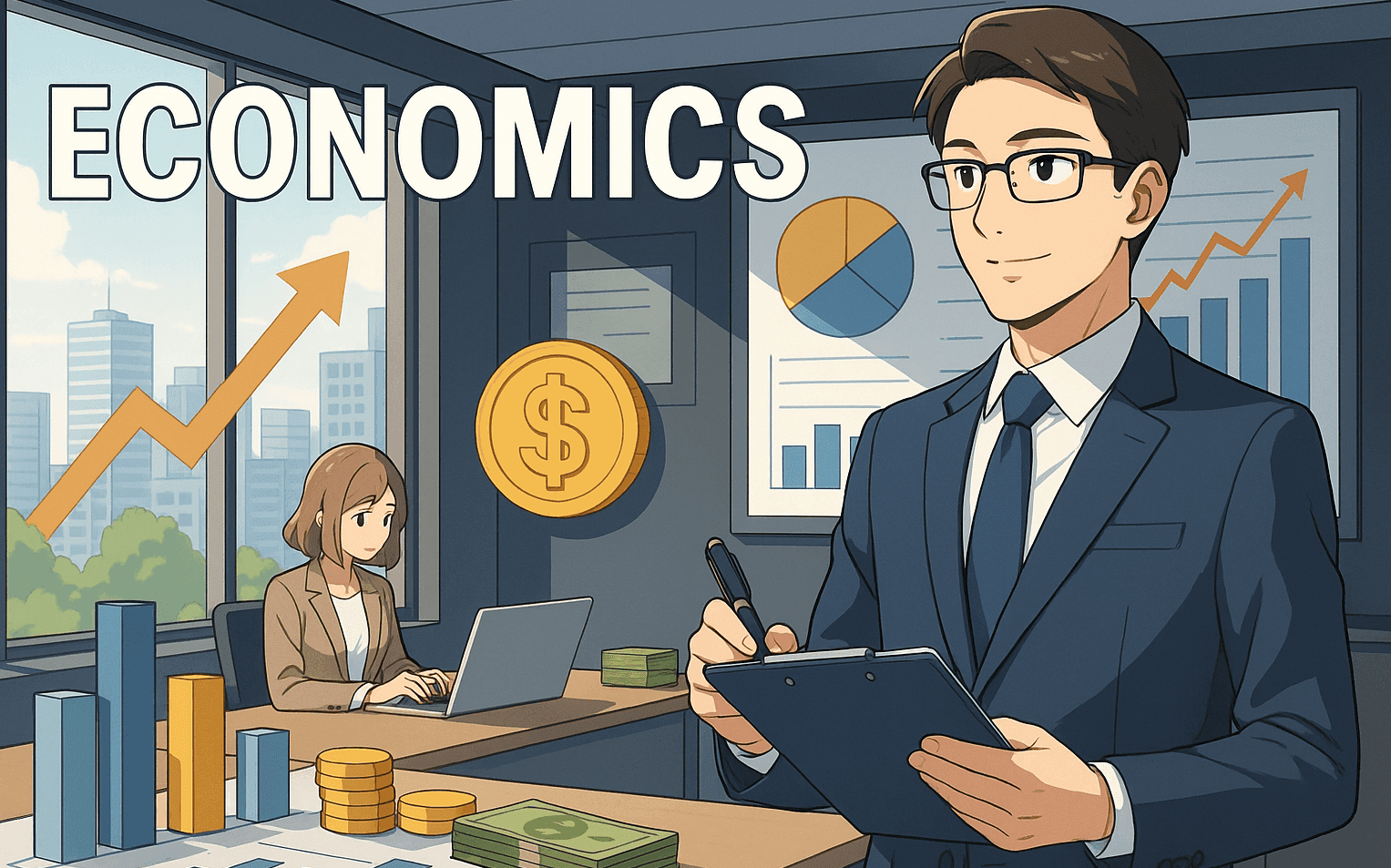
With 35 topics, economics is the largest subject on Hozaki, and for good reason. It touches everything. Business strategy, government policy, international relations, personal finance, even psychology. The concepts here will change how you read the news, evaluate job offers, and think about the world.
Microeconomics: Where Individual Choices Create Markets
Economics splits into two big branches: microeconomics (the small picture) and macroeconomics (the big picture). Micro comes first, both in logic and in most curricula, because you need to understand how individuals and firms behave before you can understand how entire economies work.
Supply, Demand, and the Price of Everything
The most famous idea in economics is supply and demand. It's also one of the most misunderstood. People say "supply and demand" like it's a single thing, but it's actually two separate forces that interact to determine prices and quantities in a market.
Demand is what buyers want at various prices. Supply is what sellers offer at various prices. When these two curves intersect, you get market equilibrium, the price where the quantity buyers want to purchase exactly matches the quantity sellers want to produce. No shortage, no surplus. Just a clearing price.
The real power of this framework becomes clear when something changes. A drought hits wheat-growing regions? Supply shifts left, prices rise. A viral TikTok makes a product trendy? Demand shifts right, prices rise again. The model predicts these outcomes with surprising accuracy.
Then there's price elasticity, which measures how sensitive buyers (or sellers) are to price changes. Insulin is inelastic: diabetics need it regardless of cost. Movie tickets are elastic: raise the price and people stay home. This single concept explains why luxury taxes often fail and why companies can charge more for products with no close substitutes.
How Consumers Actually Choose
Consumer choice theory tries to model how people decide what to buy. The classical version assumes people are rational maximizers: they evaluate all options, weigh costs against benefits, and pick the combination that gives them the most satisfaction (economists call it "utility").
Marginal utility and diminishing returns explain why the first slice of pizza is heavenly and the fifth is painful. Each additional unit of something gives you less satisfaction than the one before it. This isn't just a fun observation. It's the reason demand curves slope downward: as you accumulate more of something, you're willing to pay less for each additional unit.
The concept of opportunity cost runs through all of this. Every choice has a price, and that price isn't just what you pay. It's what you give up. Choosing to attend college costs tuition, yes, but the bigger cost is often the four years of income you didn't earn. Once you start seeing opportunity costs, you can't unsee them.
You have a free ticket to a concert tonight. Your friend offers you $100 to help them move instead. Going to the concert doesn't cost you money (the ticket was free), but it costs you $100 in forgone income. The "free" concert actually has a $100 price tag. Economics trains you to see these hidden costs everywhere.
Market Structures: From Perfect Competition to Monopoly
Not all markets work the same way. A farmer selling wheat operates in a very different world than Google selling digital advertising. Market structure refers to the competitive landscape: how many firms exist, how much power each one has, and how easy it is for new players to enter.
At one extreme, you have perfect competition: many small firms, identical products, no barriers to entry. Nobody has pricing power. At the other extreme, you have monopoly and oligopoly, where one or a few firms dominate. Monopolists set prices. Oligopolists (think airlines or cell carriers) watch each other constantly, and their strategic interactions are where game theory enters the picture.
Understanding market structures isn't academic trivia. It explains why your internet bill is so high (limited competition), why generic medications are cheap (many producers), and why tech companies acquire potential competitors before they grow (preserving market power).
Scale: Individuals, households, firms, single markets
Key questions: How do prices form? Why do consumers choose X over Y? How do firms compete?
Core tools: Supply/demand, elasticity, marginal analysis, game theory
Example: Why did the price of eggs spike in 2023?
Scale: National economies, global systems, aggregate outcomes
Key questions: Why do recessions happen? What causes inflation? How can governments stabilize economies?
Core tools: GDP, CPI, unemployment rate, fiscal/monetary policy
Example: Why did global inflation surge after COVID-19?
Macroeconomics: Zooming Out to the National Economy
If microeconomics is about individual trees, macroeconomics is about the forest. It studies aggregate phenomena: total output, overall price levels, national employment. The questions change from "why does this product cost $5?" to "why is everything getting more expensive?"
Measuring the Economy
GDP (Gross Domestic Product) is the headline number. It measures the total value of all goods and services produced within a country's borders in a given period. When people say "the economy grew 3% last year," they're talking about GDP growth.
But GDP has blind spots. It counts a car crash as positive (repairs create economic activity) and ignores unpaid household labor entirely. It doesn't measure happiness, health, or environmental quality. Knowing what GDP misses is just as important as knowing what it captures.
Inflation is the general increase in price levels over time. A little inflation (2-3% annually) is considered normal and even healthy. Too much inflation erodes purchasing power and creates uncertainty. Too little (or deflation) can be even worse, discouraging spending because consumers wait for lower prices.
Unemployment rounds out the big three macroeconomic indicators. But not all unemployment is the same. Frictional unemployment (people between jobs) is natural. Structural unemployment (skills don't match available jobs) is more concerning. Cyclical unemployment (caused by recessions) is what keeps policymakers up at night.
The Policy Toolkit
When the economy misbehaves, governments have two main levers to pull. Fiscal policy involves government spending and taxation. During a recession, a government might cut taxes or increase spending to stimulate demand. During an overheating economy, it might do the opposite.
Monetary policy is controlled by central banks (the Federal Reserve in the U.S., the European Central Bank in the EU). Their primary tool is interest rates. Lower rates make borrowing cheaper, encouraging spending and investment. Higher rates make borrowing expensive, cooling down an overheated economy.
These two policy branches don't always work in harmony. A government might want to spend aggressively while the central bank wants to tighten. This tension plays out constantly in real-world politics, and understanding it makes economic news suddenly legible.
Debt, Deficits, and the Government's Balance Sheet
When a government spends more than it collects in taxes during a single year, it runs a budget deficit. The accumulation of all those annual deficits (minus any surpluses) becomes the national debt.
Is national debt bad? The honest answer is: it depends. A household that borrows to buy a house is making a smart investment. A household that borrows to buy lottery tickets is not. The same logic applies to governments. Debt spent on infrastructure, education, and research can pay for itself through higher future growth. Debt spent on short-term consumption usually doesn't.
What matters more than the absolute number is the debt-to-GDP ratio and the interest burden. Japan's debt exceeds 250% of GDP, yet it borrows at near-zero rates. Some developing countries struggle with debt-to-GDP ratios of 60% because their interest rates are high. Context matters enormously.
When Markets Fail: Externalities, Public Goods, and Regulation
Free markets are powerful, but they're not perfect. Economists have identified several systematic ways markets can produce bad outcomes, grouped under the concept of market failure.
Externalities are costs or benefits that spill over to people not involved in a transaction. A factory pollutes a river? The people downstream bear the cost, but that cost doesn't appear in the factory's financial statements. This is a negative externality. Education generates positive externalities: an educated population benefits everyone, not just the person who went to school.
Public goods are things the market won't provide efficiently because nobody can be excluded from using them and one person's use doesn't reduce availability for others. National defense, street lighting, and clean air are classic examples. Since you can't charge people individually for breathing clean air, the private sector won't provide it, and government steps in.
This is where policy tools like subsidies, corporate taxation, and price controls enter the picture. Subsidies encourage activities with positive externalities (solar panel installation, for instance). Taxes can discourage activities with negative externalities (carbon taxes on fossil fuels). Price controls, like rent ceilings or minimum wages, attempt to override market prices for social goals, though economists are famously divided on whether they help or hurt.
Much of economics comes down to one question: when should markets be left alone, and when should governments intervene? Free-market advocates argue that intervention creates more problems than it solves. Others argue that unregulated markets produce inequality, pollution, and financial crises. The evidence suggests the answer is "it depends," which is unsatisfying but honest. Good economics is about figuring out specifically what it depends on.
International Economics: Trade, Exchange Rates, and Globalization
No country exists in isolation. International economics studies how nations interact through trade, capital flows, and policy coordination.
The foundational concept is comparative advantage, first articulated by David Ricardo in 1817. The key insight is counterintuitive: even if one country is better at producing everything, both countries benefit from specializing in what they're relatively best at and trading. This is why Portugal trades with Germany, despite Germany being more productive overall. Portugal has a comparative advantage in certain goods, and both nations are richer for the exchange.
Trade and tariffs covers the mechanics. Tariffs are taxes on imports. They protect domestic industries but raise prices for consumers. Every trade policy is a tradeoff between these interests, which is why trade debates get heated. The steelworker whose job is protected by tariffs and the consumer paying more for a car both have legitimate grievances.
Exchange rates determine how much one currency is worth in terms of another. They affect everything: the price of imported goods, the competitiveness of exports, the value of foreign investments. A strong dollar makes American vacations in Europe cheaper but makes American exports more expensive for European buyers. Countries sometimes deliberately weaken their currency to boost exports, which is why "currency manipulation" shows up in trade disputes. The entire system connects back to monetary policy: when a central bank raises interest rates, foreign investors buy that currency to earn higher returns, driving the exchange rate up.
Globalization is the broader trend of increasing economic integration across borders. It has lifted hundreds of millions out of poverty (especially in East and Southeast Asia) while simultaneously displacing workers in developed countries whose jobs moved overseas. The economic data on globalization is genuinely mixed, which is why it generates such polarized debate. For the deeper connections between economics and global patterns, the geography subject covers how location, resources, and trade routes shape economic outcomes.
Work, Wages, and Productivity
Labor markets are where most people first encounter economics personally. Your salary, your job security, and your career prospects are all shaped by the same supply and demand forces that determine the price of coffee beans. When there are more qualified workers than available jobs, wages stagnate. When specific skills are scarce and in high demand, wages climb. This is why software engineers in 2021 commanded enormous salaries (high demand, limited supply) and why many retail workers struggle for raises (high supply, replaceable skills). The labor market doesn't care about fairness. It responds to scarcity.
Minimum wage debates illustrate the tension perfectly. Classical economics predicts that a price floor above the equilibrium wage creates unemployment (employers hire fewer workers). Empirical research over the past 30 years suggests the effect is smaller than theory predicts, partly because labor markets aren't perfectly competitive. This gap between clean theory and messy reality is where economics gets genuinely interesting.
Productivity, the amount of output produced per unit of input, is the single most important determinant of long-term living standards. Countries don't get rich by working more hours. They get rich by working smarter: better technology, better education, better institutions. The productivity gap between nations explains more about global inequality than almost any other variable.
The privatization debate fits here too. Privatization, transferring state-owned enterprises to private ownership, has been a major policy trend since the 1980s. The argument for it: private firms face competitive pressure that forces efficiency. The argument against: some services (healthcare, water, prisons) may not work well as profit-maximizing businesses. The evidence varies by industry and country, and the history of privatization waves is full of both success stories and cautionary tales.
Economics Everywhere: Your Daily Decisions Through an Economic Lens
| Your Decision | The Economics Behind It | Key Concept |
|---|---|---|
| Choosing a cheaper store brand over a name brand | You're calculating that the marginal utility of the brand name isn't worth the price premium | Marginal utility, consumer choice |
| Accepting a job offer vs. waiting for a better one | You're weighing the opportunity cost of waiting (lost income now) against the expected value of a higher offer | Opportunity cost, expected value |
| Deciding whether to drive or take the bus | You're doing an informal cost-benefit analysis factoring in time, money, convenience, and environmental impact | Cost-benefit analysis, externalities |
| Watching prices rise at the grocery store | You're experiencing inflation, driven by supply chain disruptions, energy costs, or monetary policy | Inflation, supply and demand |
| Negotiating your salary | You're operating in a labor market where your pay reflects the supply of your skills vs. employer demand | Labor markets, elasticity |
| Buying something on sale "before it's gone" | Scarcity (real or manufactured) is driving urgency. Marketers understand economics very well. | Scarcity, behavioral economics |
Behavioral Economics: When Humans Don't Act "Rationally"
Classical economics assumes people are rational. Behavioral economics asks: are they, though?
The field, pioneered by Daniel Kahneman and Amos Tversky, documents the systematic ways humans deviate from the rational model. We overweight losses compared to equivalent gains (loss aversion). We anchor to the first number we see in a negotiation (anchoring bias). We choose the default option even when a better one is available (status quo bias). We value something more just because we own it (endowment effect).
These aren't random quirks. They're predictable patterns that affect everything from retirement savings (people who are auto-enrolled in pension plans save dramatically more than those who have to opt in) to pricing strategy (a $2,000 watch next to a $10,000 watch suddenly looks reasonable).
Behavioral economics gave birth to "nudge theory": the idea that you can design choices to guide people toward better decisions without removing their freedom. Organ donation rates in countries with opt-out systems (you're a donor unless you say no) are dramatically higher than in opt-in countries. The economic incentives are identical. The behavioral design is different. Governments around the world now have "nudge units" applying these principles to tax compliance, energy conservation, and public health.
The connection between behavioral economics and consumer choice theory is fascinating. Classical theory says consumers maximize utility through careful calculation. Behavioral theory says consumers use mental shortcuts, get distracted by irrelevant information, and sometimes choose against their own interests. Both perspectives are useful. The classical model works well for predicting aggregate market behavior. The behavioral model works better for understanding individual decisions and designing better policies.
Strategic Thinking: Game Theory in Economics
Game theory is the study of strategic interaction, situations where your best move depends on what others do. It started as a branch of mathematics but found its most fertile ground in economics.
The classic example is the Prisoner's Dilemma: two suspects are interrogated separately, and each must decide whether to cooperate with the other (stay silent) or defect (confess). The rational choice for each individual is to defect, but if both defect, both get a worse outcome than if they'd cooperated. This exact dynamic plays out in price wars between companies, arms races between nations, and climate negotiations between countries.
Game theory connects directly to oligopoly markets. When a handful of firms dominate an industry, each one watches the others constantly. Should Coca-Cola lower its price? That depends on whether Pepsi will follow. Should an airline add routes? That depends on what competitors will do in response. Every strategic decision is a game, and game theory provides the framework for analyzing it.
The business subject explores the applied side of these competitive dynamics, from pricing strategy to market positioning.
The Shadow Side: Underground Economies and Inequality
Not all economic activity shows up in official statistics. The shadow economy (also called the informal or underground economy) includes everything from unreported cash payments to full-scale black markets. In some developing countries, the shadow economy accounts for 30-40% of total economic activity. This matters because it distorts GDP measurements, reduces tax revenue, and makes policy design harder.
Income distribution and inequality is one of the most debated topics in economics. The Gini coefficient measures how evenly (or unevenly) income is distributed across a population. A score of 0 means perfect equality. A score of 1 means one person has everything. Most developed countries fall between 0.25 and 0.45, but the trend in many nations has been toward greater inequality since the 1980s.
The debate isn't just about fairness. Extreme inequality has measurable economic consequences: reduced social mobility, lower aggregate demand (because wealthy people save a higher share of income), political instability, and reduced trust in institutions. Whether inequality is "too high" is a value judgment. That it has economic effects is an empirical fact.
Poverty and economic development examines why some countries grow while others stagnate. Geography, institutions, education, infrastructure, governance, and access to capital all play roles. There's no single recipe for development, but the countries that have successfully industrialized (South Korea, Singapore, China) share certain patterns: investment in education, export-oriented policies, and reasonably functional institutions.
Cost-Benefit Thinking: The Economist's Swiss Army Knife
Cost-benefit analysis is exactly what it sounds like: listing all the costs of a decision, listing all the benefits, and comparing them. Simple in theory. Fiendishly difficult in practice.
How do you put a dollar value on a human life? Insurance companies and government agencies do this routinely (the current "value of a statistical life" in U.S. policy is roughly $11 million). How do you value clean air? Future generations' well-being? The beauty of a landscape? Cost-benefit analysis forces these uncomfortable questions into the open, which is precisely its value. Even when the numbers are imperfect, the framework disciplines thinking.
This analytical habit, weighing tradeoffs systematically, is what economists mean when they talk about "thinking like an economist." It doesn't mean putting a price on everything. It means recognizing that every choice involves tradeoffs and being honest about what those tradeoffs are. A city considering whether to build a new highway doesn't just look at construction costs. It factors in reduced commute times, increased property values, noise pollution, displaced residents, environmental impact, and the opportunity cost of spending that money on something else. The numbers won't make the decision for you, but they'll make sure you're not ignoring something important.
Capital Markets: Where Money Meets the Future
Capital markets are where savings are transformed into investments. Stock markets, bond markets, venture capital, and bank lending all channel money from people who have it to people who need it for productive purposes.
When capital markets work well, they're remarkably efficient at directing resources. A promising startup gets funding. A growing company issues bonds to build a factory. A government borrows to invest in infrastructure. When they fail (as in 2008), the damage radiates through the entire economy. The 2008 crisis started in one corner of the U.S. mortgage market and within months had frozen credit worldwide, collapsed banks in Iceland, triggered recessions across Europe, and wiped out trillions in household wealth. Capital markets are global, interconnected, and fast. When confidence evaporates, the contagion spreads faster than any policy response can contain it.
Understanding capital markets also means understanding risk. Every investment is a bet on the future, and the future is uncertain. The interest rate on a loan reflects the lender's assessment of risk: safe borrowers (governments of stable countries) pay low rates, risky borrowers (startups, unstable governments) pay high rates. This pricing of risk is one of the most important functions in the entire economy, and when it goes wrong (as it did with subprime mortgages), the consequences are severe.
Interest rates are the price of borrowing money, and they're the single most important price in the economy. They affect mortgages, business loans, government debt, currency values, and stock prices. When the Federal Reserve raises or lowers rates by even a quarter of a percentage point, markets around the world react.
A Brief History of Economic Thought
Economics as a formal discipline is only about 250 years old, but ideas about trade, value, and policy go back millennia. Understanding where the major schools of thought came from helps you understand the debates that still shape policy today.
Founded classical economics. Argued that self-interest, channeled through markets, produces socially beneficial outcomes (the "invisible hand"). Made the case for free trade and limited government intervention.
Proved mathematically that trade benefits all parties, even when one country is more productive at everything. This remains the intellectual foundation for free trade agreements.
Argued that capitalism inherently exploits workers and would eventually collapse under its own contradictions. His predictions were largely wrong, but his analysis of inequality and power dynamics still influences economic thought.
Argued that markets don't always self-correct and that government spending can pull economies out of depression. Created the intellectual basis for fiscal stimulus and modern macroeconomics.
Argued that controlling the money supply is more effective than fiscal policy. Pushed back against Keynesian interventionism. Influenced the free-market reforms of the 1980s under Reagan and Thatcher.
Demonstrated that people systematically violate the assumptions of rational choice theory. Launched behavioral economics and eventually won Kahneman the Nobel Prize in Economics (2002).
Exposed failures in financial regulation, risk modeling, and market self-correction. Led to massive government intervention and renewed debate about the proper role of the state in the economy.
How the 35 Topics Connect
The 35 economics topics on Hozaki aren't random. They build on each other in a logical structure. Here's how to think about the architecture.
The foundation is microeconomic theory: supply and demand, equilibrium, elasticity, opportunity cost, and marginal utility. These are the building blocks. Everything else uses them.
Market structures and behavior come next: monopoly and oligopoly, consumer choice theory, and game theory. These explain how markets work (and don't work) depending on competitive conditions.
Market failure and government response form the third layer: externalities, public goods, market failure, subsidies, price controls, and corporate taxation.
Macroeconomics builds on all of the above: GDP, inflation, unemployment, fiscal policy, monetary policy, interest rates, budget deficits, and national debt.
International economics extends the framework globally: trade and tariffs, exchange rates, comparative advantage, and globalization.
Labor and production cover the real economy: labor markets, productivity, privatization, and capital markets.
Modern perspectives add nuance: behavioral economics, cost-benefit analysis, and the shadow economy.
And the big-picture outcomes tie it all together: income distribution and inequality and poverty and economic development.
Where Economics Meets Everything Else
Economics doesn't exist in a vacuum. It connects to nearly every other subject on Hozaki.
Business is applied microeconomics. Pricing strategy, market analysis, competitive positioning, and financial planning all use concepts from this subject. If economics is the theory, business is the practice.
History is full of economic forces. The Industrial Revolution, the Great Depression, the fall of the Soviet Union, the rise of China. You can't understand these events without understanding the economic systems and decisions that drove them. Trade routes, resource access, and economic policy have shaped the fate of civilizations.
Geography determines economic outcomes more than people realize. Why is Singapore wealthy despite having no natural resources? Why are some resource-rich countries poor? Location, climate, access to trade routes, and proximity to markets all shape economic development.
Mathematics provides the tools. Much of economics is expressed in graphs, equations, and statistical models. The supply and demand diagram, the production possibilities frontier, regression analysis. You don't need advanced math to understand economics, but mathematical fluency makes the models click faster.
Why Economics Is the Most Practical Subject
Every subject claims to be "relevant to real life." Economics actually delivers on that promise. You use economic thinking every time you compare prices, negotiate a contract, evaluate a job offer, or vote on a policy question. The concepts here aren't abstract theories that live in textbooks. They're mental tools that make you better at decisions.
Economics won't tell you what to value. But it will show you the true cost of every choice you make, and that clarity is worth more than any single answer.
Start with the fundamentals: supply and demand, opportunity cost, and marginal thinking. Then expand outward to macro, international, and behavioral. The 35 topics build systematically, each one adding a new lens for understanding the world. By the time you've worked through them, you'll see economics everywhere. Because it is everywhere.