A Single Cup of Coffee, Seven Decisions Deep
Somewhere right now, a person is standing in front of two coffee shops on the same block. Both sell lattes. Both use quality beans. Both open early. The person walks into one without hesitating. Why? Because everything about that shop - the drink menu, the $4.75 price point, the corner location near the bus stop, the Instagram post that caught their eye last Tuesday - lined up to make the choice feel obvious. That alignment is not accidental. It is the marketing mix at work.
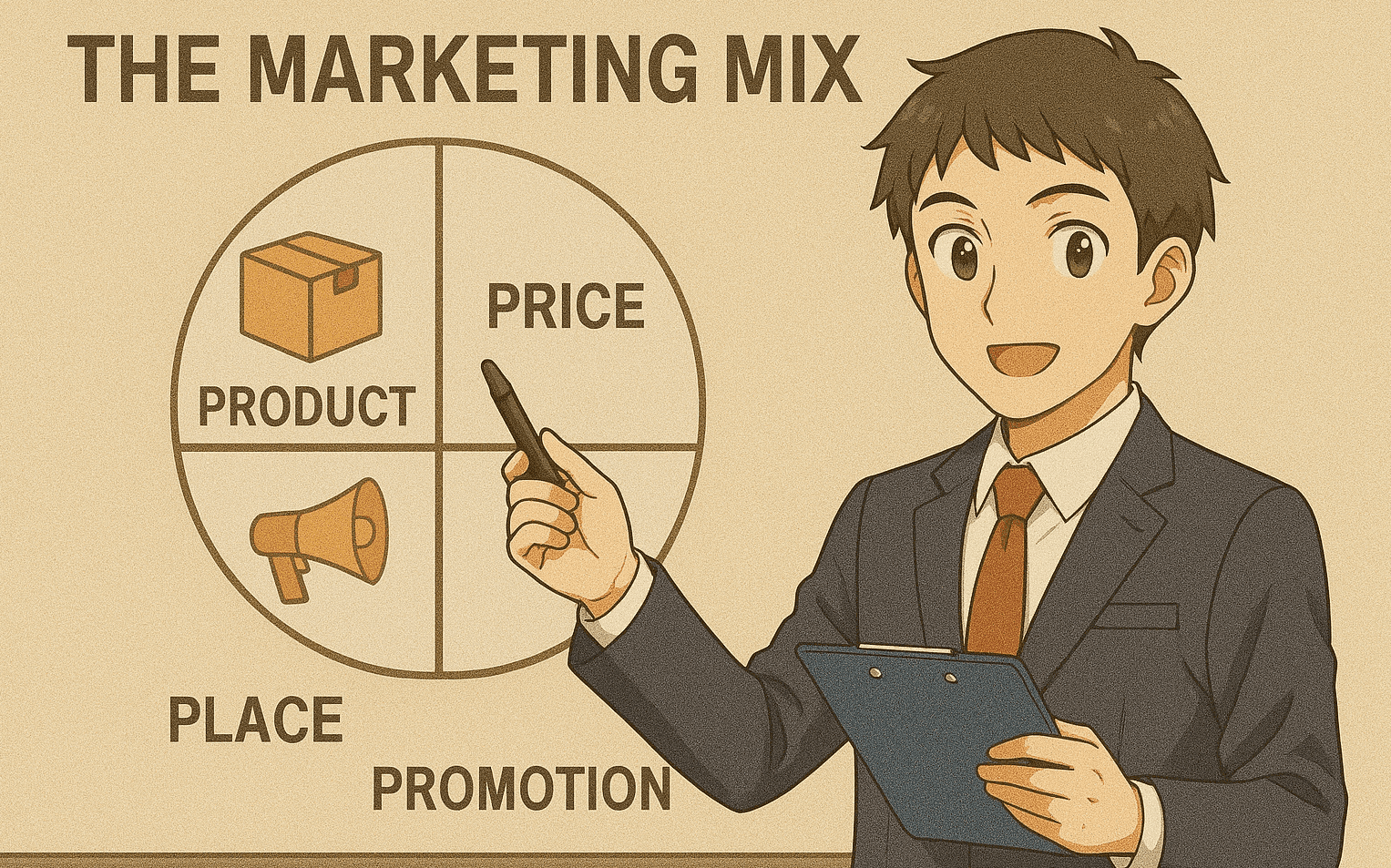
The marketing mix is the set of controllable variables a business adjusts to shape demand and deliver on its promise. In its classic form, it consists of four elements: Product, Price, Place, and Promotion - the famous 4Ps first organized by E. Jerome McCarthy in 1960. For service businesses like our coffee shop, three more variables matter: People, Process, and Physical Evidence, expanding the framework to the 7Ps. These are not abstract academic categories. They are the actual decisions that determine whether a business thrives or bleeds money quietly until the lease runs out.
Rather than marching through each P in isolation with scattered examples from a dozen industries, we are going to do something more useful. We will follow one business - a fictional independent coffee shop called Basecamp Coffee - through every single P in the mix. You will see how each element connects to the others, how trade-offs work in practice, and why changing one variable almost always forces adjustments elsewhere. By the end, the marketing mix will not feel like a textbook grid. It will feel like a decision-making system you could actually use.
Most marketing courses scatter examples across dozens of companies, which makes each P feel isolated. Walking all seven P's through a single business reveals something crucial: these variables do not operate independently. The price you set constrains the locations you can afford. The location you choose shapes who walks in. The people who walk in determine what products you need. Everything connects.
Product: What You Actually Serve
Basecamp Coffee exists because its founder noticed something while working near a university campus: students wanted good coffee, but they also needed a place to sit and work for two or three hours without feeling guilty about nursing a single drink. The chain cafes nearby had great foot traffic but uncomfortable seating and a vaguely hostile attitude toward laptop campers. The independent shops had atmosphere but inconsistent quality and no power outlets. The gap was clear: a place that combined genuinely good drinks with a workspace-friendly environment designed for people who stay.
That insight drives every product decision. The core product is not coffee. The core product is a productive third place - somewhere between home and school or work where you can get things done while caffeinated. The coffee is the vehicle, not the destination. This distinction matters enormously because it shapes what goes on the menu and what stays off it.
The menu as product architecture
Basecamp's drink menu is deliberately compact: espresso, drip coffee, cold brew, three milk options (whole, oat, almond), a seasonal special, and three non-coffee options (chai, matcha, hot chocolate). That is it. No blended drinks, no syrup menu with 14 flavors, no complicated customization system that slows down the line. The rationale is simple. Every additional menu item increases complexity at the bar, slows service during rushes, requires more training for new staff, and adds inventory that might spoil. A tight menu makes quality control easier and speed more consistent - and speed matters to someone who just wants to sit down and start working.
Food follows the same logic. Pastries sourced from a local bakery (not baked in-house, which would require equipment and skills that distract from the core mission), plus a small selection of grab-and-go items: packaged granola bars, fruit cups, a few sandwiches. Nothing that requires a kitchen. Nothing that generates cooking smells that overpower the coffee aroma. Nothing that creates dishes to wash. Every item earns its spot by supporting the core promise of productive comfort, not by chasing revenue from a different type of customer.
The physical space is product, too. Basecamp invests in solid tables that do not wobble (an absurdly overlooked detail in most cafes), chairs with actual back support, power outlets at every seating position, fast reliable WiFi, and lighting that works for reading without creating the interrogation-room vibe of overhead fluorescents. These are not interior design choices. They are product features that directly serve the core customer job.
Starbucks' product strategy reveals similar thinking at massive scale. The Frappuccino blended drinks were not added because the baristas had spare time. They were added because research showed a huge segment of potential customers - younger, sweeter-taste-preferring, often female - did not see themselves as "coffee drinkers." The Frappuccino was a gateway product that expanded Starbucks' addressable market from "people who drink coffee" to "people who want a treat from a coffee shop." Every successful menu addition solves a specific strategic problem. Additions that exist just because "customers asked for it" often dilute the brand without growing the business meaningfully.
Product lifecycle thinking
Even a coffee shop has product lifecycle dynamics. The seasonal special (a lavender latte in spring, a pumpkin spice variant in fall, a peppermint mocha in December) creates a reason to visit even if you already have your regular order. It generates social media content because people photograph novelty. It gives staff something new to talk about. And it tests flavors: if the lavender latte sells well, it might earn a permanent spot. If the pumpkin spice variant underperforms, it disappears quietly with no menu clutter left behind.
Loyalty programs are product too, not just promotions. Basecamp's loyalty card - buy nine drinks, get the tenth free - is a product feature that changes the experience of being a regular. It creates switching costs (leaving means abandoning progress toward a free drink), generates data on purchase patterns, and gives the most valuable customers a tangible reason to feel valued. The card itself is well-designed - thick stock, the shop's branding, a satisfying stamp - because even the card is a touchpoint that reinforces or undermines the brand.
Core product: Productive third place (not just coffee)
Menu strategy: Compact, quality-focused, fast to serve
Food approach: Sourced, not made in-house
Space design: Work-friendly (outlets, WiFi, stable tables)
Lifecycle tool: Seasonal specials for novelty and testing
Core product: Quick caffeine stop (grab and go)
Menu strategy: Wide, customizable, variety-driven
Food approach: Full kitchen, hot breakfast items
Space design: High turnover (small tables, no outlets)
Lifecycle tool: Rotating partnerships with food brands
Neither approach is "right." They serve different customer jobs. The critical thing is that every product decision within each approach stays internally consistent. A cafe that claims to be work-friendly but removes power outlets to increase table turnover is sending contradictory signals. Customers notice contradictions, even when they cannot articulate them. They just feel that something is off, and they stop coming back.
Price: The Number That Tells a Story
Basecamp's pricing decisions start with a question that has nothing to do with cost of goods: what does the customer expect to pay for this experience, and what does the price signal about what kind of place this is?
Price is a communication tool. Before a customer tastes the coffee or sits in the chair, the number on the menu board tells a story. $2.00 for a latte says "we cut corners somewhere." $8.50 says "we think we are a luxury destination." $4.75 says "this is a quality independent shop that respects your wallet." Each price positions the business in the customer's mental landscape, and repositioning later is brutally hard. Customers who anchor on a low price will resist increases. Customers who anchor on a high price will feel cheated if quality does not match.
Reference pricing and the competitive frame
Basecamp's founder researched pricing by visiting every coffee shop within a mile of the planned location. A chain latte cost $5.25. An independent specialty latte cost $5.50 to $6.00. The campus dining hall drip coffee cost $1.75. Gas station coffee cost $1.50. These prices form the reference frame that customers carry in their heads. Basecamp needs to land within a range that signals quality without triggering sticker shock in a college-adjacent neighborhood.
The decision: $4.75 for a standard latte, $2.50 for drip coffee, $5.25 for the seasonal special. These prices sit slightly below the local independent specialty shops (signaling accessibility) and slightly above the chains (signaling quality). The drip coffee at $2.50 serves a critical function as an entry-level product - a price point that makes the shop feel approachable for budget-conscious students who might upgrade to lattes once they are regulars.
$4.75 — Basecamp's latte price - positioned between chains ($5.25) and budget options ($1.75), signaling quality without luxury pretension
Cost structure and margins
The cost of making a latte is surprisingly low. Espresso beans, milk, a cup, and a lid cost roughly $1.10 to $1.40 depending on milk choice (oat milk costs more). At $4.75, the gross margin on a latte is around 70-75%. That sounds enormous until you factor in rent, labor, equipment maintenance, utilities, insurance, marketing, and the eight hours a day when the shop is open but relatively empty. Coffee shop economics are volume-dependent. A shop that serves 200 drinks a day can be very profitable. A shop that serves 80 drinks a day will struggle even with the same margins.
This is why Basecamp's product decisions feed directly into pricing viability. The compact menu reduces waste and labor costs. The bakery-sourced pastries avoid the capital expense of kitchen equipment. The work-friendly environment encourages longer stays, which sounds like it would hurt volume - but it actually increases average ticket. A student who stays for three hours orders twice on average: a latte on arrival and a drip coffee or pastry around hour two. That second purchase at marginal cost is extremely profitable.
Pricing psychology at work
Basecamp prices everything in round or near-round numbers. The latte is $4.75, not $4.99. The drip coffee is $2.50, not $2.49. This is a deliberate choice. Research by Kuangjie Zhang and Monica Wadhwa found that round prices "feel right" for purchases driven by feelings (like enjoying a coffee shop atmosphere), while precise prices feel right for purchases driven by rational calculation. Since Basecamp is selling an experience, not just a commodity, round-ish pricing reinforces the emotional appeal.
The seasonal special at $5.25 - slightly above the regular latte - uses anchoring effectively. The regular latte at $4.75 becomes the reference point. A $0.50 premium for something novel and limited-time feels trivial. But that $0.50 on every seasonal drink sold adds up to meaningful revenue, and the higher price actually increases perceived specialness. Something that costs more than the standard menu must be worth trying, the logic goes.
Bundle pricing appears in the loyalty card structure. Nine drinks at $4.75 equals $42.75, and the tenth is free - effectively a 10% discount for committed regulars. But because the "free" drink feels like a gift rather than a discount, it generates more goodwill than a permanent 10% price reduction would. This is the endowment effect in action: people value something they have "earned" more than an equivalent amount saved through lower prices.
Place: Where Access Happens
Basecamp's founder spent three weeks walking neighborhoods before signing a lease. Place, for a coffee shop, is not just an address - it is a strategic decision that constrains almost everything else in the mix. The wrong location will sink a business with perfect product, pricing, and promotion. The right location does half the marketing work for free.
Location strategy
The target customer is a university student or young professional who needs a productive workspace. That means the location needs to be within walking or short biking distance of campus, near public transit, and on a street with regular foot traffic. It should not be on a sleepy residential block where discovery depends entirely on someone already knowing you exist. But it also should not be in the highest-rent commercial district, because the economics would force higher prices or smaller square footage - and Basecamp needs space for people to spread out and work.
The selected location: a corner unit on a mixed-use street two blocks from campus, between a bookstore and a phone repair shop. Foot traffic is strong during weekday mornings and afternoons. The corner position gives two walls of windows, which serves double duty as natural lighting (better for working) and visibility (people walking past can see a full, lively shop, which is the most powerful form of promotion a cafe can have). Rent is 15% lower than the main commercial drag one block over, which is enough to invest in better furniture and faster WiFi instead.
Place decisions include where products sit within a space, not just where the building sits on a map. Costco famously places its $4.99 rotisserie chickens at the back of the store, forcing customers to walk past thousands of other products to reach them. The chicken is a loss leader - Costco reportedly loses $30 to $40 million per year selling them below cost. But the incremental purchases people make during that walk to the back more than compensate. That is Place strategy at the micro level: physical positioning within the environment shapes behavior.
Interior layout as place strategy
Inside the shop, layout is a place decision with direct revenue impact. Basecamp's floor plan has three zones. The front zone near the counter has high stools and a narrow bar along the window - designed for quick visits, solo coffee drinkers, and people waiting for takeout orders. This zone turns over fast. The middle zone has standard two-person tables spaced for conversation but also suitable for solo laptop work. The back zone has larger communal tables with built-in power strips and slightly lower lighting - the designated deep-work area.
This zoning serves multiple customer jobs simultaneously without conflict. The quick-visit customer does not feel annoyed by laptop campers, because they are in a different zone. The deep-work customer does not feel rushed by turnover, because their zone is designed for staying. And the owner can optimize each zone's economics independently: the front zone generates volume, the back zone generates longer stays with multiple purchases.
Digital place: the app and delivery question
Basecamp faces a question every modern food business confronts: should we be on delivery platforms? Uber Eats, DoorDash, and Grubhub charge 15-30% commissions on every order. For a $4.75 latte with $1.30 in direct costs, a 25% commission leaves roughly $2.25 - and that is before accounting for packaging (delivery requires sealed cups and carriers), the labor to prepare delivery orders during busy periods, and the risk of quality degradation during transit (a latte that sits in a delivery bag for 20 minutes is not the same product).
Basecamp's decision: no third-party delivery. Instead, a simple mobile ordering system (just a web page, not a full app) that lets customers order ahead for pickup. This preserves margins, maintains quality control, and still removes friction for regulars who want to skip the line. It also captures customer data - email addresses and order patterns - that delivery platforms would not share.
This is a trade-off, not an obvious win. Delivery platforms provide discovery: people browsing DoorDash might find Basecamp for the first time. But for a business whose core product is the in-shop experience, driving new customers through a degraded delivery experience risks creating negative first impressions. The place strategy aligns with the product strategy: come here, sit down, stay awhile.
Margin: Full margin retained (~70-75%)
Quality control: Complete - customer picks up fresh
Customer data: Owned - emails, order history
Discovery: Limited to organic and own marketing
Best for: Experience-driven brands
Margin: Reduced by 15-30% commission
Quality control: Partial - transit degrades product
Customer data: Owned by platform
Discovery: Platform's audience browses and finds you
Best for: Volume-driven or commodity products
Promotion: Getting the Right People Through the Door
Basecamp's promotional strategy starts with a constraint that most small businesses face: the marketing budget is tiny. There is no money for billboard campaigns or influencer sponsorships or a full-time social media manager. Every dollar and every hour spent on promotion needs to pull its weight. That constraint, it turns out, forces better marketing decisions than a big budget often produces.
The storefront as primary promotion
For a physical business in a foot-traffic location, the storefront is the single most important promotional asset. It is visible to every person who walks past, every day, for free. Basecamp invests accordingly. The exterior signage is clean, bold, and readable from across the street. The windows are kept uncluttered so passersby can see the interior - warm lighting, people working, the coffee bar in action. An A-frame sidewalk sign displays the seasonal special with a hand-drawn illustration that changes monthly. This is not decoration. This is high-frequency, zero-cost promotion to the exact geographic audience that matters.
The interior is also promotional. The design is photogenic on purpose - not in an over-the-top Instagram-bait way, but with enough visual character (exposed brick, a neon "good work" sign above the deep-work zone, plants on the windowsill) that customers naturally take photos and share them. Every photo shared is free, credible, third-party promotion that no paid ad can replicate.
Social media on a shoestring
Basecamp maintains one social media account: Instagram. Not Instagram plus TikTok plus Twitter plus Facebook plus LinkedIn. One platform, done well, where the target audience actually spends time. The content strategy is minimal but consistent: three posts per week. One shows a drink (the seasonal special, a well-poured latte, a cold brew on a hot day). One shows the space (a person working at a sunlit table, the bookshelf in the corner, a rainy-day window view). One is text-based (a study tip, a "this week's playlist," a campus event reminder).
The posts are not polished studio productions. They are taken on a phone by whoever is working that shift, using natural light. This is intentional. Overly polished content from a small independent shop feels inauthentic. Slightly imperfect content feels real, approachable, and human - which is exactly the brand personality Basecamp wants to project.
Hashtags are local and specific: the neighborhood name, the university name, "studycafe" plus the city name. The goal is not viral reach. The goal is showing up when a local student searches for a study spot on Instagram and seeing Basecamp in the results.
Word of mouth: the most valuable channel
For a local business, word of mouth dwarfs every other promotional channel in both effectiveness and cost efficiency. A recommendation from a friend carries more weight than any advertisement because it comes with built-in trust and social proof. Basecamp's entire marketing strategy is fundamentally designed to generate word of mouth. The product experience has to be good enough that people mention it spontaneously.
But word of mouth can also be encouraged through specific mechanisms. The loyalty card creates a natural conversation moment ("I'm one stamp away from a free drink"). The seasonal specials create a reason to tell someone ("you have to try the lavender latte before it's gone"). The productive environment creates a shareable recommendation ("I found the best study spot"). These are not paid promotions. They are product features that generate promotional effects. The line between product and promotion blurs constantly in well-designed businesses.
Local partnerships and campus integration
Basecamp partners with the campus bookstore to include a 15% discount flyer in every textbook bag during the first week of the semester. Cost: $200 for printing. Reach: every incoming student who buys textbooks. Targeting: perfect. This single tactic generates more qualified new customers per dollar than any digital ad campaign could.
Other partnership ideas that actually work for local businesses: hosting a weekly study group night with a campus club (free venue, Basecamp gets foot traffic), sponsoring a campus radio show with a simple "brought to you by Basecamp Coffee" mention (costs a few free drinks for the hosts), or partnering with the bookstore next door on a "buy a book, get $1 off a coffee" cross-promotion that benefits both businesses. These are old-school promotional tactics, and they work because they reach the right people in the right context with the right incentive.
People: The Humans Who Deliver the Promise
This is where the 4Ps expand into the 7Ps, and for a service business like a coffee shop, these extended Ps often matter more than the original four. People, Process, and Physical Evidence are the difference between a good strategy on paper and a good experience in reality.
Basecamp's staff are not just baristas who make drinks. They are the living embodiment of the brand promise. Every interaction - greeting a customer, taking an order, handling a complaint, making small talk during a slow afternoon - either reinforces or undermines the identity that took months to build. A perfectly designed shop with rude staff is a failed brand. A slightly shabby shop with genuinely warm, competent staff is a beloved one.
Hiring for the brand
Basecamp hires for personality and trains for skill. Making espresso is a teachable skill that takes two weeks to learn competently. Being naturally warm, attentive, and comfortable with prolonged quiet (remember, many customers are studying) is a personality trait that is much harder to install. The interview process includes a practical test - not just pulling shots, but handling a simulated difficult interaction. "A customer says their latte is too hot. What do you do?" The right answer is not "I'll remake it" (though that is part of it). The right answer shows empathy first, solution second, and zero defensiveness throughout.
Staff training covers the brand positioning and the specific customer job Basecamp exists to serve. Every employee should be able to articulate, in their own words, what makes Basecamp different from the chain down the street. Not because they will recite it to customers, but because that understanding guides a thousand small decisions throughout the day. Should I start a conversation with the person who has headphones on? Probably not - they are here to work. Should I refill the water pitcher at the communal table before it is empty? Yes - that is hospitality that supports the productive environment promise.
Staff as brand ambassadors
Here is something most small business owners underestimate: staff are your most credible promotional channel. When a barista genuinely recommends the seasonal special because they personally think it is great, that recommendation converts at a rate no Instagram post can match. When a staff member recognizes a regular by name and remembers their order, that moment of recognition creates loyalty that no loyalty card can replicate.
The economic math supports investing in people. Replacing a trained barista costs roughly $3,500 in recruiting, training, and lost productivity during the transition. Paying a good barista $1.50 more per hour to reduce turnover costs about $3,100 per year - and in return you get consistency, expertise, genuine customer relationships, and lower recruitment costs. The numbers are not even close. Yet most food-service businesses treat staff as interchangeable units and then wonder why their customer experience feels generic.
The takeaway: In service businesses, your people ARE your product. A coffee shop can change its beans, its decor, and its menu overnight. It cannot change the quality of human interaction overnight. Hiring, training, and retaining the right people is the single most powerful investment a service business can make.
Process: The Invisible Machinery of Experience
Process is every step that happens between a customer deciding to engage with your business and that customer leaving satisfied. It includes the visible steps (walking in, ordering, waiting, receiving the drink) and the invisible ones (inventory ordering, equipment maintenance, opening and closing routines, quality checks). For Basecamp, process design is the bridge between a good concept and a good daily reality.
The ordering flow
Basecamp's ordering process is designed for speed with warmth. The menu board is positioned to be readable from the entrance, so customers can decide before reaching the counter. The board itself is organized simply: espresso drinks on the left, non-espresso on the right, food below, seasonal special highlighted in a different color. No cluttered sub-categories. No tiny fonts. A first-time customer should be able to read the entire menu in under 15 seconds.
At the counter, the interaction follows a natural script (not a rigid one - nobody reads from a card). Greet, take the order, confirm the name, process payment, give a time estimate if the line is long. Payment is tap-only for speed, with a tip option on the screen. The barista calls the name when the drink is ready rather than assigning numbers, because a name is personal and a number is bureaucratic. This is a tiny detail that subtly reinforces the "warm, human" brand positioning.
Behind the scenes: consistency at scale
Process also governs what happens before the shop opens and after it closes. Basecamp has a daily opening checklist (machine warm-up, grinder calibration, pastry display, WiFi speed test, restroom check, music playlist loaded) and a closing checklist (cleaning, inventory count, till reconciliation, equipment shutdown). These checklists are not bureaucracy. They are the mechanisms that ensure a customer who visits on Monday morning and a customer who visits on Friday afternoon have the same quality experience.
Inventory management follows a simple system: the opening barista checks stock levels against a par sheet (minimum quantities for every item) and places orders that arrive the next morning. Basecamp avoids over-ordering by tracking waste daily. If a pastry type regularly goes unsold, the order quantity drops. If a milk type runs out by 2 PM on busy days, the order quantity rises. This feedback loop is process at its most practical: data informing decisions on a daily cycle.
The entire process from entering the door to sitting down with a drink should take under four minutes during normal hours. During a rush, it might stretch to six. Any longer and the process is failing, because the customer came here to work, not to wait in line. Process benchmarks like these are not arbitrary standards - they are direct expressions of the brand promise translated into operational targets.
Physical Evidence: Proof That the Promise Is Real
Services are intangible. You cannot hold a coffee shop experience in your hand before you decide to buy it. Physical evidence fills that gap by providing tangible cues that signal quality, professionalism, and reliability before, during, and after the service encounter.
For Basecamp, physical evidence starts before a customer even walks in. The exterior signage, the clean windows, the visible interior through the glass, the sidewalk A-frame - all of these are proof that a real, quality business operates here. A faded sign, dirty windows, or a cluttered storefront would tell a different story, regardless of how good the coffee actually is.
Inside, physical evidence is everywhere. The weight and design of the ceramic mug (Basecamp serves all dine-in drinks in ceramic, not paper - a deliberate signal of quality and sustainability). The cleanliness of the tables and restroom. The speed and reliability of the WiFi (posted on a small card at every table, along with the password - no need to ask). The quality of the napkins and stirrers. The receipt design. The loyalty card stock. Even the playlist - acoustic and lo-fi instrumentals at a volume that supports conversation without interfering with concentration.
Digital physical evidence
Physical evidence extends to digital touchpoints. Basecamp's website is a single page: location, hours, menu, and a few photos. It loads in under two seconds on mobile because a student searching "coffee shop near campus" on their phone will not wait for a slow site. The Google Business profile has current hours, recent photos (updated monthly), and prompt responses to every review. These digital artifacts are the modern equivalent of a clean storefront - they are the first physical evidence many potential customers encounter, and they form first impressions that are difficult to reverse.
Review responses deserve special attention as physical evidence. When Basecamp responds to a positive review with a specific, genuine thank-you ("Thanks, Maria! Glad the cold brew hit the spot during midterms - good luck with finals") rather than a generic "Thank you for your kind words!", that response is visible to every future reader. It is evidence that real humans who care run this business. When a negative review receives a calm, empathetic, solution-oriented response ("We're sorry the oat milk latte wasn't up to standard, James. We had a grinder calibration issue that morning and fixed it the same day. Your next drink is on us - just mention this at the counter"), that response turns a negative moment into a positive trust signal for everyone who reads it.
Here is a shortcut for evaluating any service business: check the restroom. A clean, well-maintained restroom with good soap, decent paper towels, and functional fixtures signals that management cares about details customers do not explicitly ask about. A dirty restroom signals the opposite - and customers unconsciously extend that judgment to everything else, including food safety, coffee quality, and overall trustworthiness. Physical evidence works because humans use visible cues to infer invisible qualities.
How All Seven P's Connect: The Alignment Principle
Here is where the marketing mix becomes more than the sum of its parts. Each P we have walked through for Basecamp does not exist in isolation. They form a system where every element reinforces every other element - or, if poorly designed, undermines them.
Watch how the connections work. The product (productive third place) demands a specific type of place (near campus, spacious enough for lingering). The place creates specific price constraints (rent determines minimum revenue per square foot, which sets a floor for pricing). The price point attracts a specific customer profile, which determines what people skills are needed (warmth plus the ability to respect quiet focus). The people deliver a specific process (fast ordering, minimal interruption during deep work). The process requires specific physical evidence (power outlets, stable WiFi, comfortable seating). And all of this feeds back into promotion - the story you tell is only credible if the experience matches, and the experience is shaped by every other P in the mix.
Change one P and you create pressure on the others. If Basecamp raised the latte price to $6.50, customers would expect more: better pastries, fancier mugs, maybe table service. If Basecamp moved to a cheaper location far from campus, foot traffic would drop and promotion spending would need to increase dramatically. If Basecamp switched from ceramic to paper cups to reduce dishwashing labor, the quality signal would weaken and the sustainability positioning would crumble. Every variable is connected to every other variable, and the marketer's job is to keep them aligned.
The Mix in Motion: Basecamp's First Six Months
Theory is useful. Watching it play out over time is better. Here is how Basecamp's marketing mix evolved during its first six months of operation, showing how real data drives adjustments that no pre-launch plan can fully anticipate.
Month one: discovery and correction
Opening week draws foot traffic from curiosity alone. Sales spike, then settle to roughly 120 drinks per day by week three. The owner notices two things. First, oat milk is outselling whole milk 3:1, but the shop ordered equal quantities of each - leading to oat milk shortages by afternoon. That is a product-process problem fixed by adjusting the par sheet. Second, the grab-and-go food items are barely selling, while the pastries sell out by 1 PM. The pre-packaged sandwiches are removed from the menu. Pastry orders double.
Month three: pattern recognition
By month three, distinct traffic patterns emerge. Mornings are dominated by commuters who want fast drip coffee and leave. Midday is slow. Afternoons fill with students who stay for hours. Evenings have moderate traffic from people who want a post-dinner work session. The owner responds by adjusting staffing (two baristas in the morning, one in the midday lull, two in the afternoon). A "midday happy hour" from 11 AM to 1 PM offers $1 off any pastry with a drink purchase, moving pastry inventory that would otherwise go unsold and pulling traffic into the dead zone.
Month five: growth and trade-offs
The shop is averaging 180 drinks per day. The campus discount flyers at semester start generated a measurable spike - 40 new customers in the first two weeks, tracked through the unique discount code. Instagram followers have grown to 1,200, mostly local students. Reviews on Google average 4.7 stars across 85 reviews. The owner now faces a growth trade-off: the afternoon deep-work zone is consistently full, which means some customers arrive, see no seats, and leave. Solutions include extending hours earlier in the morning to spread demand, adding outdoor seating for warmer months, or doing nothing and letting the "always full" perception become social proof that reinforces demand.
The owner chooses a hybrid approach: outdoor seating added (two tables and four chairs, total cost $600), plus a 7 AM opening on weekdays (previously 8 AM). The earlier opening captures a new segment - pre-class students who want a quiet hour - without conflicting with the afternoon crowd. The outdoor tables serve as additional physical evidence and promotion: people sitting outside with branded ceramic mugs are a living advertisement to every pedestrian.
Month six: the marketing mix audit
Six months in, the owner conducts a simple marketing mix audit. The question for each P is the same: does this element still align with our core promise and our other P's?
Product? Strong. The compact menu works, the seasonal specials drive repeat visits, the workspace features are the primary reason people choose Basecamp over alternatives. One adjustment: adding a pourover option for coffee enthusiasts who want something between drip and espresso.
Price? Holding. No complaints about value. The loyalty card has 340 active users. The midday pastry discount has become a popular habit without undermining full-price perception at other hours.
Place? The location is validated by foot traffic data and the "full shop" problem - a good problem to have. The online ordering system handles about 25 pickup orders per day, reducing counter congestion.
Promotion? The campus bookstore partnership is being renewed for next semester. Instagram engagement is stable but not growing fast - the owner plans to test short Reels showing latte art or the morning opening routine. Total marketing spend for six months: under $2,000, almost all of it on the bookstore flyers and the A-frame sign.
People? The original team of four baristas has had zero turnover. The above-market pay and genuine respect for their role appears to be working. One barista has become locally known for latte art, which generates organic social media posts from customers.
Process? The four-minute benchmark holds during normal hours. Morning rushes sometimes push to six minutes. The owner is testing a second grinder to speed up espresso production during peaks.
Physical evidence? Strong across the board. The one weakness: the restroom needs a renovation. It is clean but dated. That project is scheduled for month eight.
Beyond Coffee: The Marketing Mix in Every Industry
The Basecamp example is deliberately simple - one location, one product category, a local audience. But the marketing mix framework scales to any business in any industry. The principles are identical; only the specific decisions change.
A digital marketing agency's product is strategic thinking and execution skill, not a physical item. Its price is a monthly retainer or project fee. Its place is Zoom calls and Slack channels, not a storefront. Its promotion is case studies, thought leadership content, and referrals. Its people are the strategists and specialists. Its process is the workflow from client brief to deliverable. Its physical evidence is the proposal document, the reporting dashboard, the quality of the slide deck.
A SaaS company's product is software functionality plus support. Its price is a subscription with tiers. Its place is app stores and the web. Its promotion is content marketing, paid acquisition, and partnerships. Its people are the customer success team. Its process is onboarding flows and update cycles. Its physical evidence is the UI quality, the loading speed, the clarity of documentation.
In every case, the mix is a system of interdependent decisions. Change one and you create pressure on the others. The framework's power is not in knowing what the 7Ps are - that takes 30 seconds to memorize. The power is in learning to see the connections between them and making adjustments that keep the system aligned with a single, clear customer promise.
Common Marketing Mix Mistakes
After walking through the entire mix with Basecamp, certain failure patterns become easier to spot. These mistakes are not theoretical - they kill real businesses every year.
Promoting before the product is ready. This is the most common and most expensive mistake. Running ads for a coffee shop with inconsistent drinks, slow service, or dirty tables will accelerate failure, not prevent it. Every new customer who has a bad experience becomes a negative word-of-mouth agent. Fix the product first. Promotion amplifies whatever already exists - including problems.
Pricing by cost-plus instead of value. Adding a markup to your cost of goods and calling it a price ignores the customer's reference frame entirely. A latte does not cost $4.75 because the ingredients cost $1.30 and you want a 72% margin. It costs $4.75 because that number sits in the right position relative to what the target customer expects, what competitors charge, and what the brand promises. Cost sets a floor. Value sets the price.
Choosing place for convenience instead of strategy. Signing a lease because the rent is cheap or the landlord is friendly, without analyzing foot traffic, proximity to the target audience, or competitive density, is a mistake that cannot be fixed with better marketing. Location constrains everything else in the mix. Get it wrong and no amount of great coffee, clever social media, or friendly staff can compensate.
Treating the extended Ps as afterthoughts. Many businesses plan Product, Price, Place, and Promotion carefully, then hire people haphazardly, design processes on the fly, and ignore physical evidence until a customer complains. For service businesses especially, the extended Ps are often where competition is won or lost. Two coffee shops with similar products and prices in similar locations can have completely different outcomes based on the quality of their people, the efficiency of their processes, and the care evident in their physical environment.
Changing the mix without understanding the chain reaction. Cutting the price without adjusting the value perception. Adding delivery without accounting for quality degradation. Expanding the menu without adding staff to handle the complexity. Every mix change has downstream effects, and the businesses that fail to anticipate those effects end up with a misaligned mix that confuses customers and bleeds money.
From Framework to Instinct
The marketing mix is taught as a framework, and that is a fine place to start. But the real goal is to internalize it so deeply that you stop thinking about "the 7Ps" as a checklist and start seeing them as an interconnected system that you evaluate instinctively. When you walk into any business - a restaurant, a gym, a bookstore, a website - you should be able to identify what each P is doing and whether they are aligned.
Try it. Next time you visit a coffee shop, pay attention. What is the core product beyond the drinks? How does the price position the brand? Why did they choose this location? What promotional signals do you notice? How do the staff interact? How smooth is the ordering process? What physical evidence shapes your impression? And the big question: do all of these elements tell the same story, or are there contradictions?
That analytical habit - the ability to decode a marketing strategy by observing its execution - is more valuable than memorizing any model. Models give you vocabulary. Observation gives you judgment. And judgment is what separates the marketer who tweaks dials from the one who actually understands the machine.
The mix is not static. It evolves as markets shift, as customer expectations change, as competitors adjust, and as your own business matures. The research you do informs the product. The product informs the price. The price constrains the place. The place shapes the promotion. And the experience - delivered through people, process, and physical evidence - either validates or invalidates everything else. Keep the system aligned, keep measuring, keep adjusting. That is marketing management in practice, not just in a textbook.