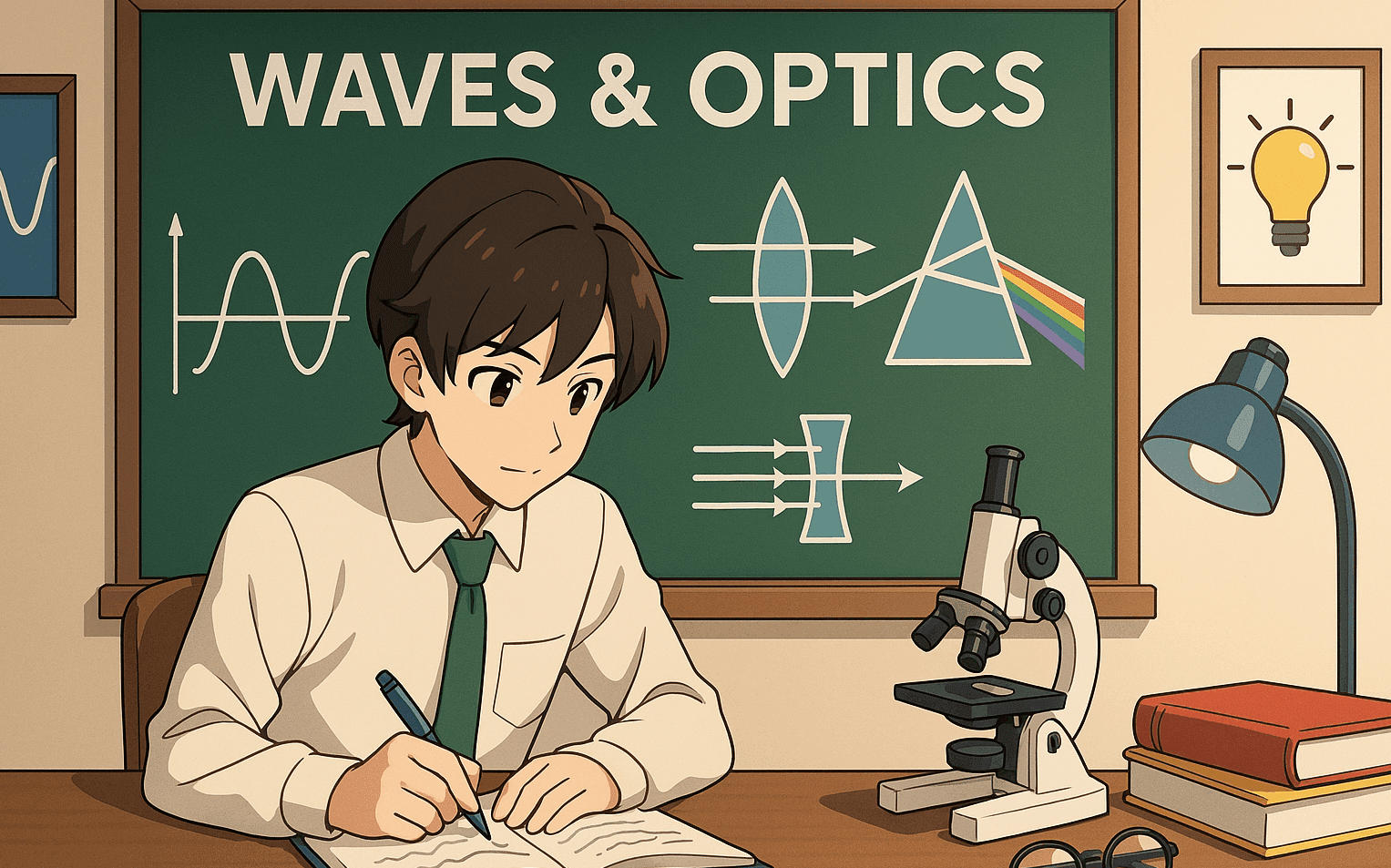
Every color you see, every sound you hear, every WiFi signal your phone catches -- it's all waves. The crimson bleed of a sunset, the bone-rattling thud of a subwoofer, the invisible pulse that carries a video call across an ocean. Waves are the universe's delivery system. They shuttle energy from point A to point B without moving any stuff along for the ride. A cork bobbing on the sea doesn't travel with the wave -- it just rises and falls while the disturbance rolls onward beneath it.
And here's what makes this topic genuinely wild: the same handful of rules govern a 20-Hz rumble from a pipe organ and a gamma ray released by a collapsing star. Wavelength, frequency, amplitude, speed. Learn those four quantities and you hold the vocabulary for everything from seismology to 5G networks. The math is elegant, the applications are everywhere, and by the end of this page, a rainbow won't just look beautiful -- it'll look inevitable.
What Makes a Wave a Wave
Strip away the specifics and a wave is simply a disturbance that carries energy through space and time. A drummer smacks a snare, and compressed air molecules push outward in a chain reaction until those pressure fluctuations tickle your eardrum. A stone drops into a pond, and ripples radiate in concentric circles. Neither the air molecules nor the water molecules actually travel to your location -- they jostle their neighbors and return roughly to where they started. The energy moves; the medium mostly stays put.
Five parameters define any wave:
Wavelength () -- the distance from one crest to the next (or one compression to the next). Frequency () -- how many complete cycles pass a point each second, measured in hertz. Period () -- the time for one full cycle; it equals . Amplitude -- the maximum displacement from the resting position. Bigger amplitude, louder sound, taller ocean wave. Wave speed () -- how fast the disturbance travels through the medium.
Those five aren't independent. Speed, frequency, and wavelength lock together through the most universal equation in wave physics:
Read it out loud: speed equals frequency times wavelength. Double the frequency while keeping the speed constant and the wavelength halves. That single relationship explains why a piccolo produces a higher pitch than a tuba (shorter wavelength, higher frequency) and why red light bends less than violet light through a prism (longer wavelength, lower frequency). One equation, hundreds of phenomena.
Underneath all of this sits the wave equation in its full mathematical glory, a second-order partial differential equation that governs everything from guitar strings to electromagnetic radiation:
Don't let the notation intimidate you. It says: the way a wave's shape curves in space determines how it accelerates in time. Solve it for a vibrating string and you get sine waves. Solve it for light in a vacuum and you get electromagnetic radiation traveling at m/s. Same equation, different media, staggeringly different outcomes.
Transverse vs. Longitudinal -- Two Flavors of Vibration
Waves split into two broad families depending on which direction the medium moves relative to the wave's travel.
The medium oscillates perpendicular to the wave's direction. Shake a rope side-to-side and watch a crest travel along its length -- your hand moves up and down, but the wave moves horizontally. Light is transverse too: the electric and magnetic fields wiggle at right angles to the direction the photon flies. Seismic S-waves, the ones that cause the worst shaking in earthquakes, are also transverse.
The medium oscillates parallel to the wave's direction. Sound is the textbook example. When a speaker cone pushes air forward, it creates a zone of higher pressure (compression) followed by a zone of lower pressure (rarefaction). Those pressure variations ripple outward at about 343 m/s in room-temperature air. Seismic P-waves -- the first tremors to arrive during an earthquake -- are longitudinal as well.
Some waves refuse to pick a lane. Ocean surface waves blend transverse and longitudinal motion: water molecules trace small ellipses, moving both up-down and back-forth as each swell passes. That hybrid behavior is why rip currents can pull swimmers seaward even though the waves seem to push toward shore.
Sound -- Pressure Waves You Can Feel
Sound is a longitudinal mechanical wave, which means it demands a medium. No air, no sound -- that's why Hollywood explosions in space are pure fiction. In Earth's atmosphere, sound travels around 343 m/s at 20 degrees Celsius. Warm the air and the molecules zip faster, boosting the speed. In water, sound rockets along at roughly 1,480 m/s. In steel, about 5,960 m/s. The denser and stiffer the medium, the faster sound propagates.
Human hearing spans roughly 20 Hz to 20,000 Hz. Below 20 Hz, you enter infrasound -- elephants communicate at these frequencies over distances exceeding 10 km. Above 20,000 Hz sits ultrasound, exploited by bats for echolocation and by physicians for prenatal imaging. The frequency determines pitch: concert A sits at 440 Hz, meaning the air pressure at your eardrum oscillates 440 times every second.
Loudness, on the other hand, correlates with amplitude. The decibel (dB) scale compresses an enormous range of intensities into manageable numbers. A whisper registers around 30 dB. Normal conversation, about 60 dB. A rock concert, 110 dB. And here's the kicker: because the decibel scale is logarithmic, every 10 dB increase represents a tenfold jump in intensity. That concert isn't just "a bit louder" than conversation -- it's delivering roughly 100,000 times more acoustic power to your eardrums. (For more on how logarithmic scales compress huge ranges, see our math coverage.)
You're at a stadium watching a baseball game from the nosebleed seats, 150 meters from home plate. The batter cracks a line drive and you see the bat connect before you hear the crack. At 343 m/s, that sound takes about 0.44 seconds to reach you -- nearly half a second of delay. Television broadcasts compensate by syncing audio to video, but in person, your brain just has to deal with it. That tiny gap is physics reminding you that light travels almost a million times faster than sound.
The Doppler Effect -- Why Sirens Change Pitch
When a source of sound moves toward you, it crams the wavefronts closer together, raising the frequency you perceive. When it moves away, the wavefronts stretch out and the pitch drops. That's the Doppler effect, and you experience it every time an ambulance races past.
In this formula, is the perceived frequency, is the emitted frequency, is the speed of sound, and the signs depend on whether the source or observer moves toward or away. Astronomers use the same principle with light -- redshift tells them a galaxy is receding, blueshift tells them it's approaching. Edwin Hubble's observation that distant galaxies are all redshifted led directly to the discovery that the universe is expanding. A siren on a highway and the fate of the cosmos, governed by the same equation.
Light -- The Electromagnetic Superstar
Light doesn't need a medium. It's a self-sustaining oscillation of electric and magnetic fields that can cross the vacuum of space at m/s -- a number so precise that the meter is literally defined in terms of it. James Clerk Maxwell showed in the 1860s that electricity and magnetism aren't separate forces; they're two faces of a single electromagnetic field. Change one and you automatically create the other. Accelerate a charged particle and it radiates an electromagnetic wave outward at the speed of light.
Visible light occupies a surprisingly narrow band of the electromagnetic spectrum, roughly 380 nm (violet) to 700 nm (red). That's less than one octave of frequency. Your eyes evolved to detect precisely the wavelengths that the Sun pumps out most intensely -- not a coincidence, just natural selection being ruthlessly practical.
What separates a radio wave from a gamma ray? Only wavelength and frequency. They all travel at the same speed in vacuum -- holds universally. A radio wave with a wavelength of 3 meters vibrates at 100 MHz. An X-ray with a wavelength of 0.1 nanometers vibrates at Hz. Same physics. Vastly different consequences for your body.
Reflection and Refraction -- Bending and Bouncing
When a wave hits a boundary between two media, two things happen simultaneously: part of the wave bounces back (reflection) and part pushes through at a different angle (refraction). Both are governed by simple geometric rules that have been understood for centuries.
Reflection obeys one clean law: the angle of incidence equals the angle of reflection, both measured from the perpendicular (normal) to the surface. That's it. A billiard ball off a cushion follows the same geometry as a beam of light off a mirror. Flat mirrors create virtual images -- your bathroom reflection appears to stand behind the glass at the same distance you stand in front of it. Curved mirrors warp those images: concave mirrors (like the inside of a spoon) can focus light to a point, which is why satellite dishes and solar concentrators use parabolic reflectors. Convex mirrors (like a car's side mirror) spread light outward, giving a wider field of view at the cost of shrinking the image.
Refraction happens because waves change speed when they enter a different medium. Light slows down in glass, water, and diamond compared to air. That speed change bends the beam at the boundary, and the relationship follows Snell's Law:
Here, is the refractive index of each material (defined as , the ratio of light's speed in vacuum to its speed in the material), and is the angle the beam makes with the normal. Glass has an index around 1.5, water about 1.33, diamond a whopping 2.42. The higher the index, the more light slows down and the more dramatically it bends. That's why diamonds sparkle so aggressively -- light entering at steep angles gets bent hard and bounced around inside before escaping.
Refraction is also why a swimming pool looks shallower than it actually is, why a straw in a glass of water appears kinked at the surface, and why lenses work at all. Every camera, every pair of glasses, every projector -- all of them exploit refraction to steer light exactly where it needs to go.
Interference -- When Waves Collide
Throw two pebbles into a still pond and watch what happens where the ripples overlap. At some points the crests line up, producing a wave twice as tall. At other points a crest meets a trough and the water goes flat. That's interference, and it's one of the strongest proofs that something behaves as a wave.
Constructive interference occurs when waves arrive in phase -- crest meets crest, trough meets trough. The amplitudes add up. Destructive interference occurs when they arrive out of phase -- crest meets trough, and they cancel. Real-world waves produce complex patterns mixing both, depending on the path length difference between the sources.
Young's Double-Slit Experiment
In 1801, Thomas Young fired a beam of light through two narrow slits and observed alternating bright and dark bands on a screen behind them. The bright bands appeared where light from the two slits traveled distances differing by whole multiples of the wavelength (constructive interference). The dark bands appeared where the path difference was half a wavelength (destructive). This experiment demolished Newton's particle theory of light in a single afternoon.
The fringe spacing follows a beautifully simple formula:
Where is the distance between adjacent bright fringes, is the wavelength, is the distance to the screen, and is the slit separation. Increase the wavelength and the fringes spread apart. Move the screen farther back and they spread more. Bring the slits closer together -- same thing. The equation hands you a direct way to measure the wavelength of light with nothing fancier than a ruler and a pair of slits.
The truly mind-bending part? This experiment works even if you send one photon at a time. Each photon passes through the apparatus individually, and yet after thousands of photons, the interference pattern builds up. A single particle interfering with itself. That's quantum mechanics knocking on the door, and it connects directly to the ideas in modern physics.
Thin-Film Interference
Soap bubbles shimmer with color. An oil slick on wet asphalt paints swirling rainbows. Both happen because light reflects off the top and bottom surfaces of a thin film, and those two reflected beams interfere. Depending on the film's thickness and the wavelength, certain colors get boosted by constructive interference while others get killed by destructive interference. Change your viewing angle and the effective path length through the film changes, shifting which colors dominate. It's why a soap bubble's colors constantly swirl as the film thins.
Engineers exploit this same principle to make anti-reflection coatings. By depositing a thin film of precisely the right thickness on a lens surface, they arrange for reflected light to destructively interfere with itself. The result: virtually no light bounces back, and almost all of it passes through. Your camera lens, your phone screen, your eyeglasses -- they all carry these coatings.
Diffraction -- Waves Bending Around Corners
Sound bends around doorways. You can hear someone talking in the next room even though there's no line of sight. Light, by contrast, seems to travel in straight lines -- you can't see around corners. The difference comes down to scale. Diffraction -- the spreading of a wave as it passes through an opening or around an obstacle -- becomes prominent when the opening is comparable in size to the wavelength.
Sound wavelengths range from about 17 mm (20 kHz) to 17 meters (20 Hz). A doorway, at roughly one meter wide, sits right in that range. So sound diffracts readily through door-sized gaps. Visible light wavelengths, however, are around 400-700 nanometers -- millions of times smaller than a doorway. Light only diffracts noticeably through slits measured in micrometers.
Shine a laser through a single narrow slit and you'll see a pattern on the far wall: a bright central band flanked by progressively dimmer bands on each side. The dark gaps between bands appear at angles where:
Here is the slit width, is the angle from center, and is an integer (but never zero -- that's the central bright maximum). Narrow the slit and the pattern spreads wider. Use a shorter wavelength and it tightens. The math is clean and the experiments are gorgeous.
Diffraction Gratings and Spectrometers
A diffraction grating is a surface scored with thousands of parallel slits per centimeter. When light hits it, each slit acts as a source of waves, and the interference among thousands of sources produces razor-sharp bright lines at specific angles. The condition for those bright lines is , where is the slit spacing. Because different wavelengths hit their maxima at different angles, a grating separates white light into a spectrum far more precisely than a prism can.
This is the backbone of spectroscopy. Astronomers point a telescope at a distant star, pass the light through a diffraction grating, and read off which wavelengths are present or absent. Those wavelength signatures reveal the star's chemical composition, temperature, velocity, and even magnetic field strength. Every element has a unique spectral fingerprint -- hydrogen, helium, iron, all of them. We know what the Sun is made of because of diffraction gratings. We know what galaxies billions of light-years away are made of. A set of scratches on a piece of glass, and suddenly you can do chemistry on a star you'll never visit.
Polarization -- Filtering the Vibration Direction
Light is a transverse wave. The electric field can oscillate in any direction perpendicular to the beam's travel. Sunlight, for instance, is a chaotic mess of every possible oscillation direction blended together -- that's unpolarized light. But you can filter it.
A polarizing filter acts like a picket fence for light waves. Only oscillations aligned with the filter's transmission axis pass through; everything else gets absorbed. Rotate two polarizing filters so their axes are perpendicular, and virtually no light gets through the combination. Rotate them parallel, and most light passes. This is why polarized sunglasses cut glare so effectively: light reflecting off flat surfaces like water or roads becomes partially polarized in the horizontal direction, and vertical-axis polarized lenses block most of it.
LCD screens exploit polarization at every pixel. A backlight sends unpolarized light through a first polarizing layer. A liquid crystal layer sits between two polarizers and rotates the light's polarization by a controllable amount when voltage is applied. The second polarizer either passes or blocks the light depending on its final polarization angle. That's how each pixel switches between bright and dark -- millions of them toggling polarization states 60+ times per second to produce the image on your monitor.
Brewster's angle offers another route to polarization. When light strikes a surface at a specific angle (where the reflected and refracted rays form a 90-degree angle), the reflected beam becomes perfectly polarized. For glass, Brewster's angle is about 56 degrees. Photographers sometimes use this knowledge to control reflections in their shots.
Dispersion and the Physics of Rainbows
White light is a blend of all visible wavelengths. When it enters a glass prism, something beautiful happens: each wavelength slows down by a slightly different amount. Violet light (short wavelength) has a higher refractive index in glass than red light (long wavelength), so it bends more. The result is that a prism fans white light into a continuous spectrum -- red, orange, yellow, green, blue, indigo, violet. Newton demonstrated this in 1666 and proved that white light isn't "pure" but a composite.
This wavelength-dependent bending is called dispersion, and it's responsible for rainbows. Sunlight enters a raindrop, refracts at the front surface, reflects off the back, and refracts again on the way out. Because each color bends differently, they exit at slightly different angles. Red light emerges at about 42 degrees from the anti-solar point; violet at about 40 degrees. Your eye catches different colors from different raindrops at different heights, and the composite is a glowing arc of separated color. The rainbow isn't a thing -- it's a geometry. Move your position and the rainbow moves with you, because it's defined by the angle between you, the Sun, and the raindrops.
The takeaway: A rainbow is not an object in a fixed location. It's a cone of light centered on the line from the Sun through your head to your shadow, which is why no two people ever see exactly the same rainbow.
Dispersion also explains chromatic aberration in lenses -- different colors focus at slightly different points, creating color fringes in images. Lens designers combat this by sandwiching two types of glass with different dispersion characteristics into an achromatic doublet, canceling out the color spread. Every decent camera lens, binocular, and telescope eyepiece uses this trick.
Standing Waves and Resonance -- Music is Physics
Pluck a guitar string. It vibrates, but not chaotically -- it settles into specific patterns called standing waves. These form when two waves of equal frequency travel in opposite directions and superpose, creating fixed nodes (points of zero displacement) and antinodes (points of maximum displacement).
A string clamped at both ends can only sustain wavelengths that fit an integer number of half-wavelengths into the string's length:
Where is the string length, is the mode number (1, 2, 3...), and is the wave speed on the string. The first mode () is the fundamental frequency -- the lowest pitch the string can produce. The second mode vibrates at twice that frequency (the first overtone), the third at three times, and so on. These are harmonics, and the particular blend of harmonics is what gives each instrument its distinctive timbre. A violin and a piano can play the same note at the same pitch, but they sound completely different because their harmonic content differs.
Wind instruments work on the same principle, except the standing waves form in air columns rather than on strings. A closed pipe (like a clarinet at its mouthpiece end) has a node at the closed end and an antinode at the open end, producing only odd harmonics. An open pipe (like a flute) has antinodes at both ends and produces all harmonics. That's why clarinets and flutes have such different tonal colors even when playing identical notes.
The Tacoma Narrows Bridge collapse of 1940 is the most dramatic resonance failure in engineering history. Wind flowing across the bridge excited a torsional vibration mode that matched one of the structure's natural frequencies. The bridge oscillated with increasing amplitude -- positive feedback via resonance -- until the roadway ripped apart and plunged into Puget Sound. Engineers now routinely test structures for resonant frequencies during design, adding damping or stiffening to ensure wind, traffic, or seismic vibrations can't push a structure into catastrophic resonance. The physics of standing waves isn't just about music; it's about whether buildings and bridges survive.
Lenses and Optical Instruments
A lens is just a carefully shaped piece of transparent material that uses refraction to bend light in a controlled way. Converging lenses (thicker in the middle) bring parallel rays to a focus. Diverging lenses (thinner in the middle) spread parallel rays apart as if they originated from a virtual focal point behind the lens.
The thin lens equation ties together the object distance , the image distance , and the focal length :
Positive means a real image (formed on the opposite side of the lens from the object, projectable onto a screen). Negative means a virtual image (same side as the object, visible only by looking through the lens). Your eye's lens is a converging lens that forms a real, inverted image on your retina. Your brain flips it -- you've been looking at an upside-down world your entire life and never noticed.
Combining lenses unlocks powerful instruments. A microscope uses two converging lenses: the objective creates a magnified real image, and the eyepiece magnifies that image further. The total magnification is the product of both. A telescope works similarly but is designed for distant objects -- a large objective lens or mirror gathers faint light, and the eyepiece magnifies the resulting image. The 1990 launch of the Hubble Space Telescope put a 2.4-meter mirror above the atmosphere, eliminating atmospheric distortion and delivering some of the sharpest images of deep space ever captured.
Cameras are just lens systems that project an image onto a sensor. Aperture controls how much light enters (and affects depth of field), shutter speed controls how long the sensor is exposed, and autofocus systems adjust the lens-to-sensor distance in real time. The physics hasn't changed since the 1800s; only the sensors have gotten better.
Fiber Optics -- Light as Data Courier
The entire modern internet runs on light. Not electrons crawling through copper -- photons bouncing through glass fibers thinner than a human hair. The principle is total internal reflection: once light enters the fiber core at a shallow enough angle, it can't escape through the sides. It zigzags from one end to the other, potentially crossing oceans, with astonishingly low signal loss.
Over 97% of intercontinental internet traffic travels through undersea fiber optic cables -- roughly 550 cable systems stretching more than 1.4 million kilometers across ocean floors. When you stream a video from a server in another country, the data is encoded as pulses of near-infrared laser light (around 1,550 nm wavelength, chosen because glass is most transparent at that frequency), fired into a fiber, amplified every 60-100 km by erbium-doped fiber amplifiers, and decoded at the other end. The entire trip takes milliseconds.
Dispersion poses a real engineering challenge in long fibers. Different wavelengths travel at slightly different speeds, so a sharp light pulse gradually smears out over hundreds of kilometers. Engineers combat this with dispersion-shifted fibers (designed so the dispersion is near zero at the operating wavelength) and wavelength-division multiplexing (cramming dozens of different wavelengths into a single fiber, each carrying its own data stream). A single modern fiber pair can carry over 100 terabits per second. That's roughly 12 million simultaneous Netflix streams through a strand of glass you can barely see.
Medical Imaging -- Waves That See Inside You
Some of the most life-saving applications of wave physics happen in hospitals.
Ultrasound sends high-frequency sound waves (typically 2-18 MHz, far above human hearing) into the body. When these pressure waves hit a boundary between tissues of different density -- say, between fluid and organ tissue -- some of the energy reflects back. A transducer picks up those echoes, measures their timing and intensity, and constructs an image in real time. Ultrasound is non-invasive, uses no ionizing radiation, and is cheap enough to be available in virtually every clinic on the planet. It's how most parents first see their unborn child.
X-ray imaging exploits electromagnetic waves with wavelengths of roughly 0.01-10 nanometers. These wavelengths are short enough to pass through soft tissue but get absorbed by dense materials like bone and metal. The result is a shadow image that reveals fractures, tumors, dental cavities, and foreign objects. Wilhelm Rontgen discovered X-rays in 1895 and immediately took a radiograph of his wife's hand -- bones and wedding ring clearly visible through the flesh. The image caused a sensation worldwide.
A CT (computed tomography) scanner takes X-ray images from hundreds of angles around the body and uses computational algorithms to reconstruct cross-sectional slices. Stack the slices together and you get a three-dimensional map of internal anatomy with sub-millimeter resolution. A chest CT can detect lung nodules smaller than a pea. The physics is straightforward -- wave attenuation through different tissues -- but the computational reconstruction is what makes it powerful.
Optical Coherence Tomography (OCT) uses low-coherence near-infrared light to create high-resolution cross-sectional images of tissue. It works on the same interference principles as the Michelson interferometer: a beam splitter sends light into the tissue and along a reference path, and the reflected beams interfere. By scanning the reference path length, the system maps reflections at different depths. OCT is the gold standard for imaging the retina and has become indispensable in ophthalmology. It can detect glaucoma damage, macular degeneration, and retinal detachment with micron-level precision.
MRI takes a different approach entirely, using radio-frequency electromagnetic waves to flip the magnetic alignment of hydrogen nuclei in the body (within a strong external magnetic field). The nuclei emit characteristic radio waves as they relax back, and those signals are spatially encoded to build an image. MRI excels at soft-tissue contrast -- it can distinguish between gray matter and white matter in the brain, image cartilage in a knee joint, or detect tumors in organs where X-rays see nothing. The physics bridges electromagnetism and nuclear spin -- waves doing the heavy lifting at every stage.
Lasers -- Coherent Light, Concentrated Power
An ordinary light bulb sprays photons in every direction at every visible wavelength, with no fixed phase relationship. A laser does the opposite. It produces light that is monochromatic (single wavelength), coherent (all waves in phase), and collimated (traveling in a tight, parallel beam). That combination yields extraordinary intensity and precision.
The key mechanism is stimulated emission. When a photon of exactly the right energy encounters an excited atom, it triggers the atom to release an identical photon -- same wavelength, same direction, same phase. Place this gain medium between two mirrors (a laser cavity), and photons bounce back and forth, triggering more and more stimulated emissions with each pass. One mirror is slightly transparent, allowing a fraction of the amplified light to escape as the laser beam.
Laser applications are staggeringly varied. Barcode scanners at grocery checkouts use low-power diode lasers. Eye surgeons reshape corneas with excimer lasers whose ultraviolet pulses ablate tissue with micron precision -- LASIK has corrected the vision of over 40 million people worldwide. Industrial lasers cut steel plates centimeters thick. Laser range-finders measure the Earth-Moon distance to within a few centimeters by timing a pulse's round trip. And the interferometers at LIGO (Laser Interferometer Gravitational-Wave Observatory) use kilometer-long laser beams to detect gravitational waves -- ripples in spacetime caused by colliding black holes billions of light-years away, stretching and compressing the detector arms by less than a thousandth of a proton's width.
The Electromagnetic Spectrum in Everyday Life
You swim through electromagnetic waves every second of every day. Your body radiates infrared. Your phone emits and receives microwaves. The Sun bathes you in visible, UV, and infrared. Here's a quick tour of the spectrum's major neighborhoods and what humans have done with each one:
Radio waves (wavelengths from kilometers to about a meter) carry AM and FM broadcasts, television signals, and the low-frequency bands used by submarines. WiFi operates at 2.4 GHz and 5 GHz -- microwave frequencies, technically, but often lumped with radio. 5G networks push into millimeter-wave territory (around 30-300 GHz), offering blazing speeds over short distances.
Microwaves (roughly 1 mm to 1 m wavelength) heat food by exciting water molecules into rotational frenzy. They also power radar -- sending out pulses and timing the reflections to measure distance and speed. Air traffic control, weather forecasting, and speed cameras all rely on microwave radar.
Infrared (700 nm to 1 mm) is thermal radiation. Every warm object emits it. Night-vision cameras detect infrared from body heat. TV remote controls pulse infrared signals. Astronomers peer through cosmic dust clouds that block visible light but let infrared pass, revealing newborn stars hidden inside.
Visible light (380-700 nm) is the sliver we evolved to see. It drives photosynthesis, powers solar panels, and carries data through fiber optics. It's also what makes art, photography, and cinema possible.
Ultraviolet (10-380 nm) from the Sun triggers vitamin D production in your skin and, in excess, causes sunburn and increases skin cancer risk. UV lamps sterilize surgical equipment and water supplies by destroying microbial DNA. Forensic investigators use UV to reveal blood stains and forged documents.
X-rays (0.01-10 nm) penetrate soft tissue, enabling medical imaging and airport security scanners. Crystallographers bounce X-rays off crystals to determine molecular structures -- Rosalind Franklin's X-ray diffraction images of DNA were pivotal in revealing the double helix.
Gamma rays (below 0.01 nm) are emitted by radioactive nuclei and cosmic events. In medicine, targeted gamma radiation kills cancer cells in treatments like the Gamma Knife. In astronomy, gamma-ray bursts are the most energetic events in the universe, briefly outshining entire galaxies. The physics connecting these applications traces back to modern physics and nuclear processes.
1024 Hz — The frequency range of gamma rays -- trillions of times faster than visible light oscillations
Quantum Whispers -- When Waves Act Like Particles
Classical wave optics works beautifully for lenses, mirrors, fibers, and instruments. But zoom down to the scale of individual photons and the rules get strange.
In 1905, Einstein explained the photoelectric effect by proposing that light comes in discrete packets -- photons -- each carrying energy:
Where J s is Planck's constant and is the frequency. Higher frequency means higher energy per photon. That's why ultraviolet light causes sunburn (high-energy photons damage DNA) while radio waves pass through your body harmlessly (low-energy photons lack the punch to break molecular bonds).
The double-slit experiment delivers the deepest puzzle. Fire photons one at a time through two slits. Each photon hits the detector as a single point -- particle behavior. But after thousands of individual hits, the points cluster into an interference pattern -- wave behavior. A single photon somehow "knows" about both slits. This wave-particle duality isn't a failure of the model; it's a fundamental feature of nature at the quantum scale. The math that governs it (quantum electrodynamics, or QED) is the most precisely tested theory in all of science, accurate to more than 10 decimal places.
For everyday optics -- designing a camera, laying fiber cable, building a spectrometer -- classical wave theory gives you everything you need. But knowing that there's a quantum layer beneath it explains why lasers emit coherent light (stimulated emission is a quantum process), why semiconductors detect specific wavelengths (photon energy must match the band gap), and why single-photon detectors can form the basis of quantum cryptography systems that are theoretically unbreakable.
Putting It All Together -- Waves Across Physics
Waves and optics don't live in isolation. They thread through every other branch of physics on this site. The electricity and magnetism article covers Maxwell's equations -- the theoretical foundation for all electromagnetic waves. Modern physics picks up where classical optics leaves off, exploring photons, wave-particle duality, and quantum phenomena. Thermodynamics connects to waves through thermal radiation -- every object above absolute zero emits electromagnetic waves, and the spectrum of that radiation follows Planck's law. Even Newtonian mechanics enters the picture: the speed of a wave on a string depends on tension and mass per unit length, quantities straight out of classical mechanics.
The mathematical backbone relies heavily on trigonometry -- sine functions describe wave shapes, angles of incidence and refraction, and the geometry of diffraction patterns. If sines and cosines feel rusty, shoring up that foundation will make wave physics dramatically more intuitive.
The takeaway: Waves are the connective tissue of physics. Understanding them doesn't just explain how sound, light, and radio work -- it reveals why the universe can transmit energy, information, and structure across any distance, from the nanometer gaps inside a microchip to the billion-light-year voids between galaxy clusters.
Next time you see a rainbow forming after a storm, you'll know it's not magic -- it's Snell's Law and dispersion, playing out across millions of raindrops, each one a tiny prism executing the same geometry. Next time you stream a movie, remember that the data traveled as pulses of infrared light through glass fibers laid across ocean floors, propelled by total internal reflection. Next time you hear a guitar chord ring out, you're hearing standing waves on steel strings, harmonics stacking in a pattern shaped by the string's length, tension, and mass.
Waves are everywhere. They always have been. Now you know what to call them.