
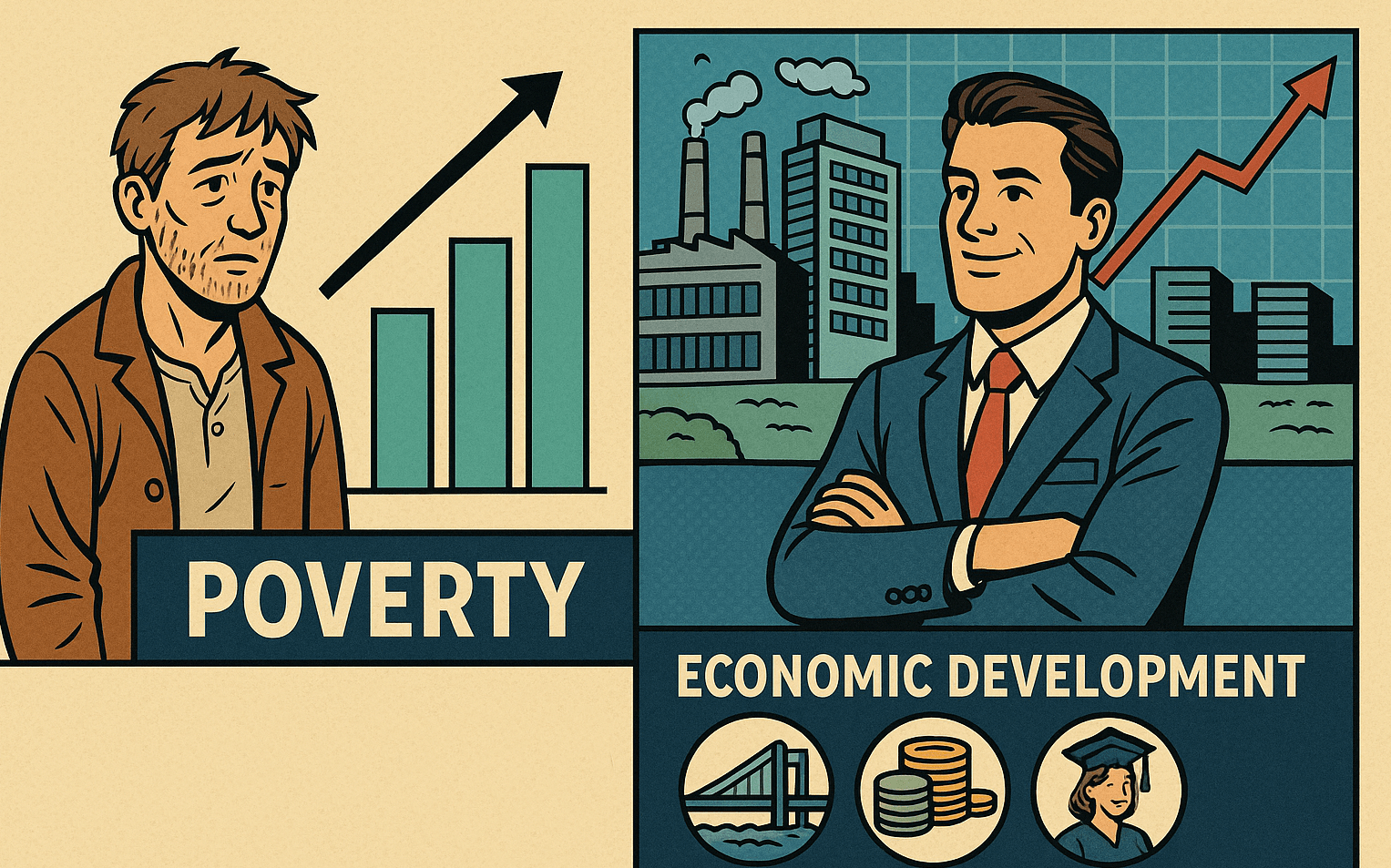
Poverty and Economic Development – Growth, Jobs, and Capability Building

Poverty is not one problem. It is a bundle of shortages that arrive together and trap families for years. Low income sits in the middle, but the daily grind shows up as unreliable food, unsafe water, weak schools, long walks to clinics, no collateral, and no way to survive a shock without losing the little you have. Economic development is the coordinated push that raises productivity, expands opportunity, and builds systems that carry households over setbacks. You win by aligning five levers at once: jobs that pay, human capital that composes those jobs, infrastructure that connects people to markets, rules that keep deals honest, and safety nets that prevent reversals from becoming permanent exits from the labor force. Miss one lever and the flywheel stalls.
Poverty by the numbers and why definitions matter
Before you propose fixes, fix the yardstick. Absolute poverty lines measure whether a person can afford a basic basket of food and nonfood items. Global trackers use thresholds expressed in comparable prices across countries. Relative lines set the bar as a fraction of median income inside a country to capture exclusion in richer settings. Both views are useful. Absolute lines tell you whether families can afford calories, shelter, and basic services. Relative lines tell you whether kids can show up at school with the tools their peers take for granted.
One number hides depth. The headcount rate says how many people fall below the line. The poverty gap shows how far below the line they sit on average. The squared gap weights the very poorest more heavily. Those measures help you budget. If most people cluster just below the line, modest cash support plus job access can push them over. If many are far below, you need bigger outlays and more time.
Income does not capture every constraint. A household can earn just enough cash and still be deprived across multiple dimensions. That is why multidimensional indexes track deprivations in schooling, nutrition, water, sanitation, housing quality, energy, and exposure to violence. If you want policy that hits the target, use both money metrics and capability metrics. The blend tells you whether to prioritize clinics, roads, price support for staple crops, or direct cash.
The production side – how growth actually cuts poverty
The strongest anti-poverty machine is steady growth in output per worker. More output per hour means more cash at the end of the week. Productivity gains flow through new tools, better skills, higher quality management, and access to bigger markets. In countries where half the labor force works on small plots far from paved roads, early gains come from improved seeds, basic machinery, and storage that limits spoilage. As people move from subsistence farming to towns and small factories, output rises again because workers specialize and firms spread fixed costs over more units. Economists call this structural change. You do not need the label to grasp the motion. Families move from low productivity activities into higher ones, and the distribution of earnings shifts up.
This transition needs a foundation. Reliable power changes production schedules from daylight only to round-the-clock. All weather roads shorten delivery times and open wider sales arcs. Ports and border posts that clear goods quickly connect farmers and workshops to buyers beyond the local market. Digital rails speed payments and create transaction histories that serve as informal collateral. These are not shiny projects. They are the backbone that lifts rural wages and lowers prices for city households.
Human capital – education and health as core capital goods
Children who can read by the end of primary school are on a path to absorb new skills later. Children who cannot read at that stage fall behind forever. That is why foundational literacy and numeracy are the first priorities. You cannot fix everything at once. Fix the basics and lock them in with honest measurement. Short, frequent assessments that teachers use for real-time feedback beat long exams that arrive after the year ends. Teacher attendance, coaching, and simple lesson plans raise time on task. Where classes are big, scripted teaching guides and peer tutoring help the average child move from guessing to understanding.
Health pulls in the same direction. A community with vaccines, clean water, and antenatal care sees fewer missed school days and fewer expensive emergencies. Nutrition in the first thousand days from conception to age two affects brain development in ways that echo across a lifetime. Iron and iodine sound boring until you see their effect on attention and energy. Safe births keep mothers alive to raise their kids and stay in the labor force. Public health is not a soft add-on. It is payroll support and school performance in disguise.
Finance and inclusion – turning small surpluses into assets
Households living near the line have volatile cash flows. A late payment from a buyer or a clinic bill can erase months of progress. Two products change that story. Basic accounts with no surprise fees let people store value safely and receive payments quickly. Simple insurance for health and weather risk supports recovery without forced sales of tools or livestock. Mobile money and agent networks bring these services to places where bank branches do not exist. Once transactions pass through accounts, families and micro firms build a digital history that lenders can use to underwrite working capital at lower cost.
Credit by itself does not guarantee growth. It must arrive with demand for what the borrower produces and with coaching on costs and recordkeeping. The strongest programs combine credit with market access. A dairy cooperative that guarantees pickup and sets transparent quality rules makes loans for cows sensible. A warehouse receipt system that allows maize to be stored and used as collateral makes loans for seed sensible. Finance is a bridge. It must land on solid ground at both ends.
Property rights, contracts, and the cost of being formal
Secure rights to land and housing encourage families to improve dwellings and fields. Clear titles also enable mortgages and long leases that help firms scale. You do not need to survey every centimeter to see gains. Even simple, low-cost registries and recognized occupancy permits reduce disputes and bribe requests. Contract enforcement sits next to property rights. If it takes years to resolve a simple dispute, small firms avoid formal contracts and stay small by design. Introducing specialized commercial benches, standard contracts, and mediation programs shortens timelines and brings more deals into the open.
Formality must be possible without elite connections. One-stop portals for registration, time-limited approvals, published fee schedules, and mobile payments remove the excuses that keep micro firms in the shadows. Enforcement against chronic non payers should focus on larger operations that undercut honest competitors. As basic services and credibility rise, smaller firms will register because the benefits exceed the costs.
Gender and inclusion – removing the blockers that shrink household income
Gender gaps are not footnotes. When women lack ID, property rights, or safe transport, households lose a second earner and future entrepreneurs. Access to childcare and safe commuting raises female participation and reduces measured poverty because total hours worked per household rise. Legal reforms that recognize female ownership of assets and allow women to sign contracts without a male guardian double the chance that a new firm forms and survives. Credit programs that deposit funds into accounts controlled by women raise control over spending and child outcomes. The data repeat the same finding across countries. When constraints on women drop, household income rises and child health metrics improve. It is common sense and macroeconomics at the same time.
Agriculture as the first engine and why extension matters
In many low income regions, raising yields on small plots delivers the fastest poverty reduction. Farmers respond to three inputs. Information on what to plant and when. Tools and seed that fit local conditions. Assured markets with fair grading and timely payment. The key institution is agricultural extension that actually meets farmers in fields and not only in offices. Demonstration plots beat lectures. Weather and price information delivered by phone beats posters. Storage that prevents spoilage and credit that arrives before planting turn advice into output.
Keep your eyes on incentives. If procurement is monopolized by a single buyer with erratic payment, adoption will stall. If border rules flip frequently, exporters will not build stable relationships. If counterfeit seed and fertilizer flood the market, yields will disappoint and trust collapses. Governance and last mile logistics decide whether the agronomy translates into income.
Urbanization and the move up the productivity ladder
Cities concentrate buyers, suppliers, and workers. That density raises productivity through matching and learning. But density without planning creates slums far from jobs and choked by traffic. The tactical moves are simple and hard. Zone for jobs near transport. Allow mid rise housing so workers can live near those jobs. Lay sewer and water mains before settlements sprawl. Create serviced plots where informal builders can plug into basic services legally. Give slum upgrading programs real budgets and property documents that support household savings. When cities get the basics right, the shift from low output rural work to higher output urban work accelerates and wages follow.
Trade, regional markets, and the hard math of logistics
Access to larger markets lets firms spread fixed costs, specialize, and increase quality. Regional trade agreements help, but they must be matched by trade facilitation. Border posts with one stop inspection, harmonized paperwork, and digital pre clearance reduce waiting. Cold chains prevent losses for perishable goods. Standards bodies that test and certify quality on a predictable schedule let small firms bid on cross-border contracts. Without these plumbing fixes, grand trade announcements do little for household income. With them, a farmer’s crop reaches new buyers and a small factory runs a second shift because orders are steady.
Macroeconomic stability as the oxygen of development
Inflation that swings wildly and exchange rates that jump around raise uncertainty and punish wage earners. Stability protects the poor because they hold more cash and fewer hedges. Sound budgets focused on core services, credible monetary policy, and stable public debt keep inflation low and predictable. The payoff is lower interest rates, longer planning horizons for firms, and less temptation for households to rush purchases or hoard goods. You cannot build long-term programs if basic prices are moving like a rollercoaster.
Social protection that prevents backsliding
Even with growth, shocks will hit. Floods, droughts, illness, and job loss can push families back below the line. Targeted cash transfers tied to basic conditions like school attendance or clinic visits raise consumption today and build human capital for tomorrow. Public works programs can provide temporary jobs that build local assets such as rural roads and drainage while smoothing incomes during lean seasons. Social pensions protect the elderly in settings where formal schemes do not reach far. The design must protect dignity, guard against leakage, and make exit possible when households stabilize. Transfers work best when they run on strong digital ID systems and reliable payment rails, with grievance mechanisms that actually resolve issues.
Climate risk and resilience without ideology
Poor households are exposed to climate shocks because they live in floodplains, work outdoors, and farm without irrigation. Adaptation is not a buzzword for them. It is survival. Pay attention to three lines of defense. First, information. Early warning systems and seasonal forecasts delivered by phone help farmers plan and help towns evacuate in time. Second, infrastructure. Drainage, levees, drought tolerant seed, and small scale irrigation reduce damage. Third, finance. Weather insurance and emergency cash programs speed recovery. The goal is to lower the variance of outcomes so a bad season does not erase years of progress.
State capability and why delivery beats proclamation
Plans fail when agencies cannot execute. Performance management, transparent dashboards, and service standards turn abstract reform into weekly delivery. Time-bound targets for school attendance, clinic supplies, road maintenance, and permit issuance keep teams focused. Civil service rules that reward competence and protect professionals from political churn build a culture that outlasts electoral cycles. Anti corruption drives that publish data on contracts and line-item spending deter theft. Citizens need visible proof that taxes become services. Without that proof, compliance falls and reforms become slogans.
Data, evaluation, and staying honest about results
You cannot manage what you cannot measure. Household surveys, civil registration, and administrative records must be current and reliable. Use randomized trials where feasible to test program tweaks, then scale what works. Use difference-in-differences when trials are impossible but good comparison groups exist. Track outcomes, not only inputs. School kits shipped is an input. Reading levels by grade is an outcome. Money released to clinics is an input. Postnatal visits completed on time is an outcome. Publish results on a fixed calendar. Kill programs that fail and redirect funds toward programs that move core metrics. That discipline builds trust and protects budgets.
Migration, remittances, and links that speed development
People move toward opportunity. When they do, money flows back home in the form of remittances that smooth consumption, fund schooling, and finance small businesses. Lower transfer fees and safe channels increase the share that reaches families. Cities that welcome newcomers with orientation, document support, and job matching reduce the period of joblessness and limit informal settlements. Circular migration is common. Respect it and plan for it. Migrants bring back skills and contacts that raise productivity in their home communities.
Aid, philanthropy, and alignment with local plans
External funding can help when it aligns with domestic priorities and builds local capability. It can hurt when it bypasses domestic systems and creates parallel structures that vanish when funding ends. The clean rule is to channel support through transparent national systems whenever possible, insist on independent audits, and co finance with domestic revenue so skin in the game is real. Short bursts of cash buy headlines. Long-term support for data, logistics, and maintenance buys results that persist after donors leave.
Technology as a force multiplier, not a magic trick
Digital ID systems, e-procurement, e-invoicing, and instant payments fix bottlenecks that punish the poor. Telemedicine extends clinics. Digital learning tools support teachers rather than replace them. Drones do not fix bad roads, but they can help in emergencies when roads are washed out. Technology wins when it removes friction and lowers costs for the last user in the chain, not when it produces a slick demo in the capital. Always budget for maintenance and training. Without both, pilots sparkle and programs fade.
Poverty traps and how to break them
Some families remain poor across generations because they cannot cross a threshold. They cannot afford the lump sum to connect to the power grid, buy a pump, or keep a child in school long enough to change lifetime earnings. Targeted, time-limited grants that help them cross those thresholds can change the slope of their future path. Once they are over the hump, they do not fall back. The same logic applies to communities. A single bridge can cut transport costs enough to attract buyers and suppliers, which then raises local wages and tax revenue. Good policy hunts for these thresholds and funds them in a way that protects against misuse.
Security, conflict, and the cost of violence
Conflict is the fastest way to generate poverty and the hardest environment for development. Schools close, clinics empty, and firms withdraw. The first priority is safety. After that, basic services must restart quickly to prevent permanent damage to children’s education and health. Cash-for-work that clears debris, repairs water systems, and prepares fields for planting restarts local economies. Reintegration programs for ex combatants reduce the chance of relapse into violence. Every dollar spent on prevention and early response saves many dollars down the line. There is no development without security and no lasting security without services and jobs.
Three short narratives that show the engine in motion
A landlocked district with poor roads and weak schools was losing youth to migration. The regional plan focused on two steps. First, an all weather road linked farms to a nearby city market and cut travel time by half. Second, the school district obsessed over early reading using weekly coaching visits and simple fluency checks. Within two seasons, maize reached buyers before it spoiled and prices received rose. Two years later, reading scores jumped and dropouts fell. Small shops opened along the new road. Poverty rates dropped because both the production side and the human capital side moved together.
A coastal town faced regular flooding that wiped out informal businesses every other year. The local council expanded drainage, introduced a simple microinsurance product bundled with utility bills, and set up a rapid cash program triggered by rainfall thresholds. Flood damage still occurred, but businesses reopened faster and households avoided distress sales. Over three years, shops moved from temporary stalls to permanent structures because risk fell. The change was not luck. It was a new risk model operationalized with clear triggers.
A city with many informal vendors and few formal jobs replaced random enforcement with same day registration, marked vending zones, and QR payment support. Vendors who registered received access to a wholesale market and a microcredit line linked to their digital receipts. Within a year, formalization climbed and fee collection stabilized. Complaints from residents dropped because zones were clean and predictable. Poverty narrowed because thousands of very small firms moved from survival to growth, backed by simple rules and light infrastructure.
Practical checkpoints for students and junior analysts
Before you weigh in on a country’s progress, ask for five facts. What share of people is below the line and how deep is the gap. What are the current reading scores by grade and the vaccine coverage by district. What fraction of rural roads is passable year round. What portion of the population has an account that can receive digital transfers. What share of social programs pays on time. These facts predict whether a plan will land. If data are missing, your first recommendation should be to fund measurement. You cannot scale what you cannot see.
Wrapping It Up
Focus on productivity, not slogans. Get kids reading on time and keep them healthy so they can learn and work. Build the dull but vital infrastructure that shrinks distance and lowers costs. Make rules simple, predictable, and fair so small firms can register, grow, and hire. Protect families from shocks so progress is not erased by one bad season or a hospital bill. Keep macro conditions stable so prices guide decisions rather than confuse them. Publish results and adjust on evidence, not on pride. Do these things consistently and poverty falls for structural reasons. In time, the story writes itself in wage slips, test scores, and businesses that last longer than campaign posters. That is development done the old-fashioned way: steady hands on the core levers, week after week, until the gains compound.