
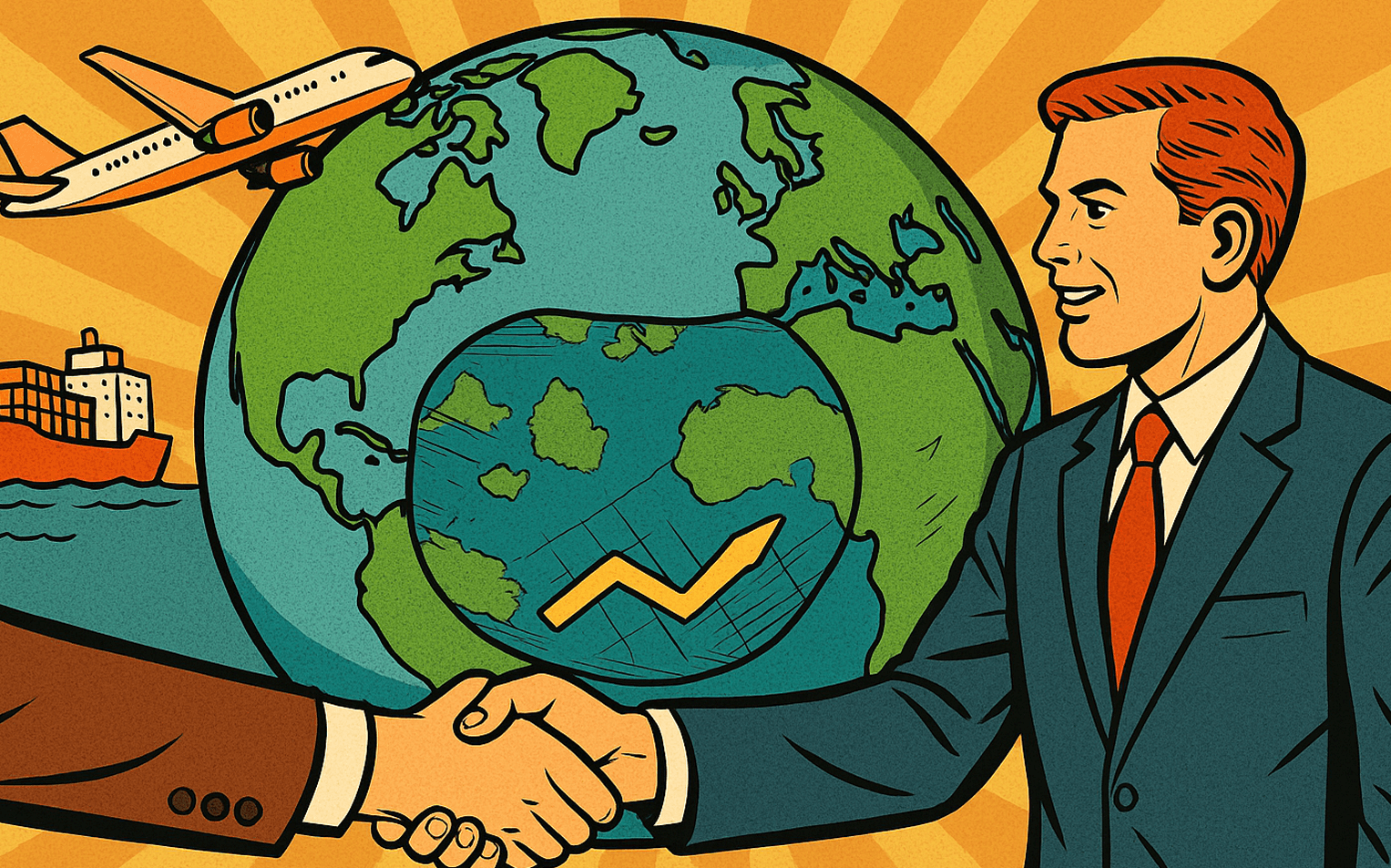
Globalization – How Trade, Capital, and Supply Chains Shape Economies
Globalization is a simple engine with many moving parts. Countries trade more, communicate faster, and weave production across borders. Costs fall, choice expands, and competition heats up. Careers shift, wages respond, and policy makers argue about rules. Learn the mechanics and you can separate signal from noise in almost any headline about trade wars, currency swings, supply chain bottlenecks, or digital platforms. This guide frames the system from first principles, then walks through operations, risks, and playbooks that stand up in the real world.
What Globalization Actually Means
Start with a clean definition. Globalization is the long run rise in cross-border flows of goods, services, people, finance, technology, data, and culture. It shows up in trade to GDP ratios, foreign ownership of local factories, multinational service contracts, seamless payments, and student exchanges. It is not a single policy. It is the combined outcome of lower transport costs, faster communications, common standards, and choices made by firms and governments over decades.
Two quiet revolutions set the pace. Containerization slashed the cost of moving goods by standardizing boxes that cranes can lift quickly from ship to rail to truck. The internet crushed the cost of moving information, which turned many local services into tradable ones. Add cheaper air travel, better logistics software, and international rules that cut tariffs and quotas, and the result is a dense web of global value chains.
A Short History You Can Hold In Your Head
A first wave ran from the late 1800s to 1914 as steamships, telegraphs, and railroads tied markets together under the gold standard. World wars and the Great Depression hit the brakes. A second wave started after 1945 with the General Agreement on Tariffs and Trade and then the World Trade Organization, which steered steady tariff cuts among members. The end of the Cold War and China’s entry into the WTO pushed the system into high gear. The Great Recession and recent geopolitical tensions slowed expansion, yet the network did not collapse. Goods trade plateaued for a while and services trade surged. Digital links deepened even as some firms shortened supply lines. The current phase mixes re-regionalization with ongoing cross-border ties in technology, media, health research, and finance.
Why Countries Trade At All
Trade lets each country focus on what it can produce at lower opportunity cost and swap for the rest. That is comparative advantage. It does not require one side to be better at everything. It only requires a difference in relative strengths. Factor endowments and know-how shape those strengths. A country rich in skilled engineers and reliable power tends to grow electronics and advanced services. A country with rich soil and favorable climate tends to export crops or food products. Over time, learning on the job and scale can shift advantage as firms improve and ecosystems mature.
Relative prices transmit the logic. If a country can produce one car with the same resources it would take to grow ten tons of wheat while its partner would need to give up twenty tons for that car, both sides gain when the country that is cheaper in cars exports cars and imports wheat. Those gains do not land evenly on every worker or region. They do raise the overall pie.
How Global Value Chains Actually Work
A phone assembled in one country contains chips from another, glass from a third, and design from a fourth. Apparel often relies on fabric from one region, sewing in another, and branding in a third. This fragmentation became feasible once transport, communications, and standards got cheap and predictable. Firms break production into tasks, place each task where it fits best, and coordinate with software and contracts.
The payoffs are lower unit costs, faster innovation through specialization, and quicker adoption of new ideas across the network. The risks are real too. A shock at a port, a key factory, or a semiconductor plant can ripple through downstream producers. That is why many companies now run supplier mapping, build second sources for critical inputs, and carry strategic buffers for items with long lead times. Efficiency still matters, yet resilience now sits beside it on the dashboard.
The Role Of Trade Policy
Tariffs, quotas, rules of origin, and product standards shape the map of production. Tariff cuts open pathways for new suppliers. Rules of origin inside trade blocs decide whether a good qualifies for zero or low tariffs, which influences where firms place steps like stamping, sewing, or final assembly. Standards and sanitary rules protect safety and quality. They can also become barriers if written to fit one country’s producers and exclude others. The WTO provides a forum to resolve disputes and a codebook that limits extreme tactics, though enforcement moves slowly.
Countries often sign regional agreements to move faster with neighbors. North America, the European Union, and multiple Asian pacts illustrate how regions standardize customs processes, certification, and digital rules. Faster customs with pre-clearance and electronic documents can cut days off shipping times and raise reliability more than a tariff cut of a few percentage points.
Services Trade And The Digital Shift
Services used to be tied to place. A haircut or a meal still is, yet many services escaped that constraint. Cloud computing, accounting, design, customer support, telehealth, education platforms, and software development travel across borders through fiber lines. Services trade grows faster than goods because once the platform exists, the extra cost of adding a new client abroad is small. Professional qualifications, privacy rules, and data transfer laws decide how far services can scale. Agreements that recognize credentials and protect data while allowing lawful flow create new export lanes for places with strong human capital.
Finance, Ownership, and Risk
Globalization moves money and ownership stakes as well as products and services. Cross-border capital flows fund factories, ports, and startups. They also bring volatility when global rates rise or risk appetite fades. Prudence comes from sound banking rules, clear property rights, and transparent statistics. Countries with good data and predictable courts tend to attract patient capital and face smaller swings. Countries with opaque accounts and sudden rule changes pay higher risk premiums and see faster outflows in stress.
People And Knowledge
Migration connects labor markets. Students and skilled workers carry know-how both ways across borders and seed business ties that last decades. Remittances from workers abroad support households and smooth shocks in home countries. The gains from mobility can be large when workers move from low productivity settings to high productivity ones. Frictions are real too. Credential recognition, language, housing, and social acceptance decide how quickly newcomers contribute. Policies that set clear rules and invest in integration capture the upside and limit social strain.
Knowledge moves even without people. Open scientific collaboration spreads methods and results at speed. Standards bodies create common languages for machines and software. Countries that contribute to these platforms punch above their weight globally, because standards set the playing field on which products compete.
Winners, Losers, And Why Local Pain Persists Even With Global Gains
Trade raises national income in theory and in many cases in practice. Yet gains are uneven. Regions concentrated in import-competing sectors can lose jobs and struggle to retool. Adjustment is not automatic. Workers face moving costs, training costs, and family ties. Housing supply near expanding hubs may be tight. Firms may not recognize skills learned in declining sectors. Without a bridge, the losses linger while the gains show up elsewhere.
Smart playbooks target these frictions directly. Speed matters. Support works best when it connects workers to real openings through paid training, employer consortia, and relocation help. Communities do better when policy leans into place-based projects that raise local productivity through transport, broadband, and clean sites for new plants. The lesson is not to close borders. It is to shorten the time between disruption and the first paycheck in a sustainable new role.
The Environment – Trade’s Footprint And The New Rules Of The Road
Trade affects the environment two ways. Shipping, aviation, and logistics use energy. Production sits where rules and technologies vary, which can shift pollution across borders. Yet trade also spreads cleaner technologies faster and helps countries scale green equipment from solar panels to efficient motors.
Policy is shifting. Carbon pricing and border adjustments aim to align incentives so that cleaner production does not face unfair competition from high-emission rivals. Supply chain disclosure laws push firms to trace materials and manage environmental risks. Trade rules now carve out channels for green goods and standards cooperation. The trend is clear. Environmental performance is becoming a market access condition in many sectors. Companies that monitor emissions and certify inputs gain reliability with customers and regulators.
Health, Food Safety, And Shock Response
Pandemics and food safety incidents test cross-border systems. Travel curbs, port closures, and factory shutdowns reveal weak links. The right response is not autarky. It is redundancy for critical goods, diversified sourcing, and transparent data on stocks and flows. In food, sanitary and phytosanitary rules prevent outbreaks and allow targeted action rather than blanket bans. In health, platforms for data sharing and joint procurement keep supplies flowing when each country acting alone would hoard. Public health is a global public good. Underfund it and the bill arrives with interest.
Currency, Prices, And Household Budgets
Globalization shows up in exchange rates and prices in ordinary life. A strong local currency makes imports cheaper. A weak currency does the opposite. When a country opens to trade, consumers often see lower prices and more variety, especially in sectors where tariffs were high or distribution was inefficient. Domestic producers face sharper competition, which can push them to improve or shift toward higher quality niches. The overall cost of living depends on local services and housing as well as traded goods, which is why trade liberalization can lower some prices without solving affordability in sectors constrained by local supply.
Standards, Intellectual Property, And Innovation
Rules that protect patents, trademarks, and copyrights influence how fast ideas spread and how strong incentives are to create new ones. Strong protection encourages development but can limit access in low income markets. International deals try to balance these goals through duration, scope, and compulsory licensing in emergencies. Standards for connectivity, payments, and data formats enable interoperability. Countries and firms that sit at the table where standards are set help shape markets for years.
Culture, Media, and Identity
Streaming platforms, gaming, and social media export culture at scale. The result is cross-pollination. Youth in one country sing songs written in another and learn slang from a third. Some celebrate this flow. Others worry about cultural dilution. Policy responses range from quotas for local content to subsidies for domestic productions. On the ground, hybrid forms often win, blending local voices with global tools. The economic point is straightforward. Creative sectors are tradable and can become strong export earners when storytelling, production skills, and platforms align.
Security, Geopolitics, And Strategic Decoupling
Trade depends on trust and predictable rules. Geopolitical tension raises the cost of moving sensitive technologies and raw materials. Governments tighten export controls on advanced chips or dual-use equipment. Firms respond by friend-shoring or near-shoring, placing key steps in countries seen as stable partners or closer to home. This is not the end of globalization. It is a re-wiring that balances efficiency with control over crucial nodes. Expect a world with several overlapping regional systems and a shared core for widely used goods and open standards.
What Drives Firms To Go Global
Executives globalize to raise scale, cut unit costs, source inputs with specific qualities, or position near growth markets. They also diversify risk across currencies and policy regimes. The decision is not only about wages. It is about ecosystems. Does the target region have skilled suppliers, logistics, court systems that enforce contracts, and depth in local talent. Firms that misread these basics pay in delays and quality misses. Firms that match product complexity with the right ecosystem run faster and cheaper.
Logistics And Customs – The Hidden Levers
Border management often matters more than tariffs in the modern era. A day of delay can cost more than a two percent tariff for time-sensitive goods. Pre-arrival processing, risk-based inspections, and single-window digital filings cut friction. Cold chain integrity makes or breaks food exports. Trusted trader programs allow frequent shippers with strong compliance records to move quickly. These are not headline items, yet they move the needle for competitiveness.
Data Localization, Privacy, And Digital Trade
Countries now write rules on where data must reside, how it can cross borders, and what disclosure is required. Privacy laws protect citizens and build trust in digital services. Heavy localization rules can slow global services and raise costs. The sweet spot keeps sensitive data safe, allows lawful transfers, and holds platforms accountable. Interoperable privacy frameworks between regions reduce duplication and make global services viable for smaller firms, not only giants.
Why “Deglobalization” Headlines Overstate The Case
Yes, some supply chains are shortening. Yes, some exports face new controls. Yet by volume and value, the world remains tightly connected. Services trade is reaching new highs. Cross-border data flows grow faster than almost any economic metric. The change is not a retreat from contact. It is a selective rearrangement to reduce single points of failure and to reflect new political realities. Leaders should plan for a both-and world with robust regional ties and persistent global links.
A Sector Tour To Make It Concrete
Manufacturing of complex goods such as autos and electronics remains global yet with more regional blocks. Medical supplies need redundancy and clear allocation rules during crises. Agriculture depends on climate, water, and soil as well as on ships and ports. Tourism and education thrive on open borders, stable rules, and quality standards. Finance needs transparency and strong supervision to keep cross-border flows healthy. Software and business services grow through talent, bandwidth, and trust. Every sector has its own mix of drivers, risks, and policy levers.
Equity And Inclusion In A Global Era
Globalization can widen gaps if gains concentrate in a few metro hubs while losses cluster in towns tied to import-competing plants. The fix is not slogans. It is a portfolio of housing near jobs, transport that links regions to hubs, rapid reskilling that maps to employer demand, and small-business platforms that cut compliance time. Transparent pay bands and skills-based hiring broaden access to tradable service roles. School systems that hit high standards in literacy and numeracy give students what they need to compete anywhere.
What Students Should Watch In The Data
To read the room, track a short list. Trade as a share of GDP shows openness. The current account tells you whether a country borrows from or lends to the world. Exchange rates move prices for traded goods. Unit labor costs show whether local industry is becoming more or less competitive. Port throughput, air cargo, and semiconductor orders signal where goods trade is going. Cross-border bandwidth and cloud adoption signal where digital trade is going. Tie those numbers to policy signals on tariffs, standards, and data rules and you can forecast who will win market share next year.
Case Narrative One – A Country Climbs The Ladder
A lower-middle income country built export zones near deep-water ports, upgraded power reliability, and streamlined customs with a single digital window. It targeted apparel first because sewing is labor intensive and the learning curve is fast. Within a few years, suppliers clustered, quality rose, and schedules stabilized. The country then moved up to technical textiles and components for sportswear, supported by training centers co-run with firms. Wages rose, yet so did productivity, so exporters stayed competitive. The climb worked because the program built a complete ecosystem instead of chasing headline deals.
Case Narrative Two – A Supply Chain Rewires For Resilience
A consumer electronics firm faced repeated delays from a sole supplier of specialty glass. It mapped the chain, qualified a second supplier in another region, and adjusted product design to accept both. It increased safety stock for that one input while reducing stock elsewhere through better forecasting. Lead times fell and on-time delivery improved. Unit cost rose slightly, yet stockouts vanished and market share stabilized. The firm kept global reach while cutting single-point risk.
Case Narrative Three – Services Go Global From A Small City
A mid-sized city far from ports built a fiber backbone and a training pipeline in cybersecurity and cloud engineering in partnership with local colleges. It marketed time zone advantages for clients on two continents and offered predictable power and secure data centers. Firms in the city now sell managed services abroad. Youth who once left for bigger hubs stay and build careers. This is globalization with zero containers and strong multipliers inside the local economy.
Wrapping It Up
Treat globalization like a toolbox rather than a slogan. Countries should cut the cost of honest trade through better ports, cleaner customs, and stable rules. They should raise human capital so people can compete for tradable service roles, not only factory roles. They should manage risk with redundancy for critical inputs and clear crisis protocols. Firms should place tasks where ecosystems fit, measure supplier risk, and design products that can tolerate more than one source. Workers should build skills that travel across borders and technologies and keep a portfolio of proofs of work that any employer can verify.
Do these things consistently and globalization becomes less of a political football and more of a dependable channel for higher productivity, wider choice, and steady wages. It will still throw curveballs. Ports will clog, currencies will swing, and policy will lurch from time to time. Yet a system built on reliability, transparency, and skill can take those hits and keep moving. That is how families, firms, and countries turn a vast network into tangible gains you can feel in the price tag, the paycheck, and the next opportunity.